
BuddhistCatholicContemplativeEvangelicalGeneral ChristianHinduJewishLatter-day SaintMuslimNew VisionsProgressive Christian
Beliefs
- Buddhist
- Catholic
- Contemplative
- Evangelical
- General Christian
- Hindu
- Jewish
- Latter-day Saint
- More Voices
- Muslim
- New Visions
- Pagan
- Progressive Christian
Topics
- Religion News
- Food and Religion
- Sports and Religion
- Religious Art
- Religious Music and Entertainment
- Religious Events
- History and Religion
- Style and Religion
- Politics and Religion
- Women in Religion
- Recreation Outdoors and Religion
- Business Finance and Religion
- Careers Workplace and Religion
- Education and Religion
- Family Parenting and Religion
- Health Fitness and Religion
- Home and Religion
- Relationships and Religion
- Technology and Religion
- Travel and Religion
Columnists
- Buddhist Columnists
- Business Finance and Religion Columnists
- Careers Workplace and Religion Columnists
- Catholic Columnists
- Contemplative Columnists
- Education and Religion Columnists
- Evangelists Columnists
- Family Parenting and Religion Columnists
- General Christian Columnists
- Health Fitness and Religion Columnists
- Hindu Columnists
- History and Religion Columnists
- Home and Religion Columnists
- Jewish Columnists
- More Voices Columnists
- Latter Day Columnists
- Muslim Columnists
- New Visions Columnists
- Nonreligious Columnists
- Pagan Columnists
- Politics and Religion Columnists
- Progressive Columnists
- Recreation Outdoors and Religion Columnists
- Relationships and Religion Columnists
- Religion News Columnists
- Religious Art Columnists
- Religious Events Columnists
- Religious Music and Entertainment Columnists
- Sports and Religion Columnists
- Style and Religion Columnists
- Technology and Religion Columnists
- Travel and Religion Columnists
- Women in Religion Columnists
Resource Library
- 2026 Calendar
- Library of World Religions
- The 100 Most Holy Places on Earth
- Patheos Answers
- Podcasts
- Videos
- Faith Leaders Database
- Anglican Episcopalian
- Bahai
- Baptist
- Buddhism
- Christianity
- Confucianism
- Eastern Orthodoxy
- Hinduism
- Holiness and Pentecostal
- ISKCON
- Islam
- Judaism
- Lutheran
- Methodist
- The Church of Jesus Christ of Latter-day Saints
- New Age
- Paganism
- Presbytarian and Reformed
- Protestantism
- Religion Behind the Scenes
- Roman Catholic
- Scientology
- Shia Islam
- Sikhism
- Sufism
- Sunni Islam
- Taoism
- Zen
- See all religions
Research Tools
 Ad-Free & Subscriber Log-In Subscription Support
Ad-Free & Subscriber Log-In Subscription Support
Follow Patheos 

- Trending:
- Forgiveness
- |
- Marriage
- |
- Consciousness
- |
- Death Penalty
- |
- Election
- |
- Halloween
 Muslimah Media Watch
- Home
- Muslim
- Religion News
- Muslim Women In The Eye of the Camera
Muslim Women In The Eye of the Camera
Last updated on: November 16, 2011 at 2:00 am by tasnim
Muslim Women In The Eye of the Camera 2011-11-14T17:28:25-04:00 tasnim
Patheos Explore the world's faith through different perspectives on religion and spirituality! Patheos has the views of the prevalent religions and spiritualities of the world.
In a short interview in The New Yorker this past September, American photographer Lynsey Addario, who has covered the Middle East and South Asia for over a decade, talks about her experience photographing Muslim women:
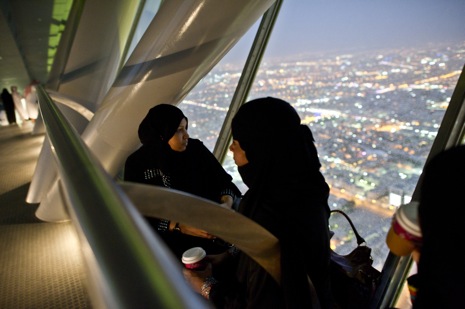
Photo by Lynsey Addario
“The more I photographed Muslim women, the more I was able to metaphorically strip away the burqas and hijabs, and start chipping away at the profound misconceptions that existed in other parts of the world about these women and their culture.”
The language used here has become so ingrained as to be unquestioned, even for Muslim women themselves. It takes a conscious effort to step back – or to use more appropriate terminology, to zoom out – to see that it is neither as matter of fact as it appears, nor as benign as those who wield it believe. It takes a conscious effort of “imagining an inverse” to see the distortions of the lens applied consistently to projects involving images of Muslim women. Imagine, for example, opening up a major newspaper in a Muslim majority country and finding an interview with a photographer who shares her expertise about Christian women, gained from photographing Christian women, with the concluding sentence presenting “a selection of images of women in the Christian world.”
There’s a certain cognitive dissonance there, even if you follow the accepted category-shifting paradigm of Western/Muslim. Yet when it comes to Muslim women, this framework is backhandedly positive: a way for the photographer to “chip away” at misconceptions regarding women from a certain religion. And so Addario goes on to express what she has gleaned from her experience:
“Family is such a fundamental part of Islam, and women run the family. I had to force myself not to impose my own definition of political and social freedom on women in Islam, and approach each story objectively.”
It’s difficult to overlook the categorical statement about how family functions in Islam, and the cultural relativism the photographer feels she needs to engage in – as though Islam was a culture, as though families function the same way and women have the same role in rural Indonesia, downtown Marrakesh, and diasporic Dearborn. Establishing a basis for engaging with Muslim women elides the diversity across a broad spectrum from the nominally or culturally Muslim to the religious, overlooking how religion is effected by factors such as nationality, ethnicity, and class as well as equating, as The New Yorker does, the somewhat problematic subset of “Women in the Muslim World” and the wider “Muslim Women.”
Talking about her visit to Saudi Arabia, Addario explains:
“My only image of the women was in the all-encompassing abayas. I never could have anticipated the intelligent, educated, and fashionable women I met over the course of that year.”
The surprise about what happens when one “metaphorically strips away the burqas and hijabs” has a similarity to evolutionary arguments about cultural difference, and it is not difficult to see how this relates to the comment that Saudi Arabia “must embrace change at its own pace.” The impression is of a sense of backwardness which is linked to religion or cultural norms to be stripped away, rather than to political, social, and economic forces which affect society on various structural levels.
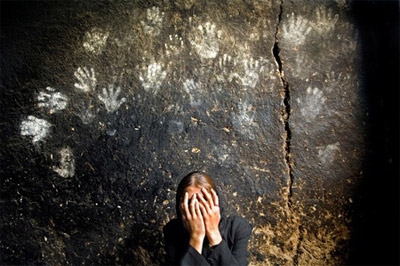
Photo by Lana Šlezić
This is at the heart of the troubling assumptions encouraged by the ready-made category of Muslim women as subjects of photography, which can precipitate a slide into images which confirm what you think you know, raising questions of ethics as well as aesthetics. There is no need to invoke the colonialist postcards of Algeria. Canadian-Croatian photographer Lana Šlezić’s project Forsaken, a collection of photographs and vignettes that document her journey over the two-year period during which she lived and worked in Afghanistan, advances a familiar debilitating narrative implicit in the project’s title, the word forsaken, a word with religious connotations, a word commonly associated with the word “child,” which should make us question, “forsaken by whom?”
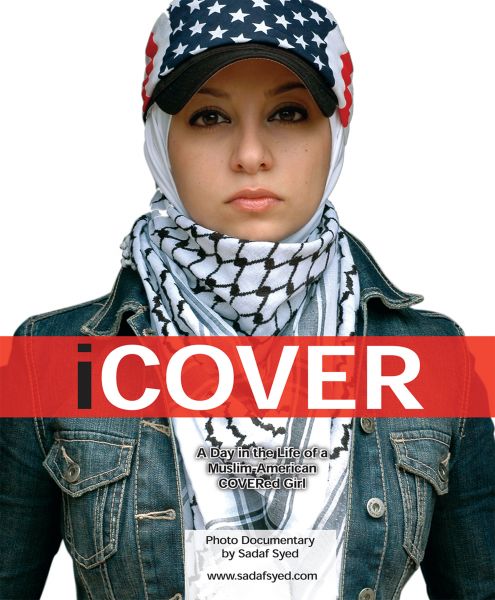
Sadaf Syed's iCOVER
If there is something troubling about the idea of “a series of images of Muslim women,” it is not least the fact that it has become so natural that we don’t even think to second-guess the assumptions underlying it. A series of images of Christian women as an already constituted and well-defined group might raise an eyebrow, a series of images of Muslim women does not. However this is also the framework for projects such as Sadaf Syed’s “iCOVER: A Day in the Life of a Muslim American covered girl,” a coffee table book of 150 pages of photographs of Muslim women in hijab. They are first and foremost Muslim women, because Syed begins from a position where religion is the most signficicant identity, and then shows the diversity within that community, as her subjects include a professional boxer, a cross-country truck driver and mechanic, an American soldier, a surfer and tri-athlete, and a court judge. Yet it could be argued that this engages on the same playing ground as the accepted discourse, even as it attempts to provide the “real” image of Muslim women as diverse. Syed herself articulates her work as wanting to combat negative media images which “are not doing justice to the beauty of Islam…A religion made up by different cultures, different races, and different backgrounds.” She explains that she wanted to use the medium of photography, to “celebrate Muslim women in Islam,” because
“That’s what inspired me as a photographer: to be a photographer that touches people’s hearts in a humanized way.”
Both Addario and Syed’s comments signifiy an attempt to capture and humanize an already-constituted community defined under the label Muslim women. The question is, does beginning from this basis contribute to the sense of this group as monolithic, does it propogate the legitimacy of the idea of “a series of images of Muslim women,” and if so, are there supplementary or alternative approaches which could offer a different way of seeing?
Arab-American photographer Rania Matar’s project A Girl and Her Room, an exhibition of 46 photographs focusing on the idea of a girl “alone in her personal space” offers one such example, as it explores the similar issues girls from both the United States and the Middle East face as they enter adulthood. The subjects, ranging in age from 12 to 23, are“teenage girls and young women at a transitional time of their lives, alone in the privacy of their own personal space and surroundings: their bedroom, a womb within the outside world.”

Alia, from Rania Matar's A Girl and Her Room
Differences and similarities leap out at us from within these rooms, differences even among those from the same region, between Alia from Beirut with her interest in graphic design, playing soccer, and modern dancing, and Bisan from Bethlehem or Shifa’a from Jerusalem, concerned about the political situation and the wall which “blocks our lives.” And there are the similarities, thoughts about the future, career ambitions, marriage, an interest in collecting stuffed toys shared by Krystal in Boston and Susan in Beirut. A Girl and Her Room is compelling in capturing the shared world of girls in their transition to womanhood, even as it captures the two worlds Rania Matar is most familiar with, “the two worlds I experienced myself as a teen and a young twenty year old: the United States and the Middle East.”

Photo by Rania Matar
Similarly, photojournalist Amira Al Sharif’s project, advertised on her Kickstarter page Unveiling Misconceptions: A Muslim Woman Documents Lives of American Women, provides one example of an approach that goes in both directions, looking both inward and outward: “looking at the lives of American women in their 20s and connecting them to the lives of her and her sisters back in Yemen.”
in her Kickstarter video, Amira Al Sharif remarks on illiteracy levels in Yemen in relation to the importance of photography. Her words on understanding the world through images reminded me of the introduction to Ways of Seeing, where John Berger comments that
“Seeing comes before words. The child looks and recognizes before it can speak. But there is also another sense in which seeing comes before words. It is seeing which establishes our place in the surrounding world; we explain that world with words, but words can never undo the fact that we are surrounded by it.”
It’s important to recognize not only that the way we see is affected by what we believe we know, to try to deconstruct those preconceptions which can work as blinders, but also to construct the way we see ourselves in relation to the world, in a dialectic process – a process which might involve unpacking the assumptions in the sometimes too readily constituted category of Muslim women.
Previous Post

November 15, 2011
The Libyan Woman's New Libya
Next Post
November 17, 2011 Against All Odds: Muslim Fashion Designers on the Politics of Clothing
Browse Our Archives
Select a Category Advertisements Art/Theater Books/Magazines Cinema Comics/Cartoons Culture/Society Events Fashion Film Friday Links Merchandise/Commodities MMW Announcements MMW Highlights Music/Radio News Photography Politics Profile Ramadan 2012 Ramadan 2013 Ramadan 2014 Ramadan 2015 Roundtable Satire Social Media Sports Technology/Science Television Uncategorized Video Web
Select a Month November 2015 October 2015 September 2015 August 2015 July 2015 June 2015 May 2015 April 2015 March 2015 January 2015 December 2014 November 2014 October 2014 September 2014 July 2014 June 2014 May 2014 April 2014 March 2014 February 2014 January 2014 December 2013 November 2013 October 2013 September 2013 August 2013 July 2013 June 2013 May 2013 April 2013 March 2013 February 2013 January 2013 December 2012 November 2012 October 2012 September 2012 August 2012 July 2012 June 2012 May 2012 April 2012 March 2012 February 2012 January 2012 December 2011 November 2011 September 2011 August 2011 July 2011 June 2011 May 2011 April 2011 March 2011 February 2011 January 2011 December 2010 November 2010 October 2010 September 2010 August 2010 July 2010 June 2010 May 2010 April 2010 March 2010 February 2010 January 2010 December 2009 November 2009 October 2009 September 2009 August 2009 July 2009 June 2009 May 2009 April 2009 March 2009 February 2009 January 2009 December 2008 November 2008 October 2008 September 2008 August 2008 July 2008 June 2008 May 2008 April 2008 March 2008 February 2008 January 2008 December 2007 November 2007 October 2007 September 2007 August 2007
Follow Us!
TAKE THE
Religious Wisdom Quiz
What character trait is praised in the Parable of the Good Samaritan?
Select your answer to see how you score.
Pride Compassion Deceit Selfishness
Related posts from Muslimah Media Watch



TRENDING AT PATHEOS Muslim

25 Years Later: How Much Has Changed for...
As we approach the 25th anniversary of September 11th, I’ve found myself...

Podcast: Third Spaces & The Rise of Yemeni...
In the latest episode of The Artistic Foodies Podcast, hosts Abbas...

HalalFest Picks: Best 60 Halal Spots for Super...
Back in 2016, I came up with a list of 29...

Unity Is America’s Strength — Division Is Its...
by Hidayatullah Ahsan When Valentina Gomez, a Republican candidate for Congress in...

Zohran Mamdani and New York’s Fight Against Islamophobia
This past June, against all odds, Zohran Mamdani won the Democratic primary...

What the Fourth of July Means to a...
As we mark another Fourth of July, millions of Americans will celebrate...
view all Muslim blogs
Ad-Free & Subscriber Log-In Subscription Support
- About Us
- 2026 Calendar
- Videos
- Podcasts
- Library of World Religions
- Faith In Media Tracker
- Advertise With Us
- Write for Us
- Privacy Policy
- Terms of Service
- Do Not Sell My Data
- Contact Us
- Radiant Digital
- Manage Newsletter Subscriptions
- Unsubscribe From Notifications
- Sitemap
Copyright 2008-2026, Patheos. All rights reserved.
Subscription Support Ad-Free & Subscriber Log-In
Follow Patheos