
BuddhistCatholicContemplativeEvangelicalGeneral ChristianHinduJewishLatter-day SaintMuslimNew VisionsProgressive Christian
Beliefs
- Buddhist
- Catholic
- Contemplative
- Evangelical
- General Christian
- Hindu
- Jewish
- Latter-day Saint
- More Voices
- Muslim
- New Visions
- Pagan
- Progressive Christian
Topics
- Religion News
- Food and Religion
- Sports and Religion
- Religious Art
- Religious Music and Entertainment
- Religious Events
- History and Religion
- Style and Religion
- Politics and Religion
- Women in Religion
- Recreation Outdoors and Religion
- Business Finance and Religion
- Careers Workplace and Religion
- Education and Religion
- Family Parenting and Religion
- Health Fitness and Religion
- Home and Religion
- Relationships and Religion
- Technology and Religion
- Travel and Religion
Columnists
- Buddhist Columnists
- Business Finance and Religion Columnists
- Careers Workplace and Religion Columnists
- Catholic Columnists
- Contemplative Columnists
- Education and Religion Columnists
- Evangelists Columnists
- Family Parenting and Religion Columnists
- General Christian Columnists
- Health Fitness and Religion Columnists
- Hindu Columnists
- History and Religion Columnists
- Home and Religion Columnists
- Jewish Columnists
- More Voices Columnists
- Latter Day Columnists
- Muslim Columnists
- New Visions Columnists
- Nonreligious Columnists
- Pagan Columnists
- Politics and Religion Columnists
- Progressive Columnists
- Recreation Outdoors and Religion Columnists
- Relationships and Religion Columnists
- Religion News Columnists
- Religious Art Columnists
- Religious Events Columnists
- Religious Music and Entertainment Columnists
- Sports and Religion Columnists
- Style and Religion Columnists
- Technology and Religion Columnists
- Travel and Religion Columnists
- Women in Religion Columnists
Resource Library
- 2026 Calendar
- Library of World Religions
- The 100 Most Holy Places on Earth
- Patheos Answers
- Podcasts
- Videos
- Faith Leaders Database
- Anglican Episcopalian
- Bahai
- Baptist
- Buddhism
- Christianity
- Confucianism
- Eastern Orthodoxy
- Hinduism
- Holiness and Pentecostal
- ISKCON
- Islam
- Judaism
- Lutheran
- Methodist
- The Church of Jesus Christ of Latter-day Saints
- New Age
- Paganism
- Presbytarian and Reformed
- Protestantism
- Religion Behind the Scenes
- Roman Catholic
- Scientology
- Shia Islam
- Sikhism
- Sufism
- Sunni Islam
- Taoism
- Zen
- See all religions
Research Tools
 Ad-Free & Subscriber Log-In Subscription Support
Ad-Free & Subscriber Log-In Subscription Support
Follow Patheos 

- Trending:
- Forgiveness
- |
- Marriage
- |
- Consciousness
- |
- Death Penalty
- |
- Election
- |
- Halloween
 Muslimah Media Watch
- Home
- Muslim
- Religion News
- Burqa Tourism at its Finest: How to Become an Expert on Muslim Women in Just One Week
Burqa Tourism at its Finest: How to Become an Expert on Muslim Women in Just One Week
Last updated on: June 13, 2012 at 12:15 pm by Krista
Burqa Tourism at its Finest: How to Become an Expert on Muslim Women in Just One Week 2012-06-13T12:15:48-04:00 Krista
Patheos Explore the world's faith through different perspectives on religion and spirituality! Patheos has the views of the prevalent religions and spiritualities of the world.
Alicia wrote last week about female members of the British police force wearing burqas and headscarves to try to better understand the Muslim community. Well, it seems like it’s “dress like a Muslim” month in Britain, because the Daily Mail’s Liz Jones has just written about her own experience wearing a burqa for a week. It’s not pretty.
Before I start, I’ll just say that, while I’m skeptical of any attempt to wear hijab in order to better comprehend (hijab-wearing) Muslim women’s lives, I can at least sort of understand it if there is a really sincere effort to learn more about the kinds of reactions that such women might face from non-Muslim members of society. What really bothers me is when these attempts are explained as a way to understand “what it’s like to wear the burqa” (or niqab, or headscarf, or whatever). If you’re wearing any of these things without any personal religious or cultural meanings attached to them, it would be hard to even come close to appreciating what it’s really like for women who wear them.
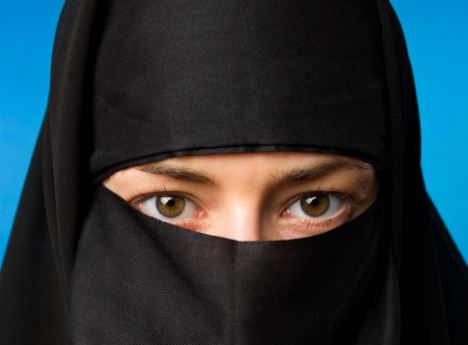
I'm not sure if this is the author herself, or just some random niqab picture that they threw in, but it's the photo that accompanied the article.
Jones explains her motivation for wearing the burqa as follows:
Moved by the plight of Lubna Hussein, a Sudanese woman who faces 40 lashes for wearing trousers in public, I decided to spend a week enveloped in what she should have been wearing.
Her article probably could not be filled with more burqa-is-oppressive cliches if she tried (for that matter, maybe she did try. Either way, she sure managed to fill it up with lots of dramatic language.) Her first day wearing it sounds almost physically impossible:
On my first day, I was unaccountably afraid to put on my burka. When I did pluck up courage, I felt suffocated.
Driving to my local station, I felt blinkered, like a racehorse. Walking to the platform, I could hardly breathe: I kept getting my nose out from beneath its shroud for fresh air. I felt weak, and faint and itchy.
She then gives us this anecdote:
I walked to the kiosk to buy coffee, staring at my feet to avoid catching anyone’s eye.
‘Mumble mumble,’ I said to the young man serving.
To his credit – the station is in Somerset, so I’m pretty sure this was the first time he’d encountered the full burka – he didn’t bat an eyelid.
I automatically lifted the cup to my lips. Ah. How on earth do women eat or drink? Later that day, at a coffee shop in Fulham, I sat outside at a table, faced with an insurmountable sandwich.
What can we learn from this? First, that burqa-wearing women are, apparently, unintelligible. Second, that Jones either can’t think ahead far enough to realize that maybe going for coffee in a public place isn’t so smart with no plan for how to consume said coffee, or that she did so deliberately to show us that Muslim women are so oppressed that we can’t even drink coffee or eat sandwiches. The idea that women who cover their faces might either have already planned for how (or where) to drink their coffee, or that some might even temporarily uncover their faces in order to eat, doesn’t really factor in.
An alternate explanation arises in Jones’ next paragraph:
An Arab man shouted abuse. I have no idea what he was saying – perhaps I shouldn’t have been out on my own, or perhaps eating is a sin – but the interesting point is that during my week in a burka, he was the only person who gave me any abuse whatsoever.
Aha! Maybe eating is a sin! That’s how Muslim women survive the coffee-shop dilemmas – they’re not supposed to be eating anyway.
That aside (yes, I know Jones was probably exaggerating; I’ll concede that she probably does know that Muslim women eat), this paragraph irks me for other reasons. First of all, if Jones “[has] no idea what he was saying,” how does she know that this “Arab” man was truly shouting “abuse” (and, for that matter, does she know for sure that he’s Arab)? And how does she know that this abuse was even burqa- or Islam-related? Maybe it was, as Jones assumes. Maybe she had stolen his table at the coffee shop, or maybe her car was blocking his in the parking lot. Maybe he was yelling at her because he didn’t like that she was wearing a burqa. Who knows? The point is that the suggestion that wearing a burqa gets negative reactions only from oppressive Muslim men attempting to police Muslim women’s bodies is disturbing and, if we listen to women in Britain who wear hijab or niqab for longer than Jones’ week-long experiment, not the full story.
In fact, Jones even dismisses one woman who talked about facing racism because of her clothing:
‘I have had so much abuse on the train,’ a British Muslim called Um Abdullah complained on Woman’s Hour. Well, she has obviously never travelled with First Great Western.
Does Jones really claim, from her one-week experience, to know more about abuse on a train than a woman who is always visibly identifiable as a Muslim? It’s not that I would have wished negative experiences on Jones, but the fact that she didn’t have any doesn’t mean that everyone else should stop complaining because those experiences don’t exist. And the solution shouldn’t be to just take a different train, as Jones implies with her praise of First Great Western.
Moreover, in the beginning of her article, Jones describes catching a glimpse of her own reflection while wearing the burqa, and seeing “a dark, depressed alien. A smudge. A nothing.” Even if she says she didn’t face any “abuse” while wearing it, this comment is rather telling of the kind of judgment that she would see entirely appropriate to place on a woman wearing a burqa. While someone in a burqa might not face overt racist comments on a daily basis, I would imagine that coming up against judgments such as this one (and having such judgments printed in a matter-of-fact way in a widespread newspaper) might just become a pretty significant frustration after a while.
Narrating other experiences, Jones tells us that:
Getting out of [a] cab, a passing decorator opened the door and grabbed my shopping – a burka makes you clumsy, slow, fearful because you can’t hear, and helpless; I spent most of the week feeling like a disabled person.
Never is there consideration made for the possibility that clumsiness and slowness might be more related to Jones’ unfamiliarity with wearing the burqa, rather than the burqa itself. As for not being able to hear, I know a whole lot of women who cover their heads (ears included) in various ways and still manage to hear just fine, so I’m not sure what the problem was here. The ableist language is also pretty striking; we should all feel shocked and sorry for Jones, because who would ever want to feel like a disabled person?! [sarcasm]
The rest of the article is more of the same, and ends with:
On yet another perfect summer’s day in Hyde Park during my week covered up, I saw a crocodile of schoolchildren. Only the pale moon of the faces of the Muslim girls was exposed.
I know now exactly how they feel: marginalised, objectified, kept box-fresh for the eyes of male relatives.
All I can say to this is, no. No, you don’t know how they feel (or at the very least, you can’t say for certain that you do.) You don’t know why they’re wearing what they’re wearing, or what meaning it has for them. Yes, some Muslim women feel marginalized and objectified, and sometimes this even relates to their clothing. Other women might wear exactly the same clothing and feel entirely different, or might even feel more marginalized and objectified by non-Muslims than by their “male relatives.” Spending a week in a burqa (especially when this experience is entered into already with fear and disgust towards the burqa) does not make someone an expert on how women who wear these things feel, or on how they should react to racism and abuse.
Previous Post

August 10, 2009
Judge Judy: Judy Bachrach Plays Judge, Jury, and Executioner
Next Post
August 12, 2009 Milke-ing it: Another Paternalistic Editorial
Browse Our Archives
Select a Category Advertisements Art/Theater Books/Magazines Cinema Comics/Cartoons Culture/Society Events Fashion Film Friday Links Merchandise/Commodities MMW Announcements MMW Highlights Music/Radio News Photography Politics Profile Ramadan 2012 Ramadan 2013 Ramadan 2014 Ramadan 2015 Roundtable Satire Social Media Sports Technology/Science Television Uncategorized Video Web
Select a Month November 2015 October 2015 September 2015 August 2015 July 2015 June 2015 May 2015 April 2015 March 2015 January 2015 December 2014 November 2014 October 2014 September 2014 July 2014 June 2014 May 2014 April 2014 March 2014 February 2014 January 2014 December 2013 November 2013 October 2013 September 2013 August 2013 July 2013 June 2013 May 2013 April 2013 March 2013 February 2013 January 2013 December 2012 November 2012 October 2012 September 2012 August 2012 July 2012 June 2012 May 2012 April 2012 March 2012 February 2012 January 2012 December 2011 November 2011 September 2011 August 2011 July 2011 June 2011 May 2011 April 2011 March 2011 February 2011 January 2011 December 2010 November 2010 October 2010 September 2010 August 2010 July 2010 June 2010 May 2010 April 2010 March 2010 February 2010 January 2010 December 2009 November 2009 October 2009 September 2009 August 2009 July 2009 June 2009 May 2009 April 2009 March 2009 February 2009 January 2009 December 2008 November 2008 October 2008 September 2008 August 2008 July 2008 June 2008 May 2008 April 2008 March 2008 February 2008 January 2008 December 2007 November 2007 October 2007 September 2007 August 2007
Follow Us!
TAKE THE
Religious Wisdom Quiz
What is the book of songs and prayers in the Bible called?
Select your answer to see how you score.
Matthew Genesis Psalms Proverbs
Related posts from Muslimah Media Watch

#PrayforParis, Muslim Women and Third World Violence


Hate Crimes and Mother Tongues

Interview with Comedian Eman El Husseini
TRENDING AT PATHEOS Muslim

25 Years Later: How Much Has Changed for...
As we approach the 25th anniversary of September 11th, I’ve found myself...

Podcast: Third Spaces & The Rise of Yemeni...
In the latest episode of The Artistic Foodies Podcast, hosts Abbas...

HalalFest Picks: Best 60 Halal Spots for Super...
Back in 2016, I came up with a list of 29...

Unity Is America’s Strength — Division Is Its...
by Hidayatullah Ahsan When Valentina Gomez, a Republican candidate for Congress in...

Zohran Mamdani and New York’s Fight Against Islamophobia
This past June, against all odds, Zohran Mamdani won the Democratic primary...

What the Fourth of July Means to a...
As we mark another Fourth of July, millions of Americans will celebrate...
view all Muslim blogs
Ad-Free & Subscriber Log-In Subscription Support
- About Us
- 2026 Calendar
- Videos
- Podcasts
- Library of World Religions
- Faith In Media Tracker
- Advertise With Us
- Write for Us
- Privacy Policy
- Terms of Service
- Do Not Sell My Data
- Contact Us
- Radiant Digital
- Manage Newsletter Subscriptions
- Unsubscribe From Notifications
- Sitemap
Copyright 2008-2026, Patheos. All rights reserved.
Subscription Support Ad-Free & Subscriber Log-In
Follow Patheos