
BuddhistCatholicContemplativeEvangelicalGeneral ChristianHinduJewishLatter-day SaintMuslimNew VisionsProgressive Christian
Beliefs
- Buddhist
- Catholic
- Contemplative
- Evangelical
- General Christian
- Hindu
- Jewish
- Latter-day Saint
- More Voices
- Muslim
- New Visions
- Pagan
- Progressive Christian
Topics
- Religion News
- Food and Religion
- Sports and Religion
- Religious Art
- Religious Music and Entertainment
- Religious Events
- History and Religion
- Style and Religion
- Politics and Religion
- Women in Religion
- Recreation Outdoors and Religion
- Business Finance and Religion
- Careers Workplace and Religion
- Education and Religion
- Family Parenting and Religion
- Health Fitness and Religion
- Home and Religion
- Relationships and Religion
- Technology and Religion
- Travel and Religion
Columnists
- Buddhist Columnists
- Business Finance and Religion Columnists
- Careers Workplace and Religion Columnists
- Catholic Columnists
- Contemplative Columnists
- Education and Religion Columnists
- Evangelists Columnists
- Family Parenting and Religion Columnists
- General Christian Columnists
- Health Fitness and Religion Columnists
- Hindu Columnists
- History and Religion Columnists
- Home and Religion Columnists
- Jewish Columnists
- More Voices Columnists
- Latter Day Columnists
- Muslim Columnists
- New Visions Columnists
- Nonreligious Columnists
- Pagan Columnists
- Politics and Religion Columnists
- Progressive Columnists
- Recreation Outdoors and Religion Columnists
- Relationships and Religion Columnists
- Religion News Columnists
- Religious Art Columnists
- Religious Events Columnists
- Religious Music and Entertainment Columnists
- Sports and Religion Columnists
- Style and Religion Columnists
- Technology and Religion Columnists
- Travel and Religion Columnists
- Women in Religion Columnists
Resource Library
- 2026 Calendar
- Library of World Religions
- The 100 Most Holy Places on Earth
- Patheos Answers
- Podcasts
- Videos
- Faith Leaders Database
- Anglican Episcopalian
- Bahai
- Baptist
- Buddhism
- Christianity
- Confucianism
- Eastern Orthodoxy
- Hinduism
- Holiness and Pentecostal
- ISKCON
- Islam
- Judaism
- Lutheran
- Methodist
- The Church of Jesus Christ of Latter-day Saints
- New Age
- Paganism
- Presbytarian and Reformed
- Protestantism
- Religion Behind the Scenes
- Roman Catholic
- Scientology
- Shia Islam
- Sikhism
- Sufism
- Sunni Islam
- Taoism
- Zen
- See all religions
Research Tools
 Ad-Free & Subscriber Log-In Subscription Support
Ad-Free & Subscriber Log-In Subscription Support
Follow Patheos 

- Trending:
- Forgiveness
- |
- Marriage
- |
- Consciousness
- |
- Death Penalty
- |
- Election
- |
- Halloween
 Muslimah Media Watch
- Home
- Muslim
- Religion News
- The Hijabi Monologues
The Hijabi Monologues
Last updated on: December 8, 2011 at 11:33 pm by Muslimah Media Watch
The Hijabi Monologues 2011-12-08T23:33:58-04:00 Muslimah Media Watch
Patheos Explore the world's faith through different perspectives on religion and spirituality! Patheos has the views of the prevalent religions and spiritualities of the world.
I’m a member of a group called BuSSy, which aims to raise awareness of women’s issues in Egypt. Every year, we put on a play which we call “the Egyptian version of the Vagina Monologues:” real stories written by real women.
So how excited was I when I found out that one of the co-founders and the writer of The Hijabi Monologues was here in Cairo? And that she’d actually seen our performance this year? Small world.
We’ve written a small post about them before, but I decided to interview Sahar, and see what she had to say.
According to their facebook group:
The Hijabi Monologues is about the power of storytelling.
It is about creating a space for American Muslim women to share their voices; a space to breathe as they are; a space that does not claim to tell every story and speak for every voice.
Through the power of storytelling, generalizations and categories are challenged. Through stories, strangers touch and connect. Through stories, the story-teller and listener are humanized.
Hijabi Monologues: Our stories. Our words.
The project began in summer 2006 by Zeenat Rahman, Dan Morrison and Sahar Ullah, all graduates of Chicago University. One day Dan, who was used to asking his “brown Muslim girlfriends” all the difficult questions, looked at Sahar and said “You know what? We should start a hijabi monologues.”
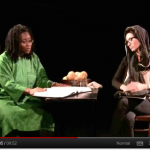
And so it began. The monologues are written by 26-year-old Sahar Ullah (pictured left) and performed by both her and Leena El-Arian, both currently studying in Cairo.
Unfortunately, they’ve only performed once in Egypt, and I didn’t manage to catch them. So Sahar (very kindly) sent me three scripts, and let’s just say if she was able to evoke so many emotions in me just by reading the scripts, then watching her perform them must be something else.
The stories run a gamut of emotions: from a comedic one talking about all the types of guys that hit on hijabis (“There’s the Mack-tivist. […] the one who prefaces his introduction with, “So, I just finished reading the autobiography of Malcolm X” and then proceeds with, “Man, I was so busy last weekend. You know, there was the pro-Palestinian rally and the pro-immigration rights/animals are our friends not food/make love not war protest”) to a poignant one where Leena El-Arian talks about what it was like when the FBI stormed her home and arrested her father, Palestinian professor Sami El-Erian.
(You can watch a short video about The Hijabi Monologues here)
All in all, the monologues aim to create a better understanding of what it means to be an American Muslim hijabi (and not focus on the hijab itself, which is cool). As mentioned in a Common Ground News article:
Re-narration, a psychoanalytical technique for dealing with past experiences […] causes people to transform the way they see traumatic events from threatening and personal, to neutral and objective. When traumatic events are looked at through this lens, the sadness, wounds, scars and tears become superficial, neutralising the hurt.
The Hijabi Monologues is [an] example of re-narration. […] Through the power of re-narration, claims are challenged and generalisations confronted. Listeners gain access to shared human experiences and an enriched understanding of the lives of these women, which transcend superficial judgments based on their appearance
Only with true storytelling, listening and understanding can the shadow that is locked in the subconscious of both Muslims and Westerners — including Muslim Westerners — be released. Only then can bridging and reconciliation attempts yield successful results.
And with only just over half a dozen performances under its belt, The Hijabi Monologues are striking a chord-other people have requested the scripts, and the first performance of the monologues independently from the group was held yesterday in California.
So, here’s my (slightly edited for coherency) interview with Sahar:
Q: Tell me a bit about your background.
I’m of Bangladeshi descent. I triple majored as an undergraduate in the University of Miami: Religious studies, English literature and Political science.
My first window into Middle Eastern Studies was politics. I decided to do Middle Eastern studies at the University of Chicago and wrote my thesis about the ideas of female beauty in the modern Middle East, focusing on Egyptian film. I met Dan and Zeena through a concert we were organizing with Muslim artists.
Q: Not all women are hijabi—why the title?
Dan thought of it and he and Zeena are in charge of marketing (she’s the face of Interfaith Youth Core (IFYC)). And once we started collecting and writing stories, it just stuck. At that time, 2006-2007, there was a lot of media coming out about in the US: anthologies of Muslim women, hijab etc. Gag! When you look at those stories for so long you’re like, it’s boring!
We never claim to speak for all women and we make that very clear before we begin any performance, saying that these are the stories of some women. Every anthology now you find people trying to talk about a representative sample and it’s annoying.
But then, if it’s for Muslim American women, why is it called the hijabi monologues? As you say, not all Muslim women are hijabis. We’re not discriminating by leaving out stories and we’re not leaving them to say those stories aren’t important. But in any type of women’s movement it will never work if you say you represent all experiences.
So with the hijabi monologues this is how I’ve conceptualized the title—first of all the title evokes the famous Vagina monologue so people immediately think “Muslim version of the vagina monologues!” and I’m like ok, marketing-wise, that’s good. Because people will think we’re progressive, supportive of feminist causes etc and brings in a certain crowd.
Second, Hijabi the way it’s used in the American Muslim context is very much American Muslim lingo: It’s a Muslim woman in a headscarf, but it’s not muhajaba. Most Muslim Americans aren’t Arab or have studied Arabic so the word hijabi is part of the American Muslim subculture lingo.
Third, when a lot of people come to the program they expect us to talk about hijab. None of the stories speak about hijab, and the hijab is not the centerpiece of any story. The characters themselves happen to wear hijab. So in a way if there’s a connection to or parallel with The Vagina Monologues, I would say it’s the inverse.
The Vagina Monologues take something that’s really private and personifies it by giving it a voice: “my vagina is angry.” But we don’t say my hijab is angry because people have already infused so many meanings into the hijab—as if it speaks when actually it’s about a woman’s experience. So we take what’s so public and people have given a voice and we push it out of people’s figurative faces by allowing a person who has a captured audience to give women a voice.
Q: But what happens when other women want to perform this? Who may not be veiled or even Muslim?
We discussed it again recently because of the new trajectory we’re taking. But to be the character they’d have to wear the hijab.
Every time I think of women’s experiences in The Vagina Monologues, I think of race. In American literature there’s a body of literature that talks about ideas of “passing” in terms of a black person passing for a white person. What happens when someone passes? They’re sitting right in front of you and you don’t know their identity, which is big because race is so important in the U.S. But hjiab can’t pass. What happens when you can’t pass?
Muslim women, we all have common experiences, but there’s a certain perception you bring about yourself—even when you aren’t that person—when you have a certain color or appearance. So hijab is very important in those stories. I even told Dan you wouldn’t have said hijabi monologues if I didn’t wear hijab. You would have said, let’s put you on Saturday night live. Or let’s do a “Brown Girls Monologues.” [Laughs]
I also told Zeena if we were to include women who don’t wear hijab all the time, that’s ok but conceptually lets try to make it consistent. It’s true that non-hijabis have their own experiences that are very different from hijabis’. Zeena, for example, tells me that people tell her things she don’t think they would if she were hijabi because they assume because she’s not hijabi she thinks in a certain way.
Q: Good enough! So how did the idea come about?
I was talking to [Dan] about how weird it is in Middle Eastern studies when you have so many people with some connection to it who think of it as that place over there and study it as this fascinating subject but believe they have no connection to it when they do.
He just looked at me and said “You know what? We should do a hijabi monologues.” I said, ok whatever! Dan works for the Clinton Global Initiative and started an NGO called One Well. He comes from an Irish catholic family and is very white and bald. He’s very open-minded and conscious of his white privilege and he kept saying we could do it.
He called me again and told me to start writing stories and I said ok though I was like “what? I’m going to start writing stories about myself and other Muslim women?” He said, just start doing it. He also told me “you have no idea how your story has changed me and my perspective on Muslim women and I tell your stories to my very white corporate friends.” It’s really amazing how that personal touch changes how people view Muslim women. It really does change people so I said ok.
Q: How did evolve into what it is today?

A poster for the performance. Image via The Hijabi Monologue
In the beginning it was just my experiences. We started with the idea of a documentary film but I wasn’t feeling it and I felt we needed to go out and ask women their stories. I was writing these stories when I realized that though not everybody is a storyteller, everyone has stories to tell. In the beginning we said it needs to be straight out of women’s mouths, but then I said, well not all these women would want to get up on stage like the one about the immigrant woman who gets HIV from her husband, or the Muslim girl who gets pregnant.
At this stage, I was just writing. Then one day my Palestinian neighbor (Leena El-Arian) was invited to speak in a lecture about her father’s case and she said she wanted me to come too (I had been sharing some of the stories I’d written with her). So I said what would I do? And the professor said talk about Muslim women. I was like, I hate that topic! [Laughs] I said, what do you want me to talk about, not only is it so done but it’s so…
So I told him I’m working on a project and I’m going to try it out on your students. He said ok. I told the stories I brought and you know what? When you’re interacting with an audience it’s completely different. Leena talked about the facts of her father’s case but that’s not what really got them, it was when she talked about missing her father, how it was like seeing him taken away by the FBI. People empathize. And that’s when I saw what Dan was saying because I could see in the student’s faces how they were taking it in. It was so important for me to see the shift—how people in the beginning were really skeptical of us, knowing us as cardboard cutouts but then changed.
In the beginning I was uncomfortable, thinking, “am I making a spectacle of Muslim women? Is this voyeuristic? Am I playing into “let’s look into their lives?” But it’s not. It has to be done and it has to be done well and that’s what we’re all working on.
You can reach the group at [email protected]
Next Post

November 21, 2008 Friday Links -- November 21, 2008
Browse Our Archives
Select a Category Advertisements Art/Theater Books/Magazines Cinema Comics/Cartoons Culture/Society Events Fashion Film Friday Links Merchandise/Commodities MMW Announcements MMW Highlights Music/Radio News Photography Politics Profile Ramadan 2012 Ramadan 2013 Ramadan 2014 Ramadan 2015 Roundtable Satire Social Media Sports Technology/Science Television Uncategorized Video Web
Select a Month November 2015 October 2015 September 2015 August 2015 July 2015 June 2015 May 2015 April 2015 March 2015 January 2015 December 2014 November 2014 October 2014 September 2014 July 2014 June 2014 May 2014 April 2014 March 2014 February 2014 January 2014 December 2013 November 2013 October 2013 September 2013 August 2013 July 2013 June 2013 May 2013 April 2013 March 2013 February 2013 January 2013 December 2012 November 2012 October 2012 September 2012 August 2012 July 2012 June 2012 May 2012 April 2012 March 2012 February 2012 January 2012 December 2011 November 2011 September 2011 August 2011 July 2011 June 2011 May 2011 April 2011 March 2011 February 2011 January 2011 December 2010 November 2010 October 2010 September 2010 August 2010 July 2010 June 2010 May 2010 April 2010 March 2010 February 2010 January 2010 December 2009 November 2009 October 2009 September 2009 August 2009 July 2009 June 2009 May 2009 April 2009 March 2009 February 2009 January 2009 December 2008 November 2008 October 2008 September 2008 August 2008 July 2008 June 2008 May 2008 April 2008 March 2008 February 2008 January 2008 December 2007 November 2007 October 2007 September 2007 August 2007
Follow Us!
TAKE THE
Religious Wisdom Quiz
What was the Jewish place of assembly for worship and teaching called?
Select your answer to see how you score.
Court Temple Synagogue Tabernacle
Related posts from Muslimah Media Watch


When Arab Women Artists "Revisit The Harem"
When Bridging Between Cultures Doesn’t Help
“Allah Makes Muslims, Allah Makes Queers”: A Interview...
TRENDING AT PATHEOS Muslim

25 Years Later: How Much Has Changed for...
As we approach the 25th anniversary of September 11th, I’ve found myself...

Podcast: Third Spaces & The Rise of Yemeni...
In the latest episode of The Artistic Foodies Podcast, hosts Abbas...

HalalFest Picks: Best 60 Halal Spots for Super...
Back in 2016, I came up with a list of 29...

Unity Is America’s Strength — Division Is Its...
by Hidayatullah Ahsan When Valentina Gomez, a Republican candidate for Congress in...

Zohran Mamdani and New York’s Fight Against Islamophobia
This past June, against all odds, Zohran Mamdani won the Democratic primary...

What the Fourth of July Means to a...
As we mark another Fourth of July, millions of Americans will celebrate...
view all Muslim blogs
Ad-Free & Subscriber Log-In Subscription Support
- About Us
- 2026 Calendar
- Videos
- Podcasts
- Library of World Religions
- Faith In Media Tracker
- Advertise With Us
- Write for Us
- Privacy Policy
- Terms of Service
- Do Not Sell My Data
- Contact Us
- Radiant Digital
- Manage Newsletter Subscriptions
- Unsubscribe From Notifications
- Sitemap
Copyright 2008-2026, Patheos. All rights reserved.
Subscription Support Ad-Free & Subscriber Log-In
Follow Patheos