
BuddhistCatholicContemplativeEvangelicalGeneral ChristianHinduJewishLatter-day SaintMuslimNew VisionsProgressive Christian
Beliefs
- Buddhist
- Catholic
- Contemplative
- Evangelical
- General Christian
- Hindu
- Jewish
- Latter-day Saint
- More Voices
- Muslim
- New Visions
- Pagan
- Progressive Christian
Topics
- Religion News
- Food and Religion
- Sports and Religion
- Religious Art
- Religious Music and Entertainment
- Religious Events
- History and Religion
- Style and Religion
- Politics and Religion
- Women in Religion
- Recreation Outdoors and Religion
- Business Finance and Religion
- Careers Workplace and Religion
- Education and Religion
- Family Parenting and Religion
- Health Fitness and Religion
- Home and Religion
- Relationships and Religion
- Technology and Religion
- Travel and Religion
Columnists
- Buddhist Columnists
- Business Finance and Religion Columnists
- Careers Workplace and Religion Columnists
- Catholic Columnists
- Contemplative Columnists
- Education and Religion Columnists
- Evangelists Columnists
- Family Parenting and Religion Columnists
- General Christian Columnists
- Health Fitness and Religion Columnists
- Hindu Columnists
- History and Religion Columnists
- Home and Religion Columnists
- Jewish Columnists
- More Voices Columnists
- Latter Day Columnists
- Muslim Columnists
- New Visions Columnists
- Nonreligious Columnists
- Pagan Columnists
- Politics and Religion Columnists
- Progressive Columnists
- Recreation Outdoors and Religion Columnists
- Relationships and Religion Columnists
- Religion News Columnists
- Religious Art Columnists
- Religious Events Columnists
- Religious Music and Entertainment Columnists
- Sports and Religion Columnists
- Style and Religion Columnists
- Technology and Religion Columnists
- Travel and Religion Columnists
- Women in Religion Columnists
Resource Library
- 2026 Calendar
- Library of World Religions
- The 100 Most Holy Places on Earth
- Patheos Answers
- Podcasts
- Videos
- Faith Leaders Database
- Anglican Episcopalian
- Bahai
- Baptist
- Buddhism
- Christianity
- Confucianism
- Eastern Orthodoxy
- Hinduism
- Holiness and Pentecostal
- ISKCON
- Islam
- Judaism
- Lutheran
- Methodist
- The Church of Jesus Christ of Latter-day Saints
- New Age
- Paganism
- Presbytarian and Reformed
- Protestantism
- Religion Behind the Scenes
- Roman Catholic
- Scientology
- Shia Islam
- Sikhism
- Sufism
- Sunni Islam
- Taoism
- Zen
- See all religions
Research Tools
 Ad-Free & Subscriber Log-In Subscription Support
Ad-Free & Subscriber Log-In Subscription Support
Follow Patheos 

- Trending:
- Forgiveness
- |
- Marriage
- |
- Consciousness
- |
- Death Penalty
- |
- Election
- |
- Halloween
 Muslimah Media Watch
- Home
- Muslim
- Religion News
- Persepolis: Explaining Iran in Black and White
Persepolis: Explaining Iran in Black and White
Last updated on: December 12, 2007 at 10:37 am by Guest Contributor
Persepolis: Explaining Iran in Black and White 2007-12-12T10:37:00-04:00 Guest Contributor
Patheos Explore the world's faith through different perspectives on religion and spirituality! Patheos has the views of the prevalent religions and spiritualities of the world.
This originally appeared on the blog epiphanies, written by Tasnim.
Persepolis, the animated film based on Marjane Satrapi’s graphic novel, will be released in the US on 25 December. The film, like the novel, is in black and white and just as visually striking. Satrapi says that she sees “images as a way of writing” in a more accessible, international language: “when you draw a situation—someone is scared or angry or happy— it means the same thing in all cultures”.
Satrapi refused several offers to buy the rights for ‘adaptations’, being aware that ”normally when you make a movie out of a book, it’s never a success.’’ But whether or not Persepolis the film gets it right, it does seems unrealistic to ask a 90 minute film to pack in all the qualities Gloria Steinem praised Satrapi’s book for having – “the intimacy of a memoir, the irresistibility of a comic book, and the political depth of a the conflict between fundamentalism and democracy.”
Such neatly phrased praise decorates the blurbs of bestselling books everywhere, and is possibly not intended to be taken as strict truth stripped of all rhetoric. But it seems to overlay a genuine feeling that reading the personal experiences of an oriental is conducive to comprehending “a world, most Westerners can scarcely comprehend”.
That quote comes from the Washington Post Book World, referring to Mernissi’s memoir, Dreams of Trespass, which is given its own triple set of helpful qualities: “its good humor is unwavering, it tempers judgmentalism with understanding, and it provides a vivid portrait…” of that other, alien world. That is, Mernissi’s memoir is intimate, irresistible and, also, as enriching its entertaining exotic aspect, it provides ‘political depth’, in the same way that waging war has the benefit of geography lessons.
It seems to me that having the political depth of the conflict between fundamentalism and democracy requires a lot of ‘depth’. Such depth as might perhaps extend beyond the personal frame of a memoir and into history. These are conflicts that Satrapi’s dry remarks acknowledge. As she says, “if I pretend that I was sitting in a house worrying day and night about my country, that would be a big lie.”
Memoirs don’t seem the most ideal form for books which attempts to explain a whole other world to western eyes. Being a memoir, its world-explicating power is rendered somewhat suspect by the fact that it is contained within such a subjective frame. Perhaps like the use of images – which, Hamid Naficy points out “provide kind of a visual supplement to the words that makes it easier for people — foreigners and whatnot — to imagine what she’s talking about,” memoirs make political depth easier to digest. The personal/political memoir leaves writers in a double bind though. On the one hand, Satrapi says “I have to defend my country because the world is not going well… I would have wished that I couldn’t sell any books because everybody already knew about it.” On the other hand, she depends on the world not “going well” to sell, her fame boosted by blurbs that recommend her as an aid to understanding an incomprehensible world. It’s a difficult balance. Satrapi does her best to get beyond the two dimensional view, saying that what is incomprehensible is not ‘her’ world, but the very idea of splitting the world into worlds. As she says: [Bush] calls us the Axis of Evil. If it was that easy then let’s exterminate the bad ones and let the good ones live happily.
Her cartoons might be in black and white, but her views aren’t, and in this her works differ from what Fatemeh Keshavarz calls the “New Orientalist” narrative, referring to novels by writers like Azar Nafisi, Khaled Husseini and Asne Seierstad, as fitting the pattern of the narrative that: “reduces the contemporary Muslim Middle East to an uncomplicated black and white world of villains (usually Muslims) and victims (usually sympathizers with the west). A vast number of people and events, that don’t fit either category, are simply left out of the picture.” Satrapi, on the other hand, is keen to point out that her books show that “The world is complex. Even in my book I show a mullah who is good.”
Despite that ‘even’, whether it’s the shifting definition of evil (“At one time the evil was the Soviet Union then Ayatollah Khomeini then Saddam Hussein then Osama Bin Laden then Saddam Hussein again. It could be UFOs from another planet”) or the belief that Iran is Arabia (“There are no camels in my country because it’s cold in Tehran in the wintertime”) Satrapi, like Mernissi, attacks the cartoon image of the Middle East. She condemns the fact that “”If something bad happens in the East, it is immediately related back to religion” words which parallel Keshavarz’s terms, the “Islamization of wickedness” and the “westernization of goodness”. These parallel trends are central to books like Azar Nafisi’s ‘New Orientalist’ Reading Lolita in Tehran, of which Keshavarz says: “there is a convenient generic shape shifting involved that allows the author to move between the freedom of writing a personal memoir and the authority of providing an eye-witness factual report.”
 Satrapi’s might not be ‘reporting’ but she does do some ‘explaining’. Which can mean changing people’s perception of Iran by reminding them that once upon a time there was an Iran which had never heard of Islam. And it necessitates taking up the infamous “the politics, not the people” shield. Satrapi insists ”I like American people very much—really, there is some kind of enthusiastic, candid way of being American that I really, really love—but the American government is just shit.”
But in breaking down the idea of Iran as a different world, she at times has to construct another world in which to put those unsightly incomprehensible phenomena which don’t appeal to western sensibilities. Maintaining that “As an Iranian, I feel much closer to an American who thinks like me than to the bearded guy of my country,” might seem a profound politically deep comment on fundamentalism and democracy to some, but then it also sounds perilously close to what a Native Informer might say, as Hamid Dabashi calls writers like Azar Nafisi – writers who put their work “at the service of US ideological psy-op.” Satrapi’s words are clearly intended to express a personal view – but she prefaces them with ‘as an Iranian’. Her perhaps throwaway comment seems a perfect analogy to reactions to her memoirs which assume her position as an ‘insider’ makes her an authorative guide to an alien world.
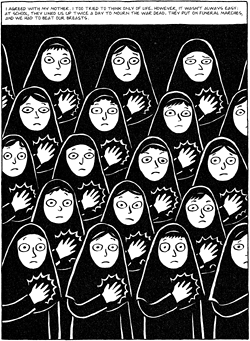
The danger of that is that many of these memoir writers – these insiders – are in fact exiles, often outsiders. Hamid Naficy says that their memoir writing is in part a form of compensation: they “couldn’t go back, so they imagined what it was like in Iran.” Satrapi knows that exiled feeling: “I am a foreigner in Iran,” and yet, she can explain Iran to the West. She can speak for a world and render it comprehensible, even though she acknowledges she is a foreigner to that world, because she is after all ‘only’ writing her memoir.
Previous Post

December 11, 2007
The Veil Does Not a Prison Make
Next Post
December 13, 2007 A Real Tragedy
Browse Our Archives
Select a Category Advertisements Art/Theater Books/Magazines Cinema Comics/Cartoons Culture/Society Events Fashion Film Friday Links Merchandise/Commodities MMW Announcements MMW Highlights Music/Radio News Photography Politics Profile Ramadan 2012 Ramadan 2013 Ramadan 2014 Ramadan 2015 Roundtable Satire Social Media Sports Technology/Science Television Uncategorized Video Web
Select a Month November 2015 October 2015 September 2015 August 2015 July 2015 June 2015 May 2015 April 2015 March 2015 January 2015 December 2014 November 2014 October 2014 September 2014 July 2014 June 2014 May 2014 April 2014 March 2014 February 2014 January 2014 December 2013 November 2013 October 2013 September 2013 August 2013 July 2013 June 2013 May 2013 April 2013 March 2013 February 2013 January 2013 December 2012 November 2012 October 2012 September 2012 August 2012 July 2012 June 2012 May 2012 April 2012 March 2012 February 2012 January 2012 December 2011 November 2011 September 2011 August 2011 July 2011 June 2011 May 2011 April 2011 March 2011 February 2011 January 2011 December 2010 November 2010 October 2010 September 2010 August 2010 July 2010 June 2010 May 2010 April 2010 March 2010 February 2010 January 2010 December 2009 November 2009 October 2009 September 2009 August 2009 July 2009 June 2009 May 2009 April 2009 March 2009 February 2009 January 2009 December 2008 November 2008 October 2008 September 2008 August 2008 July 2008 June 2008 May 2008 April 2008 March 2008 February 2008 January 2008 December 2007 November 2007 October 2007 September 2007 August 2007
Follow Us!
TAKE THE
Religious Wisdom Quiz
Which book is the largest by chapters in the Bible?
Select your answer to see how you score.
Genesis Proverbs Isaiah Psalms
Related posts from Muslimah Media Watch

Book review: Jewels of Allah by Nina Ansary

Book Review: Faïza Zerouala's Voices Behind the Veil

Making Sense of “the Other”: A Review of...

TRENDING AT PATHEOS Muslim

25 Years Later: How Much Has Changed for...
As we approach the 25th anniversary of September 11th, I’ve found myself...

Podcast: Third Spaces & The Rise of Yemeni...
In the latest episode of The Artistic Foodies Podcast, hosts Abbas...

HalalFest Picks: Best 60 Halal Spots for Super...
Back in 2016, I came up with a list of 29...

Unity Is America’s Strength — Division Is Its...
by Hidayatullah Ahsan When Valentina Gomez, a Republican candidate for Congress in...

Zohran Mamdani and New York’s Fight Against Islamophobia
This past June, against all odds, Zohran Mamdani won the Democratic primary...

What the Fourth of July Means to a...
As we mark another Fourth of July, millions of Americans will celebrate...
view all Muslim blogs
Ad-Free & Subscriber Log-In Subscription Support
- About Us
- 2026 Calendar
- Videos
- Podcasts
- Library of World Religions
- Faith In Media Tracker
- Advertise With Us
- Write for Us
- Privacy Policy
- Terms of Service
- Do Not Sell My Data
- Contact Us
- Radiant Digital
- Manage Newsletter Subscriptions
- Unsubscribe From Notifications
- Sitemap
Copyright 2008-2026, Patheos. All rights reserved.
Subscription Support Ad-Free & Subscriber Log-In
Follow Patheos