
BuddhistCatholicContemplativeEvangelicalGeneral ChristianHinduJewishLatter-day SaintMuslimNew VisionsProgressive Christian
Beliefs
- Buddhist
- Catholic
- Contemplative
- Evangelical
- General Christian
- Hindu
- Jewish
- Latter-day Saint
- More Voices
- Muslim
- New Visions
- Pagan
- Progressive Christian
Topics
- Religion News
- Food and Religion
- Sports and Religion
- Religious Art
- Religious Music and Entertainment
- Religious Events
- History and Religion
- Style and Religion
- Politics and Religion
- Women in Religion
- Recreation Outdoors and Religion
- Business Finance and Religion
- Careers Workplace and Religion
- Education and Religion
- Family Parenting and Religion
- Health Fitness and Religion
- Home and Religion
- Relationships and Religion
- Technology and Religion
- Travel and Religion
Columnists
- Buddhist Columnists
- Business Finance and Religion Columnists
- Careers Workplace and Religion Columnists
- Catholic Columnists
- Contemplative Columnists
- Education and Religion Columnists
- Evangelists Columnists
- Family Parenting and Religion Columnists
- General Christian Columnists
- Health Fitness and Religion Columnists
- Hindu Columnists
- History and Religion Columnists
- Home and Religion Columnists
- Jewish Columnists
- More Voices Columnists
- Latter Day Columnists
- Muslim Columnists
- New Visions Columnists
- Nonreligious Columnists
- Pagan Columnists
- Politics and Religion Columnists
- Progressive Columnists
- Recreation Outdoors and Religion Columnists
- Relationships and Religion Columnists
- Religion News Columnists
- Religious Art Columnists
- Religious Events Columnists
- Religious Music and Entertainment Columnists
- Sports and Religion Columnists
- Style and Religion Columnists
- Technology and Religion Columnists
- Travel and Religion Columnists
- Women in Religion Columnists
Resource Library
- 2026 Calendar
- Library of World Religions
- The 100 Most Holy Places on Earth
- Patheos Answers
- Podcasts
- Videos
- Faith Leaders Database
- Anglican Episcopalian
- Bahai
- Baptist
- Buddhism
- Christianity
- Confucianism
- Eastern Orthodoxy
- Hinduism
- Holiness and Pentecostal
- ISKCON
- Islam
- Judaism
- Lutheran
- Methodist
- The Church of Jesus Christ of Latter-day Saints
- New Age
- Paganism
- Presbytarian and Reformed
- Protestantism
- Religion Behind the Scenes
- Roman Catholic
- Scientology
- Shia Islam
- Sikhism
- Sufism
- Sunni Islam
- Taoism
- Zen
- See all religions
Research Tools
 Ad-Free & Subscriber Log-In Subscription Support
Ad-Free & Subscriber Log-In Subscription Support
Follow Patheos 

- Trending:
- Forgiveness
- |
- Marriage
- |
- Consciousness
- |
- Death Penalty
- |
- Election
- |
- Halloween

- Home
- Careers, Workplace and Religion
- We Have to Dare to Preach the Gospel
We Have to Dare to Preach the Gospel
Last updated on: June 16, 2017 at 10:46 am by Guest Contributor
We Have to Dare to Preach the Gospel 2017-06-08T19:11:43-05:00 Guest Contributor
Patheos Explore the world's faith through different perspectives on religion and spirituality! Patheos has the views of the prevalent religions and spiritualities of the world.
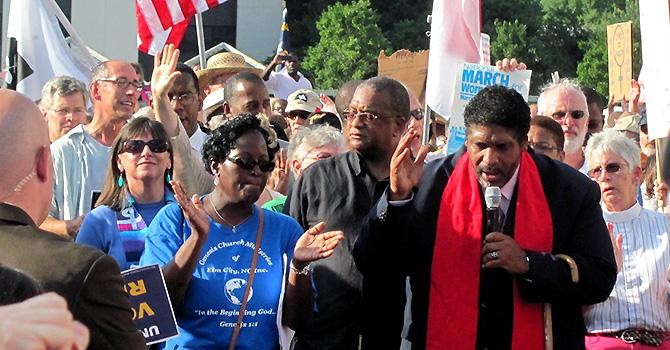
The Rev. Dr. William J. Barber II speaking at a Moral Monday rally. Creative Commons: Flickr / Twbuckner
In this interview, the leader of the Moral Mondays movement talks about leading in the public square. Reprinted from Faith&Leadership.
The Rev. Dr. William J. Barber II is the president of the North Carolina NAACP and architect of the Moral Mondays protest movement, which began in Raleigh in 2013 and has spread across the country.
Barber has been engaged in social activism for many years, but he began his rise to national prominence after organizing a 2007 coalition of advocacy groups called the Historic Thousands on Jones Street People’s Assembly (HKonJ), which marched on the state Capitol to protest conservative legislation.
Out of that grew the Forward Together Moral Movement, which organized Monday protests and civil disobedience at the state legislature building. In North Carolina, redistricting and proposed voting rights legislation have been a particular focus for progressives. The Monday protests, known as “Moral Mondays,” have spread to other states.
Barber spoke at the 2016 Democratic National Convention, where he urged voters to “embrace” Hillary Clinton.
“If you’re going to be in the public square as a preacher, you have to bring something different. So, for instance, you’ll never hear me in the public square talking about left and right, and Conservative vs. Democrat,” he said. “You have to bring to bear the sacred text in the public square.”
Barber also is the pastor of Greenleaf Christian Church (Disciples of Christ) in Goldsboro, North Carolina, which has invested $1.5 million into community development, including low-income housing, a home for senior citizens, a preschool and a community center.
Barber received an M.Div. from Duke Divinity School and a doctoral degree from Drew University. He is the recipient of the Order of the Long Leaf Pine, North Carolina’s highest citizenship award.
He was interviewed for Faith & Leadership by Jonathan Wilson-Hartgrove, who co-wrote with Barber the book “The Third Reconstruction: Moral Mondays, Fusion Politics, and the Rise of a New Justice Movement.”
Q: What can institutional church leaders do to address issues of systemic injustice?
I’m certainly a part of the institutional church. I’m in the Christian Church (Disciples of Christ) — I’ve been a pastor for nearly 30 years. I’m a part of a denomination that is 95 percent white, 5 percent Latino and African-American. I’m a moderator of the Christian Church (Disciples of Christ) in North Carolina, which is over 125 churches, the majority of which are white.
I think the first thing — and this might seem simplistic — is we have to begin to preach the gospel in our churches. Not merely attempt to quarantine the church from the issues in the world but to have the courage, as Karl Barth once said, to hold the Bible in one hand and the newspaper in the other.
I think too many of our pulpits are disconnected from the realities that people are facing every day. When you look at the ministry of Jesus or the ministry of the prophets, there was a certain Sitz im Leben, if you will. There was a certain recognition of the context of the time that they were spoken to.
For instance, Philip Esler, in one of his books, “Community and Gospel in Luke-Acts,” talks about how you can hear in Jesus’ first sermon Jesus directly contrasting Roman society, the stratification, and the poverty. Jesus gives priority and place to the poor, the very ones that Roman society and the religious cultures of that time dismissed and pushed aside.
We cannot be silent on the issue, for instance, of unarmed black and white, black men, women and children being shot.
We cannot be silent and not talk about what the gospel says when we have 14.7 million poor children in this country.
We cannot be silent in our pulpits or in our Bible studies when 64 million Americans make less than a living wage in a time when 400 families make over $97,000 an hour and 54 percent of African-Americans make less than a living wage.
We have to begin to deal with race from the perspective of the gospel, and we have to deal with race not merely as a feeling of prejudice but to unpack for people in the pews that racism is about power.
It’s not so much what’s in somebody’s heart personally but what is the heart of their policies.
And so we have to dare to preach the gospel. We have to dare like Isaiah to cry out, “Spare not!” We have to dare like Jesus to call religious hypocrisy what it is when we major in everything else but love, justice and mercy.
And I think that until we, like Jesus, come preaching, then there will always be a certain anemia as it relates to the church’s ability to deal with these issues internally. Because if we’re afraid to deal with these issues internally, then how can we ever be prophetic externally?
Q: I’ve talked to a lot of white pastors and church leaders who are feeling that they need to do something and they don’t feel like they know how. What resources or partners would you point institutional leaders toward?
Well, I certainly would point them to the piece, Jonathan, that you helped to edit, which is “A Liturgy for Ordinary Radicals.”
I think we would do well to go back and read the writings of people like William Lloyd Garrison and Charles Finney.
I think we would do ourselves well to recover the language of Howard Thurman — “Jesus and the Disinherited,” for instance. Certainly, the writings of Dr. [Martin Luther] King and Rabbi [Abraham Joshua] Heschel. And I was just reading this morning Sojourner Truth.
I think we would do well to start with people who gathered themselves, and gathered their consciousness, and chose to preach the gospel in times much worse than the times in which we live.
Because when we want to be fearful, we should look back and remember that William Lloyd Garrison and Henry Thoreau were thrown in jail for preaching [truth]. In fact, William Lloyd Garrison wrote on the wall of his jail cell, “William Lloyd Garrison was put into this cell … for preaching the [abominable and dangerous doctrine] that all men are created equal.”
I think of pieces like “America’s Original Sin” by Jim Wallis, the writings of Dr. King, especially his last book, “Where Do We Go from Here: Chaos or Community?”
I would recommend the book that I’ve written called “Forward Together: A Moral Message for the Nation,” where it shows messages in the public square that whites, blacks, brown people, Asians and others were able to hear. Or “The Third Reconstruction” that we wrote together, Jonathan. I think those are important pieces.
And I think that we should not just preach it but teach it in our Bible studies. The National Council of Churches has a series of Bible studies that can be engaged in.
But I also think we have to learn how to bring testimonies in the church, the testimonies of real people.
So, for instance, the third weekend in October and the first weekend in November, we [the ecumenical Moral Revival project] have asked rabbis, imams and pastors to preach on social justice, love and mercy. But bring someone in, for instance, who has been denied health care, and before they preach the sermon, let them testify.
Or bring someone in that has been impacted by police brutality, or show a film of someone, so that it’s not abstract.
And then last, I would encourage every minister of the gospel to pick up a copy of the Poverty and Justice Bible. I think it is an invaluable tool, because in that Bible, they mark every scripture that has to do with love, justice and mercy — over 2,000 scriptures.
In fact, I’m thinking that I’m going to replace the pew Bibles at my church with that Bible, because it drives home so clearly that if you do not deal with the issues of love, justice and mercy, it’s like taking a pair of scissors and cutting the Bible up, and you have nothing left.
Previous Post

June 8, 2017
Why Are There So Few Mainline Celebrities?
Next Post

June 27, 2017 The Curse of Hard Work: Another View
Browse Our Archives
Select a Category Art Audio posts Bible and Work Book Review Books Budgeting Calling Common Good Community Development Conferences Discipleship Economics Entrepreneurship Ethics Faith and Family Faith and the Marketplace Faith and the Workplace faith and work History of Work and Vocation Leadership Local Church Meaning New Blogger News Prayer Relationships Seminaries Theology of Work Uncategorized Video posts Vocation Worship Resources
Select a Month April 2026 October 2025 September 2025 July 2025 April 2025 January 2025 October 2024 September 2024 August 2024 May 2024 March 2024 February 2024 December 2023 November 2023 August 2023 July 2023 April 2023 January 2023 December 2022 November 2022 September 2022 August 2022 July 2022 May 2022 April 2022 February 2022 January 2022 December 2021 November 2021 October 2021 September 2021 August 2021 June 2021 May 2021 March 2021 February 2021 January 2021 December 2020 November 2020 September 2020 August 2020 July 2020 June 2020 May 2020 April 2020 March 2020 January 2020 December 2019 October 2019 September 2019 August 2019 July 2019 June 2019 May 2019 April 2019 March 2019 February 2019 January 2019 April 2018 March 2018 January 2018 December 2017 November 2017 October 2017 September 2017 August 2017 July 2017 June 2017 May 2017 April 2017 March 2017 February 2017 January 2017 December 2016 November 2016 October 2016 September 2016 August 2016 July 2016 June 2016 May 2016 April 2016 March 2016 February 2016 January 2016 December 2015 November 2015 October 2015 September 2015 August 2015 July 2015 June 2015 May 2015 April 2015 March 2015 February 2015 January 2015 December 2014 November 2014 October 2014 September 2014 August 2014 July 2014 June 2014 May 2014 April 2014 March 2014 February 2014 January 2014 December 2013
Follow Us!
TAKE THE
Religious Wisdom Quiz
What does "Apocalypse" mean in Greek?
Select your answer to see how you score.
Destruction God's Wrath The End Revelation
Related posts from MISSION:WORK

Why Beth Felker Jones is Protestant



Not Nearly So Much Like a Mall
TRENDING AT PATHEOS Careers, Workplace and Religion

'Super Scam Me' Exposes AI Jon Bon Jovi...
Leslie Pickett believed she was in a relationship with Jon Bon Jovi....

The Brazilian Remake of Kendricks' 'Flywheel' Opens in...
“Flywheel,” the story that launched the Kendrick Brothers’ filmmaking career is getting...

The Dangers of Gradual Accommodation (Winking at Sin)
Recently, the “law of gradualness” resurfaced during the opening of a weeklong,...

The Iron Gates and the Lion of the...
Yesterday, I didn't finish my report about, well, yesterday. So I'll...

The Image: On the Horror of Capitalism and...
The Image Then went the Pharisees, and took counsel how they might...

We are approaching the date of our new American national holiday: October...
view all Careers, Workplace and Religion blogs
Ad-Free & Subscriber Log-In Subscription Support
- About Us
- 2026 Calendar
- Videos
- Podcasts
- Library of World Religions
- Faith In Media Tracker
- Advertise With Us
- Write for Us
- Privacy Policy
- Terms of Service
- Do Not Sell My Data
- Contact Us
- Radiant Digital
- Manage Newsletter Subscriptions
- Unsubscribe From Notifications
- Sitemap
Copyright 2008-2026, Patheos. All rights reserved.
Subscription Support Ad-Free & Subscriber Log-In
Follow Patheos