
BuddhistCatholicContemplativeEvangelicalGeneral ChristianHinduJewishLatter-day SaintMuslimNew VisionsProgressive Christian
Beliefs
- Buddhist
- Catholic
- Contemplative
- Evangelical
- General Christian
- Hindu
- Jewish
- Latter-day Saint
- More Voices
- Muslim
- New Visions
- Pagan
- Progressive Christian
Topics
- Religion News
- Food and Religion
- Sports and Religion
- Religious Art
- Religious Music and Entertainment
- Religious Events
- History and Religion
- Style and Religion
- Politics and Religion
- Women in Religion
- Recreation Outdoors and Religion
- Business Finance and Religion
- Careers Workplace and Religion
- Education and Religion
- Family Parenting and Religion
- Health Fitness and Religion
- Home and Religion
- Relationships and Religion
- Technology and Religion
- Travel and Religion
Columnists
- Buddhist Columnists
- Business Finance and Religion Columnists
- Careers Workplace and Religion Columnists
- Catholic Columnists
- Contemplative Columnists
- Education and Religion Columnists
- Evangelists Columnists
- Family Parenting and Religion Columnists
- General Christian Columnists
- Health Fitness and Religion Columnists
- Hindu Columnists
- History and Religion Columnists
- Home and Religion Columnists
- Jewish Columnists
- More Voices Columnists
- Latter Day Columnists
- Muslim Columnists
- New Visions Columnists
- Nonreligious Columnists
- Pagan Columnists
- Politics and Religion Columnists
- Progressive Columnists
- Recreation Outdoors and Religion Columnists
- Relationships and Religion Columnists
- Religion News Columnists
- Religious Art Columnists
- Religious Events Columnists
- Religious Music and Entertainment Columnists
- Sports and Religion Columnists
- Style and Religion Columnists
- Technology and Religion Columnists
- Travel and Religion Columnists
- Women in Religion Columnists
Resource Library
- 2026 Calendar
- Library of World Religions
- The 100 Most Holy Places on Earth
- Patheos Answers
- Podcasts
- Videos
- Faith Leaders Database
- Anglican Episcopalian
- Bahai
- Baptist
- Buddhism
- Christianity
- Confucianism
- Eastern Orthodoxy
- Hinduism
- Holiness and Pentecostal
- ISKCON
- Islam
- Judaism
- Lutheran
- Methodist
- The Church of Jesus Christ of Latter-day Saints
- New Age
- Paganism
- Presbytarian and Reformed
- Protestantism
- Religion Behind the Scenes
- Roman Catholic
- Scientology
- Shia Islam
- Sikhism
- Sufism
- Sunni Islam
- Taoism
- Zen
- See all religions
Research Tools
 Ad-Free & Subscriber Log-In Subscription Support
Ad-Free & Subscriber Log-In Subscription Support
Follow Patheos 

- Trending:
- Forgiveness
- |
- Marriage
- |
- Consciousness
- |
- Death Penalty
- |
- Election
- |
- Halloween

- Home
- Careers, Workplace and Religion
- On not knowing what to say
On not knowing what to say
Last updated on: August 10, 2016 at 3:41 pm by Guest Contributor
On not knowing what to say 2016-08-10T15:41:44-05:00 Guest Contributor
Patheos Explore the world's faith through different perspectives on religion and spirituality! Patheos has the views of the prevalent religions and spiritualities of the world.
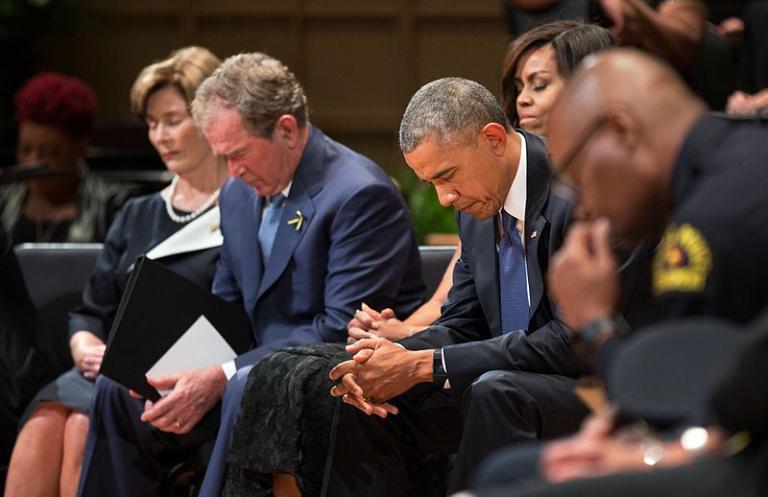
Former President George W. Bush and President Barack Obama pray at the memorial service for five police officers killed in Dallas on July 7, 2016. Photo by The White House, via Wikimedia Commons.
Christian leaders who are obligated to speak out on current events don’t have to join the media noise. Silence says more than punditry, writes a seminary professor. This post originally appeared at Faith & Leadership.
It has been a while since the sickening week during which we watched the videos of two African-American men under arrest apparently executed by the arresting officers, and then 12 Dallas officers gunned down as they policed a protest against those shootings.
A friend of mine posted on social media that he “woke up and suddenly it was 1968 all over again.”
And such commentary is one of the problems: on social media, each of us feels like a pundit. Which means we feel compelled to say something wise, to harness outrage, to redirect anger — in short, to have something to say.
But what if there are no words?
I watched as friends in prominent public positions tried to articulate something helpful for their community and beyond, to put a frame of reference around these horrifying events.
Pastors, heads of judicatories — anybody with a public role was expected to say something. I was glad, for once, not to be in such a position. I’m just a seminary professor, and class is not in session. I didn’t know what to say, and I was relieved that I didn’t have to say anything.
Because there really are no words. The horror of being executed for no obvious reason other than being black is just that. The horror of being murdered for no obvious reason other than being a police officer is just that.
We would all do well to be silent here for a moment.
Many of the challenges we face have to do with changes in the chattering classes. The number of news sources has exploded, and many of those sources seek to stand out by shouting ever more shrill and inane and outrageous things.
Our public discourse has been poisoned by pundits and politicos demonizing other people.
Our Enlightenment-encouraged forebears thought the answer to destructive or dishonest speech was not prison but better speech. I fear that our media outlets may be showing how wrong they were.
Frightened people, tuned into these cable programs all day, arm themselves, vilify other people and tune in even more as the feedback loop grows ever more frenzied. There is no obvious end to this dismal cycle.
Except, perhaps, prayer.
I remember a classmate in seminary, invited to offer questions or comments after hearing a list of heinous injustices perpetrated by a Latin American government against its citizens, replying simply, “I don’t want to talk anymore. I just want to pray.” And so we did.
We redirected all our anger and vitriol and shame (since our government had backed the government doing many of these misdeeds) toward the only One who can really heal anything. It was a blessed interruption.
What if God’s people interrupted our poisonous media with the antidote of prayer?
Leaders don’t often respond with silence. We expect them to talk. They give speeches and quotes to the media and lead meetings and deliver bad news and occasionally lend their blessing. Sometimes they do this by their mere presence, but if there’s a hot mic nearby, usually they will speak.
Of course, there are times when someone in a position of public trust simply has to step up to the mic or the keyboard and say something. That’s what leadership is: offering words when others have no words.
But what would it mean for them to offer silence?
My colleague James Howell often seizes on an obscure verse in Chronicles as an image for faithful Christian leadership: “We don’t know what to do, but our eyes are on you” (2 Chronicles 20:12).
Scripture doesn’t always have an answer. But God is always good. And Scripture is written down, preserved, read from and blessed precisely because we, God’s people, lack words. We don’t have to make them up. God has given them to us.
We can pray the Psalms, for example. The book of Psalms is chock-full of laments: words for those who are crushed, who can’t muster their own words. These words often move from sorrow to hope, but not always (see Psalm 88).
Those in public distress would do well to step up, open the book and just read, say, Psalm 102, about the devastation of Jerusalem, or Psalm 137:1-7, about the loss of God’s promised land.
One problem with our toxic media is that it’s just too fast. We’re asked to offer concrete, pithy, memorable words for situations that have just happened, are still in progress, on which we have no wise vantage.
I heard Martin Marty say one time that commentary on anything more recent than, say, 1492 is just yellow journalism! Historians can get away with such observations. Leaders usually can’t.
But if you are called upon to say something and come up short, turn to the word of God. Use it; it’s there for a reason.
A leader with nothing to say can be a blessing in other ways, too. Ludwig Wittgenstein famously said that things of which we cannot speak are things on which we must be silent.
He was echoing a longer philosophical tradition (itself full of words) reacting against talk of large, abstract, metaphysical sorts of truths as if we can say anything illuminating at all about them. We can’t. So Wittgenstein directed our attention back to things to which we do have access (like the language we use).
The early and medieval church said something similar — that our language about God misinforms as much as it informs. Even when we offer basic bedrock truths — that God is love or that God exists or that God created — our language obfuscates as much as it clarifies.
In what way is God’s love like mine for, say, Duke basketball? How is God’s existence similar to that flower or bumblebee or supernova? Is God’s creation like my creation of this article?
Their caution is a good one for an age with few hedges on words. We should qualify or even unsay lots of what we have said or want to say. It’s God we’re talking about. Who can understand? Augustine said, “If you understand, it is not God.”
If we are going to speak well of the only One really worth speaking about, we should not only take care; we should show those listening that we are taking care. Our words not only describe; sometimes they misdescribe.
We’re creatures; only One speaks truly every single time. And that One is often maddeningly silent. Especially at times like this.
Physicians still take Hippocrates’ oath to do no harm. We could do the same. Christian leaders called upon to speak out might offer time-honored words from our tradition, such as simply, “Lord have mercy.”
Or, perhaps, silence.
Image: Wikimedia Commons.
Previous Post

August 8, 2016
Productivity: 6 Tips for Getting (The Right) Stuff Done


Browse Our Archives
Select a Category Art Audio posts Bible and Work Book Review Books Budgeting Calling Common Good Community Development Conferences Discipleship Economics Entrepreneurship Ethics Faith and Family Faith and the Marketplace Faith and the Workplace faith and work History of Work and Vocation Leadership Local Church Meaning New Blogger News Prayer Relationships Seminaries Theology of Work Uncategorized Video posts Vocation Worship Resources
Select a Month April 2026 October 2025 September 2025 July 2025 April 2025 January 2025 October 2024 September 2024 August 2024 May 2024 March 2024 February 2024 December 2023 November 2023 August 2023 July 2023 April 2023 January 2023 December 2022 November 2022 September 2022 August 2022 July 2022 May 2022 April 2022 February 2022 January 2022 December 2021 November 2021 October 2021 September 2021 August 2021 June 2021 May 2021 March 2021 February 2021 January 2021 December 2020 November 2020 September 2020 August 2020 July 2020 June 2020 May 2020 April 2020 March 2020 January 2020 December 2019 October 2019 September 2019 August 2019 July 2019 June 2019 May 2019 April 2019 March 2019 February 2019 January 2019 April 2018 March 2018 January 2018 December 2017 November 2017 October 2017 September 2017 August 2017 July 2017 June 2017 May 2017 April 2017 March 2017 February 2017 January 2017 December 2016 November 2016 October 2016 September 2016 August 2016 July 2016 June 2016 May 2016 April 2016 March 2016 February 2016 January 2016 December 2015 November 2015 October 2015 September 2015 August 2015 July 2015 June 2015 May 2015 April 2015 March 2015 February 2015 January 2015 December 2014 November 2014 October 2014 September 2014 August 2014 July 2014 June 2014 May 2014 April 2014 March 2014 February 2014 January 2014 December 2013
Follow Us!
TAKE THE
Religious Wisdom Quiz
What sign does Paul give in 2 Thessalonians as his authentic mark in every letter?
Select your answer to see how you score.
His greeting in his own handwriting A special blessing His seal His signature
Related posts from MISSION:WORK

Three Conversations (in honor of Eastertide)



Not Nearly So Much Like a Mall
TRENDING AT PATHEOS Careers, Workplace and Religion

Catholic Evangelization: Sharing Your Faith Every Day
Welcome back to the Graceful Awakening mini-series called, “From Faith to Mission.” ...

The Pillar of the Boatmen: the Ancient Monument...
The Pillar of the Boatmen is a Romano-Gaulish sculpture that dates from...

In one sense walking into Westminster Abbey is like walking down the...

'Super Scam Me' Exposes AI Jon Bon Jovi...
Leslie Pickett believed she was in a relationship with Jon Bon Jovi....

The Brazilian Remake of Kendricks' 'Flywheel' Opens in...
“Flywheel,” the story that launched the Kendrick Brothers’ filmmaking career is getting...

The Dangers of Gradual Accommodation (Winking at Sin)
Recently, the “law of gradualness” resurfaced during the opening of a weeklong,...
view all Careers, Workplace and Religion blogs
Ad-Free & Subscriber Log-In Subscription Support
- About Us
- 2026 Calendar
- Videos
- Podcasts
- Library of World Religions
- Faith In Media Tracker
- Advertise With Us
- Write for Us
- Privacy Policy
- Terms of Service
- Do Not Sell My Data
- Contact Us
- Radiant Digital
- Manage Newsletter Subscriptions
- Unsubscribe From Notifications
- Sitemap
Copyright 2008-2026, Patheos. All rights reserved.
Subscription Support Ad-Free & Subscriber Log-In
Follow Patheos