
BuddhistCatholicContemplativeEvangelicalGeneral ChristianHinduJewishLatter-day SaintMuslimNew VisionsProgressive Christian
Beliefs
- Buddhist
- Catholic
- Contemplative
- Evangelical
- General Christian
- Hindu
- Jewish
- Latter-day Saint
- More Voices
- Muslim
- New Visions
- Pagan
- Progressive Christian
Topics
- Religion News
- Food and Religion
- Sports and Religion
- Religious Art
- Religious Music and Entertainment
- Religious Events
- History and Religion
- Style and Religion
- Politics and Religion
- Women in Religion
- Recreation Outdoors and Religion
- Business Finance and Religion
- Careers Workplace and Religion
- Education and Religion
- Family Parenting and Religion
- Health Fitness and Religion
- Home and Religion
- Relationships and Religion
- Technology and Religion
- Travel and Religion
Columnists
- Buddhist Columnists
- Business Finance and Religion Columnists
- Careers Workplace and Religion Columnists
- Catholic Columnists
- Contemplative Columnists
- Education and Religion Columnists
- Evangelists Columnists
- Family Parenting and Religion Columnists
- General Christian Columnists
- Health Fitness and Religion Columnists
- Hindu Columnists
- History and Religion Columnists
- Home and Religion Columnists
- Jewish Columnists
- More Voices Columnists
- Latter Day Columnists
- Muslim Columnists
- New Visions Columnists
- Nonreligious Columnists
- Pagan Columnists
- Politics and Religion Columnists
- Progressive Columnists
- Recreation Outdoors and Religion Columnists
- Relationships and Religion Columnists
- Religion News Columnists
- Religious Art Columnists
- Religious Events Columnists
- Religious Music and Entertainment Columnists
- Sports and Religion Columnists
- Style and Religion Columnists
- Technology and Religion Columnists
- Travel and Religion Columnists
- Women in Religion Columnists
Resource Library
- 2026 Calendar
- Library of World Religions
- The 100 Most Holy Places on Earth
- Patheos Answers
- Podcasts
- Videos
- Faith Leaders Database
- Anglican Episcopalian
- Bahai
- Baptist
- Buddhism
- Christianity
- Confucianism
- Eastern Orthodoxy
- Hinduism
- Holiness and Pentecostal
- ISKCON
- Islam
- Judaism
- Lutheran
- Methodist
- The Church of Jesus Christ of Latter-day Saints
- New Age
- Paganism
- Presbytarian and Reformed
- Protestantism
- Religion Behind the Scenes
- Roman Catholic
- Scientology
- Shia Islam
- Sikhism
- Sufism
- Sunni Islam
- Taoism
- Zen
- See all religions
Research Tools
 Ad-Free & Subscriber Log-In Subscription Support
Ad-Free & Subscriber Log-In Subscription Support
Follow Patheos 

- Trending:
- Forgiveness
- |
- Marriage
- |
- Consciousness
- |
- Death Penalty
- |
- Election
- |
- Halloween

- Home
- Careers, Workplace and Religion
- Restoring Dignity Through Business: Dignity Coconuts’ Story
Restoring Dignity Through Business: Dignity Coconuts’ Story
Last updated on: April 8, 2016 at 1:02 pm by The BAM Review
Restoring Dignity Through Business: Dignity Coconuts’ Story 2016-04-08T13:02:01-05:00 The BAM Review
Patheos Explore the world's faith through different perspectives on religion and spirituality! Patheos has the views of the prevalent religions and spiritualities of the world.
“We’re fighting this multi-billion dollar evil with a peashooter,” Stephen told Don as they wandered around the exhibition hall at an anti-human trafficking convention. At every booth they were encountering stories of abuse and human suffering. There were also stories of rescue and restoration. However, the sheer scale of global slavery seemed to dwarf the efforts of those at the front-lines fighting against it. Most organisations working with trafficked communities can only provide jobs for 5, 10, 20 or so people. This is great and essential work; giving meaningful work and a stable livelihood is central to people getting out and staying out of slavery. Yet the need for stable jobs far surpasses the supply. Don and Stephen came away with a burning question: How can we employ a growing number of people vulnerable to, or rescued from, human trafficking?
A year later in 2009 Stephen Freed and Don Byker left their long-held positions and set out to research business opportunities. They realised that if they were really going to tackle the underground slavery industry, they would need multiple, substantially-sized businesses that could employ hundreds or thousands of people. As they researched they found, as economists have discovered, that the key to solving poverty and bringing widespread economic development to communities is a growing number of SME-sized businesses.
Coconuts, coconuts!
Don Byker, former Harvard professor, management consultant at Bain and Company, and business owner, had been helping to support an orphanage and schools in rural Philippines since 1973. As he and Stephen were exploring business ideas, a local NGO leader said, “Our students are doing well in high school, but what happens after graduation? There are no jobs in our community. Our graduates have to leave their families and go to the cities or overseas to get work.” At best families are divided and brain-drain continues, losing those most equipped to improve the community. At worst their search for better jobs makes them vulnerable to human trafficking. The rural area where they went to school was isolated, hours from the nearest city down a barely passable road. The economy of the area consisted mainly of subsistence farming of coconuts, fish and rice, with unemployment near 80%. The message from the local leader came back clearly: “Give us a chance to compete in the global marketplace. Start a business!”
Instead of coming in with western ideas and mandates, Don and Stephen asked the community what kind of business they could create there. Their question was, “What do you have?” The rather surprising answer at the time was: coconuts!
As the business team got into some in-depth research, and seriously started using different coconut products themselves, they that coconut oil did indeed have many proven health benefits. At the time it was mainly being used by health enthusiasts, but there was already a growing market. This was the beginning of Dignity Coconuts.
Unearthing Dignity
Erik Olson, VP at Dignity Coconuts shares, “The name Dignity was chosen to counter the sad reality that most approaches to development unintentionally erode a poor person’s dignity. In order to help people rise out of poverty with dignity, we must create opportunity for meaningful work. Businesses done right have great potential due to the ability to create significant jobs.”
As they launched into product research, Don and Stephen found most companies were using one or two parts of the coconut, leaving piles of waste behind. The Dignity team sought to develop ways of processing the coconut so none of it is wasted, adding more value to this crop typically grown by the poor. Although the eventual goal is to use the whole coconut, the team knew they couldn’t launch all their planned products at the same time, they needed to focus. That has been a difficult tension for them and it’s taken discipline to focus on the R&D needed to get their first products to market, starting with coconut oil and ground shell powder.
A Plant in the Community
Another early decision in Dignity’s development was where to locate the coconut processing plant. The team wrestled with whether they should build the plant near the developed city or in the rural villages. The Bicol region where they are working is one of the poorest in all of the Philippines, and there are relatively few industries and coconut processing facilities there to begin with. On the other hand, all the existing coconut companies are established near the cities that offer developed infrastructure, access to construction materials, and easier export logistics. Their plants send trucks hours away to collect the crop from rural areas reinforcing the disconnect between the factory and the farmers.
The Dignity team knew that in order to make significant impact and create jobs in the rural community, they would have to build their plant where the people were, in the heart of the community itself. Indeed, this brought many logistical challenges and it took a full two years to build the plant. The team decided to create a smaller, more nimble plant, but this still required four buildings. It was a constant challenge to get all the materials to a place that had no major construction supplies.
Coconut Oil with a Difference
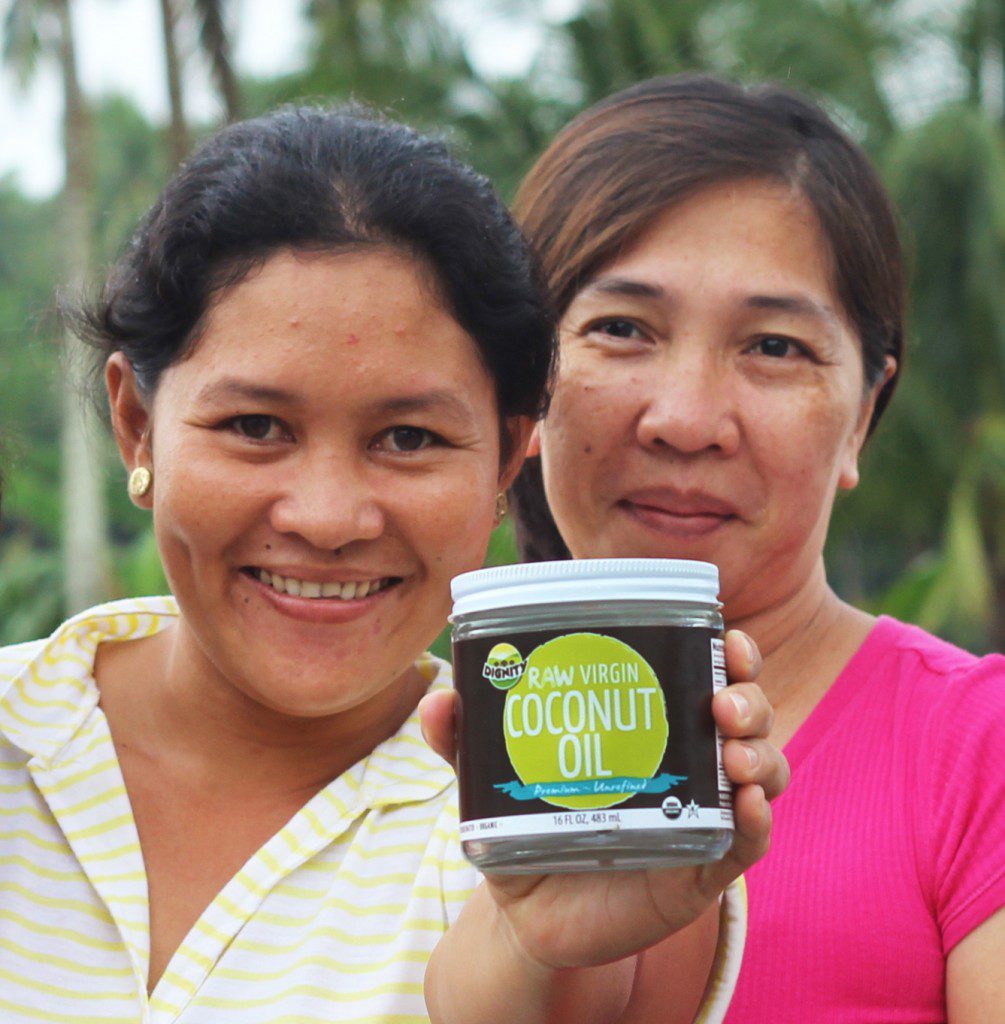
The Dignity team chose coconut oil as its first of six products because of the rapidly growing market and long shelf life. Knowing they couldn’t compete on price with big name brands, they went for a high-quality product. They aim to build a brand loyalty with people who can, quite literally, taste the difference. Dignity’s product, Raw Virgin Coconut Oil, is extremely healthy. Normally used in cooking and food preparation, it is also pure enough to be used directly on the skin. One of their unique selling points is that the centrifuge method produces oil which is considered a raw food, preserving and passing on the health benefits found in the coconut.
Dignity has already seen transformation, starting with the farmers. In the past farmers have sold their dried coconut meat to traders. This closed group dictates the price, most often with no way to check prices. The farmers were trapped in a cycle of poverty with no options. Instead Dignity invites the farmers to come to their Community Transformation Plant (CTP) for training and has helped them get organic certification. Dignity Coconuts is changing the model for how to do business in a way that can break cycles of poverty.
On the other end, the consumers benefit from the traceability of the oil and the direct connection with the farmers and the plant staff. Dignity currently employs about 80 employees, with plans for 150 at two shifts. Workers sign each jar coming off the line, creating a personal touch on the finished product. The idea that customers can make a real difference for real people by choosing this product is another of the key marketing messages for Dignity. They share extensively and openly on their website about the community impact and individual empowerment the business is facilitating. They encourage their customers by showing their purchases can improve lives and disrupt systems of oppression. Dignity’s is not just another run of the mill coconut oil!
The Real Business of Transformation
Locating the plant in this very poor, very rural coastal region has brought noticeable change in other ways. A new level of energy and hope has emerged in the community. Employees are starting to talk about sending their kids to college. Previously that seemed too far fetched, but now with a stable family income, it has become a possibility. The plant itself has brought infrastructure development to the area, better transportation links, introduced more food choices into the area and has resulted in other businesses popping up locally. More people now have mobile phones and a telecom company put a tower in the area. People can communicate better and access services like mobile banking, which empowers them with more choices.
As they rub shoulders with their employees and people in the community, the Dignity team hope they are able to demonstrate the love of Christ through their lives. There has already been tangible evidence of transformation: stable jobs have been created, community issues are being tackled, local churches are working together in greater unity, farmers have been empowered, the local economy is growing – there is a sense of hope. The real business of Dignity Coconuts isn’t processing coconuts, but bringing production into communities where it can have a holistic, transforming impact: social, environmental, economic, physical, spiritual, and emotional.
Read the full Dignity Coconuts Story on The BAM Review blog – subscribe to our twice-monthly email to get fresh Business as Mission articles and stories direct to your inbox.
Previous Post

March 21, 2016
The Cross Before the Crown
Next Post
April 5, 2016 When God closes a door, he opens....a blog?
Browse Our Archives
Select a Category Art Audio posts Bible and Work Book Review Books Budgeting Calling Common Good Community Development Conferences Discipleship Economics Entrepreneurship Ethics Faith and Family Faith and the Marketplace Faith and the Workplace faith and work History of Work and Vocation Leadership Local Church Meaning New Blogger News Prayer Relationships Seminaries Theology of Work Uncategorized Video posts Vocation Worship Resources
Select a Month April 2026 October 2025 September 2025 July 2025 April 2025 January 2025 October 2024 September 2024 August 2024 May 2024 March 2024 February 2024 December 2023 November 2023 August 2023 July 2023 April 2023 January 2023 December 2022 November 2022 September 2022 August 2022 July 2022 May 2022 April 2022 February 2022 January 2022 December 2021 November 2021 October 2021 September 2021 August 2021 June 2021 May 2021 March 2021 February 2021 January 2021 December 2020 November 2020 September 2020 August 2020 July 2020 June 2020 May 2020 April 2020 March 2020 January 2020 December 2019 October 2019 September 2019 August 2019 July 2019 June 2019 May 2019 April 2019 March 2019 February 2019 January 2019 April 2018 March 2018 January 2018 December 2017 November 2017 October 2017 September 2017 August 2017 July 2017 June 2017 May 2017 April 2017 March 2017 February 2017 January 2017 December 2016 November 2016 October 2016 September 2016 August 2016 July 2016 June 2016 May 2016 April 2016 March 2016 February 2016 January 2016 December 2015 November 2015 October 2015 September 2015 August 2015 July 2015 June 2015 May 2015 April 2015 March 2015 February 2015 January 2015 December 2014 November 2014 October 2014 September 2014 August 2014 July 2014 June 2014 May 2014 April 2014 March 2014 February 2014 January 2014 December 2013
Follow Us!
TAKE THE
Religious Wisdom Quiz
I was lifted up on a pole that healed those who looked at me. What am I?
Select your answer to see how you score.
The bronze serpent The Stone Tablets The Golden Calf A healing statue
Related posts from MISSION:WORK


Use the Breath: On What Music Teaches Us...

The One Where Jennifer Gets New Glasses and...

Can Anything Good Come Out of Nazareth?
TRENDING AT PATHEOS Careers, Workplace and Religion

The First Eucharistic Controversy: Christ’s Real Presence
For Catholics, the Eucharist is the source and summit of the Christian...

What a Stop Sign Can Teach Us About...
How to Make a Decision When You Can't Hear God Main point:...

Archdiocese Hosts Military Marriage Retreat in Germany
RASTATT, Germany — The transient military lifestyle, with its frequent deployments and...

Nearly every morning, I make the drive to Detroit with my high-school-age...

The Real AI Story Is Adoption Without Trust
Artificial intelligence has crossed a political threshold. It is no longer a...

A new article, written by Jeff Lindsay and Gale L. Pooley,...
view all Careers, Workplace and Religion blogs
Ad-Free & Subscriber Log-In Subscription Support
- About Us
- 2026 Calendar
- Videos
- Podcasts
- Library of World Religions
- Faith In Media Tracker
- Advertise With Us
- Write for Us
- Privacy Policy
- Terms of Service
- Do Not Sell My Data
- Contact Us
- Radiant Digital
- Manage Newsletter Subscriptions
- Unsubscribe From Notifications
- Sitemap
Copyright 2008-2026, Patheos. All rights reserved.
Subscription Support Ad-Free & Subscriber Log-In
Follow Patheos