
BuddhistCatholicContemplativeEvangelicalGeneral ChristianHinduJewishLatter-day SaintMuslimNew VisionsProgressive Christian
Beliefs
- Buddhist
- Catholic
- Contemplative
- Evangelical
- General Christian
- Hindu
- Jewish
- Latter-day Saint
- More Voices
- Muslim
- New Visions
- Pagan
- Progressive Christian
Topics
- Religion News
- Food and Religion
- Sports and Religion
- Religious Art
- Religious Music and Entertainment
- Religious Events
- History and Religion
- Style and Religion
- Politics and Religion
- Women in Religion
- Recreation Outdoors and Religion
- Business Finance and Religion
- Careers Workplace and Religion
- Education and Religion
- Family Parenting and Religion
- Health Fitness and Religion
- Home and Religion
- Relationships and Religion
- Technology and Religion
- Travel and Religion
Columnists
- Buddhist Columnists
- Business Finance and Religion Columnists
- Careers Workplace and Religion Columnists
- Catholic Columnists
- Contemplative Columnists
- Education and Religion Columnists
- Evangelists Columnists
- Family Parenting and Religion Columnists
- General Christian Columnists
- Health Fitness and Religion Columnists
- Hindu Columnists
- History and Religion Columnists
- Home and Religion Columnists
- Jewish Columnists
- More Voices Columnists
- Latter Day Columnists
- Muslim Columnists
- New Visions Columnists
- Nonreligious Columnists
- Pagan Columnists
- Politics and Religion Columnists
- Progressive Columnists
- Recreation Outdoors and Religion Columnists
- Relationships and Religion Columnists
- Religion News Columnists
- Religious Art Columnists
- Religious Events Columnists
- Religious Music and Entertainment Columnists
- Sports and Religion Columnists
- Style and Religion Columnists
- Technology and Religion Columnists
- Travel and Religion Columnists
- Women in Religion Columnists
Resource Library
- 2026 Calendar
- Library of World Religions
- The 100 Most Holy Places on Earth
- Patheos Answers
- Podcasts
- Videos
- Faith Leaders Database
- Anglican Episcopalian
- Bahai
- Baptist
- Buddhism
- Christianity
- Confucianism
- Eastern Orthodoxy
- Hinduism
- Holiness and Pentecostal
- ISKCON
- Islam
- Judaism
- Lutheran
- Methodist
- The Church of Jesus Christ of Latter-day Saints
- New Age
- Paganism
- Presbytarian and Reformed
- Protestantism
- Religion Behind the Scenes
- Roman Catholic
- Scientology
- Shia Islam
- Sikhism
- Sufism
- Sunni Islam
- Taoism
- Zen
- See all religions
Research Tools
 Ad-Free & Subscriber Log-In Subscription Support
Ad-Free & Subscriber Log-In Subscription Support
Follow Patheos 

- Trending:
- Forgiveness
- |
- Marriage
- |
- Consciousness
- |
- Death Penalty
- |
- Election
- |
- Halloween

- Home
- Careers, Workplace and Religion
- Art, theology, and faith: an interview with the editor of Image Journal
Art, theology, and faith: an interview with the editor of Image Journal
Last updated on: January 7, 2016 at 12:56 pm by Guest Contributor
Art, theology, and faith: an interview with the editor of Image Journal 2016-01-04T13:03:02-05:00 Guest Contributor
Patheos Explore the world's faith through different perspectives on religion and spirituality! Patheos has the views of the prevalent religions and spiritualities of the world.
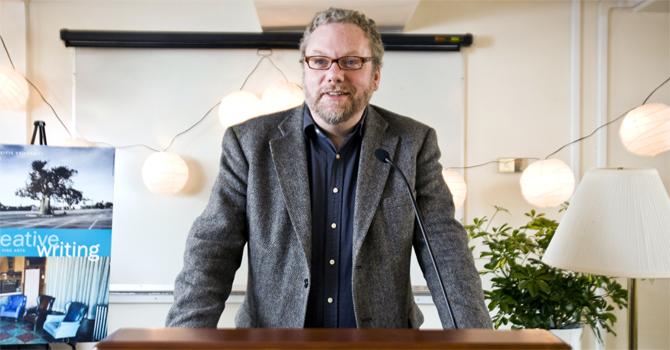
Gregory Wolfe is a writer, teacher and editor and is the founder of Image journal, which focuses on faith and the arts. Photos courtesy of Gregory Wolfe
The founder and editor of Image journal talks about why it’s important for people of faith — and those grappling with questions of faith — to engage with art. This article originally appeared at Faith and Leadership.
Does religion have a culture problem, or does culture have a religion problem? Has the Christian community sacrificed beauty in search of truth and virtue?
Gregory Wolfe, the Seattle-based founder of the arts and literature journal Image, has been grappling with these questions for decades, walking a fine line between provocation and conciliation, originality and tradition.
“That tension between what Christians would call a fallen world and the ideal itself is a form of beauty,” Wolfe said.
In addition to editing the journal, Wolfe is a teacher and author. Among his books are “Beauty Will Save the World,” “Malcolm Muggeridge: A Biography,” “Sacred Passion: The Art of William Schickel” and his latest book of collected essays, “The Operation of Grace: Further Essays on Art, Faith and Mystery.”
Wolfe, who is also the founder of the master of fine arts program in creative writing at Seattle Pacific University, spoke with Faith & Leadership to share his thoughts on art, faith and the value of leadership. The following is an edited transcript.
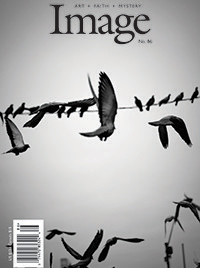 Q: You started the journal Image in 1989, near the beginning of the culture wars. Were you tempted to use the journal to enter into those debates?
Those debates were sterile at best and truly destructive at worst, for both church and society. The impulse of the journal’s founding was really to find a different way.
Our editors were very much aware that in many Christian circles, the preferred method of engaging the world was primarily in the areas of apologetics and politics. The models were to get votes and win souls. Both models overemphasize rationality and a kind of dry or abstract affirmation of doctrine.
We believed that this was an imbalance. Imagination was being slighted. For centuries within Christian circles, it’s been tricky to promote things like beauty when truth and goodness seem to get all the good PR. Beauty seems to be untrustworthy, or potentially even dangerous. In the Christian tradition, we have emphasized faith and reason to the exclusion of imagination.
Without a balance, we tend toward abstraction and legalism. We tend to see everything in terms of warfare, and we treat religion as a set of propositions rather than as an encounter with a presence.
Q: Do you think religious art or art of any kind has to be beautiful?
A lot of people think that beauty really means prettiness or attractiveness or the ideal. This goes way back. The Greeks struggled with it. On the one hand, they loved the ideal form, the supermodel.
On the other hand, there was Greek tragedy. There was this sense that beauty, in a very strange way, can coexist with brokenness. That Oedipus — with his eyes gouged out and blood and gore dripping down his face — was in some mysterious way an image of beauty, an image of dignity in distress.
That tension between what Christians would call a fallen world and the ideal itself is a form of beauty. Tragedy is not only part of the Greek tradition; it’s part of the Christian tradition, too.
To understand that the cross ties into all this is very important. I really don’t feel that the problem is with beauty; I think it’s with the ways that we’ve historically come to define what beauty is.
Q: The artwork in Image is almost exclusively contemporary. How do you decide what art and which artists fit with the journal?
We joke around the office that dead people need not apply. And it’s not because we slight the tradition. We are very much traditionalists. But that particular choice was made precisely during the era of the culture wars.
I sometimes think that anger is underestimated as a motive for true leadership. Back when we were hammering out plans for this journal, one thing that angered us was the strange confluence of agreement between two vastly different groups of people.
On the one hand, there were millions of believers in America who seemed convinced that modern art was always capitalized — “Modern Art” — and that it was monolithic and terrible. In other words, the world itself, and modern art with it, had become so tainted that the best we could do would be to circle the wagons around an older cultural heritage.
On the other hand, sophisticated secular intellectuals and cultural gatekeepers welcomed this. Why? Because Freud and others had made it abundantly clear that religion was escapism, so there could be no way to make new, great art out of an engagement with faith. Art is fundamentally about the real, and if you’re running away from reality, you can’t generate great art.
Our question at Image was, how could millions of religious believers and hundreds if not thousands of cultural-intellectual gatekeepers agree that this was not possible? So our choice to focus on the contemporary was deliberate.
Q: So the contemporary focus is deliberate, but what about the often nonreligious focus? How do you decide what’s appropriate for the magazine?
Not all short stories have to be about troubled youth ministers or alcoholic priests. Not every poem has to be about Lot’s wife. There have been hundreds of thousands of poems written about Lot’s wife, so we can take a little holiday from those for a century or two.
So what’s the criterion after that? I think there’s an element of mystery to it, a case-by-case approach. You look for resonances, you look for some sense of moral or spiritual tradition as having a kind of resonance in the world.
We’re open not only to contributors who are happily ensconced in a creedal and institutional context but also to those who are angry, those who are baffled, those who are puzzled, those who are, like Jacob, wrestling with the angel.
I call these people “grapplers,” because I think the word “seeker” is, frankly, too lame. You can be seeking for your brand of coffee on the shelf. But to grapple with something, to really not be willing to let it go, even if you’re hurt and confused and upset — that’s something. And I love that the grapplers mix in our pages with those who are more comfortable with faith and religious institutions.
The mixture of such quiet resonances between these pieces in any given issue is one of the great joys of the journal.
Q: How does being Catholic influence you as a writer and editor?
Catholics believe that the world, while fallen, still isn’t so broken that it doesn’t provide us with good analogies to understand God. We have a sacramental view that’s willing to look for those resonances without jumping immediately to the doctrinal or intellectual or philosophical divides. There’s a kind of predilection toward seeking unity, seeking a kind of fundamental human commonality.
No good-minded Catholic would say that we can figure all this stuff out without revelation. But the incarnation reveals to us that we can look at the world and discover things, and I believe that’s important.
Then again, I was not raised Catholic. I became Catholic while in graduate school, in part because of art. I was reading these great Catholic novelists of the 20th century — writers like [Graham] Greene, [Evelyn] Waugh, [Flannery] O’Connor, [Walker] Percy, [Georges] Bernanos and Muriel Spark. And I was exposed to painters like Georges Rouault and others. Their sacramentality as artists won me over.
Q: Do you have your own spiritual practices that are related to art?
I’ve been blessed in my vocation, because I really am able to embody that old Benedictine motto of ora et labora — to pray and to work. The process of reading all this rich material and then finding what we could publish and share with the world gives me an opportunity for a contemplative search for grace.
For me, slogging through the slush pile means potentially being surprised by joy and grace and even pain, but the kind of pain that is a tragic awareness of the beauty of broken things.
The other part of my life, of course, is nurturing the capacity of people to go and do these things. I’m a teacher, an educator, the founder of an MFA program in these areas. So I can understand how craft and artistic discipline are similar to ancient spiritual practices. When I’m trying to help a writer write more honestly and more poignantly, I’m really in some sense looking to enable her to tell her story, to expose the moment of grace and the epiphany.
I get these two great pathways — content and form, or vision and craft — both of which are deeply meditative. Sometimes I feel guilty that I try to make that stand in the place of actual prayer, and I probably have something to answer for there. On the other hand, at the end of the day, I really do believe that those are true forms of spiritual practice.
Q: Do you see yourself as an institution builder?
I do. I think building institutions is a lot like marriage. You don’t really foresee everything that’s involved up front, because you’re too in love with the immediate moment. I just loved literary publications and quarterlies so much that I wanted to make one. But I woke up the next morning realizing I had to figure out a way to keep it going.
I think that you’re the best institution builder when you don’t set out to build institutions but rather to pursue what you love. But I had this shock pretty quickly — the morning after, so to speak — realizing what life would have to be like. I decided that if I loved this enough, I had to be serious about the rest, because I wouldn’t have the one without the other.
So I received a whole education in what founding sustained institutions is all about. It’s a rare skill, but I think it’s very important in the larger economy of work and ministry for people who have a passion for “a long obedience in the same direction,” to quote the title of a Eugene Peterson book.
Q: What was the hardest thing for you to learn in terms of transferring a passion into an ability?
One of the key moments for me was learning when to step aside, and learning that, for all of the inestimable value of the fanatical founder, sometimes the successful completion of an activity requires a community rather than just an individual.
My biggest problem about getting out of the way was that I framed it to myself as if I was being virtuous, as if it was an act of humility.
For instance, I took forever to get a real board of directors going. I kept saying to myself, “Well, how can I ask these busy, important people to come hundreds of miles and spend hundreds of dollars on plane tickets and hotels just to help me with this project? Who am I to ask that much of people?”
Eventually, people started to say to me, “Greg, so it’s really about you! You’re saying you don’t have the right to ask this of people, as if it depends on your will. What if these people want to come because they believe in what the total package is about?” It took me a long time to understand that my pride was parading as a false humility.
Q: For someone who isn’t already inclined to be engaged in the arts, what writer, musician or visual artist would you recommend?
I think there are very few people who don’t have any art in their lives, even if they’re just people who have a poster of a sunrise with a Bible verse on it. So I think one simple answer may be a big cliché: just start where you are. What is it that you like? Is there any more of it out there, in museums or concert halls or what have you? Follow the pleasure that you already have.
The funny thing about beauty is that it has this pleasurable element, which has led a lot of people to suspect it. Because, of course, pleasure is always about guilt, right?
So follow your pleasure, and see where it leads you. There’s always a tradition there. Learning about that tradition, learning how even the most contemporary thing has deep roots, can become a great source of pleasure and reward to people.
Blake had this wonderful image of the golden string. It’s sort of like a loose thread in anyone’s experience. If you can find that thread, that golden string, and tug on it, it’s going to lead you somewhere. And I think there are many resources out there for people who are hungry to see whether or not art and imagination and beauty can enrich their lives and make their faith more concrete, more human, less abstract.
Fundamentally, for me, that’s the gift that art gives to theology and faith.
Next Post

January 11, 2016 Your Brain on Poverty: Why Poor People Seem to Make Bad Decisions
Browse Our Archives
Select a Category Art Audio posts Bible and Work Book Review Books Budgeting Calling Common Good Community Development Conferences Discipleship Economics Entrepreneurship Ethics Faith and Family Faith and the Marketplace Faith and the Workplace faith and work History of Work and Vocation Leadership Local Church Meaning New Blogger News Prayer Relationships Seminaries Theology of Work Uncategorized Video posts Vocation Worship Resources
Select a Month April 2026 October 2025 September 2025 July 2025 April 2025 January 2025 October 2024 September 2024 August 2024 May 2024 March 2024 February 2024 December 2023 November 2023 August 2023 July 2023 April 2023 January 2023 December 2022 November 2022 September 2022 August 2022 July 2022 May 2022 April 2022 February 2022 January 2022 December 2021 November 2021 October 2021 September 2021 August 2021 June 2021 May 2021 March 2021 February 2021 January 2021 December 2020 November 2020 September 2020 August 2020 July 2020 June 2020 May 2020 April 2020 March 2020 January 2020 December 2019 October 2019 September 2019 August 2019 July 2019 June 2019 May 2019 April 2019 March 2019 February 2019 January 2019 April 2018 March 2018 January 2018 December 2017 November 2017 October 2017 September 2017 August 2017 July 2017 June 2017 May 2017 April 2017 March 2017 February 2017 January 2017 December 2016 November 2016 October 2016 September 2016 August 2016 July 2016 June 2016 May 2016 April 2016 March 2016 February 2016 January 2016 December 2015 November 2015 October 2015 September 2015 August 2015 July 2015 June 2015 May 2015 April 2015 March 2015 February 2015 January 2015 December 2014 November 2014 October 2014 September 2014 August 2014 July 2014 June 2014 May 2014 April 2014 March 2014 February 2014 January 2014 December 2013
Follow Us!
TAKE THE
Religious Wisdom Quiz
According to 3 John, who loves to be first and will not welcome the brothers?
Select your answer to see how you score.
Demetrius Diotrephes Gaius Alexander
Related posts from MISSION:WORK

Three Conversations (in honor of Eastertide)


Not Nearly So Much Like a Mall
TRENDING AT PATHEOS Careers, Workplace and Religion

Emotion in Early Christianity by Andrew Crislip
Andrew Crislip’s Emotion in Early Christianity examines an often overlooked dimension of...

16 Spiritual Touchstones for a More Grounded Life
After decades of spiritual study, here are 16 principles I try...

Catholic Evangelization: Sharing Your Faith Every Day
Welcome back to the Graceful Awakening mini-series called, “From Faith to Mission.” ...

The Pillar of the Boatmen: the Ancient Monument...
The Pillar of the Boatmen is a Romano-Gaulish sculpture that dates from...

In one sense walking into Westminster Abbey is like walking down the...

'Super Scam Me' Exposes AI Jon Bon Jovi...
Leslie Pickett believed she was in a relationship with Jon Bon Jovi....
view all Careers, Workplace and Religion blogs
Ad-Free & Subscriber Log-In Subscription Support
- About Us
- 2026 Calendar
- Videos
- Podcasts
- Library of World Religions
- Faith In Media Tracker
- Advertise With Us
- Write for Us
- Privacy Policy
- Terms of Service
- Do Not Sell My Data
- Contact Us
- Radiant Digital
- Manage Newsletter Subscriptions
- Unsubscribe From Notifications
- Sitemap
Copyright 2008-2026, Patheos. All rights reserved.
Subscription Support Ad-Free & Subscriber Log-In
Follow Patheos