
BuddhistCatholicContemplativeEvangelicalGeneral ChristianHinduJewishLatter-day SaintMuslimNew VisionsProgressive Christian
Beliefs
- Buddhist
- Catholic
- Contemplative
- Evangelical
- General Christian
- Hindu
- Jewish
- Latter-day Saint
- More Voices
- Muslim
- New Visions
- Pagan
- Progressive Christian
Topics
- Religion News
- Food and Religion
- Sports and Religion
- Religious Art
- Religious Music and Entertainment
- Religious Events
- History and Religion
- Style and Religion
- Politics and Religion
- Women in Religion
- Recreation Outdoors and Religion
- Business Finance and Religion
- Careers Workplace and Religion
- Education and Religion
- Family Parenting and Religion
- Health Fitness and Religion
- Home and Religion
- Relationships and Religion
- Technology and Religion
- Travel and Religion
Columnists
- Buddhist Columnists
- Business Finance and Religion Columnists
- Careers Workplace and Religion Columnists
- Catholic Columnists
- Contemplative Columnists
- Education and Religion Columnists
- Evangelists Columnists
- Family Parenting and Religion Columnists
- General Christian Columnists
- Health Fitness and Religion Columnists
- Hindu Columnists
- History and Religion Columnists
- Home and Religion Columnists
- Jewish Columnists
- More Voices Columnists
- Latter Day Columnists
- Muslim Columnists
- New Visions Columnists
- Nonreligious Columnists
- Pagan Columnists
- Politics and Religion Columnists
- Progressive Columnists
- Recreation Outdoors and Religion Columnists
- Relationships and Religion Columnists
- Religion News Columnists
- Religious Art Columnists
- Religious Events Columnists
- Religious Music and Entertainment Columnists
- Sports and Religion Columnists
- Style and Religion Columnists
- Technology and Religion Columnists
- Travel and Religion Columnists
- Women in Religion Columnists
Resource Library
- 2026 Calendar
- Library of World Religions
- The 100 Most Holy Places on Earth
- Patheos Answers
- Podcasts
- Videos
- Faith Leaders Database
- Anglican Episcopalian
- Bahai
- Baptist
- Buddhism
- Christianity
- Confucianism
- Eastern Orthodoxy
- Hinduism
- Holiness and Pentecostal
- ISKCON
- Islam
- Judaism
- Lutheran
- Methodist
- The Church of Jesus Christ of Latter-day Saints
- New Age
- Paganism
- Presbytarian and Reformed
- Protestantism
- Religion Behind the Scenes
- Roman Catholic
- Scientology
- Shia Islam
- Sikhism
- Sufism
- Sunni Islam
- Taoism
- Zen
- See all religions
Research Tools
 Ad-Free & Subscriber Log-In Subscription Support
Ad-Free & Subscriber Log-In Subscription Support
Follow Patheos 

- Trending:
- Forgiveness
- |
- Marriage
- |
- Consciousness
- |
- Death Penalty
- |
- Election
- |
- Halloween

- Home
- Careers, Workplace and Religion
- Paralyzed by Grace? What We Can Learn From Monastic Discipline
Paralyzed by Grace? What We Can Learn From Monastic Discipline
Last updated on: December 15, 2015 at 10:25 am by Chris Armstrong
Paralyzed by Grace? What We Can Learn From Monastic Discipline 2015-12-08T18:32:57-05:00 Chris Armstrong
Patheos Explore the world's faith through different perspectives on religion and spirituality! Patheos has the views of the prevalent religions and spiritualities of the world.
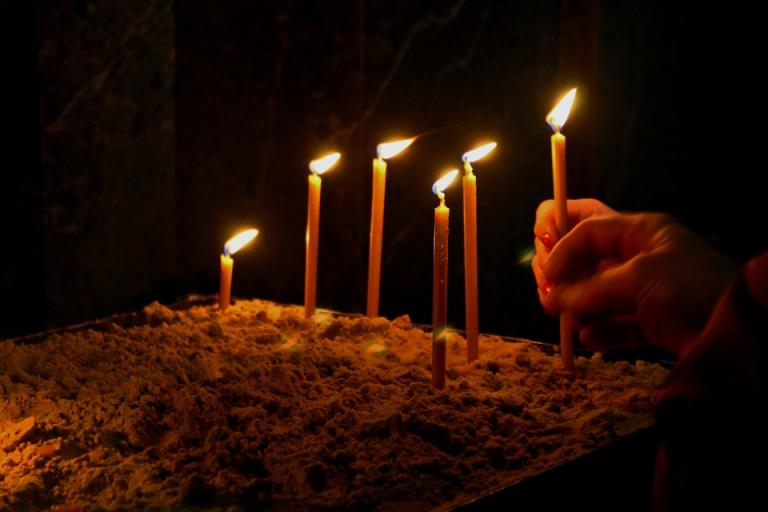
Adapted from Grateful to the Dead.
We wonder today why we are spiritually anemic. This post from the monasticism chapter of my forthcoming Medieval Wisdom: An Exploration with C S Lewis moves on from the first of the “principles of mastery”–passion–to the third–discipline.
Holiness is not optional, and it requires effort
All this talk of passion may make us think that what is required it the single big, heroic action: casting ourselves into harm’s way for the sake of our loved one. But wise teachers of the spiritual life have reminded us of something we have sometimes forgotten: our lives as Christians are not all about single crisis experiences—single events that change our lives. The imagery of sawdust-trail conversions and emotional “altar calls” may sometimes lead us to think in that way, seeking a sudden, emotional experience as the solution to all our ills—but it just ain’t so.
John Wesley, to take just one example, reminded us that those powerful moments of repentance and coming to faith are just the “porch” or the “door” into the Christian life. The substance of the Christian life, which lasts as long as we live, is holiness. Wesley had a favorite phrase to explain holiness. He said it is “having the mind of Christ and walking as he walked.” Achieving that steady character in ourselves requires, in the motto Eugene Peterson borrowed from Friedrich Nietzsche, “a long obedience in the same direction.” That is to say, the Christian life is an askesis – an ascetic life. The word, again, means training, discipline. There is a “longitude” to the concept. It is not a single event.
The late Dallas Willard warned that many modern Christians are not only saved by grace, but we are paralyzed by it. We have drifted into a misunderstanding of Reformation teaching that has tagged all moral effort as works-righteousness. By these lights, grace is only for forgiveness from guilt; it has nothing to do with spiritual growth. Says Willard, “all you have to do is open the pages of the New Testament and you see that this is far, far from the truth.”[1]
We need to rediscover a grace-enabled discipline that endures over time—a way to work out our own salvation in fear and trembling, for it is God who works in us both to will and to do of his good pleasure (Phil. 2:12-13). The monastic teachers were no pull-yourself-up-by-the-bootstraps Pelagians. They “saw the whole process of man’s perfectibility within the economy of divine grace.”[2] We must not be paralyzed by grace. We receive salvation through grace, but as Dietrich Bonhoeffer insisted, it is not a “cheap grace.”
This is why monasticism is worth our attention. We may not set up medieval monasteries on our 21st-century landscape. But we certainly can probe how virtues and vices are coloring our daily interactions in the communities to which we already belong – at work, at home – just as Benedict and his monks did. What kinds of waters are flowing out of the fountain of our character to our co-workers, our customers, our boss, our spouse, our children? Sweet, nourishing ones? Or bitter ones? And where they are bitter, how can we sweeten them?
If it takes ten thousand hours to learn mastery, and if that rule might also apply to mastery of Christian discipleship, then we need to be aware that we are always doing more at work and at home than just creating products and services or running households. We are at the same time being re-created, ourselves, after the image of God. And we must join with God in that process, and that process is going to take much time and much self-conscious effort, as well as a lot of grace.
There are much worse guides to this particular kind of work than the medieval monastics. Monasticism was set up to provide all three essential components of mastery: We have seen (in the “affective devotion chapter”) how it fostered a passion for Christ. In its constant reading, preparation of manuscripts, learning, lectio divina, it was also soaking itself in the tradition – in particular, the moral sense of scripture.[3] And the monks’ life in community afforded ample opportunities to practice the virtues (humility and obedience being two of the most important in Benedict’s Rule), doing the hard work required to gain spiritual and moral mastery. The monastics understood the need for passion, tradition, and discipline. And they trained themselves in all three in a strong communal setting, guided by the development of the virtues through the absorption of the moral sense of scripture, repeated again and again in community.
(Read more here.)
[1] Interview with author
[2] Christopher Brooke, The Age of the Cloister: The Story of Monastic Life in the Middle Ages (Mahwah, NJ: Paulist/HiddenSpring, 2003), 43.
[3] Patrick Henry Reardon, “Scripture Saturation: To achieve holiness, believed the early monks, you must soak in the moral sense of the Word,” Christian History #80: The First Bible Teachers.
Previous Post

December 13, 2015
Leading on Gratitude Road
Next Post
December 16, 2015 Christmas Truth in Star Wars
Browse Our Archives
Select a Category Art Audio posts Bible and Work Book Review Books Budgeting Calling Common Good Community Development Conferences Discipleship Economics Entrepreneurship Ethics Faith and Family Faith and the Marketplace Faith and the Workplace faith and work History of Work and Vocation Leadership Local Church Meaning New Blogger News Prayer Relationships Seminaries Theology of Work Uncategorized Video posts Vocation Worship Resources
Select a Month April 2026 October 2025 September 2025 July 2025 April 2025 January 2025 October 2024 September 2024 August 2024 May 2024 March 2024 February 2024 December 2023 November 2023 August 2023 July 2023 April 2023 January 2023 December 2022 November 2022 September 2022 August 2022 July 2022 May 2022 April 2022 February 2022 January 2022 December 2021 November 2021 October 2021 September 2021 August 2021 June 2021 May 2021 March 2021 February 2021 January 2021 December 2020 November 2020 September 2020 August 2020 July 2020 June 2020 May 2020 April 2020 March 2020 January 2020 December 2019 October 2019 September 2019 August 2019 July 2019 June 2019 May 2019 April 2019 March 2019 February 2019 January 2019 April 2018 March 2018 January 2018 December 2017 November 2017 October 2017 September 2017 August 2017 July 2017 June 2017 May 2017 April 2017 March 2017 February 2017 January 2017 December 2016 November 2016 October 2016 September 2016 August 2016 July 2016 June 2016 May 2016 April 2016 March 2016 February 2016 January 2016 December 2015 November 2015 October 2015 September 2015 August 2015 July 2015 June 2015 May 2015 April 2015 March 2015 February 2015 January 2015 December 2014 November 2014 October 2014 September 2014 August 2014 July 2014 June 2014 May 2014 April 2014 March 2014 February 2014 January 2014 December 2013
Follow Us!
TAKE THE
Religious Wisdom Quiz
What sea did Jesus walk on?
Select your answer to see how you score.
Dead Sea Sea of Galilee Mediterranean Sea Red Sea
Related posts from MISSION:WORK

Three Conversations (in honor of Eastertide)



Not Nearly So Much Like a Mall
TRENDING AT PATHEOS Careers, Workplace and Religion

When Halloween Unmasks Married Hearts
Written by Dr. David K. Ewen from Eternal Truth Bible College Behind...

Aristotle. He’s been called the father of logic, the father of the...

Methodist Central Hall and Westminster Abbey
Situated on the same square is Methodist Central Hall and Westminster Abbey. ...

57th Dove Awards Honor Dolly Parton, Crown New...
On gospel music’s biggest night, the 57th annual GMA Dove Awards honored...

The First Eucharistic Controversy: Christ’s Real Presence
For Catholics, the Eucharist is the source and summit of the Christian...

What a Stop Sign Can Teach Us About...
How to Make a Decision When You Can't Hear God Main point:...
view all Careers, Workplace and Religion blogs
Ad-Free & Subscriber Log-In Subscription Support
- About Us
- 2026 Calendar
- Videos
- Podcasts
- Library of World Religions
- Faith In Media Tracker
- Advertise With Us
- Write for Us
- Privacy Policy
- Terms of Service
- Do Not Sell My Data
- Contact Us
- Radiant Digital
- Manage Newsletter Subscriptions
- Unsubscribe From Notifications
- Sitemap
Copyright 2008-2026, Patheos. All rights reserved.
Subscription Support Ad-Free & Subscriber Log-In
Follow Patheos