
BuddhistCatholicContemplativeEvangelicalGeneral ChristianHinduJewishLatter-day SaintMuslimNew VisionsProgressive Christian
Beliefs
- Buddhist
- Catholic
- Contemplative
- Evangelical
- General Christian
- Hindu
- Jewish
- Latter-day Saint
- More Voices
- Muslim
- New Visions
- Pagan
- Progressive Christian
Topics
- Religion News
- Food and Religion
- Sports and Religion
- Religious Art
- Religious Music and Entertainment
- Religious Events
- History and Religion
- Style and Religion
- Politics and Religion
- Women in Religion
- Recreation Outdoors and Religion
- Business Finance and Religion
- Careers Workplace and Religion
- Education and Religion
- Family Parenting and Religion
- Health Fitness and Religion
- Home and Religion
- Relationships and Religion
- Technology and Religion
- Travel and Religion
Columnists
- Buddhist Columnists
- Business Finance and Religion Columnists
- Careers Workplace and Religion Columnists
- Catholic Columnists
- Contemplative Columnists
- Education and Religion Columnists
- Evangelists Columnists
- Family Parenting and Religion Columnists
- General Christian Columnists
- Health Fitness and Religion Columnists
- Hindu Columnists
- History and Religion Columnists
- Home and Religion Columnists
- Jewish Columnists
- More Voices Columnists
- Latter Day Columnists
- Muslim Columnists
- New Visions Columnists
- Nonreligious Columnists
- Pagan Columnists
- Politics and Religion Columnists
- Progressive Columnists
- Recreation Outdoors and Religion Columnists
- Relationships and Religion Columnists
- Religion News Columnists
- Religious Art Columnists
- Religious Events Columnists
- Religious Music and Entertainment Columnists
- Sports and Religion Columnists
- Style and Religion Columnists
- Technology and Religion Columnists
- Travel and Religion Columnists
- Women in Religion Columnists
Resource Library
- 2026 Calendar
- Library of World Religions
- The 100 Most Holy Places on Earth
- Patheos Answers
- Podcasts
- Videos
- Faith Leaders Database
- Anglican Episcopalian
- Bahai
- Baptist
- Buddhism
- Christianity
- Confucianism
- Eastern Orthodoxy
- Hinduism
- Holiness and Pentecostal
- ISKCON
- Islam
- Judaism
- Lutheran
- Methodist
- The Church of Jesus Christ of Latter-day Saints
- New Age
- Paganism
- Presbytarian and Reformed
- Protestantism
- Religion Behind the Scenes
- Roman Catholic
- Scientology
- Shia Islam
- Sikhism
- Sufism
- Sunni Islam
- Taoism
- Zen
- See all religions
Research Tools
 Ad-Free & Subscriber Log-In Subscription Support
Ad-Free & Subscriber Log-In Subscription Support
Follow Patheos 

- Trending:
- Forgiveness
- |
- Marriage
- |
- Consciousness
- |
- Death Penalty
- |
- Election
- |
- Halloween

- Home
- Careers, Workplace and Religion
- What do you do when your idealism crumbles?
What do you do when your idealism crumbles?
Last updated on: November 18, 2015 at 11:03 am by Mission:Work
What do you do when your idealism crumbles? 2015-11-17T11:20:48-05:00 Mission:Work
Patheos Explore the world's faith through different perspectives on religion and spirituality! Patheos has the views of the prevalent religions and spiritualities of the world.
‘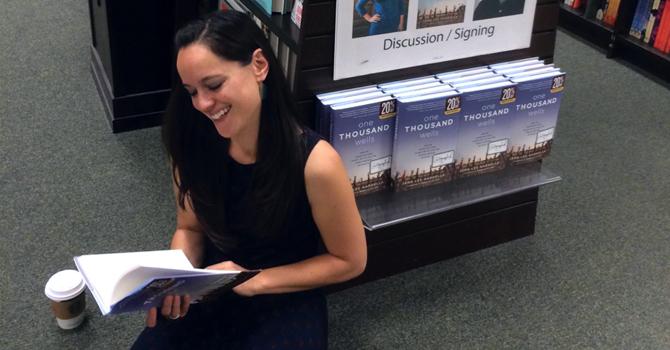
“Once you come to know the world — truly come to know the world and all its doubt and darkness — can you love it still?” That’s the question the co-founder of the nonprofit Blood:Water addresses in her new memoir. This article is reprinted from Duke Divinity School’s magazine Faith & Leadership, an offering of Leadership Education at Duke Divinity. Read more about Nardella in our recent posts from The Asbury Project.
When Jena Lee Nardella was a 21-year-old college junior, she persuaded members of the Christian band Jars of Clay to start Blood:Water Mission, a nonprofit focused on overcoming the HIV/AIDS and water crises in Africa.
 Since the founding of Blood:Water in 2004, Nardella has served as its executive director, and the organization has raised more than $27 million. From the beginning, Nardella hoped to connect concerned Americans — starting with Jars of Clay’s fan base — with African organizations working to bring clean water and HIV/AIDS support to 1 million people in 11 countries.
That tidy-sounding story is true, but it masks the stops and starts — and even heartbreak — along the way. In her new memoir, “One Thousand Wells,” Nardella recounts her journey from an idealistic college girl to the experienced Christian leader she is today. The following is an edited transcript.
Q: The subtitle of your book is “How an Audacious Goal Taught Me to Love the World Instead of Save It.” What does it mean to love the world instead of save it?
The surprise for me in writing this story was realizing that it really wasn’t about starting a nonprofit. It was so much more about this question that I’ve had to live out, which is this journey from an idealism — wanting to believe there’s something that each of us can contribute in changing and saving the world — to what happens when you come up against the real challenges of how hard it is to actually do such a thing.
When your idealism crumbles, what do you do with that, and how do you stay with it? Once you come to know the world — truly come to know the world and all its doubt and darkness — can you love it still?
I learned that the more sustainable, more responsible way to step into the world is to choose to love it, which is maybe even a little bit more heroic than trying to save it, a little bit harder to do.
Q: Talk about the idealism that fueled you in the beginning.
We were so motivated by the power of the stories that we had encountered in Africa, and so excited about being able to bring those stories back to the [Jars of Clay] fan base and really ignite response that would allow us to provide HIV and water support to these people that we met.
And it was working. It was so beautiful. It was an unlikely story of a rock band and a 22-year-old being able to actualize these ideas into something tangible.
I think the idealism is so important in the world. I’m looking back at it and realizing that a lot of the things we thought we were going to be able to achieve were not actually possible.
But it doesn’t mean that we shouldn’t step into the world or start doing this with idealism. If we ignore the idealism, then we strive for mediocrity. I think that there’s something beautiful about it, even though it’s not necessarily the most sustainable thing to hold on to the whole of your life.
Q: When did you first bump into reality on this journey?
It was when certain relationships that I had in Africa were more deceiving than I had thought — when I came up against my own naiveté and didn’t realize that some of our funds were being misused.
It was also this encounter with senseless deaths. Some of it was losing friends in Africa in the midst of the work. Issues even as basic or simple as clean water are a lot more complex in a place that has this history of extreme poverty and oppression. There’s so much complexity to it I didn’t see when we were dreaming of the Thousand Wells project.
Q: What happened to really cause your idealism to crumble?
As Americans, many of us assume that if something needs to be done, there’s a way to do it. I was pretty convinced that if I just worked hard enough or if we just gathered enough money or mobilized enough communities, certain things would work.
The laws of return on investment don’t apply in many places around the world, and so the idealism started to crumble when my own formula of how to make change happen in the world wasn’t working.
I struggled with understanding how to still believe in a good God when people were continuing to die.
We had the economic crisis in 2008, and all of a sudden the funding that was coming to Blood:Water just shrunk. It all felt like it was crumbling. That was really the key point for me.
I had to decide whether, even if the results that I’m seeking aren’t guaranteed or may never come, is it still worth fighting for? Even if my ideas of what Africa was about or who God is or who I am in the world aren’t what I thought they were when I started, is it still worth sticking with it?
I had a really amazing mentor who basically told me that hope is not passive wishing. It’s an active exercise. For me, the greatest maturing of my own story was choosing to stay with it even when the idealism faded, and to actually make a choice to love the world even as I came to know it differently than what I had originally signed up for.
Q: So you go into it with all this excitement and idealism, and then there’s a point where you write, “We felt like fools trying to put out a forest fire with a dribble of water.”
This community and Blood:Water worked so hard to build rainwater catchment tanks in northern Kenya only to be followed by a completely unexpected season of drought. Then I realized that you can do everything you possibly can but you can’t make the rain come.
And HIV was so much more complex than we thought and came to know. What came out of it was this need to be able to be realistic about what we were facing and what we were capable of doing.
Also, we had to adjust our definitions of success. There’s this concept of “proximate justice,” which is it’s better to have some justice somewhere than no justice anywhere. This is very hard for the idealist, for the 22-year-old idealist.
But there’s only a certain part of justice that I can help move the needle on. And there’s this one place, like Lwala, where all of a sudden we could celebrate small things happening, even if it’s not everything.
Even this year, in 2015, Lwala is a place where there’s a high HIV prevalence rate, but we’ve been able to celebrate the fact that of the 97 babies who have been born to HIV-positive mothers, all 97 have been born negative. So we’ve stopped the transmission of HIV from one generation to another, at least in this one particular place.
I think that’s remarkable. And that’s something that reminds me it’s worth fighting for, even if it’s in one small space in western Kenya. It’s 97 more babies whose stories are different.
Read on for more about how Nardella was betrayed by a friend and how she recovered.
Next Post

November 19, 2015 When I'm 85: A Journey With Dr. John Perkins
Browse Our Archives
Select a Category Art Audio posts Bible and Work Book Review Books Budgeting Calling Common Good Community Development Conferences Discipleship Economics Entrepreneurship Ethics Faith and Family Faith and the Marketplace Faith and the Workplace faith and work History of Work and Vocation Leadership Local Church Meaning New Blogger News Prayer Relationships Seminaries Theology of Work Uncategorized Video posts Vocation Worship Resources
Select a Month April 2026 October 2025 September 2025 July 2025 April 2025 January 2025 October 2024 September 2024 August 2024 May 2024 March 2024 February 2024 December 2023 November 2023 August 2023 July 2023 April 2023 January 2023 December 2022 November 2022 September 2022 August 2022 July 2022 May 2022 April 2022 February 2022 January 2022 December 2021 November 2021 October 2021 September 2021 August 2021 June 2021 May 2021 March 2021 February 2021 January 2021 December 2020 November 2020 September 2020 August 2020 July 2020 June 2020 May 2020 April 2020 March 2020 January 2020 December 2019 October 2019 September 2019 August 2019 July 2019 June 2019 May 2019 April 2019 March 2019 February 2019 January 2019 April 2018 March 2018 January 2018 December 2017 November 2017 October 2017 September 2017 August 2017 July 2017 June 2017 May 2017 April 2017 March 2017 February 2017 January 2017 December 2016 November 2016 October 2016 September 2016 August 2016 July 2016 June 2016 May 2016 April 2016 March 2016 February 2016 January 2016 December 2015 November 2015 October 2015 September 2015 August 2015 July 2015 June 2015 May 2015 April 2015 March 2015 February 2015 January 2015 December 2014 November 2014 October 2014 September 2014 August 2014 July 2014 June 2014 May 2014 April 2014 March 2014 February 2014 January 2014 December 2013
Follow Us!
TAKE THE
Religious Wisdom Quiz
How many children did Job lose in the disasters at the beginning of the book?
Select your answer to see how you score.
Ten Five Twelve Seven
Related posts from MISSION:WORK

Three Conversations (in honor of Eastertide)



Not Nearly So Much Like a Mall
TRENDING AT PATHEOS Careers, Workplace and Religion

Methodist Central Hall and Westminster Abbey
Situated on the same square is Methodist Central Hall and Westminster Abbey. ...

57th Dove Awards Honor Dolly Parton, Crown New...
On gospel music’s biggest night, the 57th annual GMA Dove Awards honored...

The First Eucharistic Controversy: Christ’s Real Presence
For Catholics, the Eucharist is the source and summit of the Christian...

What a Stop Sign Can Teach Us About...
How to Make a Decision When You Can't Hear God Main point:...

Archdiocese Hosts Military Marriage Retreat in Germany
RASTATT, Germany — The transient military lifestyle, with its frequent deployments and...

Nearly every morning, I make the drive to Detroit with my high-school-age...
view all Careers, Workplace and Religion blogs
Ad-Free & Subscriber Log-In Subscription Support
- About Us
- 2026 Calendar
- Videos
- Podcasts
- Library of World Religions
- Faith In Media Tracker
- Advertise With Us
- Write for Us
- Privacy Policy
- Terms of Service
- Do Not Sell My Data
- Contact Us
- Radiant Digital
- Manage Newsletter Subscriptions
- Unsubscribe From Notifications
- Sitemap
Copyright 2008-2026, Patheos. All rights reserved.
Subscription Support Ad-Free & Subscriber Log-In
Follow Patheos