
BuddhistCatholicContemplativeEvangelicalGeneral ChristianHinduJewishLatter-day SaintMuslimNew VisionsProgressive Christian
Beliefs
- Buddhist
- Catholic
- Contemplative
- Evangelical
- General Christian
- Hindu
- Jewish
- Latter-day Saint
- More Voices
- Muslim
- New Visions
- Pagan
- Progressive Christian
Topics
- Religion News
- Food and Religion
- Sports and Religion
- Religious Art
- Religious Music and Entertainment
- Religious Events
- History and Religion
- Style and Religion
- Politics and Religion
- Women in Religion
- Recreation Outdoors and Religion
- Business Finance and Religion
- Careers Workplace and Religion
- Education and Religion
- Family Parenting and Religion
- Health Fitness and Religion
- Home and Religion
- Relationships and Religion
- Technology and Religion
- Travel and Religion
Columnists
- Buddhist Columnists
- Business Finance and Religion Columnists
- Careers Workplace and Religion Columnists
- Catholic Columnists
- Contemplative Columnists
- Education and Religion Columnists
- Evangelists Columnists
- Family Parenting and Religion Columnists
- General Christian Columnists
- Health Fitness and Religion Columnists
- Hindu Columnists
- History and Religion Columnists
- Home and Religion Columnists
- Jewish Columnists
- More Voices Columnists
- Latter Day Columnists
- Muslim Columnists
- New Visions Columnists
- Nonreligious Columnists
- Pagan Columnists
- Politics and Religion Columnists
- Progressive Columnists
- Recreation Outdoors and Religion Columnists
- Relationships and Religion Columnists
- Religion News Columnists
- Religious Art Columnists
- Religious Events Columnists
- Religious Music and Entertainment Columnists
- Sports and Religion Columnists
- Style and Religion Columnists
- Technology and Religion Columnists
- Travel and Religion Columnists
- Women in Religion Columnists
Resource Library
- 2026 Calendar
- Library of World Religions
- The 100 Most Holy Places on Earth
- Patheos Answers
- Podcasts
- Videos
- Faith Leaders Database
- Anglican Episcopalian
- Bahai
- Baptist
- Buddhism
- Christianity
- Confucianism
- Eastern Orthodoxy
- Hinduism
- Holiness and Pentecostal
- ISKCON
- Islam
- Judaism
- Lutheran
- Methodist
- The Church of Jesus Christ of Latter-day Saints
- New Age
- Paganism
- Presbytarian and Reformed
- Protestantism
- Religion Behind the Scenes
- Roman Catholic
- Scientology
- Shia Islam
- Sikhism
- Sufism
- Sunni Islam
- Taoism
- Zen
- See all religions
Research Tools
 Ad-Free & Subscriber Log-In Subscription Support
Ad-Free & Subscriber Log-In Subscription Support
Follow Patheos 

- Trending:
- Forgiveness
- |
- Marriage
- |
- Consciousness
- |
- Death Penalty
- |
- Election
- |
- Halloween

- Home
- Careers, Workplace and Religion
- What would Francis Asbury have done when faced with the #PewReport ?
What would Francis Asbury have done when faced with the #PewReport ?
Last updated on: July 12, 2015 at 3:24 pm by Jennifer Woodruff Tait
What would Francis Asbury have done when faced with the #PewReport ? 2015-07-10T15:32:01-05:00 Jennifer Woodruff Tait
Patheos Explore the world's faith through different perspectives on religion and spirituality! Patheos has the views of the prevalent religions and spiritualities of the world.
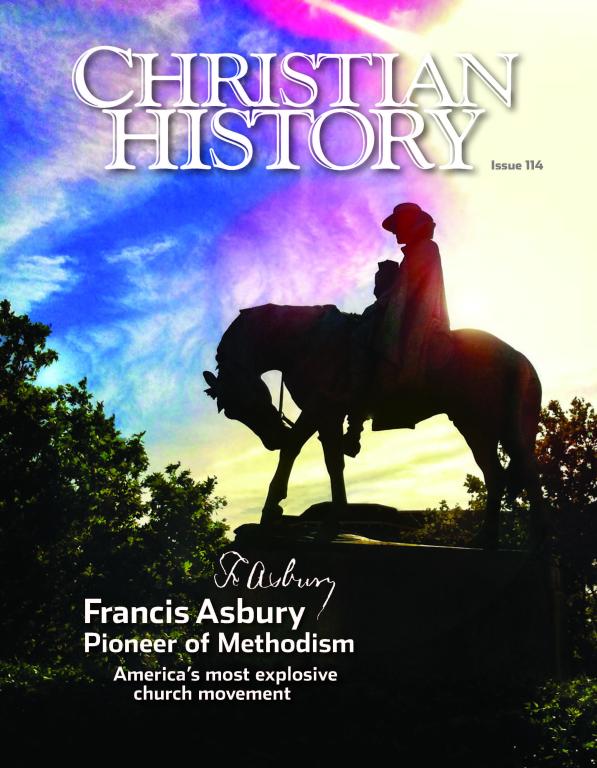 Thanks to Christian History Institute for letting me reprint this.
If you get CHI’s daily emails about this day in Christian history, you won’t have missed the fact that the June 4 quote is from a very popular person around here lately—Francis Asbury. In it, he bemoans the state of religion in New England, at least as he saw it, on his first visit there on June 4, 1791: “We are now in Connecticut; and never out of sight of a house; and sometimes we have a view of many churches and steeples, built very neatly of wood; either for use, ornament, piety, policy or interest—or it may be some of all these. I do feel as if there had been religion in this country once; and I apprehend there is a little in form and theory left.”
Asbury’s view of religion had not nearly as much use for steeples as it had for an intense experience of piety and power: “Could these people be brought to constant, fervent prayer,” he added, “the Lord would come down and work wonders among them.” As he rode through the American landscape (he probably rode in his lifetime over 130,000 miles and preached once every three days) his preaching, and the disciplined organization of Methodist laypeople he left in his wake, transformed the fabric of the new nation.
Despite our stereotype of early America as a faith-full society, it was in fact in many ways and places not so much. Religious ties from the “old country” had broken. Many people lived in isolated places where the law had not yet reached but crime and lawlessness had. Popular recreations included some of a, shall we say, very irreligious kind. Asbury and his followers changed all that. And they changed American religion, too. Emotional worship? Personal devotion? Expectation of dramatic encounters with God? A sense of fellowship that approached dwelling on the borders of heaven? Early Methodists had all of that and more. Sometimes they built churches with steeples too, like this one and this one. But their focus was on the prayer as much as the steeples.
I thought about Asbury recently while reading an article by a blogger called Ed Parker, called “Everybody Panic! Why We are All Wrong About Church Decline.” It focuses on the American church’s reaction to the recent Pew Report showing that religious attendance and commitment in the U.S. is declining. Everyone has been trying to explain this decline in somewhat of a hand-wringing, Chicken-Little-sky-is-falling mode. Parker makes three helpful suggestions: the huge bump in church attendance that we saw in the 1950s was an anomaly; it is cultural Christianity as an accepted religion and not Christianity itself that is declining; and we need to remember the church has been through a few hard knocks before. And then he says this:
We are actually demanding a church that is dependent on empire, that is served by kingdoms and governments. We want a church that needs to have all other activities banned during its worship. We long for a church that needs its prayers taught in schools and that seeks power by influencing political leaders…..As if the church lives and dies by us. Christ’s church has been around for 2000 years. It began by spending 300 years on the margins of a religiously plural world. It was subsumed into being the bureaucracy of the Roman Empire. It has been nearly blown by up schism. Almost over-run by the empires of other faiths. It has crusaded and begun terrible holy wars. It has been cracked and splintered by reformation. It has been challenged to its core by renaissance and scientific revolution. The church has survived all of that, against all odds. But now our social angst and apathy, and our institutional intractability is going to finally put the church out of its misery? Because we cannot be the church of empire or let social structures do our evangelism for us, the church will just fade away?
A declining church does not equal a declining God….So maybe, just maybe, this declining stuff… this dying stuff that the church is doing… is just what always comes right before empty tombs and being known in breaking bread.
Our situation is not all that different from the one confronting Asbury. And when faced with it, Asbury didn’t succumb to hand-wringing. (As one of my friends said when I shared Parker’s column on Facebook, “All the hand-wringing in the world won’t accomplish what ten minutes of prayer will do.”) Instead, he prayed, and then he got on his horse. He went out to seek and to save, to preach and to organize, and to tell people that they could know the risen Christ in the empty tomb and in the breaking of bread.
Read more about Asbury and his followers in Christian History #114.
Previous Post

July 10, 2015
Groups help us go fast; teams help us go far
Next Post
July 14, 2015 The pursuit of wealth is not neutral
Browse Our Archives
Select a Category Art Audio posts Bible and Work Book Review Books Budgeting Calling Common Good Community Development Conferences Discipleship Economics Entrepreneurship Ethics Faith and Family Faith and the Marketplace Faith and the Workplace faith and work History of Work and Vocation Leadership Local Church Meaning New Blogger News Prayer Relationships Seminaries Theology of Work Uncategorized Video posts Vocation Worship Resources
Select a Month April 2026 October 2025 September 2025 July 2025 April 2025 January 2025 October 2024 September 2024 August 2024 May 2024 March 2024 February 2024 December 2023 November 2023 August 2023 July 2023 April 2023 January 2023 December 2022 November 2022 September 2022 August 2022 July 2022 May 2022 April 2022 February 2022 January 2022 December 2021 November 2021 October 2021 September 2021 August 2021 June 2021 May 2021 March 2021 February 2021 January 2021 December 2020 November 2020 September 2020 August 2020 July 2020 June 2020 May 2020 April 2020 March 2020 January 2020 December 2019 October 2019 September 2019 August 2019 July 2019 June 2019 May 2019 April 2019 March 2019 February 2019 January 2019 April 2018 March 2018 January 2018 December 2017 November 2017 October 2017 September 2017 August 2017 July 2017 June 2017 May 2017 April 2017 March 2017 February 2017 January 2017 December 2016 November 2016 October 2016 September 2016 August 2016 July 2016 June 2016 May 2016 April 2016 March 2016 February 2016 January 2016 December 2015 November 2015 October 2015 September 2015 August 2015 July 2015 June 2015 May 2015 April 2015 March 2015 February 2015 January 2015 December 2014 November 2014 October 2014 September 2014 August 2014 July 2014 June 2014 May 2014 April 2014 March 2014 February 2014 January 2014 December 2013
Follow Us!
TAKE THE
Religious Wisdom Quiz
Who was stoned to death for preaching about Jesus?
Select your answer to see how you score.
Stephen James Paul Peter
Related posts from MISSION:WORK

Three Conversations (in honor of Eastertide)

Why Beth Felker Jones is Protestant

Not Nearly So Much Like a Mall

Ten Things I'm Glad I Saw On Rings...
TRENDING AT PATHEOS Careers, Workplace and Religion

The Problem with False Prophets
Miller’s Station UMC| 10/18/26| Anchor Verse: Jeremiah 23: 1, 9-23 I...

Emotion in Early Christianity by Andrew Crislip
Andrew Crislip’s Emotion in Early Christianity examines an often overlooked dimension of...

16 Spiritual Touchstones for a More Grounded Life
After decades of spiritual study, here are 16 principles I try...

Catholic Evangelization: Sharing Your Faith Every Day
Welcome back to the Graceful Awakening mini-series called, “From Faith to Mission.” ...

The Pillar of the Boatmen: the Ancient Monument...
The Pillar of the Boatmen is a Romano-Gaulish sculpture that dates from...

In one sense walking into Westminster Abbey is like walking down the...
view all Careers, Workplace and Religion blogs
Ad-Free & Subscriber Log-In Subscription Support
- About Us
- 2026 Calendar
- Videos
- Podcasts
- Library of World Religions
- Faith In Media Tracker
- Advertise With Us
- Write for Us
- Privacy Policy
- Terms of Service
- Do Not Sell My Data
- Contact Us
- Radiant Digital
- Manage Newsletter Subscriptions
- Unsubscribe From Notifications
- Sitemap
Copyright 2008-2026, Patheos. All rights reserved.
Subscription Support Ad-Free & Subscriber Log-In
Follow Patheos