
BuddhistCatholicContemplativeEvangelicalGeneral ChristianHinduJewishLatter-day SaintMuslimNew VisionsProgressive Christian
Beliefs
- Buddhist
- Catholic
- Contemplative
- Evangelical
- General Christian
- Hindu
- Jewish
- Latter-day Saint
- More Voices
- Muslim
- New Visions
- Pagan
- Progressive Christian
Topics
- Religion News
- Food and Religion
- Sports and Religion
- Religious Art
- Religious Music and Entertainment
- Religious Events
- History and Religion
- Style and Religion
- Politics and Religion
- Women in Religion
- Recreation Outdoors and Religion
- Business Finance and Religion
- Careers Workplace and Religion
- Education and Religion
- Family Parenting and Religion
- Health Fitness and Religion
- Home and Religion
- Relationships and Religion
- Technology and Religion
- Travel and Religion
Columnists
- Buddhist Columnists
- Business Finance and Religion Columnists
- Careers Workplace and Religion Columnists
- Catholic Columnists
- Contemplative Columnists
- Education and Religion Columnists
- Evangelists Columnists
- Family Parenting and Religion Columnists
- General Christian Columnists
- Health Fitness and Religion Columnists
- Hindu Columnists
- History and Religion Columnists
- Home and Religion Columnists
- Jewish Columnists
- More Voices Columnists
- Latter Day Columnists
- Muslim Columnists
- New Visions Columnists
- Nonreligious Columnists
- Pagan Columnists
- Politics and Religion Columnists
- Progressive Columnists
- Recreation Outdoors and Religion Columnists
- Relationships and Religion Columnists
- Religion News Columnists
- Religious Art Columnists
- Religious Events Columnists
- Religious Music and Entertainment Columnists
- Sports and Religion Columnists
- Style and Religion Columnists
- Technology and Religion Columnists
- Travel and Religion Columnists
- Women in Religion Columnists
Resource Library
- 2026 Calendar
- Library of World Religions
- The 100 Most Holy Places on Earth
- Patheos Answers
- Podcasts
- Videos
- Faith Leaders Database
- Anglican Episcopalian
- Bahai
- Baptist
- Buddhism
- Christianity
- Confucianism
- Eastern Orthodoxy
- Hinduism
- Holiness and Pentecostal
- ISKCON
- Islam
- Judaism
- Lutheran
- Methodist
- The Church of Jesus Christ of Latter-day Saints
- New Age
- Paganism
- Presbytarian and Reformed
- Protestantism
- Religion Behind the Scenes
- Roman Catholic
- Scientology
- Shia Islam
- Sikhism
- Sufism
- Sunni Islam
- Taoism
- Zen
- See all religions
Research Tools
 Ad-Free & Subscriber Log-In Subscription Support
Ad-Free & Subscriber Log-In Subscription Support
Follow Patheos 

- Trending:
- Forgiveness
- |
- Marriage
- |
- Consciousness
- |
- Death Penalty
- |
- Election
- |
- Halloween

- Home
- Careers, Workplace and Religion
- Death and resurrection of an urban church
Death and resurrection of an urban church
Last updated on: June 4, 2015 at 12:06 pm by Guest Contributor
Death and resurrection of an urban church 2015-05-21T12:19:34-05:00 Guest Contributor
Patheos Explore the world's faith through different perspectives on religion and spirituality! Patheos has the views of the prevalent religions and spiritualities of the world.

The Rev. Mike Mather walks with the youth at Broadway United Methodist Church in Indianapolis. The church has closed many of its traditional helping ministries and created new ways to connect and support the community surrounding it. Photos by Kelly Wilkinson
This post comes to us from Duke Divinity School’s magazine Faith & Leadership, an offering of Leadership Education at Duke Divinity.
Broadway United Methodist Church in Indianapolis has redefined what it means to serve its urban community. The approach is simple: See your neighbors as children of God.
For an idea of how Broadway United Methodist Church is turning the model of the urban church inside out, look for a moment at its food pantry, clothing ministry and after-school program.
They’ve been killed off.
In many cases, they were buried with honors. But those ministries, staples of the urban church, are all gone from Broadway. Kaput.
Broadway’s summer youth program, which at one point served 250 children a day — bringing them in for Girl Scouts and basketball, away from the violence and drugs of Broadway’s neighborhood — is gone, too. Broadway let the air out of the basketballs. Sent the Girl Scouts packing.
Then peek into the comfortably cluttered office of the Rev. Mike Mather, who is prone to putting his feet on his desk and leaning so far back in his swivel chair that you expect him to go flying at any moment.
 Watch him, inverted like this, until he suddenly gets animated, drops his feet to the floor, leans over, elbows on knees, and shares this: “One of the things we literally say around here is, ‘Stop helping people.’
“I’m serious.”
He is serious. Mather has given years of thought to this, and he’s as sure about it as anything he learned in seminary.
Broadway UMC’s leaders have changed the way they view their neighbors — as people with gifts, not just needs. In what ways does this view reframe the conversation? What difference does reframing the relationship make in the outcomes achieved?
“The church, and me in particular,” Mather said, “has done a lot of work where we have treated the people around us as if, at worst, they are a different species and, at best, as if they are people to be pitied and helped by us.”
With that in mind, Broadway (link is external) has — for more than a decade now — been reorienting itself. Rather than a bestower of blessings, the church is aiming to be something more humble.
 “The church decided its call was to be good neighbors. And that we should listen and see people as children of God,” said De’Amon Harges, a church member who sees Broadway’s transformation in terms not unlike Christ’s death, burial and resurrection.
Rejecting charity
In 2004, Mather hired Harges to be Broadway’s first “roving listener,” a position that is exactly what it sounds like. Harges’ job was to rove the neighborhood, block by block at first, spending time with the neighbors, not to gauge their needs but to understand what talents lay there.
“I was curious about what was good in people, and that was what I was going to find out,” he said.
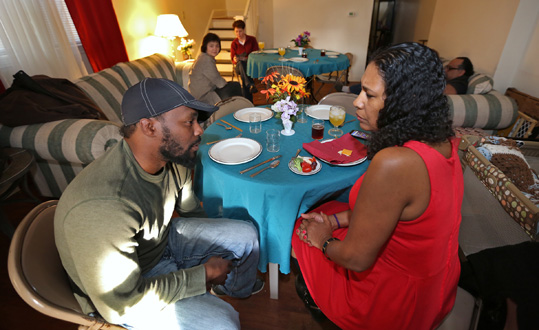
De’Amon Harges, Broadway’s “roving listener,” listens to Sheila Arnold as she talks about helping youth with her organization, Cornerstone City Mission. They have gathered with others to share a meal and discuss entrepreneurship. These meals are one way that Broadway members and people living in the neighborhood around the church connect and work together.
Harges wound up spending hours sitting on people’s porches and hovering near them as they worked in their backyard gardens. He began listening for hints about their gifts.
“I started paying attention” he said, “to what they really cared about.”
Mather, meanwhile, was drawing deeply from the philosophical well of “asset-based community development” — the notion of capitalizing on what’s good and working in a place rather than merely addressing its deficiencies.

Sarah Killingsworth, left, hosted the meal and discussion about entrepreneurship.
John McKnight, a professor emeritus at Northwestern University, is one of the founders of the approach. He literally wrote the book on building communities from the inside out. He describes Mather and Harges as a “God-given team.”
When Broadway invited him to come speak, McKnight spent some time walking the church’s neighborhood with Harges.
“What he’s listening for is their gifts — ‘What has God given you?’” McKnight said. He doesn’t advocate ignoring people’s needs and problems, but rather to look first for solutions within the community itself. Later, he said, institutions and services can help.
“John 15:15 tells us that, at the Last Supper, Jesus said to the disciples, ‘I no longer call you servants. … I call you friends.’ So the final way of defining what Christianity is based on is friendship, not service. … I think Mike and De’Amon are guided by that spiritual principle.”
A key to what’s going on now at Broadway, McKnight says, is the church’s brutally honest view of charity, which McKnight defines as “a one-way compensatory activity that never changes anything.”
Seeing and serving needs
Like so many older, urban churches, Broadway came to its charitable ways honestly, and with the best of intentions.
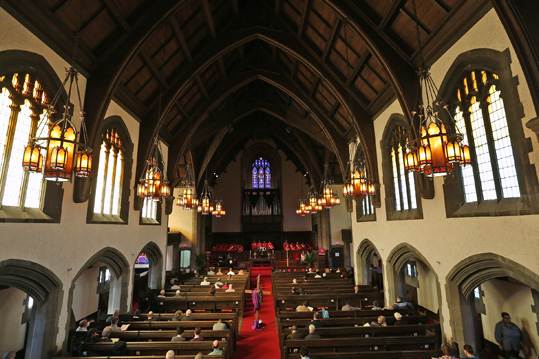
Broadway was once a thriving church. It experienced steep decline but now has about 200 in worship.
When the current building was erected, in 1927, the church along the banks of Fall Creek was on the northern outskirts of Indianapolis. It was then a flourishing area primed for growth. Within a decade, Broadway had 2,300 members. The pews were packed. The Sunday school rooms were buzzing.
But by the late 1950s, Indianapolis began to experience white flight to newer suburbs. The neighborhood began a long, slow decline. And so did the church.
By the mid-1990s, weekly attendance was down to 75. The pews were empty. The Sunday school was dark.
Amid the surrounding decay, the church assumed a new role: caregiver.
Broadway, Mather says now, came to see its neighborhood for all of its problems — poverty and abandoned houses, drugs and the related violence, high teen pregnancy and dropout rates.
Mather confesses to being part of that history. He has been pastor of Broadway twice, and during his first stint, from 1986 to 1991, he retooled the church’s summer youth program — the one with the basketballs and the Girl Scouts — and injected it with a new spiritual theme each week. And it took off.
“We felt so good about it,” Mather said, “that I broke my arm patting myself on the back.”
But then Mather was confronted with a heavy dose of reality. In a nine-month span, nine young men within a four-block radius of the church died violent deaths. Some of them had come through that great youth program at Broadway, a program that had done nothing to inoculate them against street violence.
Mather was left to bury them — along with the sense that what Broadway had been doing for its neighborhood all those years had not been effective.
Asking new questions
Mather carried that sense with him to another United Methodist church in South Bend, Indiana, where he was assigned in 1992.
Again, he was a pastor in an urban setting. But this time Mather began to probe more deeply into McKnight’s philosophies, into what it meant to be an urban preacher. Finally, he asked himself whether he was living out what he believed, and what he had been preaching.
One Pentecost Sunday, Mather preached about Peter’s sermon in Acts 2 regarding the prophecy of Joel:
“And in the last days it will be,” God says, “that I will pour out my Spirit on all people, and your sons and your daughters will prophesy, and your young men will see visions, and your old men will dream dreams. Even on my servants, both men and women, I will pour out my Spirit in those days, and they will prophesy.” (Acts 2:17-18 NET)
At a congregational meal after the service, a parishioner asked Mather pointedly, “So how come we don’t treat people like that?”
Mather didn’t understand. Then the woman explained that she was talking about the government food giveaway hosted by the church. To get food, participants had to fill out a form that basically asked, “How poor are you?”
Nowhere on the form were there questions about people’s gifts.
“If we believe that God’s spirit is flowing down on all people, old and young, women and men — and on the poor,” the woman continued, “why don’t we treat people like that’s true?”
asset-based community development
Broadway United Methodist Church
Previous Post

June 2, 2015
[VIDEO] Work is sacred
Next Post
June 6, 2015 How to Pray for Specific Vocations
Browse Our Archives
Select a Category Art Audio posts Bible and Work Book Review Books Budgeting Calling Common Good Community Development Conferences Discipleship Economics Entrepreneurship Ethics Faith and Family Faith and the Marketplace Faith and the Workplace faith and work History of Work and Vocation Leadership Local Church Meaning New Blogger News Prayer Relationships Seminaries Theology of Work Uncategorized Video posts Vocation Worship Resources
Select a Month April 2026 October 2025 September 2025 July 2025 April 2025 January 2025 October 2024 September 2024 August 2024 May 2024 March 2024 February 2024 December 2023 November 2023 August 2023 July 2023 April 2023 January 2023 December 2022 November 2022 September 2022 August 2022 July 2022 May 2022 April 2022 February 2022 January 2022 December 2021 November 2021 October 2021 September 2021 August 2021 June 2021 May 2021 March 2021 February 2021 January 2021 December 2020 November 2020 September 2020 August 2020 July 2020 June 2020 May 2020 April 2020 March 2020 January 2020 December 2019 October 2019 September 2019 August 2019 July 2019 June 2019 May 2019 April 2019 March 2019 February 2019 January 2019 April 2018 March 2018 January 2018 December 2017 November 2017 October 2017 September 2017 August 2017 July 2017 June 2017 May 2017 April 2017 March 2017 February 2017 January 2017 December 2016 November 2016 October 2016 September 2016 August 2016 July 2016 June 2016 May 2016 April 2016 March 2016 February 2016 January 2016 December 2015 November 2015 October 2015 September 2015 August 2015 July 2015 June 2015 May 2015 April 2015 March 2015 February 2015 January 2015 December 2014 November 2014 October 2014 September 2014 August 2014 July 2014 June 2014 May 2014 April 2014 March 2014 February 2014 January 2014 December 2013
Follow Us!
TAKE THE
Religious Wisdom Quiz
Who was stoned to death for preaching about Jesus?
Select your answer to see how you score.
Stephen James Paul Peter
Related posts from MISSION:WORK

Why Beth Felker Jones is Protestant


How to Succeed as an Influencer Without Really...

TRENDING AT PATHEOS Careers, Workplace and Religion

The Problem with False Prophets
Miller’s Station UMC| 10/18/26| Anchor Verse: Jeremiah 23: 1, 9-23 I...

Emotion in Early Christianity by Andrew Crislip
Andrew Crislip’s Emotion in Early Christianity examines an often overlooked dimension of...

16 Spiritual Touchstones for a More Grounded Life
After decades of spiritual study, here are 16 principles I try...

Catholic Evangelization: Sharing Your Faith Every Day
Welcome back to the Graceful Awakening mini-series called, “From Faith to Mission.” ...

The Pillar of the Boatmen: the Ancient Monument...
The Pillar of the Boatmen is a Romano-Gaulish sculpture that dates from...

In one sense walking into Westminster Abbey is like walking down the...
view all Careers, Workplace and Religion blogs
Ad-Free & Subscriber Log-In Subscription Support
- About Us
- 2026 Calendar
- Videos
- Podcasts
- Library of World Religions
- Faith In Media Tracker
- Advertise With Us
- Write for Us
- Privacy Policy
- Terms of Service
- Do Not Sell My Data
- Contact Us
- Radiant Digital
- Manage Newsletter Subscriptions
- Unsubscribe From Notifications
- Sitemap
Copyright 2008-2026, Patheos. All rights reserved.
Subscription Support Ad-Free & Subscriber Log-In
Follow Patheos