
BuddhistCatholicContemplativeEvangelicalGeneral ChristianHinduJewishLatter-day SaintMuslimNew VisionsProgressive Christian
Beliefs
- Buddhist
- Catholic
- Contemplative
- Evangelical
- General Christian
- Hindu
- Jewish
- Latter-day Saint
- More Voices
- Muslim
- New Visions
- Pagan
- Progressive Christian
Topics
- Religion News
- Food and Religion
- Sports and Religion
- Religious Art
- Religious Music and Entertainment
- Religious Events
- History and Religion
- Style and Religion
- Politics and Religion
- Women in Religion
- Recreation Outdoors and Religion
- Business Finance and Religion
- Careers Workplace and Religion
- Education and Religion
- Family Parenting and Religion
- Health Fitness and Religion
- Home and Religion
- Relationships and Religion
- Technology and Religion
- Travel and Religion
Columnists
- Buddhist Columnists
- Business Finance and Religion Columnists
- Careers Workplace and Religion Columnists
- Catholic Columnists
- Contemplative Columnists
- Education and Religion Columnists
- Evangelists Columnists
- Family Parenting and Religion Columnists
- General Christian Columnists
- Health Fitness and Religion Columnists
- Hindu Columnists
- History and Religion Columnists
- Home and Religion Columnists
- Jewish Columnists
- More Voices Columnists
- Latter Day Columnists
- Muslim Columnists
- New Visions Columnists
- Nonreligious Columnists
- Pagan Columnists
- Politics and Religion Columnists
- Progressive Columnists
- Recreation Outdoors and Religion Columnists
- Relationships and Religion Columnists
- Religion News Columnists
- Religious Art Columnists
- Religious Events Columnists
- Religious Music and Entertainment Columnists
- Sports and Religion Columnists
- Style and Religion Columnists
- Technology and Religion Columnists
- Travel and Religion Columnists
- Women in Religion Columnists
Resource Library
- 2026 Calendar
- Library of World Religions
- The 100 Most Holy Places on Earth
- Patheos Answers
- Podcasts
- Videos
- Faith Leaders Database
- Anglican Episcopalian
- Bahai
- Baptist
- Buddhism
- Christianity
- Confucianism
- Eastern Orthodoxy
- Hinduism
- Holiness and Pentecostal
- ISKCON
- Islam
- Judaism
- Lutheran
- Methodist
- The Church of Jesus Christ of Latter-day Saints
- New Age
- Paganism
- Presbytarian and Reformed
- Protestantism
- Religion Behind the Scenes
- Roman Catholic
- Scientology
- Shia Islam
- Sikhism
- Sufism
- Sunni Islam
- Taoism
- Zen
- See all religions
Research Tools
 Ad-Free & Subscriber Log-In Subscription Support
Ad-Free & Subscriber Log-In Subscription Support
Follow Patheos 

- Trending:
- Forgiveness
- |
- Marriage
- |
- Consciousness
- |
- Death Penalty
- |
- Election
- |
- Halloween

- Home
- Careers, Workplace and Religion
- God is abundantly everywhere: #3 in a series
God is abundantly everywhere: #3 in a series
Last updated on: March 23, 2015 at 10:06 am by Guest Contributor
God is abundantly everywhere: #3 in a series 2015-03-23T10:06:29-05:00 Guest Contributor
Patheos Explore the world's faith through different perspectives on religion and spirituality! Patheos has the views of the prevalent religions and spiritualities of the world.
Third in a series of posts on Luther, Lutherans, and calling by Lutheran pastor Adam Roe with responses over at Cranach by Gene Veith. Read Gene’s response to this post here and see the whole series at the bottom of this post. They’ll appear from time to time in this space for the next couple of weeks. Enjoy!
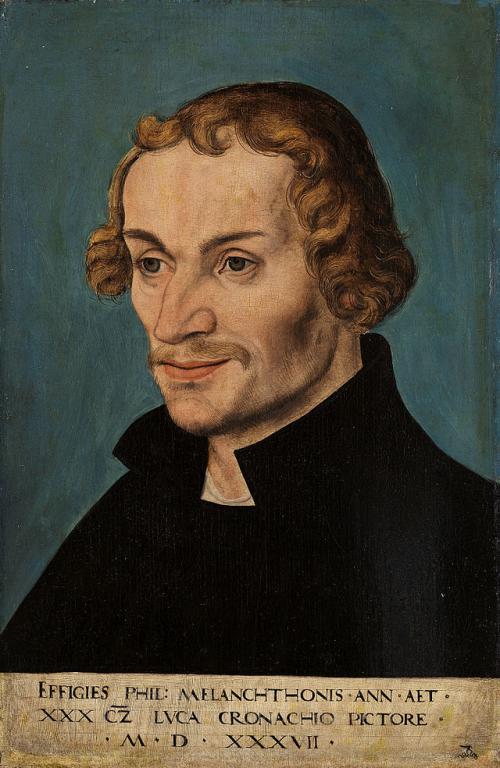
Philip Melanchthon as painted by famous Reformation artist Lucas Cranach. Image: Wikipedia.

One cannot help but note that the famous Lutheran Augsburg Confession, and its subsequent defense, were written by a layperson. Philip Melanchthon, both loved and held at arm’s length in Lutheran circles, never preached a day in his life, but his role in early Lutheranism was invaluable. For Luther, the problem of the Reformation was not that the Roman Church taught that priests receive a distinctive call within the Body of Christ. Most certainly for Lutherans, the call to the pastorate or priesthood is a distinct function within the church. The Lutheran Confessions state as much when we read, “That we may obtain this faith, the Ministry of Teaching the Gospel and administering the Sacraments was instituted. For through the Word and Sacraments, as through instruments, the Holy Ghost is given, who works faith…”
People within the Body of Christ are graced with differing gifts and talents (1 Corinthians 12). One of the gifts that God gives to people is the ability to lead worship, and he also gives the gift of ordering church life. Lutherans understand that not all people are called to Word and Sacrament ministry, but that does not mean that others within the Body of Christ are of a lesser estate! Indeed, it can be argued that Melanchthon’s theological contributions were greater than that of most of the Lutheran pastors/priests of his time. His role was not more important than that of the parish pastor, but his role was most certainly as important. Luther’s willingness to allow a layperson that sort of authority speaks volumes about the ethos of the Lutheran Reformation. Melanchthon was not trained in a monastery. His early education was received in secular institutions (not unlike Luther), and he became interested in Biblical theology after accepting a Greek teaching position at the University of Wittenberg. There he met Luther, and the rest is history.
Perhaps due to his practical work with laypersons like Melancthon, some of Luther’s finest work resulted from a strong reaction to the view that religious vocations are the only vocations. Luther and some of the other reformers recognized that God’s work within the laity was just as much a vocational ministry as Word and Sacrament ministry. There is no secular realm for the Christian in Luther’s theology of vocation. Gene Edward Veith points out, “When we pray the Lord’s Prayer, observed Luther, we ask God to give us this day our daily bread. And He does give us our daily bread. He does it by means of the farmer who planted and harvested the grain, the baker who made the flour into bread, the person who prepared our meal.” For Luther, God is everywhere.
In this way, the Lutheran view medieval classifications of vocation as failing to see God as abundantly gracious in all of life. God not only blesses us through Word and Sacrament, but also through healers, bakers, bankers, and farmers, just to name a few. One can see how this perspective flips not only the church’s understanding of the priesthood of all believers, but also the view of God’s work in the world around us. The Lutheran vocational view is one in which God is already making Himself abundantly available to us! All we need is to see how God is both blessing us, and using us, in the vocations to which we have been called. In this way, there is spiritual importance in the housewife who feeds her children, because God has ordained the vocation of parent. The question is not whether God ordains us all equally to a ministry, but whether we see God at work in the ministries/vocations to which we have been called.
What is true in everyday life is also true in church-life. Paul reminds us, “And God has appointed in the church first apostles, second prophets, third teachers, then miracles, then gifts of healing, helping, administrating, and various kinds of tongues.” (I Cor 12:28). The Lutheran observation is that in such passages, Word and Sacrament ministry is not  ordained as a higher calling. It is an important calling, but it is just one ministry among others.
Adam Roe is the pastor of New Life Lutheran Church in Sterling, IL.
Previous posts in this series:
Previous Post

March 17, 2015
From the archives: [VIDEO] How is failure part of life?
Next Post
March 22, 2015 Making homes for the arts in sacred places
Browse Our Archives
Select a Category Art Audio posts Bible and Work Book Review Books Budgeting Calling Common Good Community Development Conferences Discipleship Economics Entrepreneurship Ethics Faith and Family Faith and the Marketplace Faith and the Workplace faith and work History of Work and Vocation Leadership Local Church Meaning New Blogger News Prayer Relationships Seminaries Theology of Work Uncategorized Video posts Vocation Worship Resources
Select a Month April 2026 October 2025 September 2025 July 2025 April 2025 January 2025 October 2024 September 2024 August 2024 May 2024 March 2024 February 2024 December 2023 November 2023 August 2023 July 2023 April 2023 January 2023 December 2022 November 2022 September 2022 August 2022 July 2022 May 2022 April 2022 February 2022 January 2022 December 2021 November 2021 October 2021 September 2021 August 2021 June 2021 May 2021 March 2021 February 2021 January 2021 December 2020 November 2020 September 2020 August 2020 July 2020 June 2020 May 2020 April 2020 March 2020 January 2020 December 2019 October 2019 September 2019 August 2019 July 2019 June 2019 May 2019 April 2019 March 2019 February 2019 January 2019 April 2018 March 2018 January 2018 December 2017 November 2017 October 2017 September 2017 August 2017 July 2017 June 2017 May 2017 April 2017 March 2017 February 2017 January 2017 December 2016 November 2016 October 2016 September 2016 August 2016 July 2016 June 2016 May 2016 April 2016 March 2016 February 2016 January 2016 December 2015 November 2015 October 2015 September 2015 August 2015 July 2015 June 2015 May 2015 April 2015 March 2015 February 2015 January 2015 December 2014 November 2014 October 2014 September 2014 August 2014 July 2014 June 2014 May 2014 April 2014 March 2014 February 2014 January 2014 December 2013
Follow Us!
TAKE THE
Religious Wisdom Quiz
Who said to Jesus, "Remember me when you come into your kingdom"?
Select your answer to see how you score.
Mary Magdalene The thief on the cross Thomas Peter
Related posts from MISSION:WORK

Three Conversations (in honor of Eastertide)

Why Beth Felker Jones is Protestant


Every Vocation Everywhere All At Once
TRENDING AT PATHEOS Careers, Workplace and Religion

The First Eucharistic Controversy: Christ’s Real Presence
For Catholics, the Eucharist is the source and summit of the Christian...

How to Make a Decision When You Can't...
Main point: It’s much more valuable to stay close to God so...

Archdiocese Hosts Military Marriage Retreat in Germany
RASTATT, Germany — The transient military lifestyle, with its frequent deployments and...

Nearly every morning, I make the drive to Detroit with my high-school-age...

The Real AI Story Is Adoption Without Trust
Artificial intelligence has crossed a political threshold. It is no longer a...

A new article, written by Jeff Lindsay and Gale L. Pooley,...
view all Careers, Workplace and Religion blogs
Ad-Free & Subscriber Log-In Subscription Support
- About Us
- 2026 Calendar
- Videos
- Podcasts
- Library of World Religions
- Faith In Media Tracker
- Advertise With Us
- Write for Us
- Privacy Policy
- Terms of Service
- Do Not Sell My Data
- Contact Us
- Radiant Digital
- Manage Newsletter Subscriptions
- Unsubscribe From Notifications
- Sitemap
Copyright 2008-2026, Patheos. All rights reserved.
Subscription Support Ad-Free & Subscriber Log-In
Follow Patheos