
BuddhistCatholicContemplativeEvangelicalGeneral ChristianHinduJewishLatter-day SaintMuslimNew VisionsProgressive Christian
Beliefs
- Buddhist
- Catholic
- Contemplative
- Evangelical
- General Christian
- Hindu
- Jewish
- Latter-day Saint
- More Voices
- Muslim
- New Visions
- Pagan
- Progressive Christian
Topics
- Religion News
- Food and Religion
- Sports and Religion
- Religious Art
- Religious Music and Entertainment
- Religious Events
- History and Religion
- Style and Religion
- Politics and Religion
- Women in Religion
- Recreation Outdoors and Religion
- Business Finance and Religion
- Careers Workplace and Religion
- Education and Religion
- Family Parenting and Religion
- Health Fitness and Religion
- Home and Religion
- Relationships and Religion
- Technology and Religion
- Travel and Religion
Columnists
- Buddhist Columnists
- Business Finance and Religion Columnists
- Careers Workplace and Religion Columnists
- Catholic Columnists
- Contemplative Columnists
- Education and Religion Columnists
- Evangelists Columnists
- Family Parenting and Religion Columnists
- General Christian Columnists
- Health Fitness and Religion Columnists
- Hindu Columnists
- History and Religion Columnists
- Home and Religion Columnists
- Jewish Columnists
- More Voices Columnists
- Latter Day Columnists
- Muslim Columnists
- New Visions Columnists
- Nonreligious Columnists
- Pagan Columnists
- Politics and Religion Columnists
- Progressive Columnists
- Recreation Outdoors and Religion Columnists
- Relationships and Religion Columnists
- Religion News Columnists
- Religious Art Columnists
- Religious Events Columnists
- Religious Music and Entertainment Columnists
- Sports and Religion Columnists
- Style and Religion Columnists
- Technology and Religion Columnists
- Travel and Religion Columnists
- Women in Religion Columnists
Resource Library
- 2026 Calendar
- Library of World Religions
- The 100 Most Holy Places on Earth
- Patheos Answers
- Podcasts
- Videos
- Faith Leaders Database
- Anglican Episcopalian
- Bahai
- Baptist
- Buddhism
- Christianity
- Confucianism
- Eastern Orthodoxy
- Hinduism
- Holiness and Pentecostal
- ISKCON
- Islam
- Judaism
- Lutheran
- Methodist
- The Church of Jesus Christ of Latter-day Saints
- New Age
- Paganism
- Presbytarian and Reformed
- Protestantism
- Religion Behind the Scenes
- Roman Catholic
- Scientology
- Shia Islam
- Sikhism
- Sufism
- Sunni Islam
- Taoism
- Zen
- See all religions
Research Tools
 Ad-Free & Subscriber Log-In Subscription Support
Ad-Free & Subscriber Log-In Subscription Support
Follow Patheos 

- Trending:
- Forgiveness
- |
- Marriage
- |
- Consciousness
- |
- Death Penalty
- |
- Election
- |
- Halloween

- Home
- Careers, Workplace and Religion
- Calvinists, Puritans, and the Wesleyan response to the new industrial reality
Calvinists, Puritans, and the Wesleyan response to the new industrial reality
Last updated on: January 12, 2015 at 10:43 am by Chris Armstrong
Calvinists, Puritans, and the Wesleyan response to the new industrial reality 2015-01-12T10:43:21-05:00 Chris Armstrong
Patheos Explore the world's faith through different perspectives on religion and spirituality! Patheos has the views of the prevalent religions and spiritualities of the world.
We’re returning to our occasional series of posts on work and vocation (linked at the bottom of this post) in Christian history by Faith and Work Channel senior editor and Christian History magazine senior editor Chris Armstrong. Enjoy!
The Reformed tradition
Calvin elaborated on the Lutheran doctrine of vocation, freeing people to pursue the vocations of their choosing rather than to remain in a single “social standing” as the more conservative Luther had counseled. The Calvinist Puritans developed the idea of the sacred importance of economic work in ways that prepared the ground for the flourishing of capitalism: as Weber argued, obedience, diligence, delayed gratification, and other “ascetic” virtues were transferred in Puritanism into the world of work, and resulted in the creation of tremendous wealth.
Puritans often condemned the pursuit of money and goods for their own sake. Their “work ethic” was never about money-making. But “it opened the way to a career in business, especially for the most devout and ethically rigorous people.” Leland Ryken describes the Puritan idea of calling as including “the providence of God in arranging human tasks, work as the response of a steward to God, contentment with one’s tasks, and loyalty to one’s vocation.”
Wesley and the industrial revolution
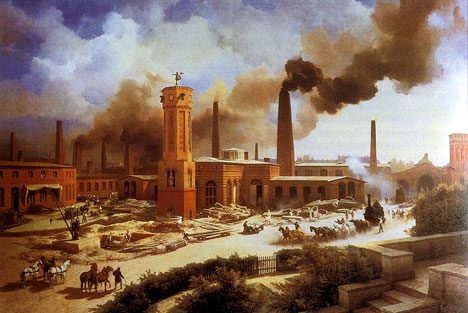
The next great change in Christian attitudes to economic work came with the industrial revolution, which was already ramping up in the time of the great 18th-century preacher John Wesley, when the commercial virtues of the Puritans and the new capitalist habits of long-term investment began to create the industries and factories that would drive Western economic growth in the centuries to come.
The Industrial Revolution brought with it the aggregation of work into factories, removing it from the town-based communal settings of homes and shops and catapulting it into the large-scale settings of cities, whose rapid growth resulted, especially in the century after Wesley, in terrible social problems. Like a great landslide, the revolution swept away centuries of solid economic and social ground, leaving Europe and America battered and bewildered. Old skills were quickly devalued, thousands abandoned the towns and countryside for the cities. The evident gap between rich and poor in some urban areas—and even between middle-class and working-class—wounded Christian consciences.
Christian responses varied, of course—from the Holiness preaching, “blood-washed” singing, and homes for fallen women of the Salvation Army; to the clean, safe, and new model villages built for workers by the Quaker owners of the Cadbury and Rowntree cocoa companies; to the fight for an alcohol-free world of the Woman’s Christian Temperance Union; to attempts by Social Gospel advocates to bring in a new society by working for the “salvation” not only of individuals but of corporate and social entities. And many who might never have darkened the door of a traditional Christian church—from members of communal societies to labor unionists—sought and claimed the directing example of Jesus as they grappled with how to right a world turned upside down.
In those days the church was awakening to its need to understand the fundamental nature of enterprise and economics, and to meet new, modern conditions with new ways of promoting human flourishing. They searched Scripture for light on economic wisdom, on human dignity rooted in the image of God, on the value of all legitimate work, on the call to love one’s neighbor as oneself, and on the fundamental importance of social institutions. And in these areas as in so many others, Wesley grappled and thought and taught.
His Methodist movement, which always kept at the center of its focus the poor—settled and working as well as indigent and destitute—insisted that Methodists educate themselves – that they improve their minds learn new skills as well as a new and sanctified way of living in the world.
Originally published at Grateful to the Dead.
Previous posts in this series:
- Getting the beginning and end of the story right
- We were made to work
- Jesus the incarnate worker God’
- A brass-tacks, real-world theology of work and vocation
- Early Christianity and everyday work
- The contemplative contribution
- Luther on ordinary work and vocation
Image: José Luís Agapito, “Industrial Revolution.”
Previous Post

December 17, 2014
Luther on ordinary work and vocation
Next Post
December 19, 2014 How and why Methodists moved the market economy forward
Browse Our Archives
Select a Category Art Audio posts Bible and Work Book Review Books Budgeting Calling Common Good Community Development Conferences Discipleship Economics Entrepreneurship Ethics Faith and Family Faith and the Marketplace Faith and the Workplace faith and work History of Work and Vocation Leadership Local Church Meaning New Blogger News Prayer Relationships Seminaries Theology of Work Uncategorized Video posts Vocation Worship Resources
Select a Month April 2026 October 2025 September 2025 July 2025 April 2025 January 2025 October 2024 September 2024 August 2024 May 2024 March 2024 February 2024 December 2023 November 2023 August 2023 July 2023 April 2023 January 2023 December 2022 November 2022 September 2022 August 2022 July 2022 May 2022 April 2022 February 2022 January 2022 December 2021 November 2021 October 2021 September 2021 August 2021 June 2021 May 2021 March 2021 February 2021 January 2021 December 2020 November 2020 September 2020 August 2020 July 2020 June 2020 May 2020 April 2020 March 2020 January 2020 December 2019 October 2019 September 2019 August 2019 July 2019 June 2019 May 2019 April 2019 March 2019 February 2019 January 2019 April 2018 March 2018 January 2018 December 2017 November 2017 October 2017 September 2017 August 2017 July 2017 June 2017 May 2017 April 2017 March 2017 February 2017 January 2017 December 2016 November 2016 October 2016 September 2016 August 2016 July 2016 June 2016 May 2016 April 2016 March 2016 February 2016 January 2016 December 2015 November 2015 October 2015 September 2015 August 2015 July 2015 June 2015 May 2015 April 2015 March 2015 February 2015 January 2015 December 2014 November 2014 October 2014 September 2014 August 2014 July 2014 June 2014 May 2014 April 2014 March 2014 February 2014 January 2014 December 2013
Follow Us!
TAKE THE
Religious Wisdom Quiz
How many chapters are in Proverbs?
Select your answer to see how you score.
40 31 50 28
Related posts from MISSION:WORK

Three Conversations (in honor of Eastertide)

Why Beth Felker Jones is Protestant

Missing the Night Sky: or, the Industrial Revolution...

Why we need a new theology of work
TRENDING AT PATHEOS Careers, Workplace and Religion

Looking at the Largest Orthodox Cathedral on Earth
There is often a considerable amount of anger and, shall we...

The Problem with False Prophets
Miller’s Station UMC| 10/18/26| Anchor Verse: Jeremiah 23: 1, 9-23 I...

Emotion in Early Christianity by Andrew Crislip
Andrew Crislip’s Emotion in Early Christianity examines an often overlooked dimension of...

16 Spiritual Touchstones for a More Grounded Life
After decades of spiritual study, here are 16 principles I try...

Catholic Evangelization: Sharing Your Faith Every Day
Welcome back to the Graceful Awakening mini-series called, “From Faith to Mission.” ...

The Pillar of the Boatmen: the Ancient Monument...
The Pillar of the Boatmen is a Romano-Gaulish sculpture that dates from...
view all Careers, Workplace and Religion blogs
Ad-Free & Subscriber Log-In Subscription Support
- About Us
- 2026 Calendar
- Videos
- Podcasts
- Library of World Religions
- Faith In Media Tracker
- Advertise With Us
- Write for Us
- Privacy Policy
- Terms of Service
- Do Not Sell My Data
- Contact Us
- Radiant Digital
- Manage Newsletter Subscriptions
- Unsubscribe From Notifications
- Sitemap
Copyright 2008-2026, Patheos. All rights reserved.
Subscription Support Ad-Free & Subscriber Log-In
Follow Patheos