
BuddhistCatholicContemplativeEvangelicalGeneral ChristianHinduJewishLatter-day SaintMuslimNew VisionsProgressive Christian
Beliefs
- Buddhist
- Catholic
- Contemplative
- Evangelical
- General Christian
- Hindu
- Jewish
- Latter-day Saint
- More Voices
- Muslim
- New Visions
- Pagan
- Progressive Christian
Topics
- Religion News
- Food and Religion
- Sports and Religion
- Religious Art
- Religious Music and Entertainment
- Religious Events
- History and Religion
- Style and Religion
- Politics and Religion
- Women in Religion
- Recreation Outdoors and Religion
- Business Finance and Religion
- Careers Workplace and Religion
- Education and Religion
- Family Parenting and Religion
- Health Fitness and Religion
- Home and Religion
- Relationships and Religion
- Technology and Religion
- Travel and Religion
Columnists
- Buddhist Columnists
- Business Finance and Religion Columnists
- Careers Workplace and Religion Columnists
- Catholic Columnists
- Contemplative Columnists
- Education and Religion Columnists
- Evangelists Columnists
- Family Parenting and Religion Columnists
- General Christian Columnists
- Health Fitness and Religion Columnists
- Hindu Columnists
- History and Religion Columnists
- Home and Religion Columnists
- Jewish Columnists
- More Voices Columnists
- Latter Day Columnists
- Muslim Columnists
- New Visions Columnists
- Nonreligious Columnists
- Pagan Columnists
- Politics and Religion Columnists
- Progressive Columnists
- Recreation Outdoors and Religion Columnists
- Relationships and Religion Columnists
- Religion News Columnists
- Religious Art Columnists
- Religious Events Columnists
- Religious Music and Entertainment Columnists
- Sports and Religion Columnists
- Style and Religion Columnists
- Technology and Religion Columnists
- Travel and Religion Columnists
- Women in Religion Columnists
Resource Library
- 2026 Calendar
- Library of World Religions
- The 100 Most Holy Places on Earth
- Patheos Answers
- Podcasts
- Videos
- Faith Leaders Database
- Anglican Episcopalian
- Bahai
- Baptist
- Buddhism
- Christianity
- Confucianism
- Eastern Orthodoxy
- Hinduism
- Holiness and Pentecostal
- ISKCON
- Islam
- Judaism
- Lutheran
- Methodist
- The Church of Jesus Christ of Latter-day Saints
- New Age
- Paganism
- Presbytarian and Reformed
- Protestantism
- Religion Behind the Scenes
- Roman Catholic
- Scientology
- Shia Islam
- Sikhism
- Sufism
- Sunni Islam
- Taoism
- Zen
- See all religions
Research Tools
 Ad-Free & Subscriber Log-In Subscription Support
Ad-Free & Subscriber Log-In Subscription Support
Follow Patheos 

- Trending:
- Forgiveness
- |
- Marriage
- |
- Consciousness
- |
- Death Penalty
- |
- Election
- |
- Halloween

- Home
- Careers, Workplace and Religion
- Does the coming economy need liberal arts graduates?
Does the coming economy need liberal arts graduates?
Last updated on: August 19, 2014 at 1:59 pm by Mission:Work
Does the coming economy need liberal arts graduates? 2014-08-19T13:59:47-05:00 Mission:Work
Patheos Explore the world's faith through different perspectives on religion and spirituality! Patheos has the views of the prevalent religions and spiritualities of the world.
 We like business folks here at MISSION:WORK (we especially like J. B. Wood, and we think you ought to read his blog.) But I was still intrigued when I saw this feature on PBS Newshour recently, as part of its Making Sen$e feature. The report focused on what some economists call the “coming artisan economy”:
In Making Sen$e’s report on “the artisan economy” Tuesday evening on the NewsHour, Paul Solman speaks with two exterminators and a dementia coach. Not what you typically think of as “artisans”? Well, how about operators of a fresh fruit Popsicle company or a line of handmade dog leashes, both crafted in a repurposed Brooklyn factory? Any of those jobs can be artisan says Larry Katz, the Harvard professor who’s coined the term “artisan economy.” What makes them artisan is that they’re not standardized occupations; they involve what he calls “personal flair” in each stage of the job.
But this movement is about a lot more than hipsters bucking a traditional career path. Katz believes the artisan economy can help shore up the American middle class by creating new jobs to replace those mass production and middle management jobs lost to outsourcing or new technology. And he thinks that a firm grounding in the multidisciplinary liberal arts is the best preparation – better even than a business degree – to taking advantage of the artisan economy that he hopes will be a path to upward mobility for the average American.
To flesh out the topic PBS conducted a interview with Larry Katz. The entire interview is interesting–here’s just an excerpt:
In the 19th century, when high-earning artisans were displaced, two groups benefited – the highly educated workers who became the managers and the engineers who designed the technological processes that replaced the artisan. And then there were a lot of frontline workers, who were less skilled than the artisans, on the assembly line. So a lot of the jobs that became the middle class jobs of the mid to late 20th century – mid-level managers and production workers, for example, are exactly what new information technology is very good at replacing. You don’t need as many middle managers if you can directly monitor with a computer what the frontline worker is doing; a robot can do the production process or it can be outsourced.
We’ve seen growth in jobs for people with abstract creative skills, like designing an auto teller or thinking of new ways to entice consumers to want to make more financial transactions. There used to be people who actually graded every mortgage; now it’s writing a program to grade the mortgage or interpreting how to market them. There’s the potentially hopeful scenario of, in some sense, being able to bring back the old mass production artisanal work with new technologies of today that allow a lot of customization and creativity in the same way that hand work did in the past.
So that could range from designing an app or being a carpenter who uses technology to customize a kitchen cabinet for the high-end abstract worker. If I’m a carpenter, if I can figure out what idiosyncratic items you would prefer and design them myself, I’m a much more valuable contractor in the same way that someone like Paul Revere could personalize what a silversmith did.
Larry adds a couple more examples of entrepreneurship:
I could be a college graduate who goes out and thinks very seriously about using local produce or I could be someone with community college training and set up my own catering service or restaurant. That might not look like a traditional college job or a middle class job, but that can be very lucrative if I’m doing that in a creative way with flair in a way that a standard fast food restaurant isn’t.
So I think there’s a possibility of an economy emerging in which the ability of people to have their own personal style and flair will be much more valuable than just doing routine things. That’s the case at both high-level jobs, but also in being a home health aide in ways that are very valuable to your patients and that will earn you a higher income eventually. I think that’s potentially where there may be a new middle class.
Where does the whole liberal arts thing come in? While Larry acknowledges there are many paths to this kind of job, he thinks that a liberal arts degree is one good one:
Where I think there’s a future is less just the traditional apprenticeship and more what you might call “contextual learning,” which gives you a foundation of liberal arts that’s very flexible and combines that with learning a trade that’s valuable in an industry today, but not so narrow that if demand for that particular skill goes away, you’re left with nothing.
He adds,
I think any young person is going to want a strong liberal arts education to give you the basis to move in a lot of different directions. I actually think it may be that a really strong liberal arts education is going to be more valuable in the future as opposed to a very specific thing by itself. A traditional business program may be less valuable in the future than someone who may have been a humanities major but learned a bunch of science and analytics as well. It’s going to be your ability to deal with what can’t be turned into an algorithm; how well do you deal with unstructured problems and how well do you deal with new situations; that’s really key.
Lots more to digest and debate over at the PBS page–along with another article called “Could Brooklyn hipsters help save the middle class” about the growing market for handmade goods and the possibility of job creation by serving that market. If we are moving to an “artisan economy,” what do Christians have to say to that–especially if we already emphasize doing one’s work with excellence? What do you think?
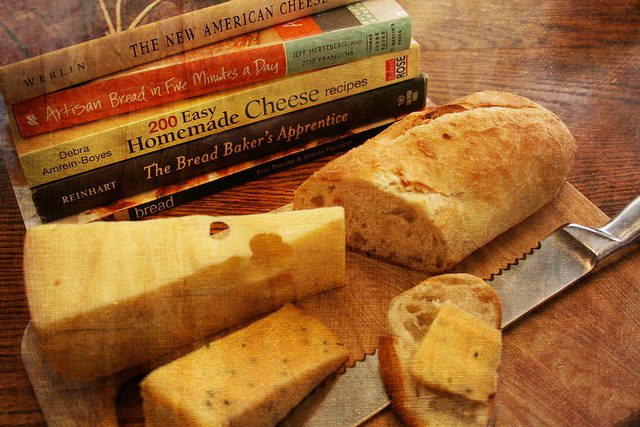
Image: “Artisan Cheese” by Just Jody.
Next Post

August 3, 2014 Jobs you couldn't do in the early church. Really.
Browse Our Archives
Select a Category Art Audio posts Bible and Work Book Review Books Budgeting Calling Common Good Community Development Conferences Discipleship Economics Entrepreneurship Ethics Faith and Family Faith and the Marketplace Faith and the Workplace faith and work History of Work and Vocation Leadership Local Church Meaning New Blogger News Prayer Relationships Seminaries Theology of Work Uncategorized Video posts Vocation Worship Resources
Select a Month April 2026 October 2025 September 2025 July 2025 April 2025 January 2025 October 2024 September 2024 August 2024 May 2024 March 2024 February 2024 December 2023 November 2023 August 2023 July 2023 April 2023 January 2023 December 2022 November 2022 September 2022 August 2022 July 2022 May 2022 April 2022 February 2022 January 2022 December 2021 November 2021 October 2021 September 2021 August 2021 June 2021 May 2021 March 2021 February 2021 January 2021 December 2020 November 2020 September 2020 August 2020 July 2020 June 2020 May 2020 April 2020 March 2020 January 2020 December 2019 October 2019 September 2019 August 2019 July 2019 June 2019 May 2019 April 2019 March 2019 February 2019 January 2019 April 2018 March 2018 January 2018 December 2017 November 2017 October 2017 September 2017 August 2017 July 2017 June 2017 May 2017 April 2017 March 2017 February 2017 January 2017 December 2016 November 2016 October 2016 September 2016 August 2016 July 2016 June 2016 May 2016 April 2016 March 2016 February 2016 January 2016 December 2015 November 2015 October 2015 September 2015 August 2015 July 2015 June 2015 May 2015 April 2015 March 2015 February 2015 January 2015 December 2014 November 2014 October 2014 September 2014 August 2014 July 2014 June 2014 May 2014 April 2014 March 2014 February 2014 January 2014 December 2013
Follow Us!
TAKE THE
Religious Wisdom Quiz
What is the teaching about honoring parents?
Select your answer to see how you score.
Leave home early Disobey Honor your father and mother Ignore advice
Related posts from MISSION:WORK



Not Nearly So Much Like a Mall

TRENDING AT PATHEOS Careers, Workplace and Religion

In one sense walking into Westminster Abbey is like walking down the...

'Super Scam Me' Exposes AI Jon Bon Jovi...
Leslie Pickett believed she was in a relationship with Jon Bon Jovi....

The Brazilian Remake of Kendricks' 'Flywheel' Opens in...
“Flywheel,” the story that launched the Kendrick Brothers’ filmmaking career is getting...

The Dangers of Gradual Accommodation (Winking at Sin)
Recently, the “law of gradualness” resurfaced during the opening of a weeklong,...

The Iron Gates and the Lion of the...
Yesterday, I didn't finish my report about, well, yesterday. So I'll...

The Image: On the Horror of Capitalism and...
The Image Then went the Pharisees, and took counsel how they might...
view all Careers, Workplace and Religion blogs
Ad-Free & Subscriber Log-In Subscription Support
- About Us
- 2026 Calendar
- Videos
- Podcasts
- Library of World Religions
- Faith In Media Tracker
- Advertise With Us
- Write for Us
- Privacy Policy
- Terms of Service
- Do Not Sell My Data
- Contact Us
- Radiant Digital
- Manage Newsletter Subscriptions
- Unsubscribe From Notifications
- Sitemap
Copyright 2008-2026, Patheos. All rights reserved.
Subscription Support Ad-Free & Subscriber Log-In
Follow Patheos