
BuddhistCatholicContemplativeEvangelicalGeneral ChristianHinduJewishLatter-day SaintMuslimNew VisionsProgressive Christian
Beliefs
- Buddhist
- Catholic
- Contemplative
- Evangelical
- General Christian
- Hindu
- Jewish
- Latter-day Saint
- More Voices
- Muslim
- New Visions
- Pagan
- Progressive Christian
Topics
- Religion News
- Food and Religion
- Sports and Religion
- Religious Art
- Religious Music and Entertainment
- Religious Events
- History and Religion
- Style and Religion
- Politics and Religion
- Women in Religion
- Recreation Outdoors and Religion
- Business Finance and Religion
- Careers Workplace and Religion
- Education and Religion
- Family Parenting and Religion
- Health Fitness and Religion
- Home and Religion
- Relationships and Religion
- Technology and Religion
- Travel and Religion
Columnists
- Buddhist Columnists
- Business Finance and Religion Columnists
- Careers Workplace and Religion Columnists
- Catholic Columnists
- Contemplative Columnists
- Education and Religion Columnists
- Evangelists Columnists
- Family Parenting and Religion Columnists
- General Christian Columnists
- Health Fitness and Religion Columnists
- Hindu Columnists
- History and Religion Columnists
- Home and Religion Columnists
- Jewish Columnists
- More Voices Columnists
- Latter Day Columnists
- Muslim Columnists
- New Visions Columnists
- Nonreligious Columnists
- Pagan Columnists
- Politics and Religion Columnists
- Progressive Columnists
- Recreation Outdoors and Religion Columnists
- Relationships and Religion Columnists
- Religion News Columnists
- Religious Art Columnists
- Religious Events Columnists
- Religious Music and Entertainment Columnists
- Sports and Religion Columnists
- Style and Religion Columnists
- Technology and Religion Columnists
- Travel and Religion Columnists
- Women in Religion Columnists
Resource Library
- 2026 Calendar
- Library of World Religions
- The 100 Most Holy Places on Earth
- Patheos Answers
- Podcasts
- Videos
- Faith Leaders Database
- Anglican Episcopalian
- Bahai
- Baptist
- Buddhism
- Christianity
- Confucianism
- Eastern Orthodoxy
- Hinduism
- Holiness and Pentecostal
- ISKCON
- Islam
- Judaism
- Lutheran
- Methodist
- The Church of Jesus Christ of Latter-day Saints
- New Age
- Paganism
- Presbytarian and Reformed
- Protestantism
- Religion Behind the Scenes
- Roman Catholic
- Scientology
- Shia Islam
- Sikhism
- Sufism
- Sunni Islam
- Taoism
- Zen
- See all religions
Research Tools
 Ad-Free & Subscriber Log-In Subscription Support
Ad-Free & Subscriber Log-In Subscription Support
Follow Patheos 

- Trending:
- Forgiveness
- |
- Marriage
- |
- Consciousness
- |
- Death Penalty
- |
- Election
- |
- Halloween

- Home
- Careers, Workplace and Religion
- “Shalom starts at home”: Housing problems, poverty, and how to change the world
“Shalom starts at home”: Housing problems, poverty, and how to change the world
Last updated on: August 19, 2014 at 2:02 pm by Mission:Work
“Shalom starts at home”: Housing problems, poverty, and how to change the world 2014-08-19T14:02:01-05:00 Mission:Work
Patheos Explore the world's faith through different perspectives on religion and spirituality! Patheos has the views of the prevalent religions and spiritualities of the world.
 Recently, Comment magazine ran a two-part interview on their website with Jonathan Bradford, CEO of the Inner City Christian Federation in Grand Rapids, Michigan, in conjunction with their June issue on Christianity and the city.
Many of us are interested in urban renewal and in alleviating poverty–but we don’t know where to start. Jonathan had plenty to say on the subject to his interviewer, James K.A. Smith of Comment. Here’s a sample.
First, he talked about the three specific areas ICCF involves themselves in as they try to help out in the housing market:
JS: In your own experience, and then in the specific kind of work ICCF does, there’s this interesting intersection of very concrete, tangible, hands-on, practical work helping people repair homes, build homes, care for homes, coupled with a little bit more big-picture, “abstract” policy work.
That comes out of your practical experience of learning how to fix homes but then also getting invested in, well, “seeking the welfare of the city.” Was your focus a strategic decision? The city has lots of problems. What made you focus on issues related to housing?
JB: Sure. Maybe this is as good as any time to tell you of our simple rule of threes here at ICCF. There are three key functions, three key program areas, and three key values…..The three functions work as if they were gears in a machine. They’re of equal size and equal importance. One gear not working? The other two won’t either. The first function is real estate development finance packaging—the very complex financial arrangements that are necessary to make a high-quality unit of housing available to somebody of lesser economic capacity. It takes a certain amount of magic. How do you pay $140,000 to build a housing unit when the target population can only afford $80,000? There’s got to be a way to close that $60,000 gap. That’s what we mean with that particular gear, our first function.
The second gear is residential construction. We are a licensed builder. Except in very large projects, we build everything ourselves so that we’re in full control of the budget, the quality of the work, and the timetable. We don’t want to set a family up for problems down the road. We don’t want mistakes and shortcuts to be hidden in the walls.
The third gear is housing education and empowerment. What we mean by that is this: sure, it’s good to be creative in the finance, and it’s good to be a responsible builder, but our target audience here, those that God is calling us to serve, are the Johnsons and Hernandez families. Most years, in the vicinity of about 2,500 households come to us facing all kinds of skill shortcomings. They likely never have lived in a home owned by a family member. They may not have ever experienced living in something that didn’t have a dozen or twenty code violations.
We want the family’s housing experience to be good for them so we encourage them attend to all kinds of skills-building opportunities, including housing repairs and maintenance (“Hey, how do you fix a broken window?” and that kind of thing—wall repair and painting and landscaping and all of those kinds of things)—but also the “soft” skills of housing and family management: insurance and taxes, time management, family budgeting, savings and investing, parenting. These are the kinds of things that quite a number of us either learned by example when we were young or had some other kind of mentoring relationship. Too often, that kind of experience is rare in the populations we serve.
From functions ICCF moves to progam areas, which include emergency shelter and rental properties as well as homebuilding:
Then there are three program areas. We have an emergency shelter for homeless families. Families stay with us for up to thirty days free of charge. We help them address the issues that cause their homelessness, help them find a permanent place to rent. That serves between seventy-five and eighty-five families a year.
Because home ownership is not suitable for everyone and the for-profit rental operator has a hard time meeting all the needs of the lower income renter ICCF had to enter the field of rental housing. We own and operate 142 units of high quality and affordable rental housing and soon we will be adding thirty more. Then finally is homeownership. For some families, it is good to own home. We do that either through the reconstruction of an existing house or new construction of a brand new house on a vacant lot.
 Finally, there are three key values important in serving this population–respect, opportunity, and beauty:
All of this is informed by our three key values, which are fundamental to all we do. We believe strongly in our responsibility to respect the Johnson and Hernandez families. God has thought enough of them to create them in His image. He wants good for them. He wants opportunity and hope and flourishing and nurture. He wants shalom. He wanted shalom for my wife and I when we were married forty-two years ago. We had various ways that helped us achieve that, a college degree, supportive parents, and so forth. The Johnsons and the Hernandez families may not have that.
Respecting these families that God sends our way means not holding wrongs against them, just as we read in 2 Corinthians 5: “The old is gone and new has come.” We have that reconciliation, and we read later on, “Therefore be as ambassadors don’t receive the grace of God in vain.” I believe very strongly that this call on contemporary Christians is all-inclusive. It often has been applied only to a spiritual dimension of our relationship to God: “Is my heart right with the Lord?” But I believe strongly that God’s care extends far beyond my heart and to every area of my activity, all of my being as a citizen in His Kingdom and in the city. Respecting the family, not holding the wrong turns against them, communicating hope and optimism is an extremely important thing.
Second value: opportunity. How do we respect? By expecting the pursuit of opportunity. That might sound like just a little clever turn of a phrase but, hey, you know what? If you regard the Hernandez and Johnson families as perfectly capable—as wanting good for themselves, as reaching for something more—for stability that has eluded them. We want to say to them: here is your chance to learn, to grow. “Mr. Johnson, Mrs. Johnson, what have you aspired to achieve?” Inevitably, we’re going to hear a financial roadblock. They’re going to say, “Yeah. I wanted to take that course at community college so I could qualify for a raise at work but I could never get the $300 tuition together.” “Well, sure, Mr. Johnson because you’re spending 55% of your income on inadequate, unsafe housing and there’s no reason why you should have to continue to do that.”
When Mr. Johnson can go from spending $850 to spending $550, Mr. Johnson has a $300 a month raise. That’s $3,600 post-tax cash stays in his pocket. What, Mr. Johnson, can you do with $3,600? Will you take that class at the community college? Will you address the health issue you’ve been denying, ducking? On and on, the pursuit of opportunity.
The final word, the final value that is, to my way of thinking as powerful, as important, as central as anything: that is simply beauty.
Here at ICCF, Jamie, we talk about beauty as a gift of God. Created in His image, we have that unique, that very special capacity to seek and to embrace that which is aesthetically satisfying. The Lord is the author of all that is right and proper and in the shaping, in the colouring, in the dimensioning of our built environment, we need to celebrate that Lordship. Guess what? The Hernandez family that I keep talking about is all created in the image of God? They have that same aesthetic compass that I do. They may not know how to articulate it. They may not be in any way accustomed to paying attention to that compass. But their needle seeks that which is right and proper just like mine does. We believe if we are faithful in our stewardship, if in full pursuit and enabling of that respectful treatment, that the heart of justice for these families in their housing is that it be beautiful.
Beauty should not be confused with the ostentatious or palatial, but simple matters of architectural balance. Do you build a house with a 4/12 roof pitch in a neighbourhood of 80-year-old houses where all the roofs have a 12/12 roof pitch? Do you build a house with a 4 x 6 front porch when all the front porches are 12 x 20 or more? No.
That’s just the tip of the iceberg. And in the second part of the interview, Jonathan chatted with James about how we can encourage living together in community across class lines, ranging from zoning policies to why many folks are starting to think twice about suburban living:
For a long time, traceable back a minimum of sixty years, in terms of land use we have been identifying certain areas of our developed communities as the place where manufacturing happens or where retail happens or where institutional stuff is or where residential stuff is. While you can find exceptions, in North America it is reasonably common that these uses are separate. You’ll also find because of the tyranny of the appraiser, the real estate appraiser, and the mortgage lender, you can also find economic stratification. So this is the area over here where wealthy people live, and around the bend, down the road another few miles, this is where middle-income people can be found.
The reason is: the lender will only lend according to the value of the houses next door. The result is that the older housing, the less desirable housing and as we often say in our “core city” neighbourhoods or “inner city” neighbourhoods, that is theresidual, that is what’s been left over for those with little economic power. Those are the areas where the public services are deficient. That is where the public schools or other facilities are not well maintained: the streets, the curbs, the gutters, the sidewalks are cracked. That’s the place where crime is common. So for our friends, the Hernandez family or the Johnson family, if their place in life—in terms of what they can afford for housing—kind of consigns them to that neighbourhood, that is, in effect, a reversed gentrification. We have said to you, “You need to stay here. This is all that your buying power will get you.”
I would maintain that is a direct contradiction to the shalom that we are to be pursuing. Again, in the fact that there is no Jew or Greek, rich or poor, male or female in the eyes of our Lord in celebrating the reality that all of us are created in his image, I am crazy enough to believe that the person who scrubs pots and pans in the kitchen in the basement of St. Mary’s Hospital can successfully live on the same block that the Director of Anesthesiology does. We are deliberately seeking to develop a community where that kind of standard is put behind us.
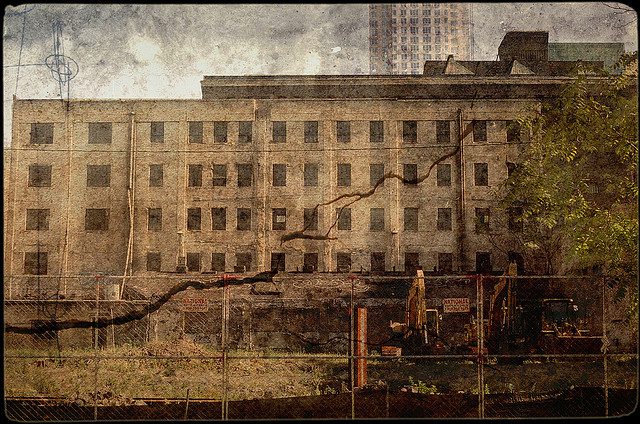
Much more on how they build that kind of community, and why he thinks the age of the suburb is over, in the rest of the interview. (And lots more cool stuff on Comment’s website as well. Including the whole issue about cities!)
Images: “Mukesh Mills, Colaba” by lecercle, “Urban Renewal” by Peter Asquith,“no longer there” by Nesster, used under a Creative Commons license.
Previous Post

July 16, 2014
Why work?
Next Post
July 18, 2014 Why not take some time off?
Browse Our Archives
Select a Category Art Audio posts Bible and Work Book Review Books Budgeting Calling Common Good Community Development Conferences Discipleship Economics Entrepreneurship Ethics Faith and Family Faith and the Marketplace Faith and the Workplace faith and work History of Work and Vocation Leadership Local Church Meaning New Blogger News Prayer Relationships Seminaries Theology of Work Uncategorized Video posts Vocation Worship Resources
Select a Month April 2026 October 2025 September 2025 July 2025 April 2025 January 2025 October 2024 September 2024 August 2024 May 2024 March 2024 February 2024 December 2023 November 2023 August 2023 July 2023 April 2023 January 2023 December 2022 November 2022 September 2022 August 2022 July 2022 May 2022 April 2022 February 2022 January 2022 December 2021 November 2021 October 2021 September 2021 August 2021 June 2021 May 2021 March 2021 February 2021 January 2021 December 2020 November 2020 September 2020 August 2020 July 2020 June 2020 May 2020 April 2020 March 2020 January 2020 December 2019 October 2019 September 2019 August 2019 July 2019 June 2019 May 2019 April 2019 March 2019 February 2019 January 2019 April 2018 March 2018 January 2018 December 2017 November 2017 October 2017 September 2017 August 2017 July 2017 June 2017 May 2017 April 2017 March 2017 February 2017 January 2017 December 2016 November 2016 October 2016 September 2016 August 2016 July 2016 June 2016 May 2016 April 2016 March 2016 February 2016 January 2016 December 2015 November 2015 October 2015 September 2015 August 2015 July 2015 June 2015 May 2015 April 2015 March 2015 February 2015 January 2015 December 2014 November 2014 October 2014 September 2014 August 2014 July 2014 June 2014 May 2014 April 2014 March 2014 February 2014 January 2014 December 2013
Follow Us!
TAKE THE
Religious Wisdom Quiz
I am a coat of many colors that sparked jealousy among brothers. What am I?
Select your answer to see how you score.
A royal garment Jacob's robe Joseph's coat The priests robe
Related posts from MISSION:WORK



Not Nearly So Much Like a Mall

TRENDING AT PATHEOS Careers, Workplace and Religion

The Problem with False Prophets
Miller’s Station UMC| 10/18/26| Anchor Verse: Jeremiah 23: 1, 9-23 I...

Emotion in Early Christianity by Andrew Crislip
Andrew Crislip’s Emotion in Early Christianity examines an often overlooked dimension of...

16 Spiritual Touchstones for a More Grounded Life
After decades of spiritual study, here are 16 principles I try...

Catholic Evangelization: Sharing Your Faith Every Day
Welcome back to the Graceful Awakening mini-series called, “From Faith to Mission.” ...

The Pillar of the Boatmen: the Ancient Monument...
The Pillar of the Boatmen is a Romano-Gaulish sculpture that dates from...

In one sense walking into Westminster Abbey is like walking down the...
view all Careers, Workplace and Religion blogs
Ad-Free & Subscriber Log-In Subscription Support
- About Us
- 2026 Calendar
- Videos
- Podcasts
- Library of World Religions
- Faith In Media Tracker
- Advertise With Us
- Write for Us
- Privacy Policy
- Terms of Service
- Do Not Sell My Data
- Contact Us
- Radiant Digital
- Manage Newsletter Subscriptions
- Unsubscribe From Notifications
- Sitemap
Copyright 2008-2026, Patheos. All rights reserved.
Subscription Support Ad-Free & Subscriber Log-In
Follow Patheos