
BuddhistCatholicContemplativeEvangelicalGeneral ChristianHinduJewishLatter-day SaintMuslimNew VisionsProgressive Christian
Beliefs
- Buddhist
- Catholic
- Contemplative
- Evangelical
- General Christian
- Hindu
- Jewish
- Latter-day Saint
- More Voices
- Muslim
- New Visions
- Pagan
- Progressive Christian
Topics
- Religion News
- Food and Religion
- Sports and Religion
- Religious Art
- Religious Music and Entertainment
- Religious Events
- History and Religion
- Style and Religion
- Politics and Religion
- Women in Religion
- Recreation Outdoors and Religion
- Business Finance and Religion
- Careers Workplace and Religion
- Education and Religion
- Family Parenting and Religion
- Health Fitness and Religion
- Home and Religion
- Relationships and Religion
- Technology and Religion
- Travel and Religion
Columnists
- Buddhist Columnists
- Business Finance and Religion Columnists
- Careers Workplace and Religion Columnists
- Catholic Columnists
- Contemplative Columnists
- Education and Religion Columnists
- Evangelists Columnists
- Family Parenting and Religion Columnists
- General Christian Columnists
- Health Fitness and Religion Columnists
- Hindu Columnists
- History and Religion Columnists
- Home and Religion Columnists
- Jewish Columnists
- More Voices Columnists
- Latter Day Columnists
- Muslim Columnists
- New Visions Columnists
- Nonreligious Columnists
- Pagan Columnists
- Politics and Religion Columnists
- Progressive Columnists
- Recreation Outdoors and Religion Columnists
- Relationships and Religion Columnists
- Religion News Columnists
- Religious Art Columnists
- Religious Events Columnists
- Religious Music and Entertainment Columnists
- Sports and Religion Columnists
- Style and Religion Columnists
- Technology and Religion Columnists
- Travel and Religion Columnists
- Women in Religion Columnists
Resource Library
- 2026 Calendar
- Library of World Religions
- The 100 Most Holy Places on Earth
- Patheos Answers
- Podcasts
- Videos
- Faith Leaders Database
- Anglican Episcopalian
- Bahai
- Baptist
- Buddhism
- Christianity
- Confucianism
- Eastern Orthodoxy
- Hinduism
- Holiness and Pentecostal
- ISKCON
- Islam
- Judaism
- Lutheran
- Methodist
- The Church of Jesus Christ of Latter-day Saints
- New Age
- Paganism
- Presbytarian and Reformed
- Protestantism
- Religion Behind the Scenes
- Roman Catholic
- Scientology
- Shia Islam
- Sikhism
- Sufism
- Sunni Islam
- Taoism
- Zen
- See all religions
Research Tools
 Ad-Free & Subscriber Log-In Subscription Support
Follow Patheos 

- Trending:
- Advent
- |
- Forgiveness
- |
- Thanksgiving
- |
- Election
- |
- Seasonal Holidays
- |
- Marriage
 Outside the Charmed Circle
- Home
- Pagan
- Misha’s Lockdown Reading List: Yvonne Aburrow, “Dark Mirror” and “The Night Journey”
Misha’s Lockdown Reading List: Yvonne Aburrow, “Dark Mirror” and “The Night Journey”
Last updated on: May 18, 2021 at 7:03 pm by Misha Magdalene
Misha’s Lockdown Reading List: Yvonne Aburrow, “Dark Mirror” and “The Night Journey” 2021-05-18T19:03:14-08:00 Misha Magdalene
Patheos Explore the world's faith through different perspectives on religion and spirituality! Patheos has the views of the prevalent religions and spiritualities of the world.
Hello, beautiful creatures.
As readers who’ve been around for more than a minute or two can attest, this blog is less an instructional column on magic or devotional practice than an series of analytical considerations of the culture (or cultures) which arise from the practice of Paganism, polytheism, and magical spirituality. It’s why, for instance, I’ve posted very little in the way of rituals or spellwork, despite those making up a substantial part of my personal practice as a witch. Similarly, while my book Outside the Charmed Circle does includes rituals, spells, and exercises, the bulk of the book’s runtime is devoted to analysis, hypothesis, theory, and personal anecdotes… which, in my defense, are intended to be relevant to the topic, or at least entertaining.
In other words, I’m less interested in writing about how we do things than about why we do what we do, and what that says about us. I make no apologies for this; the field of Pagan, polytheist, and magical literature is certainly broad enough to accomodate both instructional texts and more theoretical material. In fact, one of the consistent complaints I’ve heard and read about “Pagan books” over the years is the lack of such material. Again and again, I’ve come across the laments of people looking for something “more advanced” than the usual “Wicca 101” books1 on the market. Sadly, one of the similarly consistent criticisms of books with a more theoretical bent is their lack of pre-prepared rituals, spells, and exercises making them inaccessible to beginners. It’s something of a paradox: how can you provide advanced material in a way that doesn’t put off newbies, who are often the most avid readers (and buyers) of books on Paganism?
Fortunately for both beginners and advanced practitioners interested in Wicca and Wiccan-style witchcraft, Yvonne Aburrow has found a way to square that particular circle.
In 2018, Aburrow released Dark Mirror: The Inner Work of Witchcraft and The Night Journey: Witchcraft as Transformation. Between them, these two books comprise something quite special: two of the best simultaneously introductory and advanced works on Wiccan witchcraft to be found. With the imminent release of the second and revised editions of both Dark Mirror and The Night Journey, courtesy of the Centre for Pagan Studies and the Doreen Valiente Foundation, it seems a reasonable time to say a few words about why I say that and why, if your interests lie within a standard deviation of Wicca, you owe it to yourself to pick up Aburrow’s treatises.
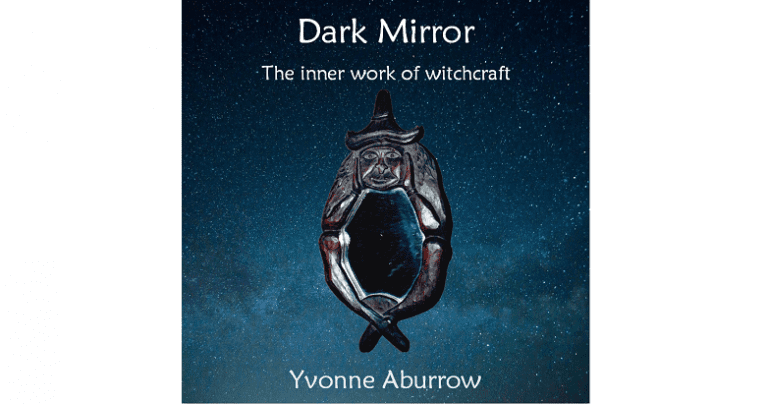
“Dark Mirror: The Inner Work of Witchcraft” (2nd edition) by Yvonne Aburrow, Centre for Pagan Studies, 2020.
On one level, Dark Mirror is an exploration of what Aburrow calls the “inner work” of witchcraft, the internal processes which ritual sets in motion to initiate change and transformation, both within the ritualist and in the world around them. Over and beyond that central goal, though, the book is an outline of Aburrow’s conception of Wicca as an inherently inclusive practice: anti-racist, queer-positive, sex-positive, and body-positive. Their explication of this image begins with first principles, inviting the reader to consider what Paganism and Wicca actually are before moving on to a discussion of how to do them. The scope of what they cover in the first half of the book is impressive, from basic techniques of ritual work to discussions of theological principles, all presented in a clear, pleasant writing voice reminiscent of Doreen Valiente2, equal parts “straightforward instruction” and “chatting over tea and biscuits.” As an academically-trained feminist nerd with a taste for systems analysis, this approach makes me positively giddy with delight.
The second half of the book, however, is where Aburrow dives into the real meat of the “inner work,” and where the book truly shines. They offer intriguing and, at times, challenging perspectives on the practices and traditions of Wicca, along with a host of exercises, rituals, meditations, discussion prompts, and suggestions for further exploration and inquiry, all intended to guide the interested reader into a deeper understanding of the mysteries at the heart of Wiccan practice. This material doesn’t come across as prescriptive, but rather as guidelines offered to the reader for engaging with Wiccan witchcraft in a fashion which is both inclusive and profound.
Following on from the previous book, The Night Journey utilizes the historical legend of the witch’s flight to the sabbat to expand Aburrow’s notion of a modern witchcraft which is “queer, transgressive, and resistant to authoritarian versions of reality.” They devote the first half of the text to picking up the threads of inner work first addressed in Dark Mirror and pursuing them through various issues of interest: social justice, queerness, ecology, witchcraft as social and political resistance, ancestor work, mental illness, and more. As before, these discussions are accompanied by exercises, personal work, and prompts for further exploration. This description might sound a bit scattershot, but Aburrow gathers all the threads together in the book’s second half, where they apply the insights and tools from the opening chapters to the practical work of the witch in the world: from running a coven to challenging authority, from navigating interpersonal relationships to reconciling with one’s own demons and fears. In the spiritual world of The Night Journey, witchcraft isn’t seen as some sort of rarefied practice isolated from the messy mundane world, but as a beautiful, viable, and practical way of living in the world as a person of power and integrity.
Taken together with Dark Mirror, these two texts comprise something quite special: a revolutionary vision of traditional Wicca which looks to the Craft’s future while simultaneously honoring its traditions. I found both books enthralling, enriching, and inspiring, especially read in conjunction with one another, and I’m desperately glad I didn’t read them before I wrote Outside the Charmed Circle. While our books aren’t identical by any means, they do cover some of the same topics, and from a similar enough viewpoint that, had I read Aburrow first, I might not have written my book. On the plus side, I now have my answer for all the witchy-minded readers who’ve asked what they should read after they’ve finished my book.
And now, so do you.
Yvonne Aburrow’s Dark Mirror: The Inner Work of Witchcraft is available for pre-order now. The Night Journey: Witchcraft as Transformation will be forthcoming soon.
[NB: I received electronic copies of both of these books from the author for review purposes. I have not received any remuneration for this review.]
Until next time, dear ones, be safe, and be kind to one another. ♥
- Of course, those “101” books consistently outsell everything else on the market… but, to steal a line from Alton Brown, that’s another blog post.
- As the “Godmother of Wicca,” Valiente’s influence on Aburrow is apparent throughout the book, from the tone of the text to Aburrow’s grounding in Gardnerian Wicca to, of all things, the magic mirror from Valiente’s collection featured on the book’s cover.

About Misha Magdalene
Misha Magdalene (Seattle) is a multiclassed, multi-geek, multiqueer witch and sorcerer with a degree in gender studies and a slightly odd sense of humor. Their first book, Outside the Charmed Circle: Exploring Gender and Sexuality in Magical Practice, was published by Llewellyn in January 2020. They're an initiate of multiple lines of traditional witchcraft, including Anderson Feri and Gardnerian Wicca, and have also been known to dabble recklessly in both modern ceremonial magic and grimoiric goetia. They've been blogging since 2001, negotiating the online world since 1987, playing Dungeons & Dragons since 1981, and listening to weird music since birth. They live on occupied Duwamish territory in the Pacific Northwest with their polymath partner, their precocious daughter, far too much coffee-making apparatus, and two adorably destructive black kittens. You can find them on Facebook, Twitter, Pinterest, Tumblr, Instagram, and their very own website, or lurking somewhere around the Seattle area, usually hiding behind a cup of coffee. You can read more about the author here.
Previous Post

July 13, 2020
A Hole in Our Midst: On Moral Vulnerabilities in Esoteric Communities
Next Post

October 30, 2020 A Word Before the Drop: On Politics, Ethics, and Compassion
Browse Our Archives
Select a Category Interviews Politics Reviews Social Justice Theology Uncategorized
Select a Month January 2021 December 2020 October 2020 August 2020 July 2020 May 2020 April 2020 March 2020 February 2020 January 2020 December 2019 November 2019 October 2019 September 2019 August 2019 July 2019 June 2019 May 2019 April 2019 March 2019 February 2019 January 2019 December 2018 November 2018 October 2018 September 2018 August 2018 July 2018 June 2018 May 2018 April 2018 March 2018 February 2018 January 2018 December 2017 November 2017 October 2017 September 2017 August 2017
Follow Us!
TAKE THE
Religious Wisdom Quiz
What does "Shiloh" (where the Tabernacle stood) mean?
Select your answer to see how you score.
House of Prayer Land of Bread Well of Water Place of Peace
Related posts from Outside the Charmed Circle
Misha's Lockdown Reading List: Lilith Dorsey, "Orishas, Goddesses,...
Misha's Lockdown Reading List: Kelden's "The Crooked Path"

Materia Magica: Some Thoughts on the Stuff We...
Review: "The Eloquent Blood" by Manon Hedenborg White
TRENDING AT PATHEOS Pagan

To help with the upcoming holiday season, I'm introducing the Holiday Helper...

10 years of the Power Sigil & Moving...
Last week while reorganizing my studio space, I found the sketchbook that...

Why are younger seekers drawn to Paganism and...
One of the things I've noticed the most is that I'm far...

When we talk about Greek religion, we often begin with the dodekatheion—the...

I was recently chatting with someone on Instagram. She asked me what...

On July 23, I saw Christopher Nolan's The Odyssey which is Homer’s...
view all Pagan blogs
Ad-Free & Subscriber Log-In Subscription Support
- About Us
- 2026 Calendar
- Videos
- Podcasts
- Library of World Religions
- Faith In Media Tracker
- Advertise With Us
- Write for Us
- Privacy Policy
- Terms of Service
- Do Not Sell My Data
- Contact Us
- Radiant Digital
- Manage Newsletter Subscriptions
- Unsubscribe From Notifications
- Sitemap
Copyright 2008-2026, Patheos, part of the Radiant Digital network of media brands. All rights reserved.
Subscription Support Ad-Free & Subscriber Log-In
Follow Patheos