
BuddhistCatholicContemplativeEvangelicalGeneral ChristianHinduJewishLatter-day SaintMuslimNew VisionsProgressive Christian
Beliefs
- Buddhist
- Catholic
- Contemplative
- Evangelical
- General Christian
- Hindu
- Jewish
- Latter-day Saint
- More Voices
- Muslim
- New Visions
- Pagan
- Progressive Christian
Topics
- Religion News
- Food and Religion
- Sports and Religion
- Religious Art
- Religious Music and Entertainment
- Religious Events
- History and Religion
- Style and Religion
- Politics and Religion
- Women in Religion
- Recreation Outdoors and Religion
- Business Finance and Religion
- Careers Workplace and Religion
- Education and Religion
- Family Parenting and Religion
- Health Fitness and Religion
- Home and Religion
- Relationships and Religion
- Technology and Religion
- Travel and Religion
Columnists
- Buddhist Columnists
- Business Finance and Religion Columnists
- Careers Workplace and Religion Columnists
- Catholic Columnists
- Contemplative Columnists
- Education and Religion Columnists
- Evangelists Columnists
- Family Parenting and Religion Columnists
- General Christian Columnists
- Health Fitness and Religion Columnists
- Hindu Columnists
- History and Religion Columnists
- Home and Religion Columnists
- Jewish Columnists
- More Voices Columnists
- Latter Day Columnists
- Muslim Columnists
- New Visions Columnists
- Nonreligious Columnists
- Pagan Columnists
- Politics and Religion Columnists
- Progressive Columnists
- Recreation Outdoors and Religion Columnists
- Relationships and Religion Columnists
- Religion News Columnists
- Religious Art Columnists
- Religious Events Columnists
- Religious Music and Entertainment Columnists
- Sports and Religion Columnists
- Style and Religion Columnists
- Technology and Religion Columnists
- Travel and Religion Columnists
- Women in Religion Columnists
Resource Library
- 2026 Calendar
- Library of World Religions
- The 100 Most Holy Places on Earth
- Patheos Answers
- Podcasts
- Videos
- Faith Leaders Database
- Anglican Episcopalian
- Bahai
- Baptist
- Buddhism
- Christianity
- Confucianism
- Eastern Orthodoxy
- Hinduism
- Holiness and Pentecostal
- ISKCON
- Islam
- Judaism
- Lutheran
- Methodist
- The Church of Jesus Christ of Latter-day Saints
- New Age
- Paganism
- Presbytarian and Reformed
- Protestantism
- Religion Behind the Scenes
- Roman Catholic
- Scientology
- Shia Islam
- Sikhism
- Sufism
- Sunni Islam
- Taoism
- Zen
- See all religions
Research Tools
 Ad-Free & Subscriber Log-In Subscription Support
Ad-Free & Subscriber Log-In Subscription Support
Follow Patheos 

- Trending:
- Forgiveness
- |
- Marriage
- |
- Consciousness
- |
- Death Penalty
- |
- Election
- |
- Halloween
 Outside the Charmed Circle
- Home
- Pagan
- Review: “The Eloquent Blood” by Manon Hedenborg White
Review: “The Eloquent Blood” by Manon Hedenborg White
Last updated on: May 18, 2021 at 7:03 pm by Misha Magdalene
Review: “The Eloquent Blood” by Manon Hedenborg White 2021-05-18T19:03:24-08:00 Misha Magdalene
Patheos Explore the world's faith through different perspectives on religion and spirituality! Patheos has the views of the prevalent religions and spiritualities of the world.
Hello, beautiful creatures. Let’s not bury the lede: The Eloquent Blood by Manon Hedenborg White is the most important book on Paganism, esoteric spirituality, and the occult to be published in the past twenty years.
I realize that’s a bold claim. It’s certainly an arguable claim. However, I stand by it, and I’ll explain why in a bit. We can all check back in twenty years to see if I was right. In the meantime, if you have any kind of serious interest in the intersection of magic, Paganism, and/or polytheism with gender, philosophy, religion, and other artifacts of culture, you owe it to yourself to pick up a copy of Dr. White’s book at your earliest possible convenience.
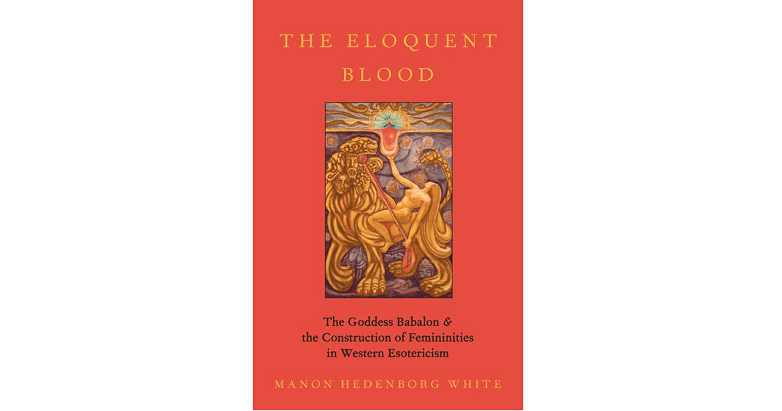
“The Eloquent Blood: The Goddess Babalon and the Construction of Femininities in Western Esotericism” by Manon Hedenborg White, Oxford University Press, 2019.
However, my recommendation comes with a couple of codicils, one of which is economic. As anyone who’s attended an institution of higher learning in the United States will attest, academic books are bloody expensive. I’m uneasy about the implications of authenticity and value only being acknowledged when delivered under the seal of academia, especially in light of the relevant issues of race, class, and economic privilege. However, this issue is somewhat ameliorated if you purchase directly from the publisher, who are currently offering a discount, and dodged completely if you request it from your local library.
The second issue, which I hesitate to mention, is one of accessibility. The Eloquent Blood is advanced material, a doctoral thesis written primarily for an academic audience, with both the tone and the sheer density of the material that implies. We need look no further than the book’s front cover, where we’re greeted by the subtitle “The Goddess Babalon and the Construction of Femininities in Western Esotericism,” to get a sense of the kind of writing and thinking within the covers. Turning to the table of contents, the reader is met by chapters titled “Divine Women, Femmes, and Whores: The Theorization of Multiple Femininities,” “Yielding Peaches and Women with Whips: Babalon, Crowley, and Magical Systematization 1911-1947,” “‘It All Goes in the Cup’: Receptivity and Unstable Polarities in the Contemporary Babalon Discourse,” and “Inhabiting the Uninhibited: Babalon, Sexual Politics, and the Liberation of the Desiring Feminine Subject.” Depending on your background and preferences, you might greet those titles with a glazed stare, a furrowed brow, or a gasp of delight. However, I promise that readers who push on will find the reward more than worth the effort. Dr. White’s writing is lucid and robust, both an aesthetic pleasure and an intellectual treat to read. As the saying goes, she knows her onions, and she’s more than happy to dice them in full view of the camera.
That’s all well and good, you might say, but garbled metaphors aside, why do I claim it’s the most important book of the past two decades in our field?
Because, dear readers, White pays her subject the profound honor of taking it seriously and on its own terms, making it a profoundly well-informed bridge between the worlds of academia and magical practice, and the single best explication of modern esoteric theology and praxis I’ve seen since Ronald Hutton’s The Triumph of the Moon. On one level, The Eloquent Blood is an overview of the role the goddess Babalon in Aleister Crowley’s religio-magical philosophy of Thelema, and an analysis of the ways in which she is venerated both within and beyond strictly Thelemic traditions. White spends considerable time and effort detailing how Crowley and his various disciples and partners—Leah Hirsig, Jack Parsons, Kenneth Grant, and others—worked with Babalon. It’s fascinating material, and if you’re not familiar with the history, much of it is essential for an understanding the roots of the modern Pagan movement. For me, the book truly comes into its own in the second half, where White uses the historical as a basis for delving into the contemporary and exploring the various ways in which modern devotees are enchanted, inspired, and enraptured by Babalon. From there, she examines the broader ramifications of this peculiarly flavor of goddess worship for sexuality, gender, queerness, occult practice, and culture, all without losing sight of the nature of Babalon as an esoteric, outsider goddess who speaks to so many, each in the voice they most need to hear.
“The Babalon discourse,” White writes in the book’s closing, “is an erotic discourse; a (queerly) feminine discourse; a hopeful, monstrous discourse messy with the blood of tender violence.” The Eloquent Blood is a brilliant contribution to that discourse, a spectacle of dark wonders and profound wisdom which sets an impressively high bar for any future continuation of our conversations about goddesses, feminism, femininities, and magic.
The Eloquent Blood: The Goddess Babalon and the Construction of Femininities in Western Esotericism by Manon Hedenborg White is available now from Oxford University Press.
[NB: I purchased a copy of this book for myself, and have received no compensation from the publisher for this review.]
Until next time, dear ones, read well. ♥

About Misha Magdalene
Misha Magdalene (Seattle) is a multi-classed, multi-geek, multi-queer witch and sorcerer with a degree in gender studies and a slightly odd sense of humor. They're an initiate of multiple lines of traditional witchcraft, including Anderson Feri and Gardnerian Wicca, and have also been known to dabble recklessly in both modern ceremonial magic and grimoiric goetia. They've been blogging since 2001, negotiating the online world since 1987, playing Dungeons & Dragons since 1981, and listening to weird music since birth. They live on occupied Duwamish territory in the Pacific Northwest with their polymath partner, their precocious daughter, far too much coffee-making apparatus, and a long-suffering bamboo plant named Smitty. You can find them on Facebook, Twitter, Pinterest, Tumblr, Instagram, and their very own website, or lurking somewhere around the Seattle area, usually hiding behind a cup of coffee. You can read more about the author here.
Previous Post

November 7, 2019
Critique as She Is Spoke: On Being "Pagan Enough" to Blog
Next Post

December 19, 2019 Unforgivable Curses: J.K. Rowling and the Tweet of Transphobia
Browse Our Archives
Select a Category Interviews Politics Reviews Social Justice Theology Uncategorized
Select a Month January 2021 December 2020 October 2020 August 2020 July 2020 May 2020 April 2020 March 2020 February 2020 January 2020 December 2019 November 2019 October 2019 September 2019 August 2019 July 2019 June 2019 May 2019 April 2019 March 2019 February 2019 January 2019 December 2018 November 2018 October 2018 September 2018 August 2018 July 2018 June 2018 May 2018 April 2018 March 2018 February 2018 January 2018 December 2017 November 2017 October 2017 September 2017 August 2017
Follow Us!
TAKE THE
Religious Wisdom Quiz
True or False: In John's Gospel, Jesus raises Lazarus from the dead after he had been in the tomb for four days.
Select your answer to see how you score.
TRUE FALSE
Related posts from Outside the Charmed Circle

Sunset Doesn't Last All Evening: A Coda and...

The Company We Keep: On Ethics, Values, and...

A Word Before the Drop: On Politics, Ethics,...

Misha's Lockdown Reading List: Yvonne Aburrow, "Dark Mirror"...
TRENDING AT PATHEOS Pagan

I was recently chatting with someone on Instagram. She asked me what...

While there are many people who share their results, the end of...

On July 23, I saw Christopher Nolan's The Odyssey which is Homer’s...

As I write this two big events have just finished up. One...

Restoring the Watershed of Divine Love
Perhaps cooperation is not something we manufacture through legislation, ideology, or moral...

Many UUs don’t pray because of bad experiences in a previous religion,...
view all Pagan blogs
Ad-Free & Subscriber Log-In Subscription Support
- About Us
- 2026 Calendar
- Videos
- Podcasts
- Library of World Religions
- Faith In Media Tracker
- Advertise With Us
- Write for Us
- Privacy Policy
- Terms of Service
- Do Not Sell My Data
- Contact Us
- Radiant Digital
- Manage Newsletter Subscriptions
- Unsubscribe From Notifications
- Sitemap
Copyright 2008-2026, Patheos. All rights reserved.
Subscription Support Ad-Free & Subscriber Log-In
Follow Patheos