
BuddhistCatholicContemplativeEvangelicalGeneral ChristianHinduJewishLatter-day SaintMuslimNew VisionsProgressive Christian
Beliefs
- Buddhist
- Catholic
- Contemplative
- Evangelical
- General Christian
- Hindu
- Jewish
- Latter-day Saint
- More Voices
- Muslim
- New Visions
- Pagan
- Progressive Christian
Topics
- Religion News
- Food and Religion
- Sports and Religion
- Religious Art
- Religious Music and Entertainment
- Religious Events
- History and Religion
- Style and Religion
- Politics and Religion
- Women in Religion
- Recreation Outdoors and Religion
- Business Finance and Religion
- Careers Workplace and Religion
- Education and Religion
- Family Parenting and Religion
- Health Fitness and Religion
- Home and Religion
- Relationships and Religion
- Technology and Religion
- Travel and Religion
Columnists
- Buddhist Columnists
- Business Finance and Religion Columnists
- Careers Workplace and Religion Columnists
- Catholic Columnists
- Contemplative Columnists
- Education and Religion Columnists
- Evangelists Columnists
- Family Parenting and Religion Columnists
- General Christian Columnists
- Health Fitness and Religion Columnists
- Hindu Columnists
- History and Religion Columnists
- Home and Religion Columnists
- Jewish Columnists
- More Voices Columnists
- Latter Day Columnists
- Muslim Columnists
- New Visions Columnists
- Nonreligious Columnists
- Pagan Columnists
- Politics and Religion Columnists
- Progressive Columnists
- Recreation Outdoors and Religion Columnists
- Relationships and Religion Columnists
- Religion News Columnists
- Religious Art Columnists
- Religious Events Columnists
- Religious Music and Entertainment Columnists
- Sports and Religion Columnists
- Style and Religion Columnists
- Technology and Religion Columnists
- Travel and Religion Columnists
- Women in Religion Columnists
Resource Library
- 2026 Calendar
- Library of World Religions
- The 100 Most Holy Places on Earth
- Patheos Answers
- Podcasts
- Videos
- Faith Leaders Database
- Anglican Episcopalian
- Bahai
- Baptist
- Buddhism
- Christianity
- Confucianism
- Eastern Orthodoxy
- Hinduism
- Holiness and Pentecostal
- ISKCON
- Islam
- Judaism
- Lutheran
- Methodist
- The Church of Jesus Christ of Latter-day Saints
- New Age
- Paganism
- Presbytarian and Reformed
- Protestantism
- Religion Behind the Scenes
- Roman Catholic
- Scientology
- Shia Islam
- Sikhism
- Sufism
- Sunni Islam
- Taoism
- Zen
- See all religions
Research Tools
 Ad-Free & Subscriber Log-In Subscription Support
Ad-Free & Subscriber Log-In Subscription Support
Follow Patheos 

- Trending:
- Forgiveness
- |
- Marriage
- |
- Consciousness
- |
- Death Penalty
- |
- Election
- |
- Halloween
 Outside the Charmed Circle
- Home
- Pagan
- Animism for Every Body: A Review of “Witchbody” by Sabrina Scott
Animism for Every Body: A Review of “Witchbody” by Sabrina Scott
Last updated on: April 8, 2019 at 10:01 pm by Misha Magdalene
Animism for Every Body: A Review of “Witchbody” by Sabrina Scott 2019-04-08T22:01:14-08:00 Misha Magdalene
Patheos Explore the world's faith through different perspectives on religion and spirituality! Patheos has the views of the prevalent religions and spiritualities of the world.
Hello, beautiful creatures.
I don’t write a lot of reviews for this blog, not because I’m at a loss for opinions, but because I’m never quite comfortable enacting what I believe to be the fundamental purpose of a review, which is to provide a reader with enough critical analysis to let them know if a given work is any damn good or not. Each of us is ensconced in our own histories and in the stories we tell ourselves about them, which are themselves shaped and influenced by the stories of those around us. In this state of entanglement, how can objectivity be anything but a myth? And yet, the very act of reviewing a work in itself positions the reviewer in an relationship of objectivity relative to the work being reviewed, regardless of the acknowledged subjectivity of the reviewer’s perspective. We, the readers, tend to assume that reviewers are somehow evaluating a work from “outside” the relational sphere, even if, on some level, we know better.
All of which is to say, I can’t tell you if something is any damn good by any standards other than my own, which may or may not mean anything to you.
Nevertheless, here we are. I’m approaching the prospect of reviewing this book with even more trepidation than usual, not because I don’t have strong opinions about the book, but because I suspect that all of the preceding babble about subjectivity applies in spades to the experience of reading Sabrina Scott‘s Witchbody. What you get out of this book will not be what I got, and that’s at least in part by design.
So, we’ll start with the question direct: is it any damn good, or not?
Yes, overall it’s quite good. It’s a challenging work, and in a couple of important ways, it’s not as accessible as it seems to aspire to being, but open-minded readers willing to meet it on its own terms stand to gain a lot from engaging with it.
It is also quite literally unlike any other occult book I’ve ever read… and, despite what one might think on first blush, it’s emphatically an occult book.
There, that’s the summation of the review. What follows is commentary, which you may take or leave as you so choose.
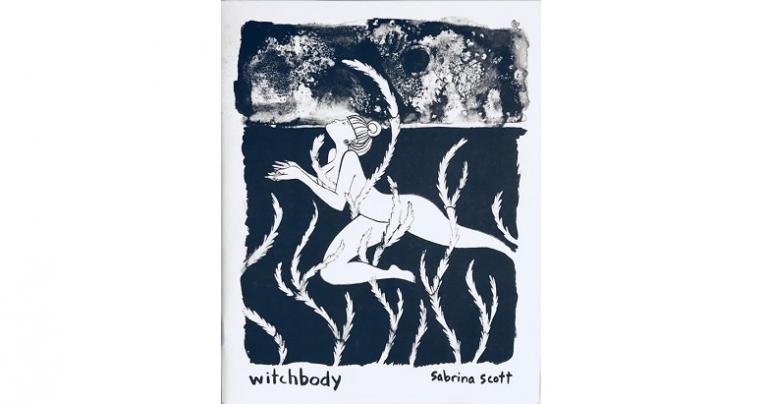
“Witchbody” by Sabrina Scott, Red Wheel/Weiser, 2018.
Now, what exactly is Witchbody?
The short, accurate-but-misleading answer is that it’s an occult graphic novel. Occult-themed graphic novels are nothing new, of course, as fans of Alan Moore, Grant Morrison, and Neil Gaiman will cheerfully attest, but Witchbody is something quite different. Essentially, it’s Sabrina Scott’s poetic expansion of an academic essay on witchcraft, magic, spiritual ecology, environmentalism, and ontology which comprises the thesis for her master’s degree in Environmental Studies, presented in the form of a graphic novel. Apart from the foreword, introduction, endnotes, and bibliography, the entire body of the book is made up of black-and-white illustrations, with accompanying hand-lettered text balloons, depicting a woman moving through her quotidian life in an unnamed city, interacting with and relating to her environment in both mundane and magical ways.
That last point cuts to the heart of the book’s themes. Distinctions like the one I just made are illusions we cast on ourselves, false dichotomies we use to separate ourselves from our environment. The power of witchcraft, as Scott illustrates it here, ultimately relies on an acknowledgement of the reality of our entanglement with our environment. It erases the lines we draw between “mundane” and “magical,” between “natural” and “artificial,” between “human and “not-human.” We aren’t simply moving through the world; we are in it and of it. We are a part of nature, and neither antibiotic soaps, nor aggressive recycling programs, nor Lesser Banishing Rituals of the Pentagram will ever elevate us above our environment. Through words and pictures, Scott lays out her argument that both our tiny little subculture of magical practitioners and the larger overculture in which we all live, move, and have our being have a desperate need to embrace something more more powerful than mere environmentalism. Though I don’t believe she ever uses the term, Witchbody espouses a kind of spiritual ecology which ultimately resolves to animism.
I realize that, to borrow the parlance of hipsters and trendleaders, animism is so hot right now, but bear with me. The animism of Witchbody isn’t the joyful serenity of Marie Kondo, nor is it the justifiably crabby doomsaying of John Michael Greer or Peter Grey. Rather, it’s a vision of the world around us as radically egalitarian and profoundly interrelated. Scott depicts this animism as the obvious philosophical and spiritual endpoint of environmentalism and, possibly, the only thing which can save us from ourselves and the disastrous mess we’ve made of the world, largely by seeing ourselves as separate from the world.
That’s a message all of us Pagans, polytheists, and occultists in the Western world could stand to internalize, and Witchbody swings for the fences trying to deliver the message. If neither factual dourness nor grim hectoring are sufficient to sway us from our present species-wide suicidal urges, perhaps it’s unfair to pin too many hopes on a charmingly hand-drawn, hand-lettered comic-book essay, but who knows? Convincing even one person is no small thing. So shines a good deed in a naughty world, as Shakespeare and Willy Wonka remind us.
With all that said, I have two criticisms: one technical, one conceptual.
The first issue, paradoxically, has to do with one of the more charming aspects of the book: its obvious handmade quality. As much as I enjoyed the artwork, I found the book’s actual text difficult to read, sometimes to the point of near-illegibility. That may have been simply a confluence of the book’s tiny lettering and my poor eyesight, but puzzling out the sentences and paragraphs became a chore it needn’t have been.
This difficulty complicated the second issue, a disagreement of tone and theme. Though perhaps I say it as shouldn’t, the book’s tone is highly variable, and to the detriment of the overall work. Scott interrupts her poetic, almost free verse style with large boluses of academic prose without warning, and utilizes technical terms—ontology, pedagogy, and so on—without providing either definitions or contextual clues by which a reader might puzzle out her meaning. The obvious rejoinders—that her tone is academic on purpose, and anyone can look up the meanings of words—are true enough, but overlook the fact that they do constitute an inconsistency of voice, one which creates a barrier to comprehension for the very people who would most benefit from a work like this.
Even with those stated critiques, I came away from the book thoughtful, sad, and strangely hopeful. I found many of Witchbody‘s images and passages thought-provoking and, in some cases, haunting. It’s a book I know I’ll read again, and which I’ll encourage those in my life to read and think about.
And that, dear reader, includes you.
Witchbody by Sabrina Scott is available now from Red Wheel/Weiser.
Until next time, dear ones, mind your step. ♥

About Misha Magdalene
Misha Magdalene (Seattle) is a multi-classed, multi-geek, multi-queer witch and sorcerer with a degree in gender studies and a slightly odd sense of humor. They're an initiate of multiple lines of traditional witchcraft, including the Anderson Feri tradition and Gardnerian Wicca, and have also been known to dabble recklessly in both modern ceremonial magic and grimoiric goetia. They've been blogging since 2001, negotiating the online world since 1987, playing Dungeons & Dragons since 1981, and listening to weird music since birth. They live on occupied Duwamish territory in the Pacific Northwest with their polymath partner, their precocious daughter, far too much coffee-making apparatus, and a long-suffering bamboo plant named Smitty. You can find them on Facebook, Twitter, Pinterest, Tumblr, Instagram, and their very own website, or lurking somewhere around the Seattle area, usually hiding behind a cup of coffee. You can read more about the author here.

Next Post

May 21, 2019 What Your Favorite Ritual Tool Says About You: An Exercise in Humor
Browse Our Archives
Select a Category Interviews Politics Reviews Social Justice Theology Uncategorized
Select a Month January 2021 December 2020 October 2020 August 2020 July 2020 May 2020 April 2020 March 2020 February 2020 January 2020 December 2019 November 2019 October 2019 September 2019 August 2019 July 2019 June 2019 May 2019 April 2019 March 2019 February 2019 January 2019 December 2018 November 2018 October 2018 September 2018 August 2018 July 2018 June 2018 May 2018 April 2018 March 2018 February 2018 January 2018 December 2017 November 2017 October 2017 September 2017 August 2017
Follow Us!
TAKE THE
Religious Wisdom Quiz
True or False: Cornelius was a Roman centurion who was the first Gentile convert.
Select your answer to see how you score.
FALSE TRUE
Related posts from Outside the Charmed Circle

Sunset Doesn't Last All Evening: A Coda and...

The Company We Keep: On Ethics, Values, and...

A Word Before the Drop: On Politics, Ethics,...

Misha's Lockdown Reading List: Yvonne Aburrow, "Dark Mirror"...
TRENDING AT PATHEOS Pagan

I was recently chatting with someone on Instagram. She asked me what...

While there are many people who share their results, the end of...

On July 23, I saw Christopher Nolan's The Odyssey which is Homer’s...

As I write this two big events have just finished up. One...

Restoring the Watershed of Divine Love
Perhaps cooperation is not something we manufacture through legislation, ideology, or moral...

Many UUs don’t pray because of bad experiences in a previous religion,...
view all Pagan blogs
Ad-Free & Subscriber Log-In Subscription Support
- About Us
- 2026 Calendar
- Videos
- Podcasts
- Library of World Religions
- Faith In Media Tracker
- Advertise With Us
- Write for Us
- Privacy Policy
- Terms of Service
- Do Not Sell My Data
- Contact Us
- Radiant Digital
- Manage Newsletter Subscriptions
- Unsubscribe From Notifications
- Sitemap
Copyright 2008-2026, Patheos. All rights reserved.
Subscription Support Ad-Free & Subscriber Log-In
Follow Patheos