
BuddhistCatholicContemplativeEvangelicalGeneral ChristianHinduJewishLatter-day SaintMuslimNew VisionsProgressive Christian
Beliefs
- Buddhist
- Catholic
- Contemplative
- Evangelical
- General Christian
- Hindu
- Jewish
- Latter-day Saint
- More Voices
- Muslim
- New Visions
- Pagan
- Progressive Christian
Topics
- Religion News
- Food and Religion
- Sports and Religion
- Religious Art
- Religious Music and Entertainment
- Religious Events
- History and Religion
- Style and Religion
- Politics and Religion
- Women in Religion
- Recreation Outdoors and Religion
- Business Finance and Religion
- Careers Workplace and Religion
- Education and Religion
- Family Parenting and Religion
- Health Fitness and Religion
- Home and Religion
- Relationships and Religion
- Technology and Religion
- Travel and Religion
Columnists
- Buddhist Columnists
- Business Finance and Religion Columnists
- Careers Workplace and Religion Columnists
- Catholic Columnists
- Contemplative Columnists
- Education and Religion Columnists
- Evangelists Columnists
- Family Parenting and Religion Columnists
- General Christian Columnists
- Health Fitness and Religion Columnists
- Hindu Columnists
- History and Religion Columnists
- Home and Religion Columnists
- Jewish Columnists
- More Voices Columnists
- Latter Day Columnists
- Muslim Columnists
- New Visions Columnists
- Nonreligious Columnists
- Pagan Columnists
- Politics and Religion Columnists
- Progressive Columnists
- Recreation Outdoors and Religion Columnists
- Relationships and Religion Columnists
- Religion News Columnists
- Religious Art Columnists
- Religious Events Columnists
- Religious Music and Entertainment Columnists
- Sports and Religion Columnists
- Style and Religion Columnists
- Technology and Religion Columnists
- Travel and Religion Columnists
- Women in Religion Columnists
Resource Library
- 2026 Calendar
- Library of World Religions
- The 100 Most Holy Places on Earth
- Patheos Answers
- Podcasts
- Videos
- Faith Leaders Database
- Anglican Episcopalian
- Bahai
- Baptist
- Buddhism
- Christianity
- Confucianism
- Eastern Orthodoxy
- Hinduism
- Holiness and Pentecostal
- ISKCON
- Islam
- Judaism
- Lutheran
- Methodist
- The Church of Jesus Christ of Latter-day Saints
- New Age
- Paganism
- Presbytarian and Reformed
- Protestantism
- Religion Behind the Scenes
- Roman Catholic
- Scientology
- Shia Islam
- Sikhism
- Sufism
- Sunni Islam
- Taoism
- Zen
- See all religions
Research Tools
 Ad-Free & Subscriber Log-In Subscription Support
Ad-Free & Subscriber Log-In Subscription Support
Follow Patheos 

- Trending:
- Forgiveness
- |
- Marriage
- |
- Consciousness
- |
- Death Penalty
- |
- Election
- |
- Halloween
 Outside the Charmed Circle
- Home
- Pagan
- A Green and Pleasant Land: On Belonging, Spirits, and Place
A Green and Pleasant Land: On Belonging, Spirits, and Place
Last updated on: May 19, 2018 at 9:34 am by Misha Magdalene
A Green and Pleasant Land: On Belonging, Spirits, and Place 2018-05-19T09:34:14-08:00 Misha Magdalene
Patheos Explore the world's faith through different perspectives on religion and spirituality! Patheos has the views of the prevalent religions and spiritualities of the world.
Hello, beautiful creatures.
Previously on Outside the Charmed Circle, I told a cautionary tale from my misspent youth about communing with the land, only to discover that not only did the land have something to say… and that it was deeply unhappy. Good times, right? The underlying point, however, wasn’t intended to be “some of us do stupid things when we’re sixteen,” but rather, “here are some of the sorts of things that can happen when you listen to the land.”
Today, I want to share another anecdote in a similar, albeit much less dramatic vein, and talk a little about listening to the land and the idea of “belonging.” In approaching these ideas, I’m going to make some statements about my own experiences: my “personal gnosis,” if you like, though I have issues with that framing1. In doing so, I want to make clear between us that I’m speaking only for my experiences, which apply to me, but won’t necessarily apply to you.
All clear? Good. So, to start with, let’s set the Wayback Machine… or, perhaps more appropriately, hop in the TARDIS.
Belonging in Albion and Éire
In September 2002, I fulfilled a lifelong dream of visiting the British Isles. Specifically, I spent two and half weeks in England, Scotland, and Ireland. In that time, I knocked around London and Norfolk, visited Glastonbury and Avebury, took a train to Edinburgh and Inverness, flew to Dublin for a weekend, and generally ran around desperately packing as many sights and experiences into seventeen days as I could. I may have been more than slightly manic about the whole thing.
It was my first time outside the United States, and from the moment I stepped off the plane, I felt something strange, something utterly magical. I spent several days over the next two and a half weeks struggling to find words for it. Much of that was in the form of incoherent babbling to my hosts, who seemed both amused and faintly bemused. It was an almost-physical sensation, something I could feel in my body, even under the most ordinary circumstances: lying in a borrowed bed, having tea in a garden, eating a so-help-me Burger King meal in Piccadilly Circus. I felt it while walking Neolithic sites in Avebury and Drogheda, sure, but also while watching Morris dancers outside a Norfolk pub or walking the cobblestone streets of Edinburgh, drinking in a glitzy Eurotrash bar in Inverness or standing, awestruck, in the Long Room at Trinity College in Dublin.
Finally, I was able to boil it down to something comprehensible: for literally the first time in my life, I felt seen and known by the land, right down to my bones. I felt like I belonged there, physically, as much a part of the landscape as the soil itself.
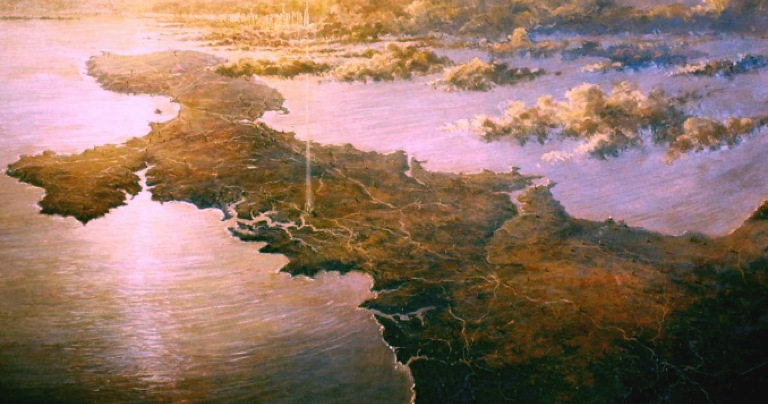
Detail from John Miller’s “Cornubia, Land of the Saints.”
It would be easy, I think, to chalk up that sensation of belonging to my chronic, hereditary love for the history and cultures of the British Isles, or with being enchanted by the lovely folks I was meeting. It would be similarly easy to write it off as the ethnic equivalent of confirmation bias. After all, my ancestors had come from England, Scotland, and Ireland, and being here was a sort of homecoming.
Any of those explanations sound reasonable, but none of them touch that nigh-physical sensation of belonging I mentioned. Standing on the “green and pleasant land” of William Blake’s poem felt… right. The trees, rocks, and dirt felt right. The skies looked right, even when they opened up and dumped a bucket of gusty London rain on me, destroying two umbrellas in five minutes’ time. It was unnerving, and numinous, and utterly joyful.
Walk (Un)like an Egyptian
It wasn’t entirely a numinous and joyful trip, though. One of the more curious moments of my British Isles sojourn put that experience of belonging into a broader context, which was both uniquely educational and distinctly unpleasant.
While in London, I visited the British Museum. If you ever have the opportunity to do so, take it. It’s an amazing experience.
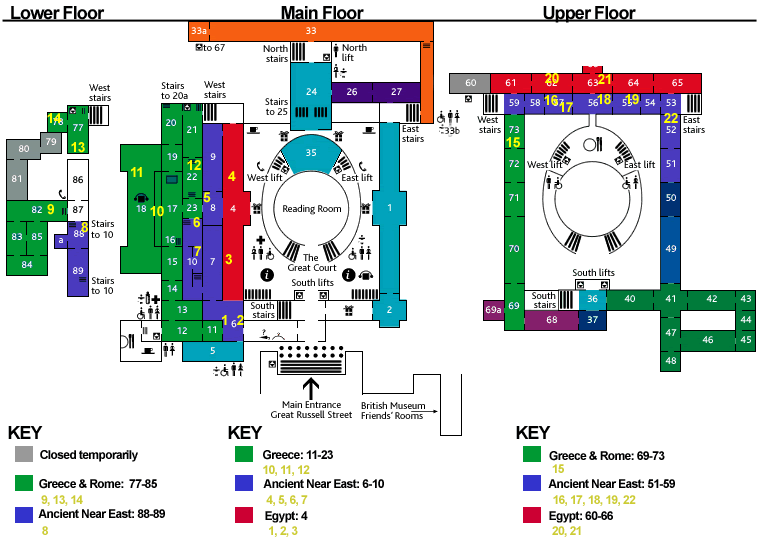
A map of the British Museum as of July 2003, less than a year after I visited.
On the map above, to the left of the central Great Court on the main floor, you’ll see a long room in red. That’s the main body of the Egyptian exhibit. I’m told there are a lot of amazing artefacts in that room. There were certainly a lot of things there, but I couldn’t tell anything about them, because I was in the room for less than a minute. I walked into from the Great Court with a companion, and came to an abrupt standstill in the center (about where the little white “4” is) for about ten seconds. Then I turned to my companion, said “Nope!” and kept on walking to the blue room further to left.
I don’t claim any great powers of clairsentience or psychic sensitivity. All I can tell you is that there were a lot of artefacts in that big, drafty room. A lot of those artefacts had spirits associated with them. And every single one of those spirits was pissed about being there.
It was a dissonant, nerve-wracking experience to be strolling through the museum, feeling that sense of belonging—utterly at home and at peace on that land—and walk into a room full of spirits who had been stolen from their homes, spirits who were alien to that land and most definitely not at peace. These were spirits rooted in Kemet, in the soil and history of Egypt, and they’d been uprooted and abducted to this cold, drafty country, put on display for tourists with cameras and audio-tour headphones. They didn’t belong there, and they didn’t want to be there.
I went and looked at the Sutton Hoo treasures instead. Much more soothing. Nothing in that exhibit snarled in anger, accused me of theft, or brooded over wrongs both ancient and modern.
That moment in the Egyptian exhibit stayed with me. It drove home some uncomfortable points about English history and cultural imperialism… which, in turn, underscored some uncomfortable things about American culture—which, after all, derives in great part from English history and culture—and our own ghastly history of cultural imperialism. It gave me a lot of food for thought about belonging, and what it meant for cultures and spirits, human and otherwise, to exist in relation to place.
More on that anon. Until next time, dear ones, be safe. ♥
- “What issues?” you ask. Okay, this’ll probably wind up as a longer piece, but the short version is that in my understanding, gnosis—experiential spiritual knowledge—is always a personal experience. After all, experience is subjective. As such, the reflexive framing of “personal gnosis,” especially in the context of the popular Pagan phrase “unsubstantiated personal gnosis,” seems more like a way to undermine the validity of someone’s spiritual experience than a legitimate form of taxonomy.

About Misha Magdalene
Misha Magdalene (Seattle) is a multi-classed, multi-geek, multi-queer witch and sorcerer with a degree in gender studies and a slightly odd sense of humor. They're an initiate of multiple lines of traditional witchcraft, including the Anderson Feri tradition and Gardnerian Wicca, and have also been known to dabble recklessly in both modern ceremonial magic and grimoiric goetia. They've been blogging since 2001, negotiating the online world since 1987, playing Dungeons & Dragons since 1981, and listening to weird music since birth. They live on occupied Duwamish territory in the Pacific Northwest with their polymath partner, their precocious daughter, far too much coffee-making apparatus, and a long-suffering bamboo plant named Smitty. You can find them on Facebook, Twitter, Pinterest, Tumblr and Instagram, or lurking somewhere around the Seattle area, usually hiding behind a cup of coffee. You can read more about the author here.
Previous Post

May 16, 2018
A Presence Beneath Our Feet: An Anecdote on Communing with the Mountain

Browse Our Archives
Select a Category Interviews Politics Reviews Social Justice Theology Uncategorized
Select a Month January 2021 December 2020 October 2020 August 2020 July 2020 May 2020 April 2020 March 2020 February 2020 January 2020 December 2019 November 2019 October 2019 September 2019 August 2019 July 2019 June 2019 May 2019 April 2019 March 2019 February 2019 January 2019 December 2018 November 2018 October 2018 September 2018 August 2018 July 2018 June 2018 May 2018 April 2018 March 2018 February 2018 January 2018 December 2017 November 2017 October 2017 September 2017 August 2017
Follow Us!
TAKE THE
Religious Wisdom Quiz
Which Christian denomination is most associated with the Reformation led by Martin Luther?
Select your answer to see how you score.
Orthodox Lutheran Catholic Anglican
Related posts from Outside the Charmed Circle

Sunset Doesn't Last All Evening: A Coda and...

The Company We Keep: On Ethics, Values, and...

A Word Before the Drop: On Politics, Ethics,...

Misha's Lockdown Reading List: Yvonne Aburrow, "Dark Mirror"...
TRENDING AT PATHEOS Pagan

I was recently chatting with someone on Instagram. She asked me what...

While there are many people who share their results, the end of...

On July 23, I saw Christopher Nolan's The Odyssey which is Homer’s...

As I write this two big events have just finished up. One...

Restoring the Watershed of Divine Love
Perhaps cooperation is not something we manufacture through legislation, ideology, or moral...

Many UUs don’t pray because of bad experiences in a previous religion,...
view all Pagan blogs
Ad-Free & Subscriber Log-In Subscription Support
- About Us
- 2026 Calendar
- Videos
- Podcasts
- Library of World Religions
- Faith In Media Tracker
- Advertise With Us
- Write for Us
- Privacy Policy
- Terms of Service
- Do Not Sell My Data
- Contact Us
- Radiant Digital
- Manage Newsletter Subscriptions
- Unsubscribe From Notifications
- Sitemap
Copyright 2008-2026, Patheos. All rights reserved.
Subscription Support Ad-Free & Subscriber Log-In
Follow Patheos