
BuddhistCatholicContemplativeEvangelicalGeneral ChristianHinduJewishLatter-day SaintMuslimNew VisionsProgressive Christian
Beliefs
- Buddhist
- Catholic
- Contemplative
- Evangelical
- General Christian
- Hindu
- Jewish
- Latter-day Saint
- More Voices
- Muslim
- New Visions
- Pagan
- Progressive Christian
Topics
- Religion News
- Food and Religion
- Sports and Religion
- Religious Art
- Religious Music and Entertainment
- Religious Events
- History and Religion
- Style and Religion
- Politics and Religion
- Women in Religion
- Recreation Outdoors and Religion
- Business Finance and Religion
- Careers Workplace and Religion
- Education and Religion
- Family Parenting and Religion
- Health Fitness and Religion
- Home and Religion
- Relationships and Religion
- Technology and Religion
- Travel and Religion
Columnists
- Buddhist Columnists
- Business Finance and Religion Columnists
- Careers Workplace and Religion Columnists
- Catholic Columnists
- Contemplative Columnists
- Education and Religion Columnists
- Evangelists Columnists
- Family Parenting and Religion Columnists
- General Christian Columnists
- Health Fitness and Religion Columnists
- Hindu Columnists
- History and Religion Columnists
- Home and Religion Columnists
- Jewish Columnists
- More Voices Columnists
- Latter Day Columnists
- Muslim Columnists
- New Visions Columnists
- Nonreligious Columnists
- Pagan Columnists
- Politics and Religion Columnists
- Progressive Columnists
- Recreation Outdoors and Religion Columnists
- Relationships and Religion Columnists
- Religion News Columnists
- Religious Art Columnists
- Religious Events Columnists
- Religious Music and Entertainment Columnists
- Sports and Religion Columnists
- Style and Religion Columnists
- Technology and Religion Columnists
- Travel and Religion Columnists
- Women in Religion Columnists
Resource Library
- 2026 Calendar
- Library of World Religions
- The 100 Most Holy Places on Earth
- Patheos Answers
- Podcasts
- Videos
- Faith Leaders Database
- Anglican Episcopalian
- Bahai
- Baptist
- Buddhism
- Christianity
- Confucianism
- Eastern Orthodoxy
- Hinduism
- Holiness and Pentecostal
- ISKCON
- Islam
- Judaism
- Lutheran
- Methodist
- The Church of Jesus Christ of Latter-day Saints
- New Age
- Paganism
- Presbytarian and Reformed
- Protestantism
- Religion Behind the Scenes
- Roman Catholic
- Scientology
- Shia Islam
- Sikhism
- Sufism
- Sunni Islam
- Taoism
- Zen
- See all religions
Research Tools
 Ad-Free & Subscriber Log-In Subscription Support
Ad-Free & Subscriber Log-In Subscription Support
Follow Patheos 

- Trending:
- Forgiveness
- |
- Marriage
- |
- Consciousness
- |
- Death Penalty
- |
- Election
- |
- Halloween
 Outside the Charmed Circle
- Home
- Pagan
- Marks of the Witch: The Bend, the Need, and the Will
Marks of the Witch: The Bend, the Need, and the Will
Last updated on: July 10, 2018 at 10:18 am by Misha Magdalene
Marks of the Witch: The Bend, the Need, and the Will 2018-07-10T10:18:34-08:00 Misha Magdalene
Patheos Explore the world's faith through different perspectives on religion and spirituality! Patheos has the views of the prevalent religions and spiritualities of the world.
Hello, beautiful creatures.
Like so many of us making our way through This Modern World, I spend a dismaying amount of time in morning traffic. Blessedly, much of the irritation of being forced to endure crowded freeways, poorly-maintained roads, and squirrelly drivers is alleviated by sharing my commute with my beloved partner. We spend our morning commute listening to the best radio station on the planet and having wide-ranging conversations about everything from the state of modern music (which is awesome) to the state of our household (which is cluttered, but cozy) to the state of modern American politics (which is a dumpster fire inside a car fire).
Yesterday morning, we were discussing the predilection of some religious movements to engage in “us vs. them” tactics, othering anyone who doesn’t fit within the charmed circle of their approval as a way to shore up their own group identities. This led to a discussion of the “in/out” dynamic in relation to witchcraft, which led to discussing precisely what it means to be a witch.
So, what is it that makes one a witch?
Hoo boy, is that ever a loaded question. I mean, my mother always taught me to treat any question as though it were loaded, but I can think of no situation in which that question isn’t loaded. For starters, it’s armed with the built-in, unexamined assumption that there’s some irreducible quality (or set of qualities) which “makes someone a witch.” This is an assumption I’m unwilling to let slide, because it leads by very short steps to the kind of moralistic elitism that turns into another “us vs. them” shouting match… or shooting match.
But seriously, what makes someone a witch?
Some folks claim to be “born witches.” This is a claim I’m entirely unqualified to judge. Others claim you have to be “made a witch,” usually through an initiatory ritual or experience. This is certainly true for some traditional iterations of witchcraft, but tells us little about what actually makes someone “witch material.” In both cases, though, the ontological state of “being a witch” is conferred by some outside force, whether hereditary, cultural, or pedagogical.
As against that, I suggest that a witch is defined by what they do, rather than by what they are. In other words, you don’t have to be born a witch to be a witch. You just have to do witchcraft. And if you do witchcraft, you’re a witch.
It’s tempting to just leave it at that, but it might be useful to deconstruct and rebuild the original question, though, because I think there’s actually an interesting question hiding inside it. Rather than asking what makes somebody a witch, let’s ask why someone would want to be one. What qualities in a person’s life lead them to doing witchcraft, to becoming a witch?
I won’t claim to have the answer, but I have some ideas that might lean in the direction of an answer. In my experience, most folks who find themselves on the Crooked Path, by whatever name (if any) they call it, share in common a set of traits I think of as “witches’ marks,” as a kind of reclamation of the old inquisitorial legend.
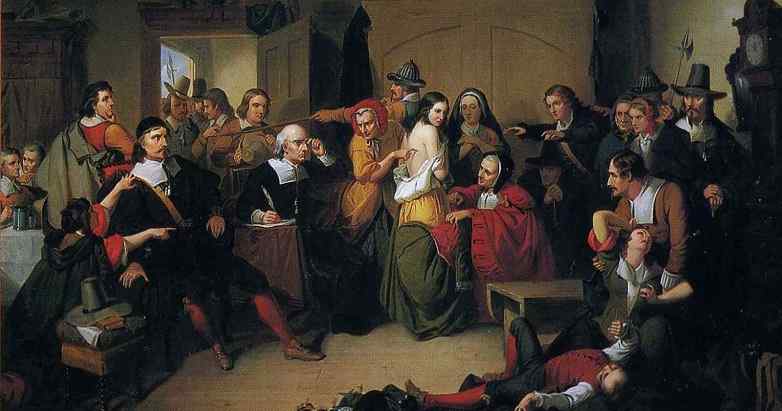
Looking for witches’ marks in the bad old days. (“Examination of a Witch” by T. H. Matteson, 1813-1884.)
No one of these marks is determinative in its own right; indeed, it’s entirely possible to have all three marks and still not feel any draw to the practice and path of witchery. I think you’ll find, though, that these marks are present to one degree or another in everyone who’s ever heard what Nigel Jackson called “the Call of the Horned Piper.”
I call these marks the Bend, the Need, and the Will.
The Bend
One of the suggested etymological sources of the word witch is the Proto-Indo-European root *weik-, meaning “to curve or bend.” Much has been made of this root, with its suggestion that witches are those who bend reality to suit their will.
Perhaps this is because most witches are kind of bent in their thinking.
I’m not seriously positing this as an etymological theory, but my statement is quite serious. Most of us who practice witchery, or indeed any other magical praxis, have a certain bent way of seeing the world, a kind of “thinking around corners.” We tend to be the sort of people who look for faeries at the bottom of the garden… or who, when confronted with an “either/or” proposition, look for the “and.” We tend to see the world not only as it is, but as it could be—perhaps, as it wants to be—with just the right application of something.
And that something, for witches, is magic.
The Need
Thorn Coyle recounts in her book Evolutionary Witchcraft how Victor Anderson, the late grandmaster of the Feri Tradition, taught her that witchcraft was born out of human suffering. A survey of the documented history of witchcraft in cultures around the world will back this up. Witches were the ones you went to for solutions when all other options were exhausted. Do you have a sick child, or a sick cow? Are you yourself love-sick, or plagued with a persistent suitor? Do you need to turn a landlord’s heart, or win over a magistrate? Whatever your need, the witch can weave a spell to meet it.
What of the witch’s need, though?
In all of us who set out on the Crooked Path, there is an unanswered desire, an unmet need which no witch can ensorcel… unless we become the witch. For each of us, that need wears a different mask. Some call it peace, or mystical union, or harmony with nature. Others may call it pleasure, or joy, or gnosis. They come from different places in our lives: a broken home life, an abusive past, an alienation from the modern world, a nagging sense that there’s something more to all of this than what we can see.
Underlying all of those names, though, is the need at the core of them all: power.
People sometimes get a little uneasy when I say that the need at the heart of witchcraft is about power. I suspect that’s due in part to the p-word community’s allergy to accusations of EVIL DEMONIC POWERS (tee hee!), and in part to our uneasy relationship with power as a real force for change. That’s a longer subject than I have space for here (and besides, I’ve touched on it in previous posts), but it’s worth remembering that power is, in itself, entirely neutral. It’s the means by which we get that power and the uses to which we put it that make give power a moral weight. The same match that lights a building on fire can light a hearth-fire, and the same hand which caresses a cheek can slap it. Power is how we make things happen. It’s what you do, and what you sacrifice to do it, that matters.
The Will
Having a bent brain and a need for power aren’t enough, though. If those were all it took to be a witch, the world would never want for blessings or hexes. Beyond them, there’s the question of will. As everyone from Doreen Valiente to Dion Fortune to Aleister freakin’ Crowley has reminded us, will is a different sort of thing from wishing or wanting. Will is an active verb, an action. To will something to be or to happen is to effect a change in reality, and—important note!—to tie yourself to that change in reality. To will something into being is to make a choice and own it, accepting the responsibility for that choice. Whatever happens, happens, and you will always have been the one to have made it happen, no take-backs, no get-out-of-jail-free cards. Buy the ticket, take the ride.
Perhaps this may come as a surprise, but many people aren’t interested to do that. Some don’t want to have to pay those bills when they comes due, and so are unwilling to incur the debt. This is a perfectly reasonable stance to take. Other folks are perfectly happy to change reality, but want to skip out on the check. I’d say this is a “less reasonable” stance, but honestly, that’s not strong enough. It’s delusional to the point of self-destruction, and when the check finally comes due… yikes2.
These, then, are some of the marks of the witch: the ability to conceive of the world as a magical place, the desire to be a part of that magic, and the willingness to engage with it. After all, to be a witch is to be a worker of will, a shaper of reality, and to work your will, you must have both a need to do so, and a vision of how it can be done. If you have these things, these marks, odds are you’d make an excellent witch.
Until next time, dear ones, make good choices. ♥
- A good definition of othering, from There Are No Others: “…any action by which an individual or group becomes mentally classified in somebody’s mind as ‘not one of us’.”
- No, I’m not trying to slip some Westernized notion of karma in here. It’s just a question of cause and effect. Our debts have a way of coming home to roost, will we or nill we.

About Misha Magdalene
Misha Magdalene (Seattle) is a multi-classed, multi-geek, multi-queer witch and sorcerer with a degree in gender studies and a slightly odd sense of humor. They're an initiate of multiple lines of traditional witchcraft, including the Anderson Feri tradition and Gardnerian Wicca, and have also been known to dabble recklessly in both modern ceremonial magic and grimoiric goetia. They've been blogging since 2001, negotiating the online world since 1987, playing Dungeons & Dragons since 1981, and listening to weird music since birth. They live on occupied Duwamish territory in the Pacific Northwest with their polymath partner, their precocious daughter, far too much coffee-making apparatus, and a long-suffering bamboo plant named Smitty. You can find them on Facebook, Twitter, Pinterest, Tumblr and Instagram, or lurking somewhere around the Seattle area, usually hiding behind a cup of coffee. You can read more about the author here.
Previous Post
April 11, 2018
Book Review: "Becoming Dangerous" (ed. Katie West and Jasmine Elliott)
Next Post
April 18, 2018 Beltane, as Viewed from Outside the Maypole Dance
Browse Our Archives
Select a Category Interviews Politics Reviews Social Justice Theology Uncategorized
Select a Month January 2021 December 2020 October 2020 August 2020 July 2020 May 2020 April 2020 March 2020 February 2020 January 2020 December 2019 November 2019 October 2019 September 2019 August 2019 July 2019 June 2019 May 2019 April 2019 March 2019 February 2019 January 2019 December 2018 November 2018 October 2018 September 2018 August 2018 July 2018 June 2018 May 2018 April 2018 March 2018 February 2018 January 2018 December 2017 November 2017 October 2017 September 2017 August 2017
Follow Us!
TAKE THE
Religious Wisdom Quiz
Who tricked Isaac into giving him Esau's blessing?
Select your answer to see how you score.
Laban Jacob Leah Rebekah
Related posts from Outside the Charmed Circle

Sunset Doesn't Last All Evening: A Coda and...

The Company We Keep: On Ethics, Values, and...

A Word Before the Drop: On Politics, Ethics,...

Misha's Lockdown Reading List: Yvonne Aburrow, "Dark Mirror"...
TRENDING AT PATHEOS Pagan

I was recently chatting with someone on Instagram. She asked me what...

While there are many people who share their results, the end of...

On July 23, I saw Christopher Nolan's The Odyssey which is Homer’s...

As I write this two big events have just finished up. One...

Restoring the Watershed of Divine Love
Perhaps cooperation is not something we manufacture through legislation, ideology, or moral...

Many UUs don’t pray because of bad experiences in a previous religion,...
view all Pagan blogs
Ad-Free & Subscriber Log-In Subscription Support
- About Us
- 2026 Calendar
- Videos
- Podcasts
- Library of World Religions
- Faith In Media Tracker
- Advertise With Us
- Write for Us
- Privacy Policy
- Terms of Service
- Do Not Sell My Data
- Contact Us
- Radiant Digital
- Manage Newsletter Subscriptions
- Unsubscribe From Notifications
- Sitemap
Copyright 2008-2026, Patheos. All rights reserved.
Subscription Support Ad-Free & Subscriber Log-In
Follow Patheos