
BuddhistCatholicContemplativeEvangelicalGeneral ChristianHinduJewishLatter-day SaintMuslimNew VisionsProgressive Christian
Beliefs
- Buddhist
- Catholic
- Contemplative
- Evangelical
- General Christian
- Hindu
- Jewish
- Latter-day Saint
- More Voices
- Muslim
- New Visions
- Pagan
- Progressive Christian
Topics
- Religion News
- Food and Religion
- Sports and Religion
- Religious Art
- Religious Music and Entertainment
- Religious Events
- History and Religion
- Style and Religion
- Politics and Religion
- Women in Religion
- Recreation Outdoors and Religion
- Business Finance and Religion
- Careers Workplace and Religion
- Education and Religion
- Family Parenting and Religion
- Health Fitness and Religion
- Home and Religion
- Relationships and Religion
- Technology and Religion
- Travel and Religion
Columnists
- Buddhist Columnists
- Business Finance and Religion Columnists
- Careers Workplace and Religion Columnists
- Catholic Columnists
- Contemplative Columnists
- Education and Religion Columnists
- Evangelists Columnists
- Family Parenting and Religion Columnists
- General Christian Columnists
- Health Fitness and Religion Columnists
- Hindu Columnists
- History and Religion Columnists
- Home and Religion Columnists
- Jewish Columnists
- More Voices Columnists
- Latter Day Columnists
- Muslim Columnists
- New Visions Columnists
- Nonreligious Columnists
- Pagan Columnists
- Politics and Religion Columnists
- Progressive Columnists
- Recreation Outdoors and Religion Columnists
- Relationships and Religion Columnists
- Religion News Columnists
- Religious Art Columnists
- Religious Events Columnists
- Religious Music and Entertainment Columnists
- Sports and Religion Columnists
- Style and Religion Columnists
- Technology and Religion Columnists
- Travel and Religion Columnists
- Women in Religion Columnists
Resource Library
- 2026 Calendar
- Library of World Religions
- The 100 Most Holy Places on Earth
- Patheos Answers
- Podcasts
- Videos
- Faith Leaders Database
- Anglican Episcopalian
- Bahai
- Baptist
- Buddhism
- Christianity
- Confucianism
- Eastern Orthodoxy
- Hinduism
- Holiness and Pentecostal
- ISKCON
- Islam
- Judaism
- Lutheran
- Methodist
- The Church of Jesus Christ of Latter-day Saints
- New Age
- Paganism
- Presbytarian and Reformed
- Protestantism
- Religion Behind the Scenes
- Roman Catholic
- Scientology
- Shia Islam
- Sikhism
- Sufism
- Sunni Islam
- Taoism
- Zen
- See all religions
Research Tools
 Ad-Free & Subscriber Log-In Subscription Support
Ad-Free & Subscriber Log-In Subscription Support
Follow Patheos 

- Trending:
- Forgiveness
- |
- Marriage
- |
- Consciousness
- |
- Death Penalty
- |
- Election
- |
- Halloween
 Outside the Charmed Circle
- Home
- Pagan
- Beltane, as Viewed from Outside the Maypole Dance
Beltane, as Viewed from Outside the Maypole Dance
Last updated on: April 18, 2018 at 1:56 pm by Misha Magdalene
Beltane, as Viewed from Outside the Maypole Dance 2018-04-18T13:56:16-08:00 Misha Magdalene
Patheos Explore the world's faith through different perspectives on religion and spirituality! Patheos has the views of the prevalent religions and spiritualities of the world.
Hello, beautiful creatures.
April is drawing to a close, taking with it both its attendant showers and its unseasonably chilly weather, and the flowers promised in May are already starting to put in an appearance. All of this meteorological and botanical wackiness heralds the arrival not only of something actually resembling Spring, but of Beltane, that much-beloved Celtic fire-festival which has been adopted and adapted by Wiccans and other p-word folks. In many ways, it can be seen as Samhain’s opposite number on the Wheel of the Year; where Samhain is a solemn observance of mortality and what lies beyond the gates of Death, Beltane is a celebration of life and, for a great many people, the means by which life comes into being.
That’s right, I’m talking about sex. Again. And you’re not even surprised, because if there’s any occasion suited to talking about sex, Beltane would be it. I mean, what could be more appropriate? It’s a fertility festival, after all! You don’t have to be Fellini to figure out the symbolism of a bunch of people, um, erecting a maypole and dancing around it, right? And, of course, there’s the classic folk rhyme associated with May Day:
Hurray, hurray, the first of May!
Outdoor fucking starts today!
Yes, well. At the risk of sounding like I’m hiding behind the ironically popular social-media game of “Unpopular Opinion” here, I’m going to out myself a bit and confess that, as much as I’m indifferent about most of the Wheel of the Year, I really don’t get along well with Beltane.
Of course, that’s probably not terribly surprising, since I’ve written before about my ambivalent relationship with the Wheel of the Year. However, my feelings of “meh” about Beltane are complicated. They’re tied up with my feelings about sexuality, culture, and the intersection of those things with spiritual practice, both on an intellectual level and on an emotional level rooted in my own experience. If you’ve read my blog for any length of time, you’re aware that I’m sex-positive, but I find a lot of the exuberant “sex-positivity” that runs rampant through much of the Pagan, polytheist, and magical practitioner communities around this time to be… well, a little tin-eared.
Here, I’ll explain.
I remember an outdoor Beltane many years ago, a popular event with the Pagan community in my area. The “official” start of the festivities involved all the men gathering one one side of the ritual field, and all the women gathering at the other. The men had hold of the maypole raised like a battering ram, while the women had hold of the beribboned floral crown which was to sit atop the maypole. The two teams faced off with each other, trading “flirtatious” comments heavy on the sexual innuendo, before positioning the crown in front of the maypole. The two artifacts were then rocked back and forth in front of one another, to the accompaniment of much moaning and yelping. Finally, the crown was finally mounted at the tip of the maypole, which was then erected in the center of the dancing field. The ribbons dangled down, and everyone grabbed an end—everyone, that is, except for the May Queen and the Green Man, our personifications of female and male divinity. They joined hands around the maypole, and we all danced around them, weaving in and out, drawing closer and closer to them, until at last they were firmly bound to the pole together. The power of the ritual was gathered and passed through them, then fired up the maypole to rain down on us all…
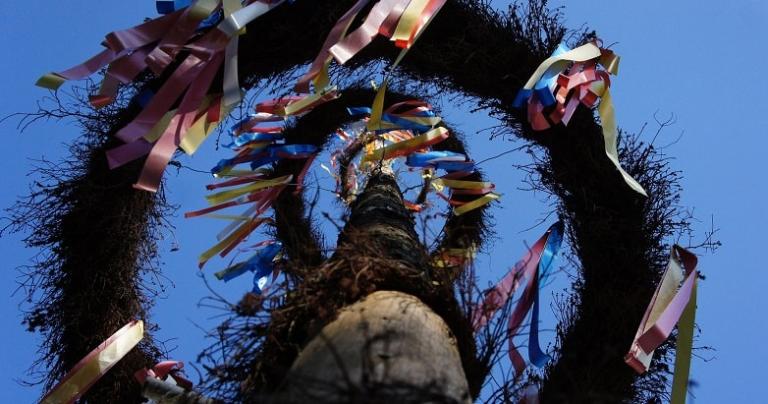
Looking up the, er, shaft of the maypole. I’m sure this isn’t symbolic… (Image via Pixabay.)
Ahem.
I don’t think it’s stretching the point to suggest this rite was a reification of heterosexual, penis-in-vagina intercourse, nor that the central component of the rite was phallic worship. Likewise, I don’t think there’s anything wrong with that, in and of itself, but…
…you knew there’s going to be a “but” here, right?
I found myself wondering how many of the women on the “girls’ side” in this ritual had been victims of sexual assault. I wondered how many of the men on the “boys’ side” were secretly embarrassed by the macho posturing. I wondered how many people on either side felt forced into these gendered, sexualized roles against their wishes or preferences, all because it was an expected part of the ritual. I wondered how many people were engaging in the lascivious banter because they felt they were required to, and how many were doing it because they got a thrill out of saying sexually explicit things in semi-public.
Most of all, I wondered how many of us were queer. I wondered how many of us were here, taking part in the ritual or watching from the sidelines, celebrating a glorification and valorization of gender and sexual roles from which we were, and would always be, excluded.
Some folks might think I’m being overly critical and unfairly negative about a ritual that’s all in good fun. You might think I’m thinking about it too much, and maybe you’re right… but as much fun as it might be for some folks, there are going to be folks for whom ritual simulated heterosexual intercourse isn’t their cup of tea.
“Well, then those people shouldn’t come!” some of you may reply.
Indeed… and that’s the very definition of exclusion. If your high holy day is predicated on a “mystery” that either requires people to lie about their truest selves or bars them from participation, I’m going to go out on a limb and say that there’s something very, very wrong with your mystery.
It’s especially frustrating because there’s so much about Beltane to love. Looking back at Lá Bealtaine (if you’re Irish) or Là Bealltainn (if you’re Scottish), we can see the festival as a celebration of fire, an honoring of its role in the communal lives of the people, as well as a reaffirmation of their relationship with the land and its spirits. Scarlet Magdalene and Cyndi Brannen have both written lovely pieces about the aspects of Beltane that resonate for me, as well as touching on the parts that, speaking frankly, I’d rather eat my copy of Eight Sabbats for Witches than ever have to sit through again.
And no, I’m not suggesting that we burn the maypoles and the flower crowns… not all of them, anyway. Maypole dances can be fun, and so can flower crowns. There’s nothing wrong with the sexiness of Beltane, but there’s more to Beltane than sex. Similarly, there’s nothing wrong with maypoles and flower crowns, but goodness knows, there’s more to sex than penis worship.
So yes, let’s all have fun… but let’s try to make it fun we can all share in, okay?
Until next time, dear ones, take care with yourselves, and with each other. ♥

About Misha Magdalene
Misha Magdalene (Seattle) is a multi-classed, multi-geek, multi-queer witch and sorcerer with a degree in gender studies and a slightly odd sense of humor. They're an initiate of multiple lines of traditional witchcraft, including the Anderson Feri tradition and Gardnerian Wicca, and have also been known to dabble recklessly in both modern ceremonial magic and grimoiric goetia. They've been blogging since 2001, negotiating the online world since 1987, playing Dungeons & Dragons since 1981, and listening to weird music since birth. They live on occupied Duwamish territory in the Pacific Northwest with their polymath partner, their precocious daughter, far too much coffee-making apparatus, and a long-suffering bamboo plant named Smitty. You can find them on Facebook, Twitter, Pinterest, Tumblr and Instagram, or lurking somewhere around the Seattle area, usually hiding behind a cup of coffee. You can read more about the author here.
Previous Post

April 13, 2018
Marks of the Witch: The Bend, the Need, and the Will
Next Post

April 26, 2018 Coloring Outside the Lines: Troubling Gender and the Myth of Universality
Browse Our Archives
Select a Category Interviews Politics Reviews Social Justice Theology Uncategorized
Select a Month January 2021 December 2020 October 2020 August 2020 July 2020 May 2020 April 2020 March 2020 February 2020 January 2020 December 2019 November 2019 October 2019 September 2019 August 2019 July 2019 June 2019 May 2019 April 2019 March 2019 February 2019 January 2019 December 2018 November 2018 October 2018 September 2018 August 2018 July 2018 June 2018 May 2018 April 2018 March 2018 February 2018 January 2018 December 2017 November 2017 October 2017 September 2017 August 2017
Follow Us!
TAKE THE
Religious Wisdom Quiz
Who interpreted dreams for a Pharaoh and a baker?
Select your answer to see how you score.
Daniel Aaron Moses Joseph
Related posts from Outside the Charmed Circle

Sunset Doesn't Last All Evening: A Coda and...

The Company We Keep: On Ethics, Values, and...

A Word Before the Drop: On Politics, Ethics,...

Misha's Lockdown Reading List: Yvonne Aburrow, "Dark Mirror"...
TRENDING AT PATHEOS Pagan

I was recently chatting with someone on Instagram. She asked me what...

While there are many people who share their results, the end of...

On July 23, I saw Christopher Nolan's The Odyssey which is Homer’s...

As I write this two big events have just finished up. One...

Restoring the Watershed of Divine Love
Perhaps cooperation is not something we manufacture through legislation, ideology, or moral...

Many UUs don’t pray because of bad experiences in a previous religion,...
view all Pagan blogs
Ad-Free & Subscriber Log-In Subscription Support
- About Us
- 2026 Calendar
- Videos
- Podcasts
- Library of World Religions
- Faith In Media Tracker
- Advertise With Us
- Write for Us
- Privacy Policy
- Terms of Service
- Do Not Sell My Data
- Contact Us
- Radiant Digital
- Manage Newsletter Subscriptions
- Unsubscribe From Notifications
- Sitemap
Copyright 2008-2026, Patheos. All rights reserved.
Subscription Support Ad-Free & Subscriber Log-In
Follow Patheos