
BuddhistCatholicContemplativeEvangelicalGeneral ChristianHinduJewishLatter-day SaintMuslimNew VisionsProgressive Christian
Beliefs
- Buddhist
- Catholic
- Contemplative
- Evangelical
- General Christian
- Hindu
- Jewish
- Latter-day Saint
- More Voices
- Muslim
- New Visions
- Pagan
- Progressive Christian
Topics
- Religion News
- Food and Religion
- Sports and Religion
- Religious Art
- Religious Music and Entertainment
- Religious Events
- History and Religion
- Style and Religion
- Politics and Religion
- Women in Religion
- Recreation Outdoors and Religion
- Business Finance and Religion
- Careers Workplace and Religion
- Education and Religion
- Family Parenting and Religion
- Health Fitness and Religion
- Home and Religion
- Relationships and Religion
- Technology and Religion
- Travel and Religion
Columnists
- Buddhist Columnists
- Business Finance and Religion Columnists
- Careers Workplace and Religion Columnists
- Catholic Columnists
- Contemplative Columnists
- Education and Religion Columnists
- Evangelists Columnists
- Family Parenting and Religion Columnists
- General Christian Columnists
- Health Fitness and Religion Columnists
- Hindu Columnists
- History and Religion Columnists
- Home and Religion Columnists
- Jewish Columnists
- More Voices Columnists
- Latter Day Columnists
- Muslim Columnists
- New Visions Columnists
- Nonreligious Columnists
- Pagan Columnists
- Politics and Religion Columnists
- Progressive Columnists
- Recreation Outdoors and Religion Columnists
- Relationships and Religion Columnists
- Religion News Columnists
- Religious Art Columnists
- Religious Events Columnists
- Religious Music and Entertainment Columnists
- Sports and Religion Columnists
- Style and Religion Columnists
- Technology and Religion Columnists
- Travel and Religion Columnists
- Women in Religion Columnists
Resource Library
- 2026 Calendar
- Library of World Religions
- The 100 Most Holy Places on Earth
- Patheos Answers
- Podcasts
- Videos
- Faith Leaders Database
- Anglican Episcopalian
- Bahai
- Baptist
- Buddhism
- Christianity
- Confucianism
- Eastern Orthodoxy
- Hinduism
- Holiness and Pentecostal
- ISKCON
- Islam
- Judaism
- Lutheran
- Methodist
- The Church of Jesus Christ of Latter-day Saints
- New Age
- Paganism
- Presbytarian and Reformed
- Protestantism
- Religion Behind the Scenes
- Roman Catholic
- Scientology
- Shia Islam
- Sikhism
- Sufism
- Sunni Islam
- Taoism
- Zen
- See all religions
Research Tools
 Ad-Free & Subscriber Log-In Subscription Support
Ad-Free & Subscriber Log-In Subscription Support
Follow Patheos 

- Trending:
- Forgiveness
- |
- Marriage
- |
- Consciousness
- |
- Death Penalty
- |
- Election
- |
- Halloween
 Outside the Charmed Circle
- Home
- Pagan
- Words Mean Things: A Resource for Discussing Gender and Sexuality
Words Mean Things: A Resource for Discussing Gender and Sexuality
Last updated on: February 26, 2018 at 6:32 pm by Misha Magdalene
Words Mean Things: A Resource for Discussing Gender and Sexuality 2018-02-26T18:32:14-08:00 Misha Magdalene
Patheos Explore the world's faith through different perspectives on religion and spirituality! Patheos has the views of the prevalent religions and spiritualities of the world.
Hello, beautiful creatures! So, I’m slowly on the mend from the con crud I discussed previously, and doing some unpacking from PantheaCon, both literally and metaphorically. One of the interesting things about the weekend, which I’ve been chewing on ever since, has to do with the understandings of gender and sexuality we have in the modern p-word community, and the words we use to talk about them. It also has to do, strangely enough, with ribbons.
So, quick explanation: at many conventions, there’s a thing where people make and give away satin ribbons to attach to the bottom of your convention membership badge. Some folks collect these ribbons, and wind up with long sashes of ribbons trailing from their convention badges. Some ribbons have funny sayings on them, some indicate association or alignment with a spiritual tradition or group, and some advertise a business, service, or artistic endeavor.
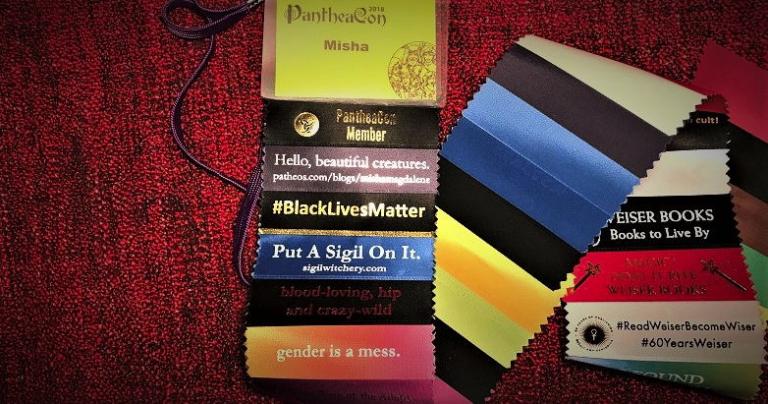
Or, y’know, a blog or something. Ahem.
My partner and I went to PantheaCon with several different ribbons to give away to folks. We had a Chuck Tingle ribbon (“TROT Proudly, Prove LOVE”), a #BlackLivesMatter ribbon, a ribbon with a quote from a Victor Anderson poem, and a poem advertising this very blog. These were all pretty popular, but by far the most popular ribbon we brought was a rainbow-hued ribbon printed, in white letters, with the message “gender is a mess.” (You can see it at the bottom of the photo above.) This is something I’ve been saying for a few years now, and decided on a whim to print as a ribbon. Some people were delighted by that one, and others were perplexed or curious and wanted to talk about it with us. They wanted to talk about gender and sexuality, and about the intersections of those two. One woman said to my partner, with honest confusion, “Things are changing so much! There used to be just two genders, and now there’s more, and I don’t understand it.” My partner pointed out, gently, that there’ve always been more than two genders, and that our culture is just starting to be more aware of it now, a point which the woman seemed to take to heart.
This was a poignant interaction for my partner, and I was quite moved when she shared it with me. We both believe that outreach and education are key in fostering understanding and acceptance, so we were more than happy to have those conversations. However, conventions are notoriously difficult places to have those conversations. They tend to be long and complicated, touching on psychology, gender theory, feminist analysis, sociology, biology, and cultural anthropology. It’s kind of impossible to cover all that ground in thirty seconds on an elevator.
As LGBTQIA+ people become more, and more visibly, a part of the Pagan, polytheist, and occult communities, these kinds of conversations become more common, and more necessary. One of the possible sticking points is the terminology we use to describe and define our identities and experiences, some of which derives from the academic world of gender theory and feminist studies. So, at the risk of waxing overly academic, I’ve defined some of these terms in the hopes of clarifying some of the discourse around these subjects. Feel free to use this as a resource, and as a starting point for discussions, with the caveat that these are my interpretations of these identifiers, as colored by my experiences and background. Other folks may (and will) have their own interpretations, and quite probably their own take on definitions.
(Content warning: Some of these definitions also make reference to deprecated terms and slang words used as slurs, many of which can be deeply hurtful to people against whom those terms are used. Please exercise caution and self-care.)
Straight
This generally refers to people of a binary gender, “male” or “female,” who are sexually and/or romantically attracted to people perceived as being of the “opposite” gender. The technical term is “heterosexual,” sometimes abbreviated as “hetero” or “het” in certain circles.
LGBTQIA+
An acronym for Lesbian, Gay, Bisexual, Transgender, Queer/Questioning, Intersex, and Asexual/Aromantic, with the plus sign standing in for other identities not addressed by those terms.
Gay
So, this term covers a lot of ground. Let’s break it down, shall we?
- Most commonly, it refers to people who are primarily or exclusively sexually and/or romantically attracted to people perceived as having the same binary gender, also known as “homosexuality.” (While “homo” is sometimes used as an abbreviation, be advised that this has highly negative connotations in most circles, equivalent to other homophobic slurs, and should really be avoided unless you’re gay yourself.)
- Another common usage refers specifically to men who are primarily or exclusively sexually and/or romantically attracted to other men, though this isn’t universal.
- Curiously, it’s also used a blanket term to refer to anyone who isn’t straight. This usage is both historical (as with the Gay Liberation Front of the late 1960s and 1970s) and current, especially among some younger LGBTQIA+ people. (For more on this, see “Queer” below.)
I know it’s confusing. I wish I could say it gets less so, but… well, let’s move on.
Lesbian
This refers to women who are primarily or exclusively sexually and/or romantically attracted to other women.
Bisexual and Pansexual
These terms are sometimes seen as interchangeable, and other times as distinct orientations. Bisexuality refers to people of any gender who are sexually and/or romantically attracted both to people who share their gender and to those who don’t. Pansexuality was coined in response to the perception that “bisexual” reinforced a binary gender paradigm of being attracted to “both men and women,” which would exclude people outside that binary. (As a personal aside, I refer to myself by both terms, depending on the context. Many people have strong feelings about one or the other. When in doubt, ask the person how they’d like to be described.)
Transgender
If you don’t identify with the gender you were assigned at birth, you’re transgender, sometimes abbreviated as “trans.” The Latin prefix trans- means “on the other side” or “across,” and can be found all over the place: transmission, translate, Transylvania, and so on. There’s no slur, criticism, or judgment inherent in the term, but certain colloquial abbreviations of it, such as “tranny” or “transie,” are often used as highly offensive slurs, and should be avoided by anyone who isn’t themselves transgender. The older term “transsexual” has largely been deprecated, but is still used by some trans people to reflect their personal experience of being transgender, especially for those who’ve opted to pursue medical transition. Again, I suggest avoiding this term unless you are trans yourself, or (in this case) you’ve been explicitly asked by a particular person to use this term to refer to them.
Cisgender
If, on the other hand, you do identify as the gender you were assigned at birth, you’re cisgender, sometimes abbreviated as “cis.” That’s it. That’s all it means. There’s no slur, criticism, or judgment built into the term, honest. The Latin prefix cis- means “on the same side,” and can be found in various other words and phrases, such as Cisalpine Gaul (“the part of Gaul on the same side of the Alps as Rome”).
Queer
I talked about my definition of the word “queer” in my belated introductory post, but to recap: “queer” is a reclaimed slur used by some people within the LGBTQIA+ community as an umbrella term to cover all of us whose gender and sexual identities exist outside the “charmed circle” of cisgender heterosexuality. Note that not all LGBTQIA+ people identify as queer, and some find the term distasteful or contentious.
Nonbinary, Agender, Neutrois, Androgynous, Genderqueer, Gender-nonconforming, and more!
These are all terms referring to people whose experiences of gender don’t fit neatly within the binary male/female gender paradigm common to Western culture. Some of these folks identify as transgender, while others don’t; as ever, it’s always a good idea to find out how an individual person identifies before using that term. There’s a bit to get a handle on here, so take a deep breath and let’s dash through it!
“Nonbinary” refers to people who don’t identify with either of the binary gender options in Western culture, “male” or “female,” regardless of what they were assigned at birth. Related terms include “agender” and “neutrois,” which both refer to people who view themselves as genderless, and “gender-fluid,” which describes people whose experience of gender can be variable, depending on mood, context, and any number of other factors.
“Androgynous” is a term which is sometimes used for people whose experience and expression of gender incorporates attributes commonly ascribed to both men and women. It’s less common than it used to be, and I’d avoid using it unless someone has told you directly that this is the term they use. Are you spotting a theme here?
“Genderqueer” describes people whose identities and expressions of identity play with or “queer” gender, while “gender-nonconforming” describes people whose outward expressions of identity don’t match their gender identity.
For reference purposes: your humble author identifies as a nonbinary, agender androgyne, all under the transgender umbrella.
Intersex
The United Nations Office of the High Commissioner for Human Rights defines intersex as follows:
Intersex people are born with sex characteristics (including genitals, gonads and chromosome patterns) that do not fit typical binary notions of male or female bodies.
Intersex is an umbrella term used to describe a wide range of natural bodily variations. In some cases, intersex traits are visible at birth while in others, they are not apparent until puberty. Some chromosomal intersex variations may not be physically apparent at all.
The term “hermaphrodite,” from the Greek deity Hermaphroditus, has been used in the past to refer to intersex people, but as this term is stigmatizing and often used as something of a slur, I’d strongly recommend avoiding it. It’s also worth noting that being intersex is not the same as being transgender. While some intersex people may identify as transgender, the majority of them do not, and the issues each group faces are distinct.
Asexual, Demisexual, and Aromantic
Simply put, people who are asexual don’t experience sexual attraction. Some lack any sort of sexual inclination or arousal, while others may experience arousal, but without a concomitant desire to have partnered sex. A common misconception is that asexuals suffer from some past trauma which has rendered them phobic about sex. In reality, most asexuality has no causal link to trauma. It may help to think of asexuality as the sexual orientation that isn’t. Most asexuals are perfectly well-adjusted people who happen to lack any interest in sexuality and, in my experience, tend to find the whole thing somewhat bemusing.
Demisexuality is sometimes seen as a subset of asexuality, and refers to folks whose sexuality is only engaged in the context of an emotional bond or relationship. This isn’t about a “save it for marriage!” sort of morality; demisexuals literally don’t feel sexual attraction to a person unless they feel something emotionally for them first.
Aromantic folks don’t experience what we tend to think of as “romantic” love. Note: this doesn’t mean they don’t love! Aromantic people can have a wide range of loving relationships, just not romantic ones.
Resources
The following is a quick list of resources to learn more about many of the sexual and gender identities described above. Please note that a listing here does not necessarily indicate endorsement of any organization’s full platform or dealings. While I’ve done my best to vet all of these sources, a complete exploration of their doings and goings-on is beyond my means.
GLAAD
PFLAG
The Advocate
Lesbian.com
BiNet USA
National Center for Transgender Equality
Genderqueer and Non-binary Identities
Neutrois.com
Intersex Society of North America
Asexual Visibility and Education Network
Demisexuality Resource Center
Until next time, dear ones, be sweet to each other. ♥
Previous Post

February 22, 2018
Some Unconventional Thoughts about Pagan Conventions
Next Post

March 1, 2018 Answer Me These Questions Three: A Word for Discerning Seekers
Browse Our Archives
Select a Category Interviews Politics Reviews Social Justice Theology Uncategorized
Select a Month January 2021 December 2020 October 2020 August 2020 July 2020 May 2020 April 2020 March 2020 February 2020 January 2020 December 2019 November 2019 October 2019 September 2019 August 2019 July 2019 June 2019 May 2019 April 2019 March 2019 February 2019 January 2019 December 2018 November 2018 October 2018 September 2018 August 2018 July 2018 June 2018 May 2018 April 2018 March 2018 February 2018 January 2018 December 2017 November 2017 October 2017 September 2017 August 2017
Follow Us!
TAKE THE
Religious Wisdom Quiz
Why was crossing the Jordan River particularly difficult for the Israelites at that time?
Select your answer to see how you score.
The river was filled with crocodiles It was at flood stage The river was frozen There were no bridges
Related posts from Outside the Charmed Circle

Sunset Doesn't Last All Evening: A Coda and...

The Company We Keep: On Ethics, Values, and...

A Word Before the Drop: On Politics, Ethics,...

A Hole in Our Midst: On Moral Vulnerabilities...
TRENDING AT PATHEOS Pagan

I was recently chatting with someone on Instagram. She asked me what...

While there are many people who share their results, the end of...

On July 23, I saw Christopher Nolan's The Odyssey which is Homer’s...

As I write this two big events have just finished up. One...

Restoring the Watershed of Divine Love
Perhaps cooperation is not something we manufacture through legislation, ideology, or moral...

Many UUs don’t pray because of bad experiences in a previous religion,...
view all Pagan blogs
Ad-Free & Subscriber Log-In Subscription Support
- About Us
- 2026 Calendar
- Videos
- Podcasts
- Library of World Religions
- Faith In Media Tracker
- Advertise With Us
- Write for Us
- Privacy Policy
- Terms of Service
- Do Not Sell My Data
- Contact Us
- Radiant Digital
- Manage Newsletter Subscriptions
- Unsubscribe From Notifications
- Sitemap
Copyright 2008-2026, Patheos. All rights reserved.
Subscription Support Ad-Free & Subscriber Log-In
Follow Patheos