
BuddhistCatholicContemplativeEvangelicalGeneral ChristianHinduJewishLatter-day SaintMuslimNew VisionsProgressive Christian
Beliefs
- Buddhist
- Catholic
- Contemplative
- Evangelical
- General Christian
- Hindu
- Jewish
- Latter-day Saint
- More Voices
- Muslim
- New Visions
- Pagan
- Progressive Christian
Topics
- Religion News
- Food and Religion
- Sports and Religion
- Religious Art
- Religious Music and Entertainment
- Religious Events
- History and Religion
- Style and Religion
- Politics and Religion
- Women in Religion
- Recreation Outdoors and Religion
- Business Finance and Religion
- Careers Workplace and Religion
- Education and Religion
- Family Parenting and Religion
- Health Fitness and Religion
- Home and Religion
- Relationships and Religion
- Technology and Religion
- Travel and Religion
Columnists
- Buddhist Columnists
- Business Finance and Religion Columnists
- Careers Workplace and Religion Columnists
- Catholic Columnists
- Contemplative Columnists
- Education and Religion Columnists
- Evangelists Columnists
- Family Parenting and Religion Columnists
- General Christian Columnists
- Health Fitness and Religion Columnists
- Hindu Columnists
- History and Religion Columnists
- Home and Religion Columnists
- Jewish Columnists
- More Voices Columnists
- Latter Day Columnists
- Muslim Columnists
- New Visions Columnists
- Nonreligious Columnists
- Pagan Columnists
- Politics and Religion Columnists
- Progressive Columnists
- Recreation Outdoors and Religion Columnists
- Relationships and Religion Columnists
- Religion News Columnists
- Religious Art Columnists
- Religious Events Columnists
- Religious Music and Entertainment Columnists
- Sports and Religion Columnists
- Style and Religion Columnists
- Technology and Religion Columnists
- Travel and Religion Columnists
- Women in Religion Columnists
Resource Library
- 2026 Calendar
- Library of World Religions
- The 100 Most Holy Places on Earth
- Patheos Answers
- Podcasts
- Videos
- Faith Leaders Database
- Anglican Episcopalian
- Bahai
- Baptist
- Buddhism
- Christianity
- Confucianism
- Eastern Orthodoxy
- Hinduism
- Holiness and Pentecostal
- ISKCON
- Islam
- Judaism
- Lutheran
- Methodist
- The Church of Jesus Christ of Latter-day Saints
- New Age
- Paganism
- Presbytarian and Reformed
- Protestantism
- Religion Behind the Scenes
- Roman Catholic
- Scientology
- Shia Islam
- Sikhism
- Sufism
- Sunni Islam
- Taoism
- Zen
- See all religions
Research Tools
 Ad-Free & Subscriber Log-In Subscription Support
Ad-Free & Subscriber Log-In Subscription Support
Follow Patheos 

- Trending:
- Forgiveness
- |
- Marriage
- |
- Consciousness
- |
- Death Penalty
- |
- Election
- |
- Halloween
 Outside the Charmed Circle
- Home
- Pagan
- Memories of the First Books: Deities & Demigods
Memories of the First Books: Deities & Demigods
Last updated on: January 17, 2018 at 3:57 am by Misha Magdalene
Memories of the First Books: Deities & Demigods 2018-01-17T03:57:18-08:00 Misha Magdalene
Patheos Explore the world's faith through different perspectives on religion and spirituality! Patheos has the views of the prevalent religions and spiritualities of the world.
Hello, beautiful creatures, and happy new Western calendar year! Now that we’ve stepped out of the radioactive dumpster fire that was 2017 and into what I’m certain will be the Lisa Frank rainbow-kitten-cupcake paradise of 20181, I thought it might be nice to start things off with a bit of fluff about deities and role-playing games. Yes, I know, the last time I said that I wound up ranting at some length about issues of consent in Pagan, polytheist, and magical practice… but I mean it this time!
Well, kind of.
As I’ve written previously, part of my early exposure to the wonderful world of polytheism, paganism, and magic was mediated through the Dungeons & Dragons role-playing game. I realize this is nowhere near as cool and legitimate as being born into a family tradition or initiated by the local neighbor lady who just happened to be the last scion of a dying line of witchcraft, but hey, we work with what we’ve got, right? And honestly, D&D was far from the worst introduction I could’ve had. It excited me about multiple genres of fiction, strengthened my imaginative faculties, and encouraged me to explore and understand the vast array of spiritual traditions throughout history. More than that, it introduced me to the idea that there were ways of being a spiritual person beyond the handful of Christian denominations I’d encountered. There were so many gods in the world! Gods who weren’t Abrahamic, gods who weren’t white, gods who weren’t men. There were gods who weren’t boring and ordinary, who weren’t essentially my friends’ parents writ large.
As a white kid from a multiethnic family growing up in the suburban central California of the 1980s, this was pretty exciting stuff. It was made all the more exciting when I encountered the 1980 D&D supplement book Deities & Demigods, a compendium of gods, demigods, and heroes2 with whom players can interact, drawing from various historical and fictional pantheons. Entering my life when it did, right around the same time I was plowing my way through Hamilton, Bulfinch, and the d’Aulaires, Deities & Demigods built a tidy little bridge between their historical mythologies and the epic sword-and-sorcery games and novels that formed a large chunk of my worldview. It encouraged me to see gods not merely as characters in a book, but as beings with whom I could actually interact… even if in the context of a glorified game of “let’s pretend.”
So, allow me to introduce you to the first god with whom I truly felt any sort of resonance or kinship.
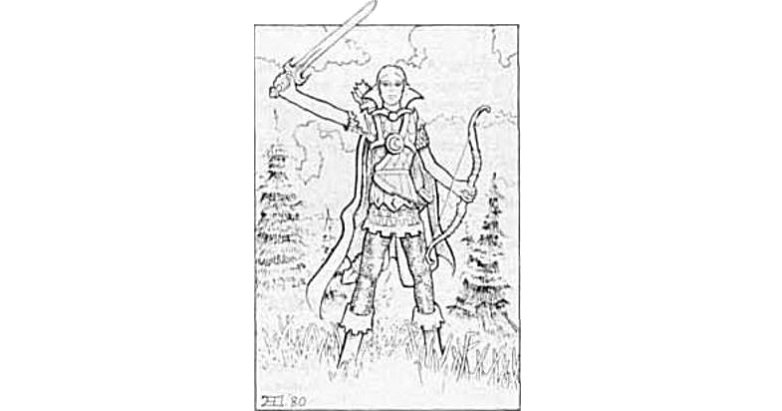
Artwork by Erol Otus from the first edition of Deities & Demigods by James M. Ward with Robert J. Kuntz, copyright Ⓒ 1980 by TSR, Inc.
The image above shows the greater god Corellon Larethian, principal deity of the Elvish pantheon in D&D, as drawn by the iconic fantasy artist Erol Otus. Corellon is identified in the accompanying text as the Elvish patron of music, poetry, and magic, who “represents the highest ideals of elvenkind.” The god is stated to be “mighty in battle,” as well as being the progenitor of the Elven race, which “sprang from the drops of blood Corellon shed” whilst battling Lolth, Demon Queen of Spiders. This was all pretty impressive, but what was utterly earthshaking for me was the sentence sandwiched between Corellon’s divine portfolio and the praise for the god’s fighting prowess:
“Corellon is alternately male and female, both or neither.”
In other words, the makers of Dungeons & Dragons published an official rulebook in 1980, for a game widely thought of as a nerdy kids’ pastime, in which the primary figure of a major race’s pantheon was a nonbinary, genderqueer, transgender deity. If you’re having trouble envisioning this, Stranger Things offers up a reasonably faithful recreation of the common view of D&D at the time in the first few minutes of the first episode. Watch that, then consider: those adorable little kids understood the idea that Corellon Larethian’s gender was “both or neither” perfectly well, thank you very much.
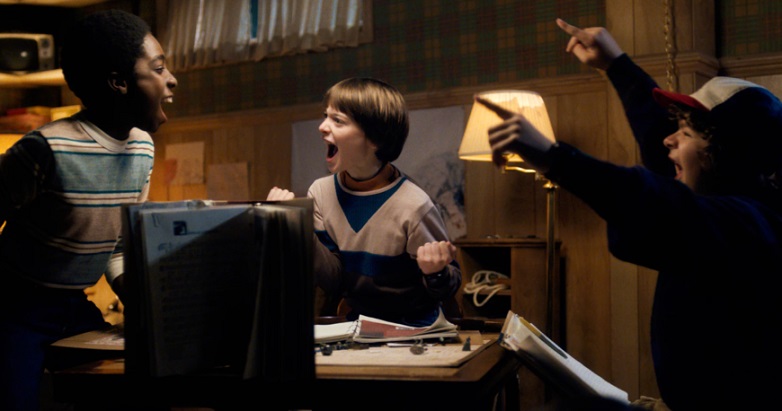
Yes, these kids. They’re smarter than you think, I promise. (Image copyright © 2016 Netflix.)
How do I know? Easy. I was one of those kids. I found D&D in 1981 or so, and got a copy of Deities & Demigods not terribly long after. That’s when I first encountered Corellon Larethian, and when I first realized that there were people thinking outside the framework of binary gender. Hell, it’s where I realized there even could be something outside the binary. The other fey, genderqueer, genderfucking heroes of my youth and adolescence—David Bowie, Annie Lennox, Prince, Tilda Swinton—all came much later. Before any of them, there was a bow-shooting, demon-fighting creator god/dess wielding a sword made from the heart of a star, not merely crossing lines of gender but utterly obliterating them. Corellon Larethian was a fictional god created for a tabletop roleplaying game, yes, but they were also my first exposure to a theology and a cosmology large enough to include someone like me.
Not bad for a “kids’ game.”
Nor was this an oddity unique to a single book from the early days of D&D. The recent 5th edition Player’s Handbook, published in 2014, ratifies the canonical state of Corellon’s gender as “all and none” on page 121, and expands on its implications: “The elf god Corellon Larethian is often seen as androgynous or hermaphroditic, for example, and some elves in the multiverse are made in Corellon’s image.” It’s worth noting that this passage is part of a larger paragraph about D&D players not needing “to be confined to binary notions of sex and gender” when creating their characters3.
So, if both the makers and the players of Dungeons & Dragons could wrap our delightfully nerdy little heads around the existence of queer gods—transgender, nonbinary, genderqueer, androgynous, hermaphroditic gods—in the same year that Ronald Reagan was elected president, and if those same makers and players today can cheerfully countenance gods, characters, and the players themselves being of any gender (or none at all!), I’m left with an uncomfortable question: what exactly is the modern Pagan and polytheist communities’ excuse for failing to do the same?
I mean, we don’t even have the excuse of scarcity. There are several notable deities across various historical pantheons who’ve queered gender in a variety of ways: Aphrodite and Dionysus from the Greeks, Ymir and Loki from the Norse, Lilith from Mesopotamian and Jewish mythology, the Man in Black in some forms of traditional witchcraft, and numerous others. Our gods have always been queer in one way or another, have always resisted convenient categorization. Similarly, people who queer gender, like people who queer sexuality, are hardly a modern phenomenon. They’ve always been with us, as far back as we care to research… if we’re honest with ourselves, that is.
In the end, the boxes into which we shove other beings, whether human or divine, say far more about our own insecurities and biases than they do about the beings themselves.
More on this anon, as ever. Until then, dear ones, let’s start smearing cupcake frosting all over 2018, shall we? ♥
- Let me dream, okay?
- Fun fact: Gods, Demi-Gods & Heroes was actually the title of the original D&D supplement predecessor to Deities & Demigods.
- Yes, I’m aware there’ve been numerous whiny man-children venting a lot of pearl-clutching arsedribble about “social justice warriors ruining D&D” with their overt acceptance of genderqueerness, including an enthusiastic inclusion of transgender characters and players. As with the similar nonsense around the latest Star Wars movie, a careful alchemical distillation of this arsedribble will reveal its constituent elements as the usual whiny man-child toxicity: sexism, racism, homophobia, transphobia, and a complete failure of critical thinking.
Previous Post

January 5, 2018
A Blessing for the New Year
Next Post

January 13, 2018 A Long, Cold Look in the Mirror
Browse Our Archives
Select a Category Interviews Politics Reviews Social Justice Theology Uncategorized
Select a Month January 2021 December 2020 October 2020 August 2020 July 2020 May 2020 April 2020 March 2020 February 2020 January 2020 December 2019 November 2019 October 2019 September 2019 August 2019 July 2019 June 2019 May 2019 April 2019 March 2019 February 2019 January 2019 December 2018 November 2018 October 2018 September 2018 August 2018 July 2018 June 2018 May 2018 April 2018 March 2018 February 2018 January 2018 December 2017 November 2017 October 2017 September 2017 August 2017
Follow Us!
TAKE THE
Religious Wisdom Quiz
What is Paul's longest letter, with the fullest explanation of the gospel?
Select your answer to see how you score.
1 Corinthians Romans 2 Corinthians James
Related posts from Outside the Charmed Circle

Sunset Doesn't Last All Evening: A Coda and...

The Company We Keep: On Ethics, Values, and...

A Word Before the Drop: On Politics, Ethics,...

Misha's Lockdown Reading List: Yvonne Aburrow, "Dark Mirror"...
TRENDING AT PATHEOS Pagan

I was recently chatting with someone on Instagram. She asked me what...

While there are many people who share their results, the end of...

On July 23, I saw Christopher Nolan's The Odyssey which is Homer’s...

As I write this two big events have just finished up. One...

Restoring the Watershed of Divine Love
Perhaps cooperation is not something we manufacture through legislation, ideology, or moral...

Many UUs don’t pray because of bad experiences in a previous religion,...
view all Pagan blogs
Ad-Free & Subscriber Log-In Subscription Support
- About Us
- 2026 Calendar
- Videos
- Podcasts
- Library of World Religions
- Faith In Media Tracker
- Advertise With Us
- Write for Us
- Privacy Policy
- Terms of Service
- Do Not Sell My Data
- Contact Us
- Radiant Digital
- Manage Newsletter Subscriptions
- Unsubscribe From Notifications
- Sitemap
Copyright 2008-2026, Patheos. All rights reserved.
Subscription Support Ad-Free & Subscriber Log-In
Follow Patheos