
BuddhistCatholicContemplativeEvangelicalGeneral ChristianHinduJewishLatter-day SaintMuslimNew VisionsProgressive Christian
Beliefs
- Buddhist
- Catholic
- Contemplative
- Evangelical
- General Christian
- Hindu
- Jewish
- Latter-day Saint
- More Voices
- Muslim
- New Visions
- Pagan
- Progressive Christian
Topics
- Religion News
- Food and Religion
- Sports and Religion
- Religious Art
- Religious Music and Entertainment
- Religious Events
- History and Religion
- Style and Religion
- Politics and Religion
- Women in Religion
- Recreation Outdoors and Religion
- Business Finance and Religion
- Careers Workplace and Religion
- Education and Religion
- Family Parenting and Religion
- Health Fitness and Religion
- Home and Religion
- Relationships and Religion
- Technology and Religion
- Travel and Religion
Columnists
- Buddhist Columnists
- Business Finance and Religion Columnists
- Careers Workplace and Religion Columnists
- Catholic Columnists
- Contemplative Columnists
- Education and Religion Columnists
- Evangelists Columnists
- Family Parenting and Religion Columnists
- General Christian Columnists
- Health Fitness and Religion Columnists
- Hindu Columnists
- History and Religion Columnists
- Home and Religion Columnists
- Jewish Columnists
- More Voices Columnists
- Latter Day Columnists
- Muslim Columnists
- New Visions Columnists
- Nonreligious Columnists
- Pagan Columnists
- Politics and Religion Columnists
- Progressive Columnists
- Recreation Outdoors and Religion Columnists
- Relationships and Religion Columnists
- Religion News Columnists
- Religious Art Columnists
- Religious Events Columnists
- Religious Music and Entertainment Columnists
- Sports and Religion Columnists
- Style and Religion Columnists
- Technology and Religion Columnists
- Travel and Religion Columnists
- Women in Religion Columnists
Resource Library
- 2026 Calendar
- Library of World Religions
- The 100 Most Holy Places on Earth
- Patheos Answers
- Podcasts
- Videos
- Faith Leaders Database
- Anglican Episcopalian
- Bahai
- Baptist
- Buddhism
- Christianity
- Confucianism
- Eastern Orthodoxy
- Hinduism
- Holiness and Pentecostal
- ISKCON
- Islam
- Judaism
- Lutheran
- Methodist
- The Church of Jesus Christ of Latter-day Saints
- New Age
- Paganism
- Presbytarian and Reformed
- Protestantism
- Religion Behind the Scenes
- Roman Catholic
- Scientology
- Shia Islam
- Sikhism
- Sufism
- Sunni Islam
- Taoism
- Zen
- See all religions
Research Tools
 Ad-Free & Subscriber Log-In Subscription Support
Ad-Free & Subscriber Log-In Subscription Support
Follow Patheos 

- Trending:
- Forgiveness
- |
- Marriage
- |
- Consciousness
- |
- Death Penalty
- |
- Election
- |
- Halloween
 Outside the Charmed Circle
- Home
- Pagan
- Mabon and Everything After, or, Learning to Love the Equinox
Mabon and Everything After, or, Learning to Love the Equinox
Last updated on: September 21, 2017 at 8:52 pm by Misha Magdalene
Mabon and Everything After, or, Learning to Love the Equinox 2017-09-21T20:52:46-08:00 Misha Magdalene
Patheos Explore the world's faith through different perspectives on religion and spirituality! Patheos has the views of the prevalent religions and spiritualities of the world.
Hello again, beautiful creatures.
The imminent arrival of the Autumnal Equinox makes this as good a time as any to confess that I’ve never felt any particular attachment to the “Wheel of the Year.”
This much-beloved chronological construct of the modern Pagan movement, suggested to be a syncretism assembled by Gerald Gardner and OBOD founder Ross Nichols, is a focal point for many folks’ traditional observances of the passage of time and the turning of seasons. For witches and other folks, it’s a solar counterpart to the lunar calendar, the eight great Sabbats overlaid upon the thirteen full-moon esbats. As a baby witchling, I learned all of the eight high holy days—their meanings and symbolism, their traditional (or “traditional”) names, the arcane methods of their calculation—with the same air of dutiful, reverent dubiosity with which I learned to read and write Theban.
Alas, the solar-agricultural mythic language encoded in the Wheel of the Year never quite seemed to gel for me. I understood the metaphors, of course, but I didn’t feel them. Maybe I was too ensconced in my birth culture, too much a product of late-20th-century life to find the deep spiritual significance of sowing, reaping, harvesting, and lying fallow. It didn’t stop me from celebrating the Sabbats, but it did mute my enthusiasm for them. After all, I was a witch, but I was also a digitally-minded urbanite whose livelihood was far more dependent on handling sheaves of paper than of wheat.
When I began to study Feri, I was amused to note that my coven at the time observed the same holidays as my previous British traditional Wiccan coven, though with a Feri twist on things that removed them somewhat from the metaphorical language of farming and animal husbandry. Still, I found myself ruminating on the curiosity of these nature-based holidays within a tradition of witchcraft that was more ecstatic than agricultural, and on their broader appeal. I’ve seen Thelemic Beltanes, reconstructionist Samhains, even a Discordian Yule… which, to be honest, wasn’t all that different from some of my Christmases as a child. Why has so much of the p-word community, even folks whose traditions had nothing to do with Wicca or Druidry, latched onto this Celto-Germanic framework of holy days?
My feelings about Mabon were, if anything, even more conflicted. The Autumnal Equinox was loaded with a host of emotional baggage that had nothing to do with the last crop-gathering of the year. Then again, where I come from, “Harvest Home” was a TV miniseries1 adapted from a Thomas Tryon novel. As a kid, the end of September was the beginning of both the school year, with all its attendant social pressures and nightmares, and the icky-weather seasons, with their constant damp chill. Even as an adult, I found little to celebrate about the dimming of the light and the fading of the warmth.
This began to change when I moved to the Pacific Northwest, where the seasons seemed to have a little more of their own character. I found myself looking forward to the way that September’s changeable moods led into October’s brisk, businesslike brusqueness. Moreover, this far north of the equator, I was able to really notice the change in the balance of daylight. At the height of Summer, the Sun would shine well after 9 PM, but after the Equinox, it would be setting before I was ready to make dinner. The fantastic cloudscapes of our skies would shift from vivid blues and whites to soft shades of grey, and I soon found the internal rhythms of my own life changing to accommodate the change of my environment. I would go to bed earlier and sleep deeper. My eating habits changed to favor heartier meals, and at one point I caught myself actually looking forward to baking.
All unawares, I’d become an Autumn person2.
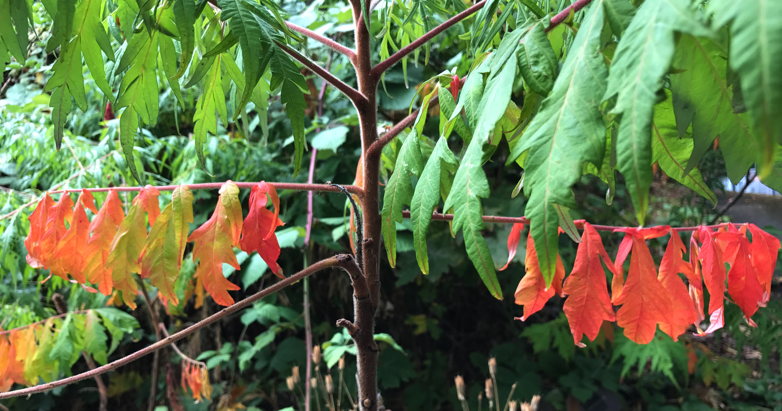
The upper leaves on our staghorn sumac still think it’s Summer, but the lower ones are all, “Here we go…!”
Those of you for whom the metaphors of the Wheel of the Year hold deep resonance may be shaking your heads at my obtuseness, and I accept your rebuke with a rueful grin. I hasten to add in my defense that this blind spot isn’t entirely a function of my obtuseness. I had approached Mabon (and the other Sabbats of the Wheel) as I found it presented in the traditions and materials available to me: as a set of historical symbols and ritualized actions, preserved relics from another time and place. The reality, though, is that I’m a modern American living through the early 21st century, not a scion of some Celtic or Germanic tribe in pre-Christian Ireland, Gaul, or Old Saxony. I can’t claim to find the same resonances my ancestors found in the cultural signifiers of their era. I can, however, find meaning in the same natural phenomena they experienced, and I can take cues from the ways they reacted to those phenomena. I can observe, reflect, and respond to the tipping point of the year, as the Sun begins its slide into the chilly dark of Winter. I can bake bread, make stew, and brew countless pots of tea. I can haul out the extra blankets, set out extra candles, and open my home to family and friends in need of warmth and light. I can take stock of my larder and stores, and make sure that I have not only enough for the days ahead, but enough to give to those who might run short, or who are already in need.
I can choose to see, in this inflection point between day and night, a symbol for all moments of decision, all shifts from this state of being into that. It was just this resonance which led my partner and I to choose it for the date of our wedding, five years ago3. In choosing to link the formal observance of our emotional and spiritual bond to a cyclical physical phenomenon, we were reminding ourselves, and each other, of the cycles in all of life. Hardships and sorrows will come, but so too will joys and celebrations. The Equinox is the moment of change, holding within it the promise that change is not the end.
You don’t have to be a druid or a witch to find meanings in such things. You just have to be alive, awake, and willing to look for them.
A blessed Mabon to those of you who celebrate it, and a blessed Autumnal Equinox to us all. ♥
- Which I was too young to watch when it aired in 1978, and so missed out on the deliciously creepy Pagan themes.
- Though not one of the Autumn People. That would be creepy.
- In the interests of full disclosure, it also makes remembering our anniversary a snap.

Browse Our Archives
Select a Category Interviews Politics Reviews Social Justice Theology Uncategorized
Select a Month January 2021 December 2020 October 2020 August 2020 July 2020 May 2020 April 2020 March 2020 February 2020 January 2020 December 2019 November 2019 October 2019 September 2019 August 2019 July 2019 June 2019 May 2019 April 2019 March 2019 February 2019 January 2019 December 2018 November 2018 October 2018 September 2018 August 2018 July 2018 June 2018 May 2018 April 2018 March 2018 February 2018 January 2018 December 2017 November 2017 October 2017 September 2017 August 2017
Follow Us!
TAKE THE
Religious Wisdom Quiz
What is the meaning of the word "Golgotha"?
Select your answer to see how you score.
River of Blood City of Bread Peaceful Garden Place of the Skull
Related posts from Outside the Charmed Circle

Sunset Doesn't Last All Evening: A Coda and...

The Company We Keep: On Ethics, Values, and...

A Word Before the Drop: On Politics, Ethics,...

Misha's Lockdown Reading List: Yvonne Aburrow, "Dark Mirror"...
TRENDING AT PATHEOS Pagan

I was recently chatting with someone on Instagram. She asked me what...

While there are many people who share their results, the end of...

On July 23, I saw Christopher Nolan's The Odyssey which is Homer’s...

As I write this two big events have just finished up. One...

Restoring the Watershed of Divine Love
Perhaps cooperation is not something we manufacture through legislation, ideology, or moral...

Many UUs don’t pray because of bad experiences in a previous religion,...
view all Pagan blogs
Ad-Free & Subscriber Log-In Subscription Support
- About Us
- 2026 Calendar
- Videos
- Podcasts
- Library of World Religions
- Faith In Media Tracker
- Advertise With Us
- Write for Us
- Privacy Policy
- Terms of Service
- Do Not Sell My Data
- Contact Us
- Radiant Digital
- Manage Newsletter Subscriptions
- Unsubscribe From Notifications
- Sitemap
Copyright 2008-2026, Patheos. All rights reserved.
Subscription Support Ad-Free & Subscriber Log-In
Follow Patheos