
BuddhistCatholicContemplativeEvangelicalGeneral ChristianHinduJewishLatter-day SaintMuslimNew VisionsProgressive Christian
Beliefs
- Buddhist
- Catholic
- Contemplative
- Evangelical
- General Christian
- Hindu
- Jewish
- Latter-day Saint
- More Voices
- Muslim
- New Visions
- Pagan
- Progressive Christian
Topics
- Religion News
- Food and Religion
- Sports and Religion
- Religious Art
- Religious Music and Entertainment
- Religious Events
- History and Religion
- Style and Religion
- Politics and Religion
- Women in Religion
- Recreation Outdoors and Religion
- Business Finance and Religion
- Careers Workplace and Religion
- Education and Religion
- Family Parenting and Religion
- Health Fitness and Religion
- Home and Religion
- Relationships and Religion
- Technology and Religion
- Travel and Religion
Columnists
- Buddhist Columnists
- Business Finance and Religion Columnists
- Careers Workplace and Religion Columnists
- Catholic Columnists
- Contemplative Columnists
- Education and Religion Columnists
- Evangelists Columnists
- Family Parenting and Religion Columnists
- General Christian Columnists
- Health Fitness and Religion Columnists
- Hindu Columnists
- History and Religion Columnists
- Home and Religion Columnists
- Jewish Columnists
- More Voices Columnists
- Latter Day Columnists
- Muslim Columnists
- New Visions Columnists
- Nonreligious Columnists
- Pagan Columnists
- Politics and Religion Columnists
- Progressive Columnists
- Recreation Outdoors and Religion Columnists
- Relationships and Religion Columnists
- Religion News Columnists
- Religious Art Columnists
- Religious Events Columnists
- Religious Music and Entertainment Columnists
- Sports and Religion Columnists
- Style and Religion Columnists
- Technology and Religion Columnists
- Travel and Religion Columnists
- Women in Religion Columnists
Resource Library
- 2026 Calendar
- Library of World Religions
- The 100 Most Holy Places on Earth
- Patheos Answers
- Podcasts
- Videos
- Faith Leaders Database
- Anglican Episcopalian
- Bahai
- Baptist
- Buddhism
- Christianity
- Confucianism
- Eastern Orthodoxy
- Hinduism
- Holiness and Pentecostal
- ISKCON
- Islam
- Judaism
- Lutheran
- Methodist
- The Church of Jesus Christ of Latter-day Saints
- New Age
- Paganism
- Presbytarian and Reformed
- Protestantism
- Religion Behind the Scenes
- Roman Catholic
- Scientology
- Shia Islam
- Sikhism
- Sufism
- Sunni Islam
- Taoism
- Zen
- See all religions
Research Tools
 Ad-Free & Subscriber Log-In Subscription Support
Ad-Free & Subscriber Log-In Subscription Support
Follow Patheos 

- Trending:
- Forgiveness
- |
- Marriage
- |
- Consciousness
- |
- Death Penalty
- |
- Election
- |
- Halloween
 Outside the Charmed Circle
- Home
- Pagan
- Memories of the First Books: A Treasury of Witches
Memories of the First Books: A Treasury of Witches
Last updated on: September 8, 2017 at 6:05 pm by Misha Magdalene
Memories of the First Books: A Treasury of Witches 2017-09-08T18:05:14-08:00 Misha Magdalene
Patheos Explore the world's faith through different perspectives on religion and spirituality! Patheos has the views of the prevalent religions and spiritualities of the world.
Previously on Outside the Charmed Circle, I described the kindling of my grade-school romance with Dungeons & Dragons, and the means by which that led me to devouring fantasy novels and books on mythology. (I was particularly taken with the childhood trifecta of Bulfinch’s Mythology, Hamilton’s Mythology: Timeless Tales of Gods and Heroes, and D’Aulaire’s Book of Greek Myths.) Between the exploits of gods and heroes, the sorcerous adventures of Le Guin and Moorcock, and my own imaginal ramblings, my head was abuzz with magic. It came as something of a jolt, then, to discover that there were actual practitioners of magic, real magic, in the real world. (My first encounter with a real-life Pagan—in grade school, no less!—is a story for another day.)
Not only that, but there were books, neither fiction nor mythology, which could reveal these mysteries to me. Best of all, there was one of those books at home, on my very own mother’s bookcase.
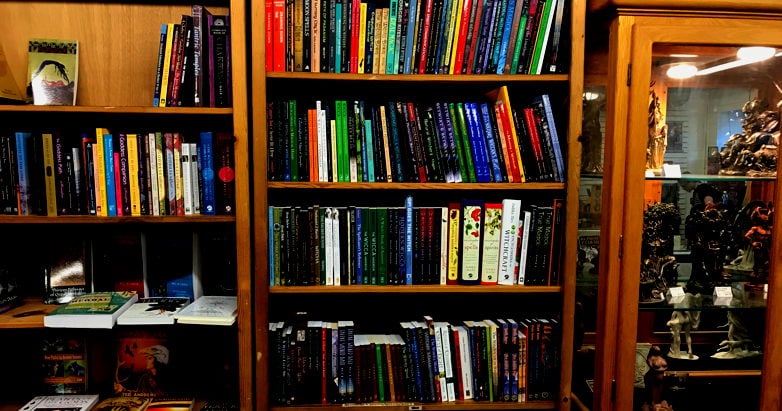
Which looked nothing like this, but hey, one can dream… (Photo of the witchcraft section at Edge of the Circle Books, Seattle, WA.)
My first literary exposure to The Real Thing, the first grimoire I encountered as a wee slip of a child in early 1980s California, was my mother’s copy of A Treasury of Witchcraft, Harry E. Wedeck’s 1961 classic of sensationalist occultism. Sure, it was an overbaked mishmash of half-understood pieces from a double-dozen unrelated cultures, but the glances I snuck through the leaves of this grim tome sparked my imagination as nothing before, and the terms that danced before my eyes—osculum infame, Hand of Glory, Malleus Maleficarum, the Black Mass—visited me again in my dreams, rolling from the mouths of robed Inquisitors, chanted by nude women streaked with soot and rendered baby fat. That I understood almost none of what I read was not only irrelevant, it was instrumental to the ways in which my imagination ran wild. I pored over his description of the witch’s mark and searched my own body for similar markings or scars, desperately hoping to find validation for my occult desires. After all, Wedeck’s tome made it clear that something mysterious was happening out there in the world and, with care and perseverance, I could find out what it was… even become part of it.
Not long after, I found a copy of Erica Jong’s Witches (1981) at my local library.
An inexplicably unlikely installment of the Harry N. Abrams folklore series, which also included Wil Hugyen’s Gnomes and Brian Froud and Alan Lee’s Faeries, Jong’s book presented the figure of the witch as both a fairytale monster and a historical reality, part of a hidden tradition of magic and mystery. She added depth, nuance, and a whole host of complications to my nascent understanding of witchcraft. I didn’t understand half of what I read at the time, but anything I failed to grasp from her writing, Joseph A. Smith’s illustrations to accompany the text rendered as clearly as I could’ve asked. His evocative, hallucinatory images of witches gathering herbs by moonlight and embracing the Goat of the Sabbat, broken on the wheel and burning at the stake, taught me as much as the written text did, if not more. This was witchcraft as “women’s wisdom,” diametrically opposed to the faux-perfection of glorified toxic masculinity1. It was appealing, poetic stuff—dark, sexual, and powerful—but it was also frustratingly, inextricably tied to an “empowered,” quintessentially Seventies take on feminism which I knew, even as a late-tweener to early-teen, had little room for someone like… well, me. Hers was the classic binary-essentialist view of gender and sexuality, wrapped in Neo-Paganism and called “rebellion,” and in many ways it was as reactionary as a Reagan speech, as mainstream as an upsized combo meal. In Witches Jong danced right up to the edge of something truly transgressive, then backpedaled her Earth Shoes right the hell away from it.
Still, her vision had a potency and a poetry which transcended its other limitations, at least for one barely-teenage genderqueer kid lost in the 1980s. I was drawn to the witchcraft she evoked with her words, even as I was excluded from it for being a “boy,” and that calling—first heard in the pages of role-playing gamebooks and fantasy novels, amplified by my first confused tastes of what real witchcraft looked like—would haunt me for years after…
…and then, one day, an adult in my social circle handed me his copies of Drawing Down the Moon and The Spiral Dance and suggested I might find them interesting.
The rest, as they say, is history. And there, at long last, is my real answer to the “what was your first book?” question.
So, beautiful creatures, what was your first book—or books? Tell us about them in comments below, or on the Facebook page!
___
-
In all fairness to Jong, she does spend a couple of paragraphs on the subject of male witches:
“And yet, there were men witches, too—though as archetypes they are seldom depicted, either in paintings, literature, or in our fantasies. Many men were condemned to death for being witches, widowers of witches, fathers of witches. However much we know this to be true historically, the notion of the witch as male never quite sticks. In some sense, the word ‘witch’ is synonymous in our minds with the word ‘woman.’
“Perhaps this is because we associate woman’s creative powers with the manipulation of vast, unseen forces. Or perhaps we intuitively understand that during the long centuries when women were the semislaves of society, they were naturally drawn to witchcraft as a cure for their powerlessness, a means of manipulating a world that otherwise painfully manipulated them. In any case, we always imagine the witch as female—and the Devil as male.” (Witches, p. 69)
Previous Post
August 28, 2017
Memories of the First Books: Dungeons, Dragons, and the Dark Arts
Next Post

September 5, 2017 Mixtape of Shadows: Tori Amos, "Little Earthquakes"
Browse Our Archives
Select a Category Interviews Politics Reviews Social Justice Theology Uncategorized
Select a Month January 2021 December 2020 October 2020 August 2020 July 2020 May 2020 April 2020 March 2020 February 2020 January 2020 December 2019 November 2019 October 2019 September 2019 August 2019 July 2019 June 2019 May 2019 April 2019 March 2019 February 2019 January 2019 December 2018 November 2018 October 2018 September 2018 August 2018 July 2018 June 2018 May 2018 April 2018 March 2018 February 2018 January 2018 December 2017 November 2017 October 2017 September 2017 August 2017
Follow Us!
TAKE THE
Religious Wisdom Quiz
True or False: The entire city of Nineveh repented after Jonah preached to them.
Select your answer to see how you score.
TRUE FALSE
Related posts from Outside the Charmed Circle

Sunset Doesn't Last All Evening: A Coda and...

The Company We Keep: On Ethics, Values, and...

A Word Before the Drop: On Politics, Ethics,...

Misha's Lockdown Reading List: Yvonne Aburrow, "Dark Mirror"...
TRENDING AT PATHEOS Pagan

I was recently chatting with someone on Instagram. She asked me what...

While there are many people who share their results, the end of...

On July 23, I saw Christopher Nolan's The Odyssey which is Homer’s...

As I write this two big events have just finished up. One...

Restoring the Watershed of Divine Love
Perhaps cooperation is not something we manufacture through legislation, ideology, or moral...

Many UUs don’t pray because of bad experiences in a previous religion,...
view all Pagan blogs
Ad-Free & Subscriber Log-In Subscription Support
- About Us
- 2026 Calendar
- Videos
- Podcasts
- Library of World Religions
- Faith In Media Tracker
- Advertise With Us
- Write for Us
- Privacy Policy
- Terms of Service
- Do Not Sell My Data
- Contact Us
- Radiant Digital
- Manage Newsletter Subscriptions
- Unsubscribe From Notifications
- Sitemap
Copyright 2008-2026, Patheos. All rights reserved.
Subscription Support Ad-Free & Subscriber Log-In
Follow Patheos