
BuddhistCatholicContemplativeEvangelicalGeneral ChristianHinduJewishLatter-day SaintMuslimNew VisionsProgressive Christian
Beliefs
- Buddhist
- Catholic
- Contemplative
- Evangelical
- General Christian
- Hindu
- Jewish
- Latter-day Saint
- More Voices
- Muslim
- New Visions
- Pagan
- Progressive Christian
Topics
- Religion News
- Food and Religion
- Sports and Religion
- Religious Art
- Religious Music and Entertainment
- Religious Events
- History and Religion
- Style and Religion
- Politics and Religion
- Women in Religion
- Recreation Outdoors and Religion
- Business Finance and Religion
- Careers Workplace and Religion
- Education and Religion
- Family Parenting and Religion
- Health Fitness and Religion
- Home and Religion
- Relationships and Religion
- Technology and Religion
- Travel and Religion
Columnists
- Buddhist Columnists
- Business Finance and Religion Columnists
- Careers Workplace and Religion Columnists
- Catholic Columnists
- Contemplative Columnists
- Education and Religion Columnists
- Evangelists Columnists
- Family Parenting and Religion Columnists
- General Christian Columnists
- Health Fitness and Religion Columnists
- Hindu Columnists
- History and Religion Columnists
- Home and Religion Columnists
- Jewish Columnists
- More Voices Columnists
- Latter Day Columnists
- Muslim Columnists
- New Visions Columnists
- Nonreligious Columnists
- Pagan Columnists
- Politics and Religion Columnists
- Progressive Columnists
- Recreation Outdoors and Religion Columnists
- Relationships and Religion Columnists
- Religion News Columnists
- Religious Art Columnists
- Religious Events Columnists
- Religious Music and Entertainment Columnists
- Sports and Religion Columnists
- Style and Religion Columnists
- Technology and Religion Columnists
- Travel and Religion Columnists
- Women in Religion Columnists
Resource Library
- 2026 Calendar
- Library of World Religions
- The 100 Most Holy Places on Earth
- Patheos Answers
- Podcasts
- Videos
- Faith Leaders Database
- Anglican Episcopalian
- Bahai
- Baptist
- Buddhism
- Christianity
- Confucianism
- Eastern Orthodoxy
- Hinduism
- Holiness and Pentecostal
- ISKCON
- Islam
- Judaism
- Lutheran
- Methodist
- The Church of Jesus Christ of Latter-day Saints
- New Age
- Paganism
- Presbytarian and Reformed
- Protestantism
- Religion Behind the Scenes
- Roman Catholic
- Scientology
- Shia Islam
- Sikhism
- Sufism
- Sunni Islam
- Taoism
- Zen
- See all religions
Research Tools
 Ad-Free & Subscriber Log-In Subscription Support
Ad-Free & Subscriber Log-In Subscription Support
Follow Patheos 

- Trending:
- Forgiveness
- |
- Marriage
- |
- Consciousness
- |
- Death Penalty
- |
- Election
- |
- Halloween
 Outside the Charmed Circle
- Home
- Pagan
- Memories of the First Books: Dungeons, Dragons, and the Dark Arts
Memories of the First Books: Dungeons, Dragons, and the Dark Arts
Last updated on: September 8, 2017 at 6:06 pm by Misha Magdalene
Memories of the First Books: Dungeons, Dragons, and the Dark Arts 2017-09-08T18:06:10-08:00 Misha Magdalene
Patheos Explore the world's faith through different perspectives on religion and spirituality! Patheos has the views of the prevalent religions and spiritualities of the world.
Hello again, beautiful creatures.
Amongst witches, magicians, Pagans, polytheists, and other practitioners of a certain age, there’s a line of “getting-to-know-you” conversation common enough to be a cliché which opens with the question, “So, what was your first book?” Many folks commonly cite books by neo-Pagan witches like Scott Cunningham, Marion Green, and Raymond Buckland, or ceremonial magicians like Dion Fortune, Aleister Crowley, and Israel Regardie, even mythologists like Thomas Bulfinch, Edith Hamilton, and my personal favorites, Ingri and Edgar Parin d’Aulaire.
When it’s my turn to play, I usually explain that my first exposure to Paganism, witchcraft, and magic was in the pages of Margot Adler’s Drawing Down the Moon and Starhawk’s The Spiral Dance, which I read simultaneously when I was about 14. It’s a respectable entry point to cite; Starhawk’s Feri-inflected recension of feminist Wicca and Goddess-worship dovetails nicely with Adler’s snapshot travelogue of late 1970s/early 1980s Neo-Paganism, creating a pleasant (if somewhat dated) image redolent of Nag Champa and Polo by Ralph Lauren, perhaps with a Yes album playing in the background.
The trouble is, it’s a false memory. Like many of my contemporary practitioners of the dark arts, I am forced to confess, after all these years, that Jack Chick was right: Dungeons & Dragons led me to witchcraft.
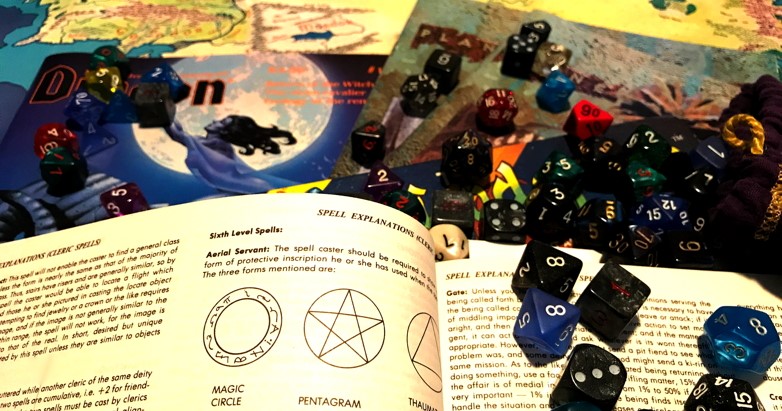
I mean, really, how could it not? (Grimoires and graven mystic gems from the author’s collection.)
A little backstory may be appropriate at this point.
It was 1981. I was eight years old and in 4th grade, having gone through 2nd and 3rd grades in a single year. I was younger, smaller, and far more insecure than my classmates. I desperately wanted to fit in with them, of course, and my obvious desperation probably had something to do with my social ostracism. (The fact that I was socially awkward and used to thinking of myself as the smartest person in the room probably didn’t help much.)
Some of the cool kids in my “gifted and talented” class (just let that sink in for a moment) were really into playing some sort of weird make-believe game that involved shuffling sheets of paper and pencils around, reading from strange-looking books, and rolling polyhedral dice at random intervals. Being the social outcast of the class (let that one sink in for a moment, too), it was several weeks before I finally got one of them to let me in on the secret. I was even allowed to roll up a character of my own: a gnome illusionist who died the moment he entered the dungeon, when the ceiling fell and crushed him into gnome paté. Despite this less-than-illustrious beginning, the game had opened an entire imaginal realm for me, and I was hooked. I raided the school library for books on mythology and fantasy novels, then moved on to my local town library, all the while moping around my house like a miniature Robert Smith until my mother broke down and surprised me with the basic D&D box set and an issue of Dragon magazine.
That was more or less the death blow to any chance I might’ve had for normalcy.
Not by itself, of course. Gary Gygax and Dave Arneson’s role-playing game of swords, sorcery, and adventure was brilliant, to be sure, but the portrayal of D&D in Chick’s hysterical Dark Dungeons tract wildly overestimates the extent to which the game draws on real-world occultism. Even in its occasional feinting towards historical magic, D&D tended to get its facts wrong… or, to put it kindly, D&D used bits of historical occultism as window dressing, much as horror films and metal bands tend to. It created a delightfully atmospheric vibe, equal parts Hammer horror and pulp fantasy à la Robert E. Howard or H. P. Lovecraft, but it was a far cry from anything resembling historical thaumaturgy. Anyone who tried to practice magic as outlined in the Player’s Handbook and Dungeon Master’s Guide would find themselves standing in a circle inscribed with meaningless squiggles, holding a handful of tiny balls of bat guano1.
Still, the assembled oeuvre of Gygax, Arneson, et al. pushed my imagination in directions it might never have otherwise travelled. Through their good offices, I discovered the works of Bulfinch, Hamilton, and the d’Aulaires, as well as a host of fantasists whose books would, for better and for worse, form the basis of my teenaged cosmology: Michael Moorcock, Ursula K. Le Guin, J. R. R. Tolkien, the aforementioned Messrs. Howard and Lovecraft, and a host of others. Again, though, these authors weren’t teaching magic and witchcraft in their stories. A great deal of magic can be found in their books, and a careful reader can glean a great deal of spiritual and philosophical truth from their pages (especially from Ms. Le Guin’s Earthsea novels), but they are fictions, first and foremost. They’re no more intended as instructional manuals in the occult than is J. K. Rowling’s Harry Potter and the Philosopher’s Stone, despite some excitable Christians’ protestations to the contrary. (When a child successfully manages to cast Avada Kedavra, or even Wingardium Leviosa, I’ll be forced to revisit my position, but in the meantime, let’s move on.)
My first real exposure to the occult came not long afterward, though, and from the unlikeliest place I could imagine: my own home library.
___
- Players of 1st edition AD&D with sharp memories may recall that bat guano, mixed with sulfur, was the material component for one of the first truly useful offensive magic-user spells, the ever-popular Fireball.
Previous Post

August 24, 2017
A Belated Introduction, with Roadmap and Coming Attractions
Next Post

August 31, 2017 Memories of the First Books: A Treasury of Witches
Browse Our Archives
Select a Category Interviews Politics Reviews Social Justice Theology Uncategorized
Select a Month January 2021 December 2020 October 2020 August 2020 July 2020 May 2020 April 2020 March 2020 February 2020 January 2020 December 2019 November 2019 October 2019 September 2019 August 2019 July 2019 June 2019 May 2019 April 2019 March 2019 February 2019 January 2019 December 2018 November 2018 October 2018 September 2018 August 2018 July 2018 June 2018 May 2018 April 2018 March 2018 February 2018 January 2018 December 2017 November 2017 October 2017 September 2017 August 2017
Follow Us!
TAKE THE
Religious Wisdom Quiz
Who saw a vision of the Lord seated on a throne, surrounded by seraphim?
Select your answer to see how you score.
Isaiah Jeremiah Ezekiel Daniel
Related posts from Outside the Charmed Circle

Misha's Lockdown Reading List: Yvonne Aburrow, "Dark Mirror"...
Misha's Lockdown Reading List: Lilith Dorsey, "Orishas, Goddesses,...
Misha's Lockdown Reading List: Kelden's "The Crooked Path"

Materia Magica: Some Thoughts on the Stuff We...
TRENDING AT PATHEOS Pagan

I was recently chatting with someone on Instagram. She asked me what...

While there are many people who share their results, the end of...

On July 23, I saw Christopher Nolan's The Odyssey which is Homer’s...

As I write this two big events have just finished up. One...

Restoring the Watershed of Divine Love
Perhaps cooperation is not something we manufacture through legislation, ideology, or moral...

Many UUs don’t pray because of bad experiences in a previous religion,...
view all Pagan blogs
Ad-Free & Subscriber Log-In Subscription Support
- About Us
- 2026 Calendar
- Videos
- Podcasts
- Library of World Religions
- Faith In Media Tracker
- Advertise With Us
- Write for Us
- Privacy Policy
- Terms of Service
- Do Not Sell My Data
- Contact Us
- Radiant Digital
- Manage Newsletter Subscriptions
- Unsubscribe From Notifications
- Sitemap
Copyright 2008-2026, Patheos. All rights reserved.
Subscription Support Ad-Free & Subscriber Log-In
Follow Patheos