
BuddhistCatholicContemplativeEvangelicalGeneral ChristianHinduJewishLatter-day SaintMuslimNew VisionsProgressive Christian
Beliefs
- Buddhist
- Catholic
- Contemplative
- Evangelical
- General Christian
- Hindu
- Jewish
- Latter-day Saint
- More Voices
- Muslim
- New Visions
- Pagan
- Progressive Christian
Topics
- Religion News
- Food and Religion
- Sports and Religion
- Religious Art
- Religious Music and Entertainment
- Religious Events
- History and Religion
- Style and Religion
- Politics and Religion
- Women in Religion
- Recreation Outdoors and Religion
- Business Finance and Religion
- Careers Workplace and Religion
- Education and Religion
- Family Parenting and Religion
- Health Fitness and Religion
- Home and Religion
- Relationships and Religion
- Technology and Religion
- Travel and Religion
Columnists
- Buddhist Columnists
- Business Finance and Religion Columnists
- Careers Workplace and Religion Columnists
- Catholic Columnists
- Contemplative Columnists
- Education and Religion Columnists
- Evangelists Columnists
- Family Parenting and Religion Columnists
- General Christian Columnists
- Health Fitness and Religion Columnists
- Hindu Columnists
- History and Religion Columnists
- Home and Religion Columnists
- Jewish Columnists
- More Voices Columnists
- Latter Day Columnists
- Muslim Columnists
- New Visions Columnists
- Nonreligious Columnists
- Pagan Columnists
- Politics and Religion Columnists
- Progressive Columnists
- Recreation Outdoors and Religion Columnists
- Relationships and Religion Columnists
- Religion News Columnists
- Religious Art Columnists
- Religious Events Columnists
- Religious Music and Entertainment Columnists
- Sports and Religion Columnists
- Style and Religion Columnists
- Technology and Religion Columnists
- Travel and Religion Columnists
- Women in Religion Columnists
Resource Library
- 2026 Calendar
- Library of World Religions
- The 100 Most Holy Places on Earth
- Patheos Answers
- Podcasts
- Videos
- Faith Leaders Database
- Anglican Episcopalian
- Bahai
- Baptist
- Buddhism
- Christianity
- Confucianism
- Eastern Orthodoxy
- Hinduism
- Holiness and Pentecostal
- ISKCON
- Islam
- Judaism
- Lutheran
- Methodist
- The Church of Jesus Christ of Latter-day Saints
- New Age
- Paganism
- Presbytarian and Reformed
- Protestantism
- Religion Behind the Scenes
- Roman Catholic
- Scientology
- Shia Islam
- Sikhism
- Sufism
- Sunni Islam
- Taoism
- Zen
- See all religions
Research Tools
 Ad-Free & Subscriber Log-In Subscription Support
Ad-Free & Subscriber Log-In Subscription Support
Follow Patheos 

- Trending:
- Forgiveness
- |
- Marriage
- |
- Consciousness
- |
- Death Penalty
- |
- Election
- |
- Halloween
 Michelle Arnold
- Home
- Catholic
- History and Religion
- Conversions and Catholic Sola Scriptura
Conversions and Catholic Sola Scriptura
Last updated on: August 28, 2022 at 9:11 pm by Michelle Arnold
Conversions and Catholic Sola Scriptura 2022-08-28T21:11:36-07:00 Michelle Arnold
Patheos Explore the world's faith through different perspectives on religion and spirituality! Patheos has the views of the prevalent religions and spiritualities of the world.
 Perhaps the most poignant conversion story I’ve read was that of Rabbi Israel Zolli (1881–1956), the Chief Rabbi of Rome during World War II. In his book, Before the Dawn, Rabbi Zolli (who took the name Eugenio as his baptismal name in honor of Pius XII) told of his lifelong fascination with Christianity.
One of his earliest memories was of sitting beneath a crucifix with a Christian school friend as they studied together. In the mid-1930s, a full decade before he entered the Church, he wrote a book on Jesus of Nazareth. A bishop friend told him that the book was so in line with Catholic thought that the bishop could have granted Zolli’s book an imprimatur. Zolli would later say that he was a “natural Christian” for at least two decades before he converted.
So, why didn’t he convert until late in life, after the war in Italy ended? While I need to nod in the direction of the controversy surrounding his motives, Zolli himself insisted that he didn’t convert earlier because he couldn’t bear to abandon his people during the rise of antisemitism in Europe that eventually exploded into the Shoah.
From the perspective of hindsight, we now know that conversion to Christianity didn’t necessarily save Europe’s Jews. St. Edith Stein was murdered in Auschwitz. Cardinal Jean-Marie Lustiger, a young teen at the time, had to flee Vichy territory in France to escape deportation. At the time though, had Rabbi Zolli merely been interested in saving his own backside (as was later alleged), conversion would have appeared to be a viable option.
Instead, he went into hiding (as did many Jews during the Shoah). Alone with God and his thoughts, he promised God that if he survived the war, he’d enter the Church. Jesus evidently decided to hold Rabbi Zolli to his word. At the first celebration of the High Holy Days in liberated Italy, Zolli reported that he had a vision of Jesus telling him that this was the last time Zolli would preside in the synagogue. A few months later, Zolli entered the Church, along with his wife and daughter.
I was reminded of Rabbi Zolli’s story as I read Joe Heschmeyer’s recent article for Catholic Answers, titled “When Converting Hurts, Do It Anyway.” Heschmeyer acknowledges that conversion can be difficult for all sorts of reasons:
Maybe you’re part of a solid Protestant community. Maybe converting would create serious tension in your marriage or with your parents. Maybe you would lose your job in ministry. In some of the most extreme cases, maybe you live in a country in which converting to Catholicism is a capital crime. In short, people weighing whether to become Catholic are often dealing with much more than simply answering the question, “Is it true?”
Nevertheless, Heschmeyer insists, you must convert anyway or go to hell. In case you think I’m exaggerating, here’s how Heschmeyer puts it:
But as serious and well grounded as those hesitations [to convert] may be, the Second Vatican Council [in Lumen Gentium] doesn’t mince words: “In explicit terms [Jesus] himself affirmed the necessity of faith and baptism and thereby affirmed also the necessity of the Church, for through baptism as through a door men enter the Church. Whosoever, therefore, knowing that the Catholic Church was made necessary by Christ, would refuse to enter or to remain in it, could not be saved” (formatting edited slightly for clarity).
Come now, Michelle, you might be saying, Heschmeyer doesn’t flat out say a person who chooses not to convert, for one of the reasons he himself lays out, will go to hell. Um, does he?
Judge for yourself: “The person who sees the truth of the Catholic claim and yet refuses to respond to it is knowingly rejecting the fullness of Christ, cutting himself off from salvation” (emphasis in original).
Are we to believe then that if the Nazis had found Rabbi Zolli, dragged him out of his hiding place and murdered him, that he would have gone to hell? Are we to believe that a man who, by his own account, loved Jesus of Nazareth most of his life, would have been tossed into hell by God for not formally entering the Catholic Church—despite having sacrificed so much, endured sufferings we cannot imagine, because he wanted to remain in solidarity with his people during the Shoah?
Many Catholics have their own version of sola scriptura. Rather than treat the Bible as their sole authority, to be interpreted by each man as he sees fit, Catholic sola scriptura is a bit different from its Protestant counterpart.
Apologists, in particular, will cherry-pick quotes from Church documents, rip them from context, and brandish them as “proof” for their claims. Do they want to deny Communion to Catholics who are in irregular marriages? Well, let’s pull texts from canon law and the Catechism of the Catholic Church, stitch the texts together in an article or podcast script, and show everyone what the Church “really” teaches on the matter. By the end of a 1,200-word essay or 30-minute talk, everyone will have to agree that this is what the Church has “always” taught—and stop bothering me already with what Apologetics Superhero Frank Sheed had to say on the subject in his memoir, The Church and I!
Heschmeyer does much the same thing in his essay. While he recognizes that many who want to convert to Catholicism may have serious reasons that make conversion appear impossible, all he does is wave around Scripture verses and citations from Vatican II and the Catechism before presuming to tell everyone struggling with burdens he doesn’t have to lift a finger to carry (Matt. 23:4) to convert anyway. He doesn’t offer any kind of practical assistance—such as information on how conversions don’t necessarily have to be made public—to help those who are struggling to see over the obstacles to the Communion rail on the other side.
In his book, The Name of God is Mercy, Pope Francis reminded his readers of St. John of the Cross’s reassurance that “As we prepare to leave this life, we will be judged on the basis of love.” We won’t be judged on what we know, or on how well we fall into line with what we know—much less on what anyone else thinks we ought to know or to do. God, who is love (1 John 4:8), judges us by how well we love him and love our neighbor as ourselves (Matt. 22:37–40).
Rabbi Zolli chose not to enter the Church for many years, for what seemed to him to be very good reasons. But had he not survived the war, we could confidently say that his writings and his personal sacrifices for his community amply demonstrated his love for God and for his neighbor. Anyone who would dare to suggest that wouldn’t have been enough for salvation has Jesus’ solemn promise that they will themselves receive the measure by which they’ve measured others (Matt. 7:2).
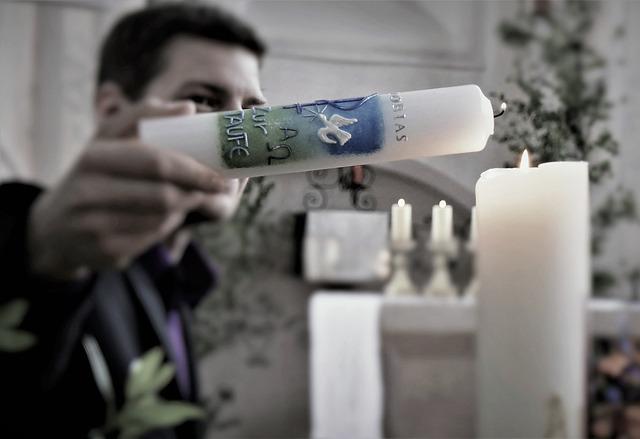
(Image: Man lighting a baptismal candle, Pixabay.)
History and Religion
Previous Post

April 4, 2022
How Not to Be a Terrible Sea Lion
Next Post
May 22, 2022 How to Bring Catholics Back to Mass
Browse Our Archives
Select a Category Apologetics News Personal Popular Culture Uncategorized
Select a Month August 2024 May 2024 February 2024 December 2023 July 2023 December 2022 October 2022 June 2022 May 2022 April 2022 March 2022 November 2021 October 2021 September 2021 June 2021 April 2021 January 2021 December 2020 November 2020 October 2020 September 2020 August 2020 December 2015 July 2015 June 2015 May 2015 April 2015
Follow Us!
TAKE THE
Religious Wisdom Quiz
What was the first plague in Egypt?
Select your answer to see how you score.
Frogs Water turning to blood Hail Darkness
Related posts from Michelle Arnold


Catholic Answers and the Trouble with Yoga

Pro-Lifers and the Case of the Invisible Woman
TRENDING AT PATHEOS Catholic

Rejecting Doom: Christian Hope And Human Action
Christianity is a religion of hope. We are to have hope and...

It’s What Comes From Within Which Matters
One of the most difficult things for us to understand is why...

Why I Choose the Eucharist Over the Sermon
Choose the Eucharist, Not the Sermon What are we supposed to get...

5 Design Elements Found in Spiritually Rooted Homes
Putting Spirituality Into Home Decor Our homes are more than our living...

Credo: A Story of God Told with the...
About 10 years ago, I began to imagine a personal "Credo" that...

The Anatomy of Divine Revelation in Catholic Thought
The claim that God has made Himself known to human beings is...
view all Catholic blogs
Ad-Free & Subscriber Log-In Subscription Support
- About Us
- 2026 Calendar
- Videos
- Podcasts
- Library of World Religions
- Faith In Media Tracker
- Advertise With Us
- Write for Us
- Privacy Policy
- Terms of Service
- Do Not Sell My Data
- Contact Us
- Radiant Digital
- Manage Newsletter Subscriptions
- Unsubscribe From Notifications
- Sitemap
Copyright 2008-2026, Patheos. All rights reserved.
Subscription Support Ad-Free & Subscriber Log-In
Follow Patheos