
BuddhistCatholicContemplativeEvangelicalGeneral ChristianHinduJewishLatter-day SaintMuslimNew VisionsProgressive Christian
Beliefs
- Buddhist
- Catholic
- Contemplative
- Evangelical
- General Christian
- Hindu
- Jewish
- Latter-day Saint
- More Voices
- Muslim
- New Visions
- Pagan
- Progressive Christian
Topics
- Religion News
- Food and Religion
- Sports and Religion
- Religious Art
- Religious Music and Entertainment
- Religious Events
- History and Religion
- Style and Religion
- Politics and Religion
- Women in Religion
- Recreation Outdoors and Religion
- Business Finance and Religion
- Careers Workplace and Religion
- Education and Religion
- Family Parenting and Religion
- Health Fitness and Religion
- Home and Religion
- Relationships and Religion
- Technology and Religion
- Travel and Religion
Columnists
- Buddhist Columnists
- Business Finance and Religion Columnists
- Careers Workplace and Religion Columnists
- Catholic Columnists
- Contemplative Columnists
- Education and Religion Columnists
- Evangelists Columnists
- Family Parenting and Religion Columnists
- General Christian Columnists
- Health Fitness and Religion Columnists
- Hindu Columnists
- History and Religion Columnists
- Home and Religion Columnists
- Jewish Columnists
- More Voices Columnists
- Latter Day Columnists
- Muslim Columnists
- New Visions Columnists
- Nonreligious Columnists
- Pagan Columnists
- Politics and Religion Columnists
- Progressive Columnists
- Recreation Outdoors and Religion Columnists
- Relationships and Religion Columnists
- Religion News Columnists
- Religious Art Columnists
- Religious Events Columnists
- Religious Music and Entertainment Columnists
- Sports and Religion Columnists
- Style and Religion Columnists
- Technology and Religion Columnists
- Travel and Religion Columnists
- Women in Religion Columnists
Resource Library
- 2026 Calendar
- Library of World Religions
- The 100 Most Holy Places on Earth
- Patheos Answers
- Podcasts
- Videos
- Faith Leaders Database
- Anglican Episcopalian
- Bahai
- Baptist
- Buddhism
- Christianity
- Confucianism
- Eastern Orthodoxy
- Hinduism
- Holiness and Pentecostal
- ISKCON
- Islam
- Judaism
- Lutheran
- Methodist
- The Church of Jesus Christ of Latter-day Saints
- New Age
- Paganism
- Presbytarian and Reformed
- Protestantism
- Religion Behind the Scenes
- Roman Catholic
- Scientology
- Shia Islam
- Sikhism
- Sufism
- Sunni Islam
- Taoism
- Zen
- See all religions
Research Tools
 Ad-Free & Subscriber Log-In Subscription Support
Ad-Free & Subscriber Log-In Subscription Support
Follow Patheos 

- Trending:
- Forgiveness
- |
- Marriage
- |
- Consciousness
- |
- Death Penalty
- |
- Election
- |
- Halloween
 Michelle Arnold
- Home
- Catholic
- The Virgin and the Philosophers
The Virgin and the Philosophers
Last updated on: November 4, 2021 at 3:51 am by Michelle Arnold
The Virgin and the Philosophers 2021-11-04T03:51:41-07:00 Michelle Arnold
Patheos Explore the world's faith through different perspectives on religion and spirituality! Patheos has the views of the prevalent religions and spiritualities of the world.
 A few years ago, the Church marked the fiftieth anniversary of Humanae Vitae, Paul VI’s reaffirmation of the Church’s traditional teaching on artificial contraception. In honor of that milestone, Catholic Answers published a book of essays on the document. The staff was always offered hot-off-the-presses copies of new products, and I was eager to see this one.
I still remember pulling off the plastic wrap and thumbing to the table of contents. My eyes widened when I saw the list of contributors. With the exception of a husband and wife, writing together, all of the contributors were men. I noted that the foreword was written by a prominent American cardinal. Then I turned over the book and noted the list of people who had offered promotional quotes, giving the book their personal thumbs up. All bishops. Not one layperson, let alone one woman, was listed.
Sitting there, holding in my hands a book I’d hoped I might be able to recommend to clients, and now realizing I couldn’t do that, I wondered if it was worth expressing my disappointment to the publications department. After all, the book had just been published. What was done was done. And yet…. If I didn’t say anything, how would anyone know there was a problem?
“I worked really hard on that book, and I don’t have time for this,” was the curt response when I brought my concerns to the book’s editor. I left his office quietly and went back to my desk. A few minutes later, a new email popped up in my inbox. The editor, perhaps still feeling stung by my complaint that women’s perspectives hadn’t really been featured in a book on a subject of particular importance to them, told me that he had reached out to two female writers during the planning of the book but that they’d declined to participate.
That was when I became angry. When I had the free time to spare, I did some digging on the Internet. Within an hour, I had a list of ten Catholic women who could’ve been approached about contributing to the project. I stopped at ten, point made to myself. I could’ve added more. But even though Catholic Answers had two female apologists on staff at the time, neither of us were asked to help on this project—either as contributors or to identify other Catholic women who might be interested in contributing.
An experience like this one might explain why I was completely unsurprised by Catholic philosopher Peter Kreeft’s admission that “he made a terrible mistake” while working on Socrates’ Children, his four-volume compilation of the greatest philosophers throughout history. He “somehow left out women.”
How could that be? How do you overlook women in discussing history’s greatest philosophers? And, granting that you’ve done so, how is it that this “terrible mistake” got past the editorial team? Well, what was done was done, and Kreeft was eager to make atonement. Did he put together a supplementary volume on the world’s best-known female philosophers, perhaps taking the five minutes it took me to google and find this starting point?
Alas, no. Rather, when he realized he’d ignored women’s contributions to philosophy, Kreeft suddenly discovered he’d “overlooked the greatest [philosophical] mind of them all.”
Ah. Okay. Diotima? Hypatia? Heloise? Mary Wollstonecraft? Perhaps Saints Catherine of Alexandria, Hildegard of Bingen, or Edith Stein? No, he’d neglected that heretofore unknown philosopher, Mary of Nazareth. Yes, that’s right, the Virgin Mary. And, with that, Kreeft has written a new book on how Mary is “the greatest philosopher who ever lived.” Not convinced?
This book is a one-of-a-kind study on Mary of Nazareth, the mother of Jesus. If Jesus Christ is wisdom incarnate, and if Mary loved Him more than anyone else ever did, then it holds that Mary is the greatest philosopher, the greatest wisdom-lover. With precision and humor, Kreeft not only unpacks the thought and spirit of Mary as we know her through Scripture and Church doctrine, but offers a heartfelt crash course in the basics of philosophy—methodology, epistemology, logic, metaphysics, cosmology, ethics, politics, aesthetics, and more—all through the lens of the Mother of God.
If loving Jesus makes a person a philosopher, then there are over two billion philosophers in the world right now—and that number doesn’t include all Christians over the past two millennia since the birth of Christianity. St. Luke does note that the Virgin “kept all these things, pondering them in her heart” (Luke 2:19), but I daresay that philosophy is about more than thinking deep thoughts, no matter how holy you are.
I also daresay that Peter Kreeft, who has been a professor of philosophy at Boston College for over fifty years, knows that loving Jesus and thinking deep thoughts, in and of themselves, do not a philosopher make. So, what is he up to with this new book? The book is due out later this month, so I haven’t read it. Based on the book’s description though, I’ll hazard a guess.
Kreeft evidently received blow-back for neglecting to include women in Socrates’ Children. To his credit, he seems to have taken that negative feedback seriously. So far as I know, Kreeft hasn’t yet written a full-length book about the Virgin Mary. Perhaps he saw an opportunity to stone two birds by using the earlier criticism he’d received for Socrates’ Children as a platform from which to dive into writing a book about Mary.
Lots of ladies were so upset that there were no female philosophers counted among the world’s greats? Hmm, how about a book devoted to the greatest Lady of all time? What does she have to do with philosophy? Well, God the Son is understood by the Church to be Wisdom Incarnate and his Mom loved him better than any other human person, so that means she loved wisdom. She must be the greatest philosopher who ever lived. Oh, hey, that would make a great title!
The root of the problem here—illustrated by these two books, published by conservative Catholic publishing houses—is that women’s contributions to Christian apologetics and philosophy are systemically marginalized. When the issues under discussion affect women’s lives far more significantly than they do men’s lives, women’s voices can be either overlooked or ignored. In compilations of The Greats, men are chosen by default; women, if they’re lucky, get bracketed out into Female Greats. When challenges are made, the response is either defensiveness or a patronizing deference to the “feminine genius” embodied by the Virgin Mary.
In an early issue of Catholic Answers’ magazine, This Rock, there was a humorous discussion of why women don’t engage in apologetics (or, at least, why they didn’t at that time, in the early 1990s). I still remember the conclusion of a female reader whose letter was printed in the magazine: women are far too busy tending to the home and their children to have time to argue about doctrine and morals. She was joking, but I honestly believe that all too many conservative Catholics consider publicly talking about morality, philosophy, and theology to be Men’s Work.
The solution to this problem isn’t to lionize the Virgin Mary, especially by trying to turn her into something she is not. While ticking off lists of female philosophers (and even female saints who were philosophers) can be helpful, that’s not the solution either.
The solution is to recognize that there has been a long history of marginalizing women’s voices in the Church and to consciously set about to correcting that problem. Are you compiling essays on a hot-button topic? Consider who is most affected and represent accordingly. Discussion of contraception, for example, should include both men and women—and, if anything, lean toward women’s perspectives. Collecting profiles of The Greats? Women should be represented. And if half the human race can’t be represented equally? Well, wouldn’t it be helpful to include commentary on why women haven’t had the same access men do to academia, or even to education, for much of the past few millennia?
Some years back, a female colleague was planning to write a commentary on one of the Gospels for Catholic Answers. She was leaning toward choosing the Gospel of Matthew, but I said to her, “Why not choose Luke? That’s Mary’s Gospel.” She was enthusiastic at the idea that Luke was “Mary’s Gospel” and always included that story when discussing her commentary. Her listeners were confused. “Mary wrote a Gospel? Say, what?”
No, the Virgin Mary didn’t write the Gospel of Luke, but she was undoubtedly one of the “eyewitnesses” Luke had in mind when introducing his Gospel to Theophilus (Luke 1:1–4), and was likely Luke’s major source for his infancy narrative. Luke didn’t name his sources though (which, to be fair, wasn’t really a thing then) and the Virgin went uncredited for her contributions to what we know about her Son. But it is likely through her that we know of her visit to her kinswoman Elizabeth, that we have the words of her Magnificat, that we know about Jesus being lost for three days and found in the Temple.
The Virgin’s contributions to our knowledge of her Son and to Christian thought have gone unrecognized, uncredited, even though they’re in plain sight on the pages of Scripture for anyone with eyes to see. And, in much the same way, women’s contributions to Christian apologetics and philosophy have similarly been unrecognized and uncredited.
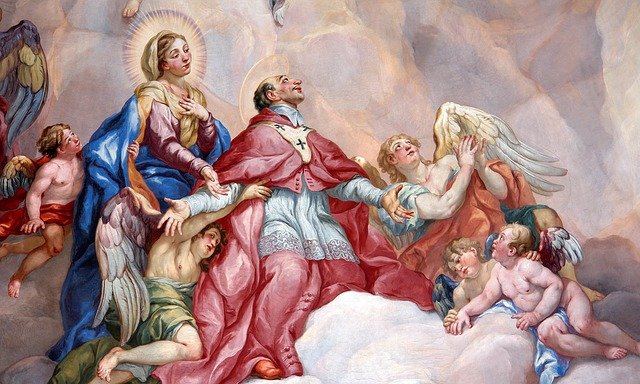
(Image: Painting of Virgin Mary, male saint, and angels; Pixabay.)
Previous Post

October 22, 2021
Praying for Pity's Sake
Next Post
March 5, 2022 A Lapsed Catholic's Guide to Observing Lent
Browse Our Archives
Select a Category Apologetics News Personal Popular Culture Uncategorized
Select a Month August 2024 May 2024 February 2024 December 2023 July 2023 December 2022 October 2022 June 2022 May 2022 April 2022 March 2022 November 2021 October 2021 September 2021 June 2021 April 2021 January 2021 December 2020 November 2020 October 2020 September 2020 August 2020 December 2015 July 2015 June 2015 May 2015 April 2015
Follow Us!
TAKE THE
Religious Wisdom Quiz
Who found baby Moses in the river?
Select your answer to see how you score.
Pharaoh himself Pharaoh’s daughter Miriam An Egyptian priest
Related posts from Michelle Arnold

Catholic Answers and the Trouble with Yoga
Pro-Lifers and the Case of the Invisible Woman

How to Bring Catholics Back to Mass
TRENDING AT PATHEOS Catholic

Rejecting Doom: Christian Hope And Human Action
Christianity is a religion of hope. We are to have hope and...

It’s What Comes From Within Which Matters
One of the most difficult things for us to understand is why...

Why I Choose the Eucharist Over the Sermon
Choose the Eucharist, Not the Sermon What are we supposed to get...

5 Design Elements Found in Spiritually Rooted Homes
Putting Spirituality Into Home Decor Our homes are more than our living...

Credo: A Story of God Told with the...
About 10 years ago, I began to imagine a personal "Credo" that...

The Anatomy of Divine Revelation in Catholic Thought
The claim that God has made Himself known to human beings is...
view all Catholic blogs
Ad-Free & Subscriber Log-In Subscription Support
- About Us
- 2026 Calendar
- Videos
- Podcasts
- Library of World Religions
- Faith In Media Tracker
- Advertise With Us
- Write for Us
- Privacy Policy
- Terms of Service
- Do Not Sell My Data
- Contact Us
- Radiant Digital
- Manage Newsletter Subscriptions
- Unsubscribe From Notifications
- Sitemap
Copyright 2008-2026, Patheos. All rights reserved.
Subscription Support Ad-Free & Subscriber Log-In
Follow Patheos