
BuddhistCatholicContemplativeEvangelicalGeneral ChristianHinduJewishLatter-day SaintMuslimNew VisionsProgressive Christian
Beliefs
- Buddhist
- Catholic
- Contemplative
- Evangelical
- General Christian
- Hindu
- Jewish
- Latter-day Saint
- More Voices
- Muslim
- New Visions
- Pagan
- Progressive Christian
Topics
- Religion News
- Food and Religion
- Sports and Religion
- Religious Art
- Religious Music and Entertainment
- Religious Events
- History and Religion
- Style and Religion
- Politics and Religion
- Women in Religion
- Recreation Outdoors and Religion
- Business Finance and Religion
- Careers Workplace and Religion
- Education and Religion
- Family Parenting and Religion
- Health Fitness and Religion
- Home and Religion
- Relationships and Religion
- Technology and Religion
- Travel and Religion
Columnists
- Buddhist Columnists
- Business Finance and Religion Columnists
- Careers Workplace and Religion Columnists
- Catholic Columnists
- Contemplative Columnists
- Education and Religion Columnists
- Evangelists Columnists
- Family Parenting and Religion Columnists
- General Christian Columnists
- Health Fitness and Religion Columnists
- Hindu Columnists
- History and Religion Columnists
- Home and Religion Columnists
- Jewish Columnists
- More Voices Columnists
- Latter Day Columnists
- Muslim Columnists
- New Visions Columnists
- Nonreligious Columnists
- Pagan Columnists
- Politics and Religion Columnists
- Progressive Columnists
- Recreation Outdoors and Religion Columnists
- Relationships and Religion Columnists
- Religion News Columnists
- Religious Art Columnists
- Religious Events Columnists
- Religious Music and Entertainment Columnists
- Sports and Religion Columnists
- Style and Religion Columnists
- Technology and Religion Columnists
- Travel and Religion Columnists
- Women in Religion Columnists
Resource Library
- 2026 Calendar
- Library of World Religions
- The 100 Most Holy Places on Earth
- Patheos Answers
- Podcasts
- Videos
- Faith Leaders Database
- Anglican Episcopalian
- Bahai
- Baptist
- Buddhism
- Christianity
- Confucianism
- Eastern Orthodoxy
- Hinduism
- Holiness and Pentecostal
- ISKCON
- Islam
- Judaism
- Lutheran
- Methodist
- The Church of Jesus Christ of Latter-day Saints
- New Age
- Paganism
- Presbytarian and Reformed
- Protestantism
- Religion Behind the Scenes
- Roman Catholic
- Scientology
- Shia Islam
- Sikhism
- Sufism
- Sunni Islam
- Taoism
- Zen
- See all religions
Research Tools
 Ad-Free & Subscriber Log-In Subscription Support
Ad-Free & Subscriber Log-In Subscription Support
Follow Patheos 

- Trending:
- Forgiveness
- |
- Marriage
- |
- Consciousness
- |
- Death Penalty
- |
- Election
- |
- Halloween
 Michelle Arnold
- Home
- Catholic
- In Defense of Preferred Pronouns
In Defense of Preferred Pronouns
Last updated on: January 27, 2021 at 5:14 pm by Michelle Arnold
In Defense of Preferred Pronouns 2021-01-27T17:14:10-07:00 Michelle Arnold
Patheos Explore the world's faith through different perspectives on religion and spirituality! Patheos has the views of the prevalent religions and spiritualities of the world.
 About a week ago, Joseph Strickland, the bishop of Tyler, Texas, and an active tweeter, took to his social media soapbox to once again agitate against the COVID-19 vaccines on the erroneous basis “that ANY vaccine available today involves using murdered children before they could even be born.” He’s taken this stance despite confirmation from the Congregation for the Doctrine of the Faith that “it is morally acceptable to receive Covid-19 vaccines that have used cell lines from aborted fetuses in their research and production process.” Strickland wrote:
All the political posturing on vaccines is truly disgusting. The fact remains that ANY vaccine available today involves using murdered children before they could even be born. I renew my pledge….I will not extend my life by USING murdered children. This is evil WAKE UP! [sic]
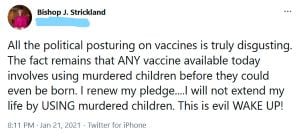
Screenshot of tweet by Bishop Strickland (1/21/21).
Knowing very well that Strickland is influential in the conservative American Catholic bubble, I decided to respond sharply to him. I hoped that what I said might act as a counter-weight with a few of his readers. I wrote:
Honestly, I don’t care whether you extend your life or not. What you are going to do, do quickly. What I care about is you’re trying to influence people into going and doing likewise—then you’ll have innocent blood on your hands to try to explain away when you meet St. Peter.
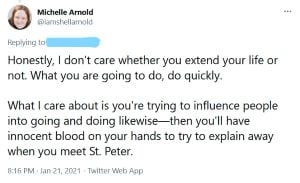
Screenshot of tweet by Michelle Arnold (1/21/21).
As I expected, my words went largely ignored. Which was why I was amused to find less than a handful of snarky responses a few days later. I didn’t mind the snark, but found the non-sequiturs entertaining. This one, in particular, caught my attention:
You have pronouns in bio.
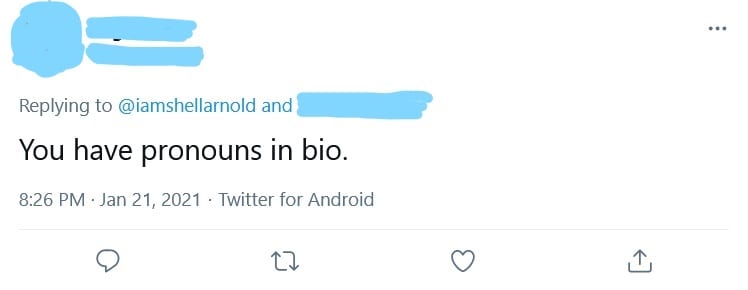
Screenshot of tweet (1/21/21).
My commenter was referring to my Twitter bio, which reads: “Freelance writer and editor. I just have a lot to say. My opinions are my own. RTs and Hearts aren’t Endorsements. She/her.” I wrote back:
A non-sequitur to my challenge to [Bishop Joseph Strickland] over his anti-vax campaign, but I’m happy to respond. You’re right, I do [use pronouns in my bio]. It’s intended to signal that I won’t judge people for how they choose to identify. And to annoy those who are all about judging others.
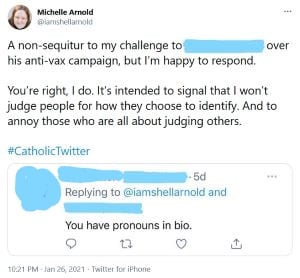
Screenshot of tweet by Michelle Arnold (1/26/21).
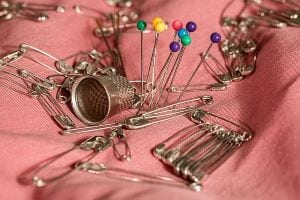
After the 2016 election, some anti-Trump activists encouraged wearing a safety pin to show solidarity with marginalized people who were targets of abuse from Trump supporters. The safety pin as a symbol of safety had been adopted earlier that year in the U.K. in response to the Brexit vote and, according to reports, was imported into America by activists “as a symbol of unity: a way for people—regardless of their politics—to show they are allies and do not stand for the kind of violence and abuse that has emerged and been reported on since Trump was elected.”
Naturally, this symbol quickly came under fire, derided as an empty, feel-good gesture by the privileged. And perhaps, on an individual level, it could have been. If those people who wore safety pins after Trump’s election spent the next four years looking the other way from police brutality toward people of color, anti-immigration laws that targeted Muslims and Dreamers, and abusive behavior (even online) from friends or family members toward marginalized groups, then the safety pins were indeed a meaningless symbol signifying nothing.
But that doesn’t make concrete symbols of principle meaningless. Which brings me back to the use of pronouns.
Over the past few years—yes, under the Trump Administration—the rights of people identifying as transgender have come under attack. Among other human rights abuses, Trump’s Department of Education limited the access trans students had to bathrooms in school, HUD allowed single-sex homeless shelters to turn away people if they didn’t look like women, and HHS sought to erase protections for transgender people in accessing medical care.
Much like wearing safety pins, declaring pronouns has become a way for non-trans people to show support for transgender people and for trans rights. It may be a symbolic gesture for someone like me, who has never had to struggle with gender dysphoria or with questions about gender identity. According to LGBT activists though, it’s a means of showing support for inclusivity:
“Including pronouns in your email signature and social media profiles is an important move towards inclusivity,” says LGBT+ Inclusion Consultant Gina Battye.
“It shows you care about individuals preferences and is a simple solution to accidental misgendering.”
Of course, such discussions about how best to support the rights and safety of trans people are often met with sputters of indignation from conservative Catholics. Most conservative Catholics will pay lip service to the directives of Church documents that require that every human person, including trans persons, be treated with respect and dignity, nodding in the direction of teaching such as this:
[There is a] need to educate children and young people to respect every person in their particularity and difference, so that no one should suffer bullying, violence, insults or unjust discrimination based on their specific characteristics (such as special needs, race, religion, sexual tendencies, etc.). Essentially, this involves educating for active and responsible citizenship, which is marked by the ability to welcome all legitimate expressions of human personhood with respect (Male and Female He Created Them, 16).
But when supporters of trans people start suggesting practical methods of support, such as using preferred pronouns, avoiding “deadnaming” trans people, and providing safe public accommodations for trans people to pee in peace, many conservative Catholics freak out at the implications.
I don’t use the descriptive phrase, “freak out,” lightly. I’ve watched them come unglued over the past few years in their online rhetoric. These freak outs have ranged from organizing boycotts of companies that provide unisex public restrooms, to insisting upon calling trans celebrities by their dead names, to heckling Catholics who choose to embrace symbols of support for trans people. And they do all this in the name of objective truth.
“Truth doesn’t care about your feelings!” is a common mantra of Catholic anti-trans activists. Truth, in their minds, is both strong enough to crush any appeal to an individual’s feelings beneath its jackbooted heel and fragile enough to be threatened by ephemeral symbols such as pride flags, safety pins, and Twitter bios.
I examined the idea that truth and feelings have nothing to do with each other in the last essay I wrote for Catholic Answers. As I wrote in that article:
Feelings are part of the human condition, part of our humanity that Jesus came to redeem, not to ignore or abolish. In his own earthly life, we see Christ rejoicing with his disciples after a successful mission (Luke 10:17–21); weeping as he predicted the destruction of Jerusalem (Luke 19:41–44); and raging at the money-changers, who were profaning the Temple, in such a display of temper that his disciples remembered the messianic prophecy that “Zeal for thy house will consume me” (John 2:14–17). As the Catechism concludes, “In Christ, human feelings are able to reach their consummation in charity and divine beatitude” (1769).
Because we are embodied human persons, we use that which is material to symbolize that which is spiritual, including objective truth. Because we are finite creatures, we can’t embody all truth all the time, so we have to choose which truths we want to emphasize. That’s one reason why conservative Catholics often focus all of their social justice energies entirely on the issue of abortion—a focus they’ll vehemently defend. That’s why other people focus their energies on issues that matter to them (e.g., race relations, LGBT rights, environmental activism, etc.). And, so, since we can’t cover our bodies in symbols of every truth, that’s why some people wear precious feet pins to support unborn children and others wear red ribbons to support AIDS victims.
In the case of the pronouns, I choose to include my pronouns on my Twitter bio. I don’t include them everywhere, anymore than my longstanding custom of writing “+JMJ” at the top of my personal checks as a nod to the Holy Family means I write those initials elsewhere. I’m emphasizing different truths in different places. On my Twitter bio, I’m emphasizing openness to LGBT people; on my checks, I’m emphasizing the Holy Family’s place in my household. I can see both of those customs being sources of annoyance or amusement, but neither harms anyone.
If you don’t want to include pronouns in your social media or correspondence, you’re free to decline to do so. But you may want to look at the symbols you do use in your life—married names, religious titles, personal jewelry, etc.—and consider what truths you’re choosing to emphasize and why.
(Images: Sewing notions, Pixabay. Screenshots from Twitter.)
ETA (1/27/21): Updated screenshots of tweets and article to remove Twitter handles.
Previous Post

December 14, 2020
To Whom Would Jesus Deny Communion?
Next Post
January 28, 2021 Apologies of a Pro-Choice, Pro-Life Catholic
Browse Our Archives
Select a Category Apologetics News Personal Popular Culture Uncategorized
Select a Month August 2024 May 2024 February 2024 December 2023 July 2023 December 2022 October 2022 June 2022 May 2022 April 2022 March 2022 November 2021 October 2021 September 2021 June 2021 April 2021 January 2021 December 2020 November 2020 October 2020 September 2020 August 2020 December 2015 July 2015 June 2015 May 2015 April 2015
Follow Us!
TAKE THE
Religious Wisdom Quiz
Who wore a coat of many colors?
Select your answer to see how you score.
Joseph Moses Jacob Abel
Related posts from Michelle Arnold

Catholic Answers and the Trouble with Yoga
Pro-Lifers and the Case of the Invisible Woman

How to Bring Catholics Back to Mass
TRENDING AT PATHEOS Catholic

Rejecting Doom: Christian Hope And Human Action
Christianity is a religion of hope. We are to have hope and...

It’s What Comes From Within Which Matters
One of the most difficult things for us to understand is why...

Why I Choose the Eucharist Over the Sermon
Choose the Eucharist, Not the Sermon What are we supposed to get...

5 Design Elements Found in Spiritually Rooted Homes
Putting Spirituality Into Home Decor Our homes are more than our living...

Credo: A Story of God Told with the...
About 10 years ago, I began to imagine a personal "Credo" that...

The Anatomy of Divine Revelation in Catholic Thought
The claim that God has made Himself known to human beings is...
view all Catholic blogs
Ad-Free & Subscriber Log-In Subscription Support
- About Us
- 2026 Calendar
- Videos
- Podcasts
- Library of World Religions
- Faith In Media Tracker
- Advertise With Us
- Write for Us
- Privacy Policy
- Terms of Service
- Do Not Sell My Data
- Contact Us
- Radiant Digital
- Manage Newsletter Subscriptions
- Unsubscribe From Notifications
- Sitemap
Copyright 2008-2026, Patheos. All rights reserved.
Subscription Support Ad-Free & Subscriber Log-In
Follow Patheos