
BuddhistCatholicContemplativeEvangelicalGeneral ChristianHinduJewishLatter-day SaintMuslimNew VisionsProgressive Christian
Beliefs
- Buddhist
- Catholic
- Contemplative
- Evangelical
- General Christian
- Hindu
- Jewish
- Latter-day Saint
- More Voices
- Muslim
- New Visions
- Pagan
- Progressive Christian
Topics
- Religion News
- Food and Religion
- Sports and Religion
- Religious Art
- Religious Music and Entertainment
- Religious Events
- History and Religion
- Style and Religion
- Politics and Religion
- Women in Religion
- Recreation Outdoors and Religion
- Business Finance and Religion
- Careers Workplace and Religion
- Education and Religion
- Family Parenting and Religion
- Health Fitness and Religion
- Home and Religion
- Relationships and Religion
- Technology and Religion
- Travel and Religion
Columnists
- Buddhist Columnists
- Business Finance and Religion Columnists
- Careers Workplace and Religion Columnists
- Catholic Columnists
- Contemplative Columnists
- Education and Religion Columnists
- Evangelists Columnists
- Family Parenting and Religion Columnists
- General Christian Columnists
- Health Fitness and Religion Columnists
- Hindu Columnists
- History and Religion Columnists
- Home and Religion Columnists
- Jewish Columnists
- More Voices Columnists
- Latter Day Columnists
- Muslim Columnists
- New Visions Columnists
- Nonreligious Columnists
- Pagan Columnists
- Politics and Religion Columnists
- Progressive Columnists
- Recreation Outdoors and Religion Columnists
- Relationships and Religion Columnists
- Religion News Columnists
- Religious Art Columnists
- Religious Events Columnists
- Religious Music and Entertainment Columnists
- Sports and Religion Columnists
- Style and Religion Columnists
- Technology and Religion Columnists
- Travel and Religion Columnists
- Women in Religion Columnists
Resource Library
- 2026 Calendar
- Library of World Religions
- The 100 Most Holy Places on Earth
- Patheos Answers
- Podcasts
- Videos
- Faith Leaders Database
- Anglican Episcopalian
- Bahai
- Baptist
- Buddhism
- Christianity
- Confucianism
- Eastern Orthodoxy
- Hinduism
- Holiness and Pentecostal
- ISKCON
- Islam
- Judaism
- Lutheran
- Methodist
- The Church of Jesus Christ of Latter-day Saints
- New Age
- Paganism
- Presbytarian and Reformed
- Protestantism
- Religion Behind the Scenes
- Roman Catholic
- Scientology
- Shia Islam
- Sikhism
- Sufism
- Sunni Islam
- Taoism
- Zen
- See all religions
Research Tools
 Ad-Free & Subscriber Log-In Subscription Support
Ad-Free & Subscriber Log-In Subscription Support
Follow Patheos 

- Trending:
- Forgiveness
- |
- Marriage
- |
- Consciousness
- |
- Death Penalty
- |
- Election
- |
- Halloween
 Michelle Arnold
- Home
- Catholic
- What Mary Knew Is Her Own Business
What Mary Knew Is Her Own Business
Last updated on: December 11, 2020 at 9:00 am by Michelle Arnold
What Mary Knew Is Her Own Business 2020-12-10T23:52:39-07:00 Michelle Arnold
Patheos Explore the world's faith through different perspectives on religion and spirituality! Patheos has the views of the prevalent religions and spiritualities of the world.
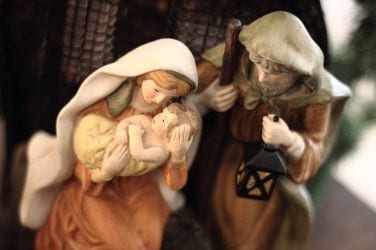 Welcome to Advent, that time of year when Christians ponder the deep mysteries of the birth of Christ—and start arguing about the Virgin Mary. Protestants and Catholics usually bicker over whether the Virgin and St. Joseph had other children after Christ was born. Catholics argue among themselves over the details of Christ’s birth, in particular how he was born. Was he born in the same manner most humans are born, via natural childbirth, or was his birth in some way a miraculous event that left his Mother’s physical virginity intact?
To put it crudely, did the Virgin Mary lose her hymen during the birth of Christ, or did Christ “emerge” from her womb without damaging his Mother’s hymen?
It’s fair for Catholic apologists to note that this issue has been of deep interest to Catholic theologians for centuries. Tim Staples, Director of Apologetics for Catholic Answers, provided an overview of the arguments for his book Behold Your Mother, noting that the Catechism of the Council of Trent gave what would become the common analogy for a miraculous birth, light shining through glass:
But as the conception itself transcends the order of nature, so also the birth of our Lord … just as the rays of the sun penetrate without breaking or injuring in the least the solid substance of glass, so after a like but more exalted manner did Jesus Christ come forth from his mother’s womb without injury to her maternal virginity.
Tim made clear his preference for believing that the birth of Christ was a miracle that preserved Mary’s physical virginity:
Although there is certainly no argument from necessity here, and this teaching is a matter of legitimate debate in the Church today, I argue it to be most fitting as a sign of hope for the entire body of Christ. All can see in this unique gift to Mary a sign of the ultimate deliverance from all bodily pain and suffering that awaits the Church through the resurrection of Jesus Christ. In Mary we see the fullness of the grace of Easter incarnated in a human person.
Stating a preference is fine, but unfortunately, many Catholics don’t leave it at that. When a friend of mine posted an image of the Virgin giving birth to her social media platforms, it sparked an intense debate over Mary’s virginity. Men, in particular, took offense at the idea of the Virgin giving birth naturally, claiming that belief in a natural birth for Christ is “heretical.”
Rather than wade into the argument directly, I’d like to look at this from another angle.
What if I told you it’s none of your business how the Virgin Mary gave birth or whether her hymen was broken during the birth of her Son?
Years ago, a Catholic Answers client asked me why Jesus never mentioned his Mother’s virginity. Rather than rely on the more common apologetics answer that not everything Jesus said was recorded in the New Testament (cf. John 20:30–31), I decided to point out something I thought to be even more fundamental: it would have been disrespectful for Jesus to have done so:
It would hardly have been appropriate or respectful for Jesus to discuss his Mother’s sexual history during his public ministry. He entrusted to his Church the task of discerning and then promulgating the dogma that his Mother was a perpetual virgin.
The fact that Mary was a perpetual virgin was important for the Church to know. That she was a virgin before Christ’s birth “manifests God’s absolute initiative in the Incarnation. Jesus has only God as Father” (CCC 503). That she remained a virgin after “is the sign of her faith ‘unadulterated by any doubt,’ and of her undivided gift of herself to God’s will” (CCC 506). And, yes, the ordinary teaching of the Church is that she remained a virgin during birth, but how that happened isn’t explained:
The deepening of faith in the virginal motherhood led the Church to confess Mary’s real and perpetual virginity even in the act of giving birth to the Son of God made man. In fact, Christ’s birth “did not diminish his mother’s virginal integrity but sanctified it” (CCC 499).
We’re given that information about the birth of Christ that is necessary for us to know. I contend that what is unnecessary for us to know about Christ’s birth is not only a theological mystery but also is none of our business.
Last year, the rapper T.I. stirred up a firestorm of controversy by declaring during an interview on a podcast that he has a doctor perform a hymen check on his teenage daughter once a year. Many of his listeners were revolted by the revelation, in no small part because of how unnecessarily invasive and traumatizing such a check would be for a young woman. In my own response to the story, I wrote that T.I.’s actions were one example of how virginity has become objectified:
In a world engulfed in moral and spiritual darkness, virginity all too often is treated as a commodity by those holding power over others. T.I. is a good example of this mindset, seeing his daughter’s virginity as something he controls—seeing it, in fact, as belonging to him. (“Give me back my results expeditiously,” he ordered his daughter’s doctor.)
Frankly, I believe the same holds true for the Virgin Mary. Accepting with gratitude the knowledge we have about the Blessed Virgin—that she chose, for love of God, to dedicate herself entirely to him; that Jesus is the only-begotten Son of the Father; that St. Joseph respected his wife’s choice to remain a virgin within marriage—that’s one thing. But to claim to know for certain what we can’t know, to claim to know the physical mechanics of Christ’s birth or the physical state of his Mother’s vagina, is to tread into the private lives of God and his Mother.
I believe it’s very possible that Mary experienced the pain of childbirth. Her Son chose to enter into human suffering to accomplish the redemption of the world. His agony on the Cross opened heaven to us. I think it would be very fitting if Mary experienced the pain of childbirth—in anticipation of her Son’s suffering and in union with it, her own agony in childbirth would have the potential to contribute to the redemption of the world.
But I don’t know whether or not Mary suffered pain during her Son’s birth. I don’t know if she gave birth naturally or if Christ emerged from her by miraculous means. And, unlike other questions I have in mind to ask someday, if and when I make it to heaven (“Whatever happened to Thomas’s twin?” “Was Paul really knocked off a horse during his conversion experience?” “Who wrote the Book of Hebrews?”), I will refrain from asking for nitty-gritty details about Christ’s birth.
Because I can’t imagine anything more awkward or inappropriate than asking a woman about the intimate details of her child’s birth. She’s free to share those details with whomever she wishes, but that choice is hers to make. If that’s true for any woman, how much more so should it hold true for the Mother of God that her privacy should be respected?
The physical state of the Blessed Virgin’s vagina is none of our business.
(Image: Holy Family, Pixabay.)
Catechism of the Catholic Church
Previous Post

November 30, 2020
O Stay Home, All Ye Hypocrites
Next Post
December 14, 2020 To Whom Would Jesus Deny Communion?
Browse Our Archives
Select a Category Apologetics News Personal Popular Culture Uncategorized
Select a Month August 2024 May 2024 February 2024 December 2023 July 2023 December 2022 October 2022 June 2022 May 2022 April 2022 March 2022 November 2021 October 2021 September 2021 June 2021 April 2021 January 2021 December 2020 November 2020 October 2020 September 2020 August 2020 December 2015 July 2015 June 2015 May 2015 April 2015
Follow Us!
TAKE THE
Religious Wisdom Quiz
What animal is commonly associated with Jesus?
Select your answer to see how you score.
Lamb Lion Fish Donkey
Related posts from Michelle Arnold


Catholic Answers and the Trouble with Yoga
Pro-Lifers and the Case of the Invisible Woman
TRENDING AT PATHEOS Catholic

Creation, Preservation, and Teleology in Catholic Theology
As I write this, it is very early Monday morning. Like millions...

The Parable Of The Sower And The Word...
One of Christ’s most famous parables is that of the sower who...

Rejecting Doom: Christian Hope And Human Action
Christianity is a religion of hope. We are to have hope and...

Why I Choose the Eucharist Over the Sermon
Choose the Eucharist, Not the Sermon What are we supposed to get...

5 Design Elements Found in Spiritually Rooted Homes
Putting Spirituality Into Home Decor Our homes are more than our living...

Credo: A Story of God Told with the...
About 10 years ago, I began to imagine a personal "Credo" that...
view all Catholic blogs
Ad-Free & Subscriber Log-In Subscription Support
- About Us
- 2026 Calendar
- Videos
- Podcasts
- Library of World Religions
- Faith In Media Tracker
- Advertise With Us
- Write for Us
- Privacy Policy
- Terms of Service
- Do Not Sell My Data
- Contact Us
- Radiant Digital
- Manage Newsletter Subscriptions
- Unsubscribe From Notifications
- Sitemap
Copyright 2008-2026, Patheos. All rights reserved.
Subscription Support Ad-Free & Subscriber Log-In
Follow Patheos