
BuddhistCatholicContemplativeEvangelicalGeneral ChristianHinduJewishLatter-day SaintMuslimNew VisionsProgressive Christian
Beliefs
- Buddhist
- Catholic
- Contemplative
- Evangelical
- General Christian
- Hindu
- Jewish
- Latter-day Saint
- More Voices
- Muslim
- New Visions
- Pagan
- Progressive Christian
Topics
- Religion News
- Food and Religion
- Sports and Religion
- Religious Art
- Religious Music and Entertainment
- Religious Events
- History and Religion
- Style and Religion
- Politics and Religion
- Women in Religion
- Recreation Outdoors and Religion
- Business Finance and Religion
- Careers Workplace and Religion
- Education and Religion
- Family Parenting and Religion
- Health Fitness and Religion
- Home and Religion
- Relationships and Religion
- Technology and Religion
- Travel and Religion
Columnists
- Buddhist Columnists
- Business Finance and Religion Columnists
- Careers Workplace and Religion Columnists
- Catholic Columnists
- Contemplative Columnists
- Education and Religion Columnists
- Evangelists Columnists
- Family Parenting and Religion Columnists
- General Christian Columnists
- Health Fitness and Religion Columnists
- Hindu Columnists
- History and Religion Columnists
- Home and Religion Columnists
- Jewish Columnists
- More Voices Columnists
- Latter Day Columnists
- Muslim Columnists
- New Visions Columnists
- Nonreligious Columnists
- Pagan Columnists
- Politics and Religion Columnists
- Progressive Columnists
- Recreation Outdoors and Religion Columnists
- Relationships and Religion Columnists
- Religion News Columnists
- Religious Art Columnists
- Religious Events Columnists
- Religious Music and Entertainment Columnists
- Sports and Religion Columnists
- Style and Religion Columnists
- Technology and Religion Columnists
- Travel and Religion Columnists
- Women in Religion Columnists
Resource Library
- 2026 Calendar
- Library of World Religions
- The 100 Most Holy Places on Earth
- Patheos Answers
- Podcasts
- Videos
- Faith Leaders Database
- Anglican Episcopalian
- Bahai
- Baptist
- Buddhism
- Christianity
- Confucianism
- Eastern Orthodoxy
- Hinduism
- Holiness and Pentecostal
- ISKCON
- Islam
- Judaism
- Lutheran
- Methodist
- The Church of Jesus Christ of Latter-day Saints
- New Age
- Paganism
- Presbytarian and Reformed
- Protestantism
- Religion Behind the Scenes
- Roman Catholic
- Scientology
- Shia Islam
- Sikhism
- Sufism
- Sunni Islam
- Taoism
- Zen
- See all religions
Research Tools
 Ad-Free & Subscriber Log-In Subscription Support
Ad-Free & Subscriber Log-In Subscription Support
Follow Patheos 

- Trending:
- Forgiveness
- |
- Marriage
- |
- Consciousness
- |
- Death Penalty
- |
- Election
- |
- Halloween
 Michelle Arnold
- Home
- Catholic
- St. Maria Goretti: The Girl Who Lived
St. Maria Goretti: The Girl Who Lived
Last updated on: July 6, 2015 at 8:53 pm by Michelle Arnold
St. Maria Goretti: The Girl Who Lived 2015-07-06T20:53:51-07:00 Michelle Arnold
Patheos Explore the world's faith through different perspectives on religion and spirituality! Patheos has the views of the prevalent religions and spiritualities of the world.
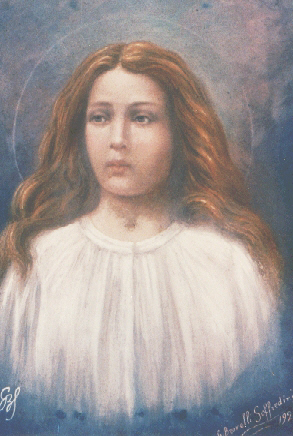 Every year around this time, I brace myself for the onslaught of social media posts and essays on St. Maria Goretti, whose feast day is July 6. Until a few years ago, I never realized how controversial St. Maria was, and how difficult it can be for some Catholics (especially women) to relate to her. But the more I see on the Internet about St. Maria, the more I understand why some Catholics do shy away from her.
Which is a tragedy in itself because St. Maria Goretti was not quite 12 years old when she was murdered by a young neighbor whose sexual advances she had rebuffed. She was a little girl who died as the result of a heinous crime, one that may well have been uncommon in her day but is all too common in our day.
But then the only thing we know for certain about St. Maria is how she died. As with many victims of violent crime, very little is known about how she lived.
Let’s try to piece together what little we do know, and see if we can find the little girl, Maria Teresa Goretti, under the hagiography. I’ve drawn the facts for this sketch from her entry on Wikipedia, perhaps not the most reliable source, but it may be a toehold to deeper study by anyone interested in learning more about Maria.
Maria was born on October 16, 1890. (Coincidentally, this would be the same day that John Paul II would be elected to the papacy 88 years later in 1978.) She was the third child of a large Italian peasant family. The family lived in desperate poverty, poverty made worse when Maria’s father died of malaria when she was 9. As the eldest daughter, Maria often took care of her youngest siblings while her mother and other siblings worked in the fields.
The family lived in close proximity to the Serenellis, a father and son who shared a rented house with Maria’s family. The son, Alessandro, was not yet 21, still a minor in the eyes of Italian law. By his own account, Alessandro was caught up in the pleasures of the day. While he did acknowledge the bad influences to which he had access, he also took personal responsibility and noted that he ignored good influences he could have chosen to listen to instead:
Looking back at my past, I can see that in my early youth, I chose a bad path which led me to ruin myself.
My behavior was influenced by print, mass-media, and bad examples which are followed by the majority of young people without even thinking. And I did the same. I was not worried.
There were a lot of generous and devoted people who surrounded me, but I paid no attention to them because a violent force blinded me and pushed me toward a wrong way of life.
More than once, for at least a year before the final assault, Alessandro tried to coerce Maria into sexual acts, which she refused. On her deathbed, Maria would tell her mother and the police that she had not told of Alessandro’s prior harassment because he had threatened to kill her. Finally, on the afternoon of July 5, 1902, Alessandro threatened Maria with choking and a knife. She fought him, and in retaliation, he stabbed her a total of fourteen times. He ran off, leaving Maria bleeding to death on the floor and her baby sister crying nearby.
When she was found, by her mother and Alessandro’s father, she was taken to the hospital for treatment. According to the reports, the surgery she endured was horrific, and she did not receive adequate anesthesia. She died about 24 hours after the initial attack.
Reports of her stay in the hospital are filled with sentiment. The pharmacist, possibly what today we would call an anesthesiologist, asked her to remember him in paradise even before the young girl fully understood she was going to die. She is said to have asked about her mother’s welfare. She was given a picture of the Virgin Mary and a crucifix to hold while she died.
And, of course, there are the reports that Maria forgave Alessandro on her deathbed and stated that she wanted him to join her in heaven. I remember reading somewhere, I cannot recall now where, that these statements were made upon prodding by her priest. That is not to say that she did not actually forgive Alessandro or that her words were false. But it is to say that she may not have spontaneously thought on her deathbed to forgive Alessandro. To some extent, her choice to forgive him may have been influenced by others.
As I said, we mainly remember St. Maria by how she died. She has become a patron saint of chastity, invoked as an intercessor for preserving personal purity. The lion’s share of focus upon her is those few minutes when she fought Alessandro. Whether the focus is on her defending her chastity, or whether the focus is on her screaming to Alessandro that he would go to hell if he persisted, the focus is on that last struggle. How we interpret that struggle says a lot about our own personal agendas. As Kathleen Norris wrote in her book, The Cloister Walk:
Exploitation is at the heart of Maria Goretti’s story, so much so that I wonder if it is possible to write about her in the late twentieth century without exploiting her further.
I think if we are truly to see St. Maria as she lived—freed, at last, from the burdens of poverty, adult responsibility at a young age, fear of assault, and, yes, fear of sin (as we should expect from a pious young Catholic girl in early-20th century Italy)—then we have to look at the one episode in her life when she was entirely free of coercion, entirely free from fear. When she entirely acted on her own initiative. Then, and only then, do we see her fully human, fully alive.
According to Alessandro, for several years during his imprisonment, he was entirely unrepentant. Then one night he had a vision. Reports generally agree that this is what happened:
While in prison for his crime, Alessandro had a vision of Maria. He saw a garden where a young girl, dressed in white, gathered lilies. She smiled, came near him, and encouraged him to accept an armful of the lilies. As he took them, each lily transformed into a still white flame. Maria then disappeared. This vision of Maria led to Alessandro’s conversion, and he later testified at her cause for beatification.
If these reports of Alessandro’s vision are indeed accurate, then we can deduce several things about Maria’s encounter with Alessandro.
- Maria was clothed in white, carrying flowers that are a traditional symbol of purity.
- Maria smiled at Alessandro, greeting him as one might an old friend. She no longer feared him.
- Maria approached Alessandro of her own free will, and offered him a gift that symbolized purity. She offered him a gift that symbolized an opportunity to be both reconciled with her and restored in his own purity.
- This vision evidently was an entirely free gift to Alessandro, not the result of pious prodding or lingering Catholic guilt.
Alessandro accepted the grace offered him through this vision, reforming his life. Eventually, after his release from prison, he would beg forgiveness from Maria’s mother (which was granted), and spent the remainder of his life in humble service as a gardener and porter for a Franciscan friary. But, even had he rejected this grace, the vision alone shows us the real Maria—the not-quite 12-year-old child, the girl who finally lived fully in life beyond death, no longer a victim but entirely free to be the saint the Church eventually recognized she was.
St. Maria Goretti, pray for us.
(Image credit: Wikimedia Commons)

Previous Post

June 24, 2015
Grace Flows North from Charleston to Boston
Next Post

July 7, 2015 One Size May Not Fit All
Browse Our Archives
Select a Category Apologetics News Personal Popular Culture Uncategorized
Select a Month August 2024 May 2024 February 2024 December 2023 July 2023 December 2022 October 2022 June 2022 May 2022 April 2022 March 2022 November 2021 October 2021 September 2021 June 2021 April 2021 January 2021 December 2020 November 2020 October 2020 September 2020 August 2020 December 2015 July 2015 June 2015 May 2015 April 2015
Follow Us!
TAKE THE
Religious Wisdom Quiz
Besides Samuel, Elkanah and Hannah had this many children.
Select your answer to see how you score.
5 0 8 2
Related posts from Michelle Arnold
"I Hated That Woman!": The Human Frailty of...

Catholic Answers and the Trouble with Yoga
Pro-Lifers and the Case of the Invisible Woman
TRENDING AT PATHEOS Catholic

Rejecting Doom: Christian Hope And Human Action
Christianity is a religion of hope. We are to have hope and...

It’s What Comes From Within Which Matters
One of the most difficult things for us to understand is why...

Why I Choose the Eucharist Over the Sermon
Choose the Eucharist, Not the Sermon What are we supposed to get...

5 Design Elements Found in Spiritually Rooted Homes
Putting Spirituality Into Home Decor Our homes are more than our living...

Credo: A Story of God Told with the...
About 10 years ago, I began to imagine a personal "Credo" that...

The Anatomy of Divine Revelation in Catholic Thought
The claim that God has made Himself known to human beings is...
view all Catholic blogs
Ad-Free & Subscriber Log-In Subscription Support
- About Us
- 2026 Calendar
- Videos
- Podcasts
- Library of World Religions
- Faith In Media Tracker
- Advertise With Us
- Write for Us
- Privacy Policy
- Terms of Service
- Do Not Sell My Data
- Contact Us
- Radiant Digital
- Manage Newsletter Subscriptions
- Unsubscribe From Notifications
- Sitemap
Copyright 2008-2026, Patheos. All rights reserved.
Subscription Support Ad-Free & Subscriber Log-In
Follow Patheos