
BuddhistCatholicContemplativeEvangelicalGeneral ChristianHinduJewishLatter-day SaintMuslimNew VisionsProgressive Christian
Beliefs
- Buddhist
- Catholic
- Contemplative
- Evangelical
- General Christian
- Hindu
- Jewish
- Latter-day Saint
- More Voices
- Muslim
- New Visions
- Pagan
- Progressive Christian
Topics
- Religion News
- Food and Religion
- Sports and Religion
- Religious Art
- Religious Music and Entertainment
- Religious Events
- History and Religion
- Style and Religion
- Politics and Religion
- Women in Religion
- Recreation Outdoors and Religion
- Business Finance and Religion
- Careers Workplace and Religion
- Education and Religion
- Family Parenting and Religion
- Health Fitness and Religion
- Home and Religion
- Relationships and Religion
- Technology and Religion
- Travel and Religion
Columnists
- Buddhist Columnists
- Business Finance and Religion Columnists
- Careers Workplace and Religion Columnists
- Catholic Columnists
- Contemplative Columnists
- Education and Religion Columnists
- Evangelists Columnists
- Family Parenting and Religion Columnists
- General Christian Columnists
- Health Fitness and Religion Columnists
- Hindu Columnists
- History and Religion Columnists
- Home and Religion Columnists
- Jewish Columnists
- More Voices Columnists
- Latter Day Columnists
- Muslim Columnists
- New Visions Columnists
- Nonreligious Columnists
- Pagan Columnists
- Politics and Religion Columnists
- Progressive Columnists
- Recreation Outdoors and Religion Columnists
- Relationships and Religion Columnists
- Religion News Columnists
- Religious Art Columnists
- Religious Events Columnists
- Religious Music and Entertainment Columnists
- Sports and Religion Columnists
- Style and Religion Columnists
- Technology and Religion Columnists
- Travel and Religion Columnists
- Women in Religion Columnists
Resource Library
- 2026 Calendar
- Library of World Religions
- The 100 Most Holy Places on Earth
- Patheos Answers
- Podcasts
- Videos
- Faith Leaders Database
- Anglican Episcopalian
- Bahai
- Baptist
- Buddhism
- Christianity
- Confucianism
- Eastern Orthodoxy
- Hinduism
- Holiness and Pentecostal
- ISKCON
- Islam
- Judaism
- Lutheran
- Methodist
- The Church of Jesus Christ of Latter-day Saints
- New Age
- Paganism
- Presbytarian and Reformed
- Protestantism
- Religion Behind the Scenes
- Roman Catholic
- Scientology
- Shia Islam
- Sikhism
- Sufism
- Sunni Islam
- Taoism
- Zen
- See all religions
Research Tools
 Ad-Free & Subscriber Log-In Subscription Support
Ad-Free & Subscriber Log-In Subscription Support
Follow Patheos 

- Trending:
- Forgiveness
- |
- Marriage
- |
- Consciousness
- |
- Death Penalty
- |
- Election
- |
- Halloween
 Michelle Arnold
- Home
- Catholic
- Baptism “Delayed” Is Not Baptism “Denied”
Baptism “Delayed” Is Not Baptism “Denied”
Last updated on: May 4, 2015 at 8:51 pm by Michelle Arnold
Baptism “Delayed” Is Not Baptism “Denied” 2015-05-04T20:51:40-07:00 Michelle Arnold
Patheos Explore the world's faith through different perspectives on religion and spirituality! Patheos has the views of the prevalent religions and spiritualities of the world.
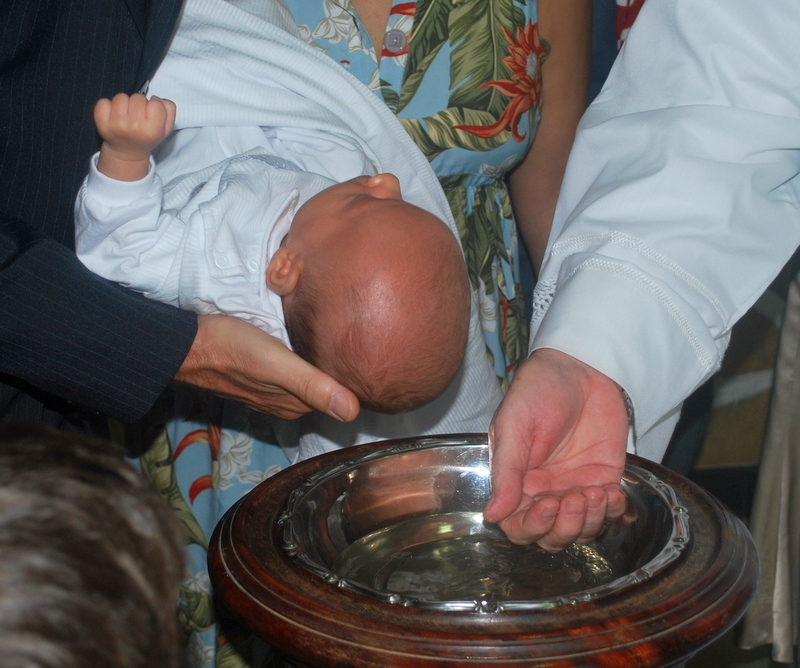 When I was about 15 or 16, I noticed a small black-and-white advertisement in the back of one of those now rapidly-disappearing oddities called a “magazine.” No, the ad wasn’t seeking mail-order brides or offering unmentionables to be shipped in brown-paper packages. It was an offer of a free correspondence course on Catholicism from the Knights of Columbus.
As an unbaptized “cultural Christian,” more or less, I only had a vague idea of what the Knights of Columbus was, but I was interested in the correspondence course. I had just finished reading The Great Controversy, Seventh-Day Adventist “prophetess” Ellen G. White’s black fable, published in the guise of a history of the Christian faith. You can guess the identity of the villain of that black fable, I’m sure.
Once the correspondence course arrived, I also received a catalogue of the Knights’ booklets on various aspects of the Catholic faith. Intrigued, I sent away for all of them. I treated those booklets like a cache of religious porn. Not only did I read them avidly, expecting more dark, dirty secrets of the type Ellen White had written about, but I took my pen to the pages, underlining passages and scrawling smart-aleck remarks in the margins.
What can I say? I was a kid. Thank God I got it out of my system before the Internet was invented.
I was reminded of this less than admirable episode from my youth today when I was reading a Traditionalist Catholic’s response to Pope Francis’s admonition to priests that they should not refuse baptism to anyone who asks for it. First, let’s look at a report of the Holy Father’s remarks, which he gave in a recent homily:
In words that may be interpreted to rebut Catholic priests who refuse to baptize children of same-sex couples, Pope Francis has said that priests should not refuse baptism to anyone who asks for the sacrament.
Speaking in a homily Sunday for the ordination of 19 new priests for the Diocese of Rome, Francis told the new ministers: “With baptism, you unite the new faithful to the People of God. It is never necessary to refuse baptism to someone who asks for it!”
I joked with friends on Facebook that we could expect “screams to begin in 5 . . . 4 . . . 3. . . .” And, sure enough, today I read a May 1 column on the Pope’s remarks by Christopher Ferrara, a lawyer who writes for Traditionalist Catholic outlets such as The Remnant and the late Fr. Nicholas Gruner’s Fatima Network. Ferrara opined:
Another day, another novelty from the lips of Francis. This time, in remarks following the ordination of new priests, he declared: “Do not ever refuse baptism to anyone who asks! (my emphasis)”
Never refuse baptism? Under any circumstances? That is hardly what the Church always taught before Francis. For example, in a 1980 Instruction on Infant Baptism, the Congregation for the Doctrine of the Faith stated that “infant baptism must be governed by two great principles, the second of which is subordinate to the first.” The first great principle, of course, is that “Baptism, which is necessary for salvation, is the sign and the means of God’s prevenient love, which frees us from original sin and communicates to us a share in divine life. . . .”
But the second great principle, which Francis would apparently ignore, is that: “Assurances must be given that the gift thus granted can grow by an authentic education in the faith and Christian life, in order to fulfill the true meaning of the sacrament.” Accordingly, “if these assurances are not really serious there can be grounds for delaying the sacrament; and if they are certainly non-existent the sacrament should even be refused.”
Notice all of Ferrara’s emphases? He underlines “ever” and “anyone” in the Pope’s statement. Then he underlines the points he’s dug up from a CDF document that he thinks refutes the Pope’s remarks. Much like my scribbles in the margins of those KofC booklets so long ago, where I used exclamation marks and proof-texts from my King James Bible to show why those wacky Catholics were so obviously wrong, Ferrara evidently thinks he has actually made a point here.
The problem is that Ferrara has completely missed the meaning of the one word he should have focused upon. That word is refuse. One online dictionary defines that word this way: “To indicate unwillingness to do, accept, give, or allow” or, to put it more simply, to deny outright, without qualification, or room for discussion or appeal. In the context of the Pope’s statement, the Pope is saying to priests that “It is never necessary to refuse [i.e., ‘deny outright’] baptism to someone who asks for it!”
What the Pope did not do was to suggest that there is never a reason to defer [i.e., postpone] baptism, when serious reason suggests a need, such as when there are legitimate concerns over whether the child to be baptized will be raised Catholic (or that an adult who requests baptism for himself will live as a Catholic, for that matter).
The 1983 Code of Canon Law—which, by the way, was promulgated after the CDF document that Ferrara cites—says:
For an infant to be baptized lawfully it is required . . . that there be a well-founded hope that the child will be brought up in the Catholic religion. If such hope is truly lacking, the baptism is, in accordance with the provisions of particular law, to be deferred and the parents advised of the reason for this (canon 868 §1 2°).
Nowhere in this canon are priests ever advised to outright refuse to baptize a child.
In a blog post I wrote for the Catholic Answers Blog on how to write rebuttals, I wrote:
Stephen R. Covey, the late educator and motivational guru who wrote The 7 Habits of Highly Effective People, once observed that “Most people do not listen with the intent to understand; they listen with the intent to reply.”
A reader commented: “Adding to what Stephen Covey said, I’d say that, unfortunately, a lot of people listen and read with the intent to contradict and to find a reason to get angry.”
Precisely.
(Image credit: Wikimedia Commons; Title credit: Will Duquette)

Previous Post

April 30, 2015
Climate Change or Earthly Purgatory
Next Post

May 7, 2015 Natalie Portman and Second Things
Browse Our Archives
Select a Category Apologetics News Personal Popular Culture Uncategorized
Select a Month August 2024 May 2024 February 2024 December 2023 July 2023 December 2022 October 2022 June 2022 May 2022 April 2022 March 2022 November 2021 October 2021 September 2021 June 2021 April 2021 January 2021 December 2020 November 2020 October 2020 September 2020 August 2020 December 2015 July 2015 June 2015 May 2015 April 2015
Follow Us!
TAKE THE
Religious Wisdom Quiz
What did King Nebuchadnezzar order everyone to worship?
Select your answer to see how you score.
A golden statue His crown A lion The sun
Related posts from Michelle Arnold

Catholic Answers and the Trouble with Yoga

Pro-Lifers and the Case of the Invisible Woman
How to Bring Catholics Back to Mass
TRENDING AT PATHEOS Catholic

Rejecting Doom: Christian Hope And Human Action
Christianity is a religion of hope. We are to have hope and...

It’s What Comes From Within Which Matters
One of the most difficult things for us to understand is why...

Why I Choose the Eucharist Over the Sermon
Choose the Eucharist, Not the Sermon What are we supposed to get...

5 Design Elements Found in Spiritually Rooted Homes
Putting Spirituality Into Home Decor Our homes are more than our living...

Credo: A Story of God Told with the...
About 10 years ago, I began to imagine a personal "Credo" that...

The Anatomy of Divine Revelation in Catholic Thought
The claim that God has made Himself known to human beings is...
view all Catholic blogs
Ad-Free & Subscriber Log-In Subscription Support
- About Us
- 2026 Calendar
- Videos
- Podcasts
- Library of World Religions
- Faith In Media Tracker
- Advertise With Us
- Write for Us
- Privacy Policy
- Terms of Service
- Do Not Sell My Data
- Contact Us
- Radiant Digital
- Manage Newsletter Subscriptions
- Unsubscribe From Notifications
- Sitemap
Copyright 2008-2026, Patheos. All rights reserved.
Subscription Support Ad-Free & Subscriber Log-In
Follow Patheos