
BuddhistCatholicContemplativeEvangelicalGeneral ChristianHinduJewishLatter-day SaintMuslimNew VisionsProgressive Christian
Beliefs
- Buddhist
- Catholic
- Contemplative
- Evangelical
- General Christian
- Hindu
- Jewish
- Latter-day Saint
- More Voices
- Muslim
- New Visions
- Pagan
- Progressive Christian
Topics
- Religion News
- Food and Religion
- Sports and Religion
- Religious Art
- Religious Music and Entertainment
- Religious Events
- History and Religion
- Style and Religion
- Politics and Religion
- Women in Religion
- Recreation Outdoors and Religion
- Business Finance and Religion
- Careers Workplace and Religion
- Education and Religion
- Family Parenting and Religion
- Health Fitness and Religion
- Home and Religion
- Relationships and Religion
- Technology and Religion
- Travel and Religion
Columnists
- Buddhist Columnists
- Business Finance and Religion Columnists
- Careers Workplace and Religion Columnists
- Catholic Columnists
- Contemplative Columnists
- Education and Religion Columnists
- Evangelists Columnists
- Family Parenting and Religion Columnists
- General Christian Columnists
- Health Fitness and Religion Columnists
- Hindu Columnists
- History and Religion Columnists
- Home and Religion Columnists
- Jewish Columnists
- More Voices Columnists
- Latter Day Columnists
- Muslim Columnists
- New Visions Columnists
- Nonreligious Columnists
- Pagan Columnists
- Politics and Religion Columnists
- Progressive Columnists
- Recreation Outdoors and Religion Columnists
- Relationships and Religion Columnists
- Religion News Columnists
- Religious Art Columnists
- Religious Events Columnists
- Religious Music and Entertainment Columnists
- Sports and Religion Columnists
- Style and Religion Columnists
- Technology and Religion Columnists
- Travel and Religion Columnists
- Women in Religion Columnists
Resource Library
- 2026 Calendar
- Library of World Religions
- The 100 Most Holy Places on Earth
- Patheos Answers
- Podcasts
- Videos
- Faith Leaders Database
- Anglican Episcopalian
- Bahai
- Baptist
- Buddhism
- Christianity
- Confucianism
- Eastern Orthodoxy
- Hinduism
- Holiness and Pentecostal
- ISKCON
- Islam
- Judaism
- Lutheran
- Methodist
- The Church of Jesus Christ of Latter-day Saints
- New Age
- Paganism
- Presbytarian and Reformed
- Protestantism
- Religion Behind the Scenes
- Roman Catholic
- Scientology
- Shia Islam
- Sikhism
- Sufism
- Sunni Islam
- Taoism
- Zen
- See all religions
Research Tools
 Ad-Free & Subscriber Log-In Subscription Support
Ad-Free & Subscriber Log-In Subscription Support
Follow Patheos 

- Trending:
- Forgiveness
- |
- Marriage
- |
- Consciousness
- |
- Death Penalty
- |
- Election
- |
- Halloween
 Coming down to Earth
- Home
- Catholic
- Welcome to America, Pope Francis!
Welcome to America, Pope Francis!
Last updated on: July 29, 2015 at 1:00 am by Michael Novak
Welcome to America, Pope Francis! 2015-07-28T21:10:12-05:00 Michael Novak
Patheos Explore the world's faith through different perspectives on religion and spirituality! Patheos has the views of the prevalent religions and spiritualities of the world.
The first pope to visit the United States was Paul VI in October 1965, just before the close of Vatican II. Pope John Paul II during his long reign visited seven times. And Benedict came in 2008. So there is already a tradition of popes getting to know our country.
The history of famous Europeans writing their first reflections on America after their visits here is also extensive, including Alexis de Tocqueville, Charles Dickens, G. K. Chesterton, Jacques Maritain, and Jean-Jacques Servan-Schreiber. The writings of many of these shrewd observers are quite brilliant.
![By Eduardo Martín Schweitzer Benegas (Own work) [CC BY-SA 4.0], via Wikimedia Commons](https://wp-media.patheos.com/blogs/sites/513/2015/07/Jacques_Maritain.jpg)
Jacques Maritain, by Eduardo Martín Schweitzer Benegas (Own work) [CC BY-SA 4.0], via Wikimedia Commons

Jacques Maritain, for example, came here with the typical European Catholic prejudices about America: that Americans are materialistic, that our system is based on pure self-interest and nothing else, and that we are supreme individualists with little sense of community. In his Reflections on America he analyzes with a philosopher’s shrewdness how and why these prejudices of his were shattered.
So the writers in Rome preparing the longer speeches and briefer remarks of Pope Francis for his appearances in the United States during his upcoming visit in September have a mound of past testimony from non-American points of view to work from.
They also have from such research institutes as Georgetown’s Center for Applied Research in the Apostolate a good picture of the myriad institutions and national organizations built by American Catholics, especially during the last 200 years. Two hundred twenty-four colleges and universities, some 1,200 secondary schools, and almost 13,000 elementary schools. The Catholic Church in the United States has built the second largest hospital system in the world, with over 600 hospitals and approximately 1,400 long-term care and other health facilities around the nation.
Americans in Rome early discover that Vatican officials either do not know at all or pay little regard to this amazing panoply of institutions, built largely from the bottom up, through the efforts and funds of Catholic families and individuals themselves. Scores of thousands of missionaries from elsewhere have come (and keep coming) to help build the Catholic Church in America. In return, scores of thousands of American Catholic missionaries have labored (and some have died) in missionary service around the world.
The papal nuncio to the United States, a couple of decades ago, commented with amusement that America is heavily spiced, like a really good Italian sauce, with lots of energy and originality and turbulence to enliven any kind of pasta. Thus ours is not a bland national church, but peppery and alive.
Among my own favorite comments of a pope visiting the U.S. is that of John Paul II on the occasion of his visit to that great baseball stadium of the Baltimore Orioles, Camden Yards, in October 1995. There the pope reminded Americans of President Abraham Lincoln’s deeply troubling question at Gettysburg in 1863: whether a nation conceived in liberty and dedicated to the proposition that all men are created equal can long endure. The pope worried that “the Biblical wisdom which played so large a part in the founding of America” might “be excluded from public moral debate.” He further reminded us that “every generation of Americans needs to know that freedom consists not in doing what we would like, but in having the right to do what we ought.”
Further, the pope encouraged Catholic parents and his brother bishops to guard the truth, “especially in view of the challenges posed by a materialistic culture and by a permissive mentality that reduces freedom to license.” He pictured Christian life in the United States as a constant intergenerational battle in which both the liberty and the liveliness of conscience are in danger of perishing.
Above all, St. John Paul the Great worried that “Americans would forget the Biblical wisdom which played such a formative part in the founding of your country.” And he asked searchingly, “Would not doing so mean that America’s founding documents no longer have any defining content, but are only the formal dressing of changing opinion?” Relativism, the pope knew, would totally undermine America’s founding ideas.
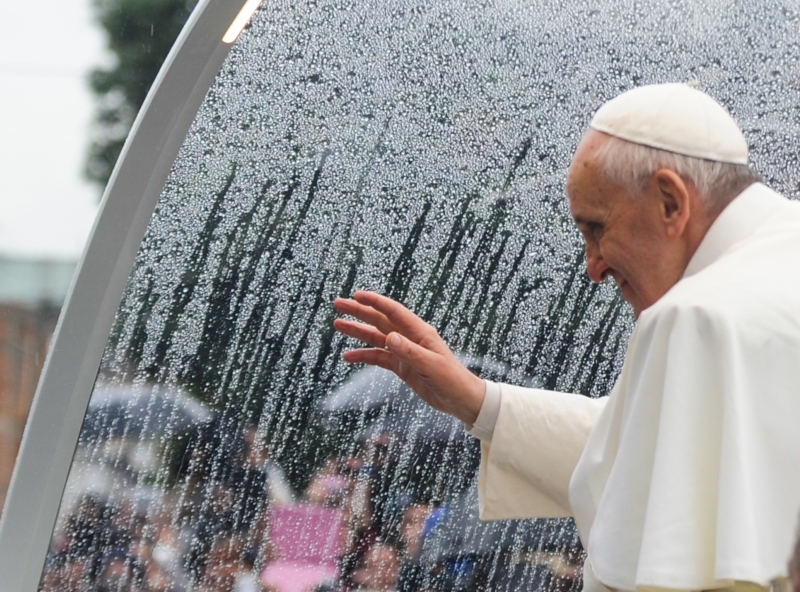
Pope Francis need not worry about criticizing Americans too severely. Any taxi driver in New York City will blame the country far more than the pope can imagine. Americans are constantly criticizing one another. We have schemes of perfection dancing in our heads, to which we want others to conform. That is what it means to be born within a Puritan heritage. Even our libertines chastise one another for not being libertine enough.
One thing I wish Pope Francis would not do, though, is repeat some of the sweeping rhetorical comments he has made until now. In the light of my own experience, some of these claims are simply not valid. For example, he has said more than once that the poor never get richer. But virtually all Americans come from families who began life poor, but under the challenges of a free and responsible society, ceased being poor after at most two generations. That is true of my own family. It is true of virtually every other family I know.
Our pope is already deeply beloved here in America. Not long ago I attended a meeting of devout Evangelical leaders. A generation back, virtually all the members of such a group would have described themselves as ardent anti-papists, and it would have been rare to hear any speak of a pope with respect. But at this conference, several were describing Francis as the best model of Jesus Christ anywhere on earth today.
On a quite different point of the cultural spectrum, many of the most anti-religious, even anti-Catholic, feminists and secularists seem unable to get enough of Francis in the media – the articles, interviews, questions, praise…. All wondering, what next.
Welcome to America, Pope Francis! We’re eager to hear what you have to say.
Previous Post

July 22, 2015
Pope Francis Asked for Help on Economics
Next Post
August 5, 2015 Ave Maria at the Beach
Browse Our Archives
Select a Category Abortion America Art Ave Maria Beauty Bible Caritas Christian unity Dark night of the soul Democratic capitalism Economics Ecumenism Environment Eucharist Family Football Francis Golden Rule Human rights Inequality Iraq War John Paul II Just war Leo XIII Liberty Liturgy Love March for Life Marriage Moral ecology New Testament Old Testament Politics Poverty Prayer Shakespeare Spirituality Sports St. John of the Cross Subjectivity Tradition Travels Trinity Uncategorized
Select a Month August 2015 July 2015 June 2015 May 2015 April 2015 March 2015 February 2015 January 2015
Follow Us!
TAKE THE
Religious Wisdom Quiz
What does "Pentecost" mean in Greek?
Select your answer to see how you score.
Fiftieth Fortieth First Seventh
Related posts from Coming down to Earth
Pope Francis Asked for Help on Economics

Blue Environmentalism - Part Three

Blue Environmentalism - Part Two
TRENDING AT PATHEOS Catholic

Rejecting Doom: Christian Hope And Human Action
Christianity is a religion of hope. We are to have hope and...

It’s What Comes From Within Which Matters
One of the most difficult things for us to understand is why...

Why I Choose the Eucharist Over the Sermon
Choose the Eucharist, Not the Sermon What are we supposed to get...

5 Design Elements Found in Spiritually Rooted Homes
Putting Spirituality Into Home Decor Our homes are more than our living...

Credo: A Story of God Told with the...
About 10 years ago, I began to imagine a personal "Credo" that...

The Anatomy of Divine Revelation in Catholic Thought
The claim that God has made Himself known to human beings is...
view all Catholic blogs
Ad-Free & Subscriber Log-In Subscription Support
- About Us
- 2026 Calendar
- Videos
- Podcasts
- Library of World Religions
- Faith In Media Tracker
- Advertise With Us
- Write for Us
- Privacy Policy
- Terms of Service
- Do Not Sell My Data
- Contact Us
- Radiant Digital
- Manage Newsletter Subscriptions
- Unsubscribe From Notifications
- Sitemap
Copyright 2008-2026, Patheos. All rights reserved.
Subscription Support Ad-Free & Subscriber Log-In
Follow Patheos