
BuddhistCatholicContemplativeEvangelicalGeneral ChristianHinduJewishLatter-day SaintMuslimNew VisionsProgressive Christian
Beliefs
- Buddhist
- Catholic
- Contemplative
- Evangelical
- General Christian
- Hindu
- Jewish
- Latter-day Saint
- More Voices
- Muslim
- New Visions
- Pagan
- Progressive Christian
Topics
- Religion News
- Food and Religion
- Sports and Religion
- Religious Art
- Religious Music and Entertainment
- Religious Events
- History and Religion
- Style and Religion
- Politics and Religion
- Women in Religion
- Recreation Outdoors and Religion
- Business Finance and Religion
- Careers Workplace and Religion
- Education and Religion
- Family Parenting and Religion
- Health Fitness and Religion
- Home and Religion
- Relationships and Religion
- Technology and Religion
- Travel and Religion
Columnists
- Buddhist Columnists
- Business Finance and Religion Columnists
- Careers Workplace and Religion Columnists
- Catholic Columnists
- Contemplative Columnists
- Education and Religion Columnists
- Evangelists Columnists
- Family Parenting and Religion Columnists
- General Christian Columnists
- Health Fitness and Religion Columnists
- Hindu Columnists
- History and Religion Columnists
- Home and Religion Columnists
- Jewish Columnists
- More Voices Columnists
- Latter Day Columnists
- Muslim Columnists
- New Visions Columnists
- Nonreligious Columnists
- Pagan Columnists
- Politics and Religion Columnists
- Progressive Columnists
- Recreation Outdoors and Religion Columnists
- Relationships and Religion Columnists
- Religion News Columnists
- Religious Art Columnists
- Religious Events Columnists
- Religious Music and Entertainment Columnists
- Sports and Religion Columnists
- Style and Religion Columnists
- Technology and Religion Columnists
- Travel and Religion Columnists
- Women in Religion Columnists
Resource Library
- 2026 Calendar
- Library of World Religions
- The 100 Most Holy Places on Earth
- Patheos Answers
- Podcasts
- Videos
- Faith Leaders Database
- Anglican Episcopalian
- Bahai
- Baptist
- Buddhism
- Christianity
- Confucianism
- Eastern Orthodoxy
- Hinduism
- Holiness and Pentecostal
- ISKCON
- Islam
- Judaism
- Lutheran
- Methodist
- The Church of Jesus Christ of Latter-day Saints
- New Age
- Paganism
- Presbytarian and Reformed
- Protestantism
- Religion Behind the Scenes
- Roman Catholic
- Scientology
- Shia Islam
- Sikhism
- Sufism
- Sunni Islam
- Taoism
- Zen
- See all religions
Research Tools
 Ad-Free & Subscriber Log-In Subscription Support
Ad-Free & Subscriber Log-In Subscription Support
Follow Patheos 

- Trending:
- Forgiveness
- |
- Marriage
- |
- Consciousness
- |
- Death Penalty
- |
- Election
- |
- Halloween
 Coming down to Earth
- Home
- Catholic
- Papal Humility
Papal Humility
Last updated on: July 15, 2015 at 1:00 am by Michael Novak
Papal Humility 2015-07-14T20:40:01-05:00 Michael Novak
Patheos Explore the world's faith through different perspectives on religion and spirituality! Patheos has the views of the prevalent religions and spiritualities of the world.
On his way from Paraguay back to Rome recently, Pope Francis showed signs of personal humility, directly in front of the world’s press, that must be unrivaled in papal history.
![By Benhur Arcayan/Malatinszky (cropping) [Public domain], via Wikimedia Commons](https://wp-media.patheos.com/blogs/sites/513/2015/07/Pope_Francis_Malacanang_7_cropped.jpg)
By Benhur Arcayan/Malatinszky (cropping) [Public domain], via Wikimedia Commons

Three times in the short interview of sixty-five minutes, Francis confessed that in his public teaching, especially on economics, he had not spoken well, or not fully, or else had done so with a considerable lack of knowledge, or with an inward resistance to dealing with economics.
He thanked reporters for pressing him on neglecting the middle class in his remarks. So much on the poor, one reporter said, so much on the rich. Why so little on the middle class?
The pope admitted he had been wrong on this, and that he would study the question and think about it more, and would try to improve in the future. He thanked the reporter for pointing out this fault in his public teaching so far.
During my years in Rome, I have observed four popes rather closely. All gave evidence of knowing their limitations and recognizing their ignorance about many things in this world. But I know of none who has been so frank about his personal limitations, his finite knowledge. I can’t remember anybody almost pleadingly ask for more help, more questions, more dialogue.
Pope John Paul II introduced eight or nine new ideas into Catholic social thought, from areas in which he had confronted his own lack of direct experience and then thought more fully about the things he didn’t know.
For example, in one encyclical, he claimed that “labor” is always superior to “capital,” because labor is always about humans, but capital is always about things – things like money, investments, machinery, equipment, factories. But by the time of a later encyclical, he began to stress the right to personal initiative and creativity, and to emphasize the acquisition of knowledge and know-how and new discoveries. In other words, he began to grasp the role of “human capital.”
This insight allowed John Paul II to generate a much more down-to-earth view of how wealth is created, and indeed, of the most important form of wealth: that which is rooted in human knowledge and habits.
Another example is when he began to speak of the economic need that is prior to the distribution of wealth, namely, the creation of new wealth. When more wealth is created, there is more to pass around to all: ‘‘A rising tide can lift all boats.”
Further still, John Paul II recognized the importance of “moral ecology,” that is, the widespread practice of good habits, the social power in ennobling stories and music that enriches the mind and soul, and the common desire of many to become better than they now are.
When families and individuals live within an upward-thrusting social milieu, it is much easier for them to grow in virtue and grace.
In a decadent culture, one that constantly lowers its moral standards and moral expectations, it is much harder for the young to swim against the tide and to defend themselves against the filth.
The moral ethos of cultures does rise and fall. There is a public ecology to the personal moral life.
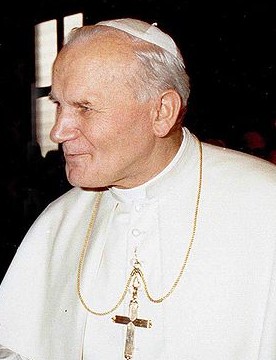
“John Paul II 1980 cropped” by Fels_Papst.JPG: Nikolaus von Nathusiusderivative work: JJ Georges – This file was derived from: Fels Papst.JPG: . Licensed under Public Domain via Wikimedia Commons.

When John Paul II became pope, his chief adult experience had been lived under National Socialism and then under the economic socialism of the Soviets. He had very little prior experience of a free polity in a free economy.
Particularly in worldly matters such as politics, and especially in economics, every pope has had to be stretched beyond his personal experience to learn about the experience of others. Each has also had to learn new patterns of vision for interpreting economic realities more truly and realistically.
It is wonderful to see that our current pope, “Good Pope Francis,” is so willing to embark on the learning curve, and in frank and humble dialogue with so many different cultures.
Previous Post

July 8, 2015
Blue Environmentalism - Part Three
Next Post
July 22, 2015 Pope Francis Asked for Help on Economics
Browse Our Archives
Select a Category Abortion America Art Ave Maria Beauty Bible Caritas Christian unity Dark night of the soul Democratic capitalism Economics Ecumenism Environment Eucharist Family Football Francis Golden Rule Human rights Inequality Iraq War John Paul II Just war Leo XIII Liberty Liturgy Love March for Life Marriage Moral ecology New Testament Old Testament Politics Poverty Prayer Shakespeare Spirituality Sports St. John of the Cross Subjectivity Tradition Travels Trinity Uncategorized
Select a Month August 2015 July 2015 June 2015 May 2015 April 2015 March 2015 February 2015 January 2015
Follow Us!
TAKE THE
Religious Wisdom Quiz
What does "I AM WHO I AM" mean in Hebrew?
Select your answer to see how you score.
Adonai Yahweh Elohim Jehovah-Jireh
Related posts from Coming down to Earth
Welcome to America, Pope Francis!
Pope Francis Asked for Help on Economics

Blue Environmentalism - Part Three
Blue Environmentalism - Part Two
TRENDING AT PATHEOS Catholic

Rejecting Doom: Christian Hope And Human Action
Christianity is a religion of hope. We are to have hope and...

It’s What Comes From Within Which Matters
One of the most difficult things for us to understand is why...

Why I Choose the Eucharist Over the Sermon
Choose the Eucharist, Not the Sermon What are we supposed to get...

5 Design Elements Found in Spiritually Rooted Homes
Putting Spirituality Into Home Decor Our homes are more than our living...

Credo: A Story of God Told with the...
About 10 years ago, I began to imagine a personal "Credo" that...

The Anatomy of Divine Revelation in Catholic Thought
The claim that God has made Himself known to human beings is...
view all Catholic blogs
Ad-Free & Subscriber Log-In Subscription Support
- About Us
- 2026 Calendar
- Videos
- Podcasts
- Library of World Religions
- Faith In Media Tracker
- Advertise With Us
- Write for Us
- Privacy Policy
- Terms of Service
- Do Not Sell My Data
- Contact Us
- Radiant Digital
- Manage Newsletter Subscriptions
- Unsubscribe From Notifications
- Sitemap
Copyright 2008-2026, Patheos. All rights reserved.
Subscription Support Ad-Free & Subscriber Log-In
Follow Patheos