
BuddhistCatholicContemplativeEvangelicalGeneral ChristianHinduJewishLatter-day SaintMuslimNew VisionsProgressive Christian
Beliefs
- Buddhist
- Catholic
- Contemplative
- Evangelical
- General Christian
- Hindu
- Jewish
- Latter-day Saint
- More Voices
- Muslim
- New Visions
- Pagan
- Progressive Christian
Topics
- Religion News
- Food and Religion
- Sports and Religion
- Religious Art
- Religious Music and Entertainment
- Religious Events
- History and Religion
- Style and Religion
- Politics and Religion
- Women in Religion
- Recreation Outdoors and Religion
- Business Finance and Religion
- Careers Workplace and Religion
- Education and Religion
- Family Parenting and Religion
- Health Fitness and Religion
- Home and Religion
- Relationships and Religion
- Technology and Religion
- Travel and Religion
Columnists
- Buddhist Columnists
- Business Finance and Religion Columnists
- Careers Workplace and Religion Columnists
- Catholic Columnists
- Contemplative Columnists
- Education and Religion Columnists
- Evangelists Columnists
- Family Parenting and Religion Columnists
- General Christian Columnists
- Health Fitness and Religion Columnists
- Hindu Columnists
- History and Religion Columnists
- Home and Religion Columnists
- Jewish Columnists
- More Voices Columnists
- Latter Day Columnists
- Muslim Columnists
- New Visions Columnists
- Nonreligious Columnists
- Pagan Columnists
- Politics and Religion Columnists
- Progressive Columnists
- Recreation Outdoors and Religion Columnists
- Relationships and Religion Columnists
- Religion News Columnists
- Religious Art Columnists
- Religious Events Columnists
- Religious Music and Entertainment Columnists
- Sports and Religion Columnists
- Style and Religion Columnists
- Technology and Religion Columnists
- Travel and Religion Columnists
- Women in Religion Columnists
Resource Library
- 2026 Calendar
- Library of World Religions
- The 100 Most Holy Places on Earth
- Patheos Answers
- Podcasts
- Videos
- Faith Leaders Database
- Anglican Episcopalian
- Bahai
- Baptist
- Buddhism
- Christianity
- Confucianism
- Eastern Orthodoxy
- Hinduism
- Holiness and Pentecostal
- ISKCON
- Islam
- Judaism
- Lutheran
- Methodist
- The Church of Jesus Christ of Latter-day Saints
- New Age
- Paganism
- Presbytarian and Reformed
- Protestantism
- Religion Behind the Scenes
- Roman Catholic
- Scientology
- Shia Islam
- Sikhism
- Sufism
- Sunni Islam
- Taoism
- Zen
- See all religions
Research Tools
 Ad-Free & Subscriber Log-In Subscription Support
Ad-Free & Subscriber Log-In Subscription Support
Follow Patheos 

- Trending:
- Forgiveness
- |
- Marriage
- |
- Consciousness
- |
- Death Penalty
- |
- Election
- |
- Halloween
 Coming down to Earth
- Home
- Catholic
- A Tribute to Father Matthew Lamb
A Tribute to Father Matthew Lamb
Last updated on: February 10, 2015 at 1:00 am by Michael Novak
A Tribute to Father Matthew Lamb 2015-02-09T20:55:17-05:00 Michael Novak
Patheos Explore the world's faith through different perspectives on religion and spirituality! Patheos has the views of the prevalent religions and spiritualities of the world.
Adapted from remarks given February 7, at the closing dinner of the annual conference of the Aquinas Center for Theological Renewal at Ave Maria University in Florida. The conference celebrated the university’s graduate program in theology, alumni of which presented very moving and learned papers. This year’s conference paid special tribute to Father Matthew Lamb, the bold and pioneering founder of the program.
* * *
As a quite young monk from the Trappist monastery at Conyers, Georgia, the neatly tonsured Father Matt arrived in Rome at the middle point of the Vatican Council in 1964, after the first two sessions, but before the dramatic final two. Like many other excited Catholics in America, Father Matt had been eagerly keeping up-to-date (that is, aggiornamento’d) on every morsel of information about the Council, even the juicy tidbits.
One cannot exaggerate how thrilling those days were. Television coverage almost every day. Front-page stories in The New York Times, above the fold.
Yes, Father Lamb had been closely following the suspenseful first year at Vatican II, not least the shadowy Vatican intrigue reported by the mysterious “Xavier Rynne” in The New Yorker, and gathered up from the scuttlebutt – to use a technical theological term of that time – the buzz that hung above the tables in the fragrant coffee shops along the Via della Conciliazione, and inside the restaurants from the “Hilton on the Hill” (where most of the American bishops stayed) to Piazza Navona, famous for stunning scenes starring Marcello Mastroianni and Sophia Loren.
Sadly, nontheological scuttlebutt was at times at the very center of the Council, at least as reporters saw things. In 1964 I was among those reporters. I was working for Time that year, and Karen and I had an unlimited expense account so that we could take as many “sources” as we could out to lunch or dinner for interviews and wide-ranging conversations on the state of the Church.
If we could have known in those days that the young Father Lamb would become such an important force in the post-Council Church, and would found the theology department at Ave Maria University, and if we knew where to find him, we would have taken him to such a restaurant as neither he nor we could ever afford to enter again.
Not long after his days in Rome, Father Matt went on to further and then further studies. It seemed in those days as if further studies never ended. Matt studied one philosophy of history after another, and then the metaphysics they implied, then the different horizons employed, the higher viewpoints, the emergent probabilities. (By the way, that’s why Father Matt can always think of another higher viewpoint, horizon, meta-meta . . . and has trouble finishing an explanation.)
Another thing Matt can’t finish – he never forgets his friends. Once, he took a train from Germany back to Rome to visit Fred Lawrence and Fred’s wife, Sue. Fred had left the seminary, but kept up his studies in Rome under Bernard Lonergan. That’s how Fred and Father Matt first met.
Well, one week a few years later, Sue had to stay in the hospital during a scary pregnancy episode, leaving Fred at home with two-year-old Dyer. Like most males, Fred was not quite up to being both mother and father. (How is it most wives seem to do both?) Father Lamb volunteered to help out. He had no idea what he was getting into.
If Fred felt incompetent that week, Father Lamb became completely bewildered. For family chaos the Trappists had not prepared him. A family kitchen was nothing like the world of silence and contemplation. Eventually Father Lamb announced that he must leave. Fred would be better off without him: Be easier to care for one infant, than one infant plus Father Lamb.
When he left Father told Fred and Sue that they could contract with the North American College for a stipend to have a few seminarians come up to help them with their children – that would give them what Newman called a “real apprehension” of the challenges of marriage and children, and why Our Lord made it a sacrament of His self-sacrificing love for His Body, the Church.
Those are days Father Lamb says he truly verified his vocation: Celibacy, pure and simple. Some persons are meant for celibacy. (And by the way, Fred still agrees that after Father left, his little son settled down, at least as much as boys of two ever do.)
After Germany, Father was called to Marquette, where he fell into heavy-lifting writing and editing – including a memorable festschrift for Father Lonergan. Matt’s reputation kept growing. More and more people couldn’t follow Father Lamb’s arguments – Lonergan does that to people – although they knew Matt was quite deep, and holy, and his writing always sparkled with little diamonds of spiritual wisdom.
Then Father Lamb was invited to Boston College. There he met and inspired a marvelous company. With his old friend Fred Lawrence, and Father Joe Flanagan, S.J., who had also studied under Lonergan, and Father Ernest Fortin, the indomitable Straussian, Father Romanus Cessario, O.P., and Mary Ann Glendon of Harvard, he formed a monthly study group centered on Thomas Aquinas’s Summa Theologiae. Father Lonergan used to complain to Matt that too many had failed to devote time to studying Aquinas.
In the theology department at B.C. Father Lamb faced some notable theological dissent. Some seemed to take Rome as bête-noire. In fact, there was a rumor around the Boston area that Father Lamb once petitioned the president of B.C. to put into practice the principles of Affirmative Action, by hiring at least one ethicist in the theology department who agreed with the Magisterium.
Recalling his own days in theological education, when he was expected to study theological classics in Hebrew, Greek, Latin, French, and German – not to mention Italian, for reading La Civiltà Cattolica and other Magisterial documents – Father Lamb began to doubt whether American theologians of the future would ever be prepared to pass on the Catholic theological tradition in its fullness. How will they ever be able to grasp the terms of the Greek and Latin Fathers, the millennium and a half of theology after Christ, official Church teaching worded in Latin, and even the rest of the Catholic world outside the U.S.?
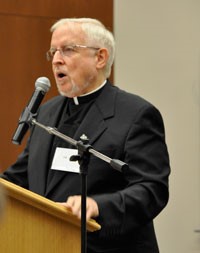
Photo courtesy of The Ave Herald
That is how Father Lamb began to dream of building a place where deeper understanding could be reached. Ave Maria is still moving toward this goal. But even now our graduates are giving a good account of themselves. Most are finding positions rather quickly, while the demand for them keeps growing – thanks to Father Matt’s vision, insistence, and perseverance.
In person, too, Father Lamb is a wise counsellor. Doesn’t get too excited about difficulties. Urges prayer, patience, and time, time, time. Employs his long experience and the fruits of many inner battles. Knows the mountains and the valleys of the soul in its voyages, its darknesses and lights. Just over ten years ago, he showed immense courage in moving from Boston College to seemingly endless tomato fields in southwest Florida, above which the great Oratory now rises up over large expanses of lawn and campus buildings and hundreds of homes, together reminding one of Tuscany.
This past weekend, the mature, profound, deep, and spiritual papers presented by these sixteen Ave Maria scholars now teaching in other universities and seminaries are a living monument, and a lasting one, to Father Lamb’s courage, depth, and wisdom. His maturing students showed also that they learned well the habit of theological friendship.
This is my way of thinking of Father Lamb: contemplata aliis tradere. He has passed along to others his own contemplation in the presence of the Love of the Holy Trinity, where all theology begins.
Previous Post

February 6, 2015
Following up with Emily
Next Post
February 13, 2015 Saint Valentine Helped Lovers. Why?
Browse Our Archives
Select a Category Abortion America Art Ave Maria Beauty Bible Caritas Christian unity Dark night of the soul Democratic capitalism Economics Ecumenism Environment Eucharist Family Football Francis Golden Rule Human rights Inequality Iraq War John Paul II Just war Leo XIII Liberty Liturgy Love March for Life Marriage Moral ecology New Testament Old Testament Politics Poverty Prayer Shakespeare Spirituality Sports St. John of the Cross Subjectivity Tradition Travels Trinity Uncategorized
Select a Month August 2015 July 2015 June 2015 May 2015 April 2015 March 2015 February 2015 January 2015
Follow Us!
TAKE THE
Religious Wisdom Quiz
What holiday celebrates Jesus rising from the dead?
Select your answer to see how you score.
Pentecost Easter Christmas Passover
Related posts from Coming down to Earth

Welcome to America, Pope Francis!
TRENDING AT PATHEOS Catholic

Creation, Preservation, and Teleology in Catholic Theology
As I write this, it is very early Monday morning. Like millions...

The Parable Of The Sower And The Word...
One of Christ’s most famous parables is that of the sower who...

Rejecting Doom: Christian Hope And Human Action
Christianity is a religion of hope. We are to have hope and...

Why I Choose the Eucharist Over the Sermon
Choose the Eucharist, Not the Sermon What are we supposed to get...

5 Design Elements Found in Spiritually Rooted Homes
Putting Spirituality Into Home Decor Our homes are more than our living...

Credo: A Story of God Told with the...
About 10 years ago, I began to imagine a personal "Credo" that...
view all Catholic blogs
Ad-Free & Subscriber Log-In Subscription Support
- About Us
- 2026 Calendar
- Videos
- Podcasts
- Library of World Religions
- Faith In Media Tracker
- Advertise With Us
- Write for Us
- Privacy Policy
- Terms of Service
- Do Not Sell My Data
- Contact Us
- Radiant Digital
- Manage Newsletter Subscriptions
- Unsubscribe From Notifications
- Sitemap
Copyright 2008-2026, Patheos. All rights reserved.
Subscription Support Ad-Free & Subscriber Log-In
Follow Patheos