
BuddhistCatholicContemplativeEvangelicalGeneral ChristianHinduJewishLatter-day SaintMuslimNew VisionsProgressive Christian
Beliefs
- Buddhist
- Catholic
- Contemplative
- Evangelical
- General Christian
- Hindu
- Jewish
- Latter-day Saint
- More Voices
- Muslim
- New Visions
- Pagan
- Progressive Christian
Topics
- Religion News
- Food and Religion
- Sports and Religion
- Religious Art
- Religious Music and Entertainment
- Religious Events
- History and Religion
- Style and Religion
- Politics and Religion
- Women in Religion
- Recreation Outdoors and Religion
- Business Finance and Religion
- Careers Workplace and Religion
- Education and Religion
- Family Parenting and Religion
- Health Fitness and Religion
- Home and Religion
- Relationships and Religion
- Technology and Religion
- Travel and Religion
Columnists
- Buddhist Columnists
- Business Finance and Religion Columnists
- Careers Workplace and Religion Columnists
- Catholic Columnists
- Contemplative Columnists
- Education and Religion Columnists
- Evangelists Columnists
- Family Parenting and Religion Columnists
- General Christian Columnists
- Health Fitness and Religion Columnists
- Hindu Columnists
- History and Religion Columnists
- Home and Religion Columnists
- Jewish Columnists
- More Voices Columnists
- Latter Day Columnists
- Muslim Columnists
- New Visions Columnists
- Nonreligious Columnists
- Pagan Columnists
- Politics and Religion Columnists
- Progressive Columnists
- Recreation Outdoors and Religion Columnists
- Relationships and Religion Columnists
- Religion News Columnists
- Religious Art Columnists
- Religious Events Columnists
- Religious Music and Entertainment Columnists
- Sports and Religion Columnists
- Style and Religion Columnists
- Technology and Religion Columnists
- Travel and Religion Columnists
- Women in Religion Columnists
Resource Library
- 2026 Calendar
- Library of World Religions
- The 100 Most Holy Places on Earth
- Patheos Answers
- Podcasts
- Videos
- Faith Leaders Database
- Anglican Episcopalian
- Bahai
- Baptist
- Buddhism
- Christianity
- Confucianism
- Eastern Orthodoxy
- Hinduism
- Holiness and Pentecostal
- ISKCON
- Islam
- Judaism
- Lutheran
- Methodist
- The Church of Jesus Christ of Latter-day Saints
- New Age
- Paganism
- Presbytarian and Reformed
- Protestantism
- Religion Behind the Scenes
- Roman Catholic
- Scientology
- Shia Islam
- Sikhism
- Sufism
- Sunni Islam
- Taoism
- Zen
- See all religions
Research Tools
 Ad-Free & Subscriber Log-In Subscription Support
Ad-Free & Subscriber Log-In Subscription Support
Follow Patheos 

- Trending:
- Forgiveness
- |
- Marriage
- |
- Consciousness
- |
- Death Penalty
- |
- Election
- |
- Halloween
 Michael Farris: Defying Conventional Wisdom
- Home
- Politics and Religion
- Situational Ethics & Voting: Answering Wayne Grudem
Situational Ethics & Voting: Answering Wayne Grudem
Last updated on: August 5, 2016 at 2:32 pm by Michael Farris
Situational Ethics & Voting: Answering Wayne Grudem 2016-08-05T14:32:12-04:00 Michael Farris
Patheos Explore the world's faith through different perspectives on religion and spirituality! Patheos has the views of the prevalent religions and spiritualities of the world.
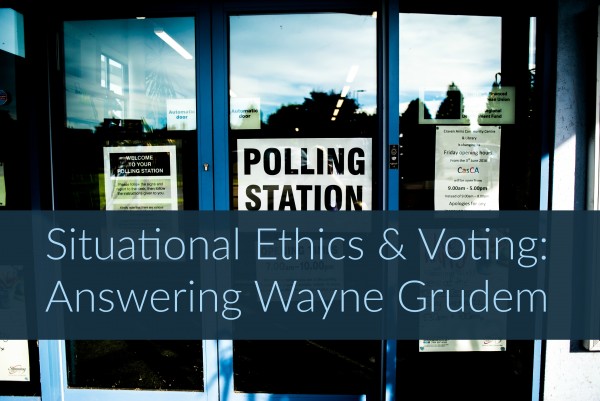
If I had a dollar for every time this year that I have encountered the phrase “lesser of two evils,” I would be as rich as Donald Trump claims to be. Few evangelical Christians advocate the election of Donald Trump directly—rather, it is on the basis of the claim that Trump, though seriously flawed, is better than Hillary Clinton. He is the lesser of two evils, they say.
Does the lesser-of-two evils kind of thinking come from a biblical worldview? Well, according to the highly regarded theologian, Wayne Grudem, yes indeed. The crux of Grudem’s oft-circulated article lies in the following assertion:
I do not think that voting for Donald Trump is a morally evil choice because there is nothing morally wrong with voting for a flawed candidate if you think he will do more good for the nation than his opponent. In fact, it is the morally right thing to do.
Grudem, who is highly respected, is making a moral argument that is being used to encourage Bible-believing Christians to vote for Trump. This article is aimed at the same audience. Neither Grudem nor I would ever think of imposing scriptural precepts on voters in general. This is a debate for those who voluntarily want to follow the Word of God.
You may note the lack of any reference to any passage from the Word of God supporting Grudem’s central claim. A full reading of his piece reveals that he never attempts to prove his central thesis from Scripture. In the entire article, Grudem directly cites only three passages of Scripture.
- I Peter 1:1 is cited for the idea that we are “exiles” on earth.
- This is immediately followed by a citation of Jeremiah 29:7, which says that we are to “seek the welfare of the city where I have sent you into exile.”
- Finally, Grudem warns against indifference by citing Obadiah 1:11, which condemns those who stand “aloof” on the day that invaders entered the city of Jerusalem.
Grudem’s reading of these verses is non-controversial, but they lack any relevance to his central contention: that in choosing a leader of a nation, we should accept the lesser of two evils—even when both major choices are seriously flawed. Moreover, it is quite telling that Grudem fails to cite even one passage of Scripture in his discussion of the question of whether character matters in the selection of a leader.
It is ironic that Grudem is a theologian and yet he spends the vast majority of his time discussing ramifications of the election on the Supreme Court of the United States; whereas, I am a constitutional lawyer (having argued in the Supreme Court) and a professor of Constitutional Law (two of my former students are currently clerking for the Supreme Court) and, yet, I am going to spend the bulk of my time discussing the teaching of Scripture. (I will follow up with another article to dissect Grudem’s analysis of the Supreme Court issues.)
The central question that thoughtful evangelical Christians are seeking to resolve is this: what does the Bible teach about the standards for voting in a democratic republic?
This question, however, requires me to answer a preliminary question: can we find guidance for voting in the Bible? I assert that we can. I will admit that it is not an easy question and that our study requires diligence, because Scripture does not contain a straight-forward passage that directly answers the question.
But, the sufficiency of Scripture to provide answers for every issue in life is quite clear. Psalm 19 declares, in majestic poetry, the all-encompassing power of the Word in our lives. Do we need to have understanding of a difficult and dark situation? “The commands of the Lord are radiant, giving light to the eyes.” Psalm 19:8. Moreover, 2 Timothy 3:16-17 proclaims that Scripture enables us to be “thoroughly equipped for every good work.” When Christians vote, we should aspire to do a good work, and the light we need to do so can reliably be found in Scripture.
Since voting in a democratic republic is not directly discussed in Scripture, we should first consult the passages that deal with the closest analogies possible. I would submit that the following sections should guide our discussion:
- The New Testament passages about “governors” and other civil leaders.
- Deuteronomy 17’s directives to Israel on the standards it should employ to pick a king.
- The many New Testament passages that describe the standards for choosing leaders of the church.
It is important to emphasize at the outset that I am using these passages not as direct commands or answers, but as containing guiding principles that lead us to the right answer. Those who reject anything from the Old Testament on the subject of government need to pay attention to this passage from Jeremiah 18:
7 If at any time I announce that a nation or kingdom is to be uprooted, torn down and destroyed, 8 and if that nation I warned repents of its evil, then I will relent and not inflict on it the disaster I had planned. 9 And if at another time I announce that a nation or kingdom is to be built up and planted, 10 and if it does evil in my sight and does not obey me, then I will reconsider the good I had intended to do for it.
God’s Word contains answers for every nation in every era.
Continue to find out the biblical standards for our authorities…
Previous Post
September 8, 2016
We Are About to Elect a Monarch
Browse Our Archives
Select a Category Politics Religion
Select a Month September 2016 August 2016
Follow Us!
TAKE THE
Religious Wisdom Quiz
What did Daniel's three friends refuse to worship, resulting in their persecution?
Select your answer to see how you score.
A Persian king A cedar pole A bronze snake A golden image
Related posts from Michael Farris: Defying Conventional Wisdom
We Are About to Elect a Monarch
Michael Farris: Defying Conventional Wisdom
Why Grudem Is Simply Wrong About the Supreme...
Michael Farris: Defying Conventional Wisdom
TRENDING AT PATHEOS Politics and Religion

Christians should care about politics. Here are 4...
How can Christians best engage with politics in a way that shows...

For Abortion "Rights" Advocates - a Compromise
For pro-life conservatives, it’s like a dream come true. For pro-choice feminazis...

Cornerstone Pastor Issues Apology - GOOD
The apology was warranted. The follow-up is essential. A week ago, the...

From a Conservative to Conservatives on President Trump...
I am a conservative, a Republican, and an evangelical Christian, and I...
view all Politics and Religion blogs
Ad-Free & Subscriber Log-In Subscription Support
- About Us
- 2026 Calendar
- Videos
- Podcasts
- Library of World Religions
- Faith In Media Tracker
- Advertise With Us
- Write for Us
- Privacy Policy
- Terms of Service
- Do Not Sell My Data
- Contact Us
- Radiant Digital
- Manage Newsletter Subscriptions
- Unsubscribe From Notifications
- Sitemap
Copyright 2008-2026, Patheos. All rights reserved.
Subscription Support Ad-Free & Subscriber Log-In
Follow Patheos