
BuddhistCatholicContemplativeEvangelicalGeneral ChristianHinduJewishLatter-day SaintMuslimNew VisionsProgressive Christian
Beliefs
- Buddhist
- Catholic
- Contemplative
- Evangelical
- General Christian
- Hindu
- Jewish
- Latter-day Saint
- More Voices
- Muslim
- New Visions
- Pagan
- Progressive Christian
Topics
- Religion News
- Food and Religion
- Sports and Religion
- Religious Art
- Religious Music and Entertainment
- Religious Events
- History and Religion
- Style and Religion
- Politics and Religion
- Women in Religion
- Recreation Outdoors and Religion
- Business Finance and Religion
- Careers Workplace and Religion
- Education and Religion
- Family Parenting and Religion
- Health Fitness and Religion
- Home and Religion
- Relationships and Religion
- Technology and Religion
- Travel and Religion
Columnists
- Buddhist Columnists
- Business Finance and Religion Columnists
- Careers Workplace and Religion Columnists
- Catholic Columnists
- Contemplative Columnists
- Education and Religion Columnists
- Evangelists Columnists
- Family Parenting and Religion Columnists
- General Christian Columnists
- Health Fitness and Religion Columnists
- Hindu Columnists
- History and Religion Columnists
- Home and Religion Columnists
- Jewish Columnists
- More Voices Columnists
- Latter Day Columnists
- Muslim Columnists
- New Visions Columnists
- Nonreligious Columnists
- Pagan Columnists
- Politics and Religion Columnists
- Progressive Columnists
- Recreation Outdoors and Religion Columnists
- Relationships and Religion Columnists
- Religion News Columnists
- Religious Art Columnists
- Religious Events Columnists
- Religious Music and Entertainment Columnists
- Sports and Religion Columnists
- Style and Religion Columnists
- Technology and Religion Columnists
- Travel and Religion Columnists
- Women in Religion Columnists
Resource Library
- 2026 Calendar
- Library of World Religions
- The 100 Most Holy Places on Earth
- Patheos Answers
- Podcasts
- Videos
- Faith Leaders Database
- Anglican Episcopalian
- Bahai
- Baptist
- Buddhism
- Christianity
- Confucianism
- Eastern Orthodoxy
- Hinduism
- Holiness and Pentecostal
- ISKCON
- Islam
- Judaism
- Lutheran
- Methodist
- The Church of Jesus Christ of Latter-day Saints
- New Age
- Paganism
- Presbytarian and Reformed
- Protestantism
- Religion Behind the Scenes
- Roman Catholic
- Scientology
- Shia Islam
- Sikhism
- Sufism
- Sunni Islam
- Taoism
- Zen
- See all religions
Research Tools
 Ad-Free & Subscriber Log-In Subscription Support
Ad-Free & Subscriber Log-In Subscription Support
Follow Patheos 

- Trending:
- Forgiveness
- |
- Marriage
- |
- Consciousness
- |
- Death Penalty
- |
- Election
- |
- Halloween
 Messy Inspirations
- Home
- Catholic
- Flesh and Blood
Flesh and Blood
Last updated on: August 7, 2021 at 7:06 am by Fellow Dying Inmate
Flesh and Blood 2021-08-07T07:06:13-04:00 Fellow Dying Inmate
Patheos Explore the world's faith through different perspectives on religion and spirituality! Patheos has the views of the prevalent religions and spiritualities of the world.
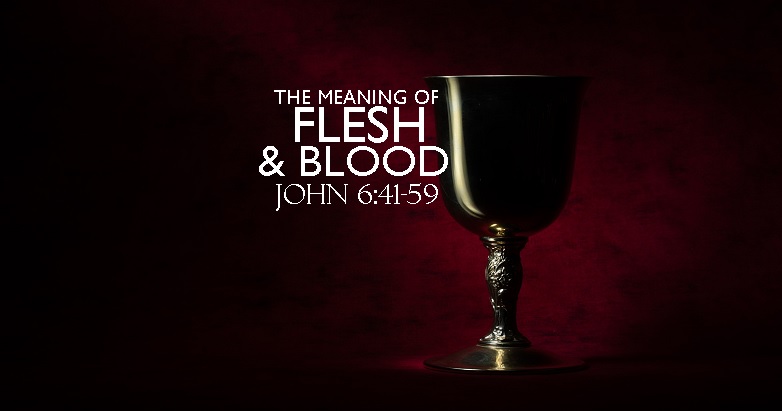
Flesh and Blood / Image by u_g45l9jv0 from Pixabay
This August, Sunday Gospels swim in “John.” The Gospel reading for this Sunday is John 6:41-51. We are going to dive deep into John 6 with the next several posts. What exactly does Jesus mean in the Fourth Gospel called “John” when he insists that his audience must “eat his flesh and drink his blood (John 6:51–58)? What does he mean by “flesh and blood,” anyway? Is he talking cannibalism?
Indeed, say many Catholics, Jesus meant the Eucharist. We consume his flesh and blood when we receive holy communion. Today, any Catholic who carefully reads “flesh and blood” in John 6:41-59 cannot help but notice the substantial and explicit Eucharistic tone, right? The meaning is clear (read, “stop asking questions”).
Here is a video going deep into “flesh and blood”—
Flesh and Blood Meaning…
But Jesus wasn’t addressing Christians (fourth-century reality), much less Catholics. In the story of “John,” Jesus was addressing his fellow Israelites. He tells them to ingest his flesh and blood so that they might enjoy the high life. And by high life, I mean the highest possible kind of life—sky-vault life, “from above.” In other words, the life of the children of God.
Forget all context, too many homilies will say this upcoming Sunday. It’s all about us Catholics. In this business of ingesting flesh and blood, Jesus is obviously teaching Catholics about the Holy Eucharist—really the consecrated species at Mass. Every Catholic knows that!
Beware of spurious familiarity. The anonymous evangelist (named a century later “John”) didn’t have transcripts or tape recordings of Jesus’ lectures (i.e., he got creative with the dialogue). He wasn’t a Catholic or interested in Catholics. “John” didn’t write to Catholics, about Catholics, or for Catholics.
Flesh & Blood: Anti-Society Talk
Who was “John”? He was an Israelite scribe writing to, for, and about an antisociety in a special anti-language. “Flesh and blood” is an anti-language expression. But what is anti-language? And what are antisocieties?
Unlike the other New Testament Jesus groups, the Johannine community became an antisociety probably sometime in the 80s CE. According to Context Scholar Bruce Malina, an antisociety is a conscious alternative group to the Dominant Society, in this case, first-century Israel. It is an alternate society rooted made up of those deemed to be social deviants and misfits. Their group is forged in the form of social conflict. Its members are dissociated persons surviving in a social bubble inside within the dominant social order.
Just as societies share language, antisocieties share anti-language. Anti-language is the language of an antisociety. Anti-language gets developed precisely to keep outsiders out. It prevents outsiders from understanding the antisocial group.
On the surface, anti-language looks like the dominant society’s language. But don’t be fooled! While it may employ the same vocabulary and grammar of the dominant language, anti-language words bear different, unusual meanings rooted in chief concerns of the antisociety. This plays into how we must adequately understand flesh and blood.
Qualities of Anti-Language
Often, anti-languages overlexicalize, and Johannine anti-language with its consuming “flesh and blood” certainly does this. Overlexicalization means too many words and expressions expressing the same reality of concern for the antisociety. Indeed, “John” does this. It features too many words that mean the same thing. It is so repetitive because it says the same something repeatedly but in different words and expressions.
Catholics and other Christians mess up their reading of “John” because they think it was written to teach and communicate ideas (“the truth!”). Instead, “John” was written to imbue Johannine believers with emotional anchoring in interpersonal relationships insider the Johannine Jesus group. Put another way, the Gospel of “John” was written for group cohesion. “John” is all about Johannine believers sticking together like glue forever. The only ideas it has to give are found in the first eighteen verses. After that, it is all rehash.
Flesh and Blood is Anti-Language
That includes John chapter 6, folks. Sorry to disappoint my fellow Catholics, but that means there is no magnificent theological treatise on the Eucharist to be found in John chapter 6. It may have some Eucharistic overtones, sure, as well as nods to Passover Exodus readings. But theological ideas about the Eucharist aren’t what’s going on. Whatever meaning it has was already given in the Prologue, John 1:1-18. Again, “John” isn’t giving us any new ideas in John 6 because “John” doesn’t communicate new ideas after John 1:18.
“Flesh and Blood”: Not New Ideas
Unfortunately, thanks to Scott Hahn and friends and the folks at EWTN, the ever-shrinking Catholic circle in the U.S. is becoming a bubble of proof-texting fundamentalists. So many Catholics in invincible stupidity are proof-texting now and mix-and-match verses from different documents in our New Testament library. But “John” wasn’t written to be fitted together like a jigsaw puzzle piece with the Synoptics.
So misinformed Catholics conflate John 6 with what’s happening in the Last Supper featured in the Synoptic Gospels into a gobbledygook. In the Synoptics, Jesus refers to the bread as his body and the wine as his blood. In contrast, “John” has a completely different context. Unlike the Synoptics and Paul (see Matthew 26:26-29; Mark 14:22-25; Luke 22:15-20; 1 Corinthians 10:16; 11:23-27), “John” lacks an institution narrative! Instead, Jesus’ farewell dinner is centered on a foot-washing.
Sorry but you can’t legitimately take John’s anti-language expression “flesh and blood” and mix it up into a cake-batter with “this is my body… this is my blood” in these other texts.
But who can say no to confused Catholics? Especially those who enjoy reading John 6 to justify their obsessions with Eucharistic devotions and prove their brand of Christianity is superior to all others? Don’t tell them that they ignore our Orthodox, Anglican, Lutheran, and ancient Eastern siblings who share the Eucharist.
Johannine Audience: Flesh and Blood
“John” wrote directly to ancient Israelites, those in his Jesus group. Before we escape into allegory-gone-wild for indirect meanings, let’s read “John” and his “flesh and blood” expression respectfully. To understand his use of “flesh and blood,” you need to first grasp two different social contexts taken from the dominant society of first-century Israel.
We will pick up that thread tomorrow…
Previous Post

August 3, 2021
Finding the Real Deal Jesus
Next Post
August 7, 2021 Eating Flesh and Drinking Blood is Anti-Language
Browse Our Archives
Select a Category Uncategorized
Select a Month August 2021 July 2021 June 2021 May 2021 April 2021 March 2021 February 2021 January 2021 December 2020 November 2020 October 2020 September 2020 August 2020 July 2020 June 2020 May 2020 April 2020 March 2020 February 2020 January 2020 December 2019 November 2019 October 2019 September 2019 August 2019
Follow Us!
TAKE THE
Religious Wisdom Quiz
What was an ephah's volume? (Biblical Measurement)
Select your answer to see how you score.
15 liters 10 liters 22 liters 30 liters
Support this
Column


Related posts from Messy Inspirations

Understanding Apocalypse & Its Creatures



TRENDING AT PATHEOS Catholic

Rejecting Doom: Christian Hope And Human Action
Christianity is a religion of hope. We are to have hope and...

It’s What Comes From Within Which Matters
One of the most difficult things for us to understand is why...

Why I Choose the Eucharist Over the Sermon
Choose the Eucharist, Not the Sermon What are we supposed to get...

5 Design Elements Found in Spiritually Rooted Homes
Putting Spirituality Into Home Decor Our homes are more than our living...

Credo: A Story of God Told with the...
About 10 years ago, I began to imagine a personal "Credo" that...

The Anatomy of Divine Revelation in Catholic Thought
The claim that God has made Himself known to human beings is...
view all Catholic blogs
Ad-Free & Subscriber Log-In Subscription Support
- About Us
- 2026 Calendar
- Videos
- Podcasts
- Library of World Religions
- Faith In Media Tracker
- Advertise With Us
- Write for Us
- Privacy Policy
- Terms of Service
- Do Not Sell My Data
- Contact Us
- Radiant Digital
- Manage Newsletter Subscriptions
- Unsubscribe From Notifications
- Sitemap
Copyright 2008-2026, Patheos. All rights reserved.
Subscription Support Ad-Free & Subscriber Log-In
Follow Patheos