
BuddhistCatholicContemplativeEvangelicalGeneral ChristianHinduJewishLatter-day SaintMuslimNew VisionsProgressive Christian
Beliefs
- Buddhist
- Catholic
- Contemplative
- Evangelical
- General Christian
- Hindu
- Jewish
- Latter-day Saint
- More Voices
- Muslim
- New Visions
- Pagan
- Progressive Christian
Topics
- Religion News
- Food and Religion
- Sports and Religion
- Religious Art
- Religious Music and Entertainment
- Religious Events
- History and Religion
- Style and Religion
- Politics and Religion
- Women in Religion
- Recreation Outdoors and Religion
- Business Finance and Religion
- Careers Workplace and Religion
- Education and Religion
- Family Parenting and Religion
- Health Fitness and Religion
- Home and Religion
- Relationships and Religion
- Technology and Religion
- Travel and Religion
Columnists
- Buddhist Columnists
- Business Finance and Religion Columnists
- Careers Workplace and Religion Columnists
- Catholic Columnists
- Contemplative Columnists
- Education and Religion Columnists
- Evangelists Columnists
- Family Parenting and Religion Columnists
- General Christian Columnists
- Health Fitness and Religion Columnists
- Hindu Columnists
- History and Religion Columnists
- Home and Religion Columnists
- Jewish Columnists
- More Voices Columnists
- Latter Day Columnists
- Muslim Columnists
- New Visions Columnists
- Nonreligious Columnists
- Pagan Columnists
- Politics and Religion Columnists
- Progressive Columnists
- Recreation Outdoors and Religion Columnists
- Relationships and Religion Columnists
- Religion News Columnists
- Religious Art Columnists
- Religious Events Columnists
- Religious Music and Entertainment Columnists
- Sports and Religion Columnists
- Style and Religion Columnists
- Technology and Religion Columnists
- Travel and Religion Columnists
- Women in Religion Columnists
Resource Library
- 2026 Calendar
- Library of World Religions
- The 100 Most Holy Places on Earth
- Patheos Answers
- Podcasts
- Videos
- Faith Leaders Database
- Anglican Episcopalian
- Bahai
- Baptist
- Buddhism
- Christianity
- Confucianism
- Eastern Orthodoxy
- Hinduism
- Holiness and Pentecostal
- ISKCON
- Islam
- Judaism
- Lutheran
- Methodist
- The Church of Jesus Christ of Latter-day Saints
- New Age
- Paganism
- Presbytarian and Reformed
- Protestantism
- Religion Behind the Scenes
- Roman Catholic
- Scientology
- Shia Islam
- Sikhism
- Sufism
- Sunni Islam
- Taoism
- Zen
- See all religions
Research Tools
 Ad-Free & Subscriber Log-In Subscription Support
Ad-Free & Subscriber Log-In Subscription Support
Follow Patheos 

- Trending:
- Forgiveness
- |
- Marriage
- |
- Consciousness
- |
- Death Penalty
- |
- Election
- |
- Halloween
 Messy Inspirations
- Home
- Catholic
- Assumptions about the Assumption
Assumptions about the Assumption
Last updated on: August 19, 2021 at 3:57 pm by Fellow Dying Inmate
Assumptions about the Assumption 2021-08-19T15:57:45-04:00 Fellow Dying Inmate
Patheos Explore the world's faith through different perspectives on religion and spirituality! Patheos has the views of the prevalent religions and spiritualities of the world.
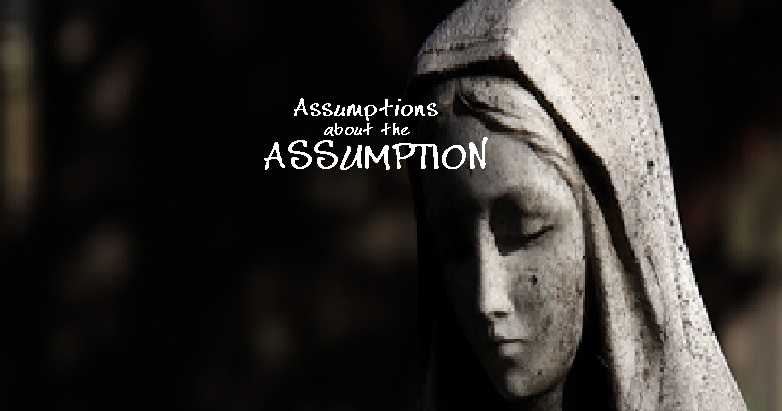
Assumptions / Image by Jacques GAIMARD from Pixabay
Assumptions make an ass out of you and me, Catholics.
Someone asked me,
“Did the earliest Christians who knew and followed Jesus believe in the Assumption of Mary?”
My answer comes by way of a question. Here it is: do you want to know what the authors of the New Testament really wrote about and meant to communicate? Ideally, students of the Bible endeavor to discover precisely what a particular biblical author wrote about and indicated by his composition. Therefore, they are careful not to substitute their desired meanings in place of the actual original meanings. That’s because genuine Bible students seek the meaning intended by the human author for their original audience.
If the New Testament reader is a Christian, then they will treasure this meaning of the original human author theologically. For they will identify it as God’s own intended meaning. This is because God intended to express one and the same meaning in his Word (please see Vatican II’s Dogmatic Constitution on Divine Revelation, no. 12).
What the human author of Scripture writes about is essential. What he doesn’t write about is critical also to consider. We should ask: what did “Mark” write about Mary? And what did “Matthew” write about her? How about “Luke“? Were there differences between the authors here? And what of the highly symbolic depiction of the unnamed mother of Jesus in “John”? Finally, did the author of Revelation write about Mary?—the answer is no.
Here is a video of the Colossal Pregnant Sky-Woman in Revelation 12—
So Many Assumptions!
When it comes to Scripture, how can we discover the meaning of any text (i.e., the meaning intended by the human author = God’s intended meaning)? Apparently, this is impossible without access to the social system of these ancient Mediterranean authors.
But why? It’s because, as Dr. Bruce Malina so deftly explained, what our written Bible actually means derives from the first-century eastern Mediterranean social system. And it is precisely this social system that is crucial to our biblical studies and Marian assumptions here! Ultimately, this is because it shaped the meanings shared by the original author and his audience.
Whatever assumptions about Mary we have, those who knew her and her death, belonged to the first-century eastern Mediterranean social world. And they belonged to New Testament times. And writing didn’t come easy for them! So if people managed such a Herculean feat as writing about anything (a task we post-Industrials take for granted), believe me, it was damn crucial for them.
Assuming a Culturally Plausible Reading
Assumptions or not, we need a sufficient model for investigating this question. Without it, our reading is incapable of entering into the social world of the first-century eastern Mediterranean Bible, the New Testament, and the village life of peasant-woman Mary. Therefore, all we have are spurious assumptions! Consequently, we need an adequate model that compares our mainstream United States society with preindustrial peasant society fortified with traditional Mediterranean features.
Now our tools, no matter how sophisticated, are not the same thing as a time machine. But it’s the closest thing we have. And without these imperfect tools, no matter how lofty our assumptions are, how can we ever honestly speak about Mary, the mother of Jesus? How can we ever examine her honestly as she is presented across Mediterranean New Testament documents? Or how she is subsequently presented through an astounding evolution and developing Mariology in later early Christian centuries? In the theological Mary, we view five centuries of an evolving symbol, and all that growth happens in the Mediterranean.
We cannot do this or even hope to do it without the aid of some sufficient model of the social system of those ancient times.
Assumptions & More is Needed
But still, this will not be enough. Anyone willing to look at Mary in the New Testament honestly must admit the absence of information. We must confess that nearly everything claimed about her over the past two millennia—including her Assumption!—is simply nowhere to be found in the New Testament. I am a Catholic, but I cannot be honest about this subject unless and until I admit to this deafening New Testament silence. My assumptions won’t help.
What does the New Testament say about Mary’s Immaculate Conception? Nothing. Her Perpetual Virginity? Zilch. Her Assumption? Zero. Who were Mary’s parents? It gives no answers. How was her birth? Nada. What was her childhood like? Nothing is said. How was her marriage? Nope, nothing there. What was her life like in the holy family? You don’t find a thing. What exactly was her role, if any, in the early Jesus Movement? Nothing is said. And what about her death? Not a word is to be found in the whole New Testament.
Those are cold facts, friends, not assumptions. Catholics like myself need to be honest about Mary and the New Testament. The authors of those inspired, normative documents say precious little about her. And whenever they do speak of her, what little they say focuses on serving the purpose of who Jesus might be. That is the intended meaning, not Marian fancy or assumptions.
I’m sorry, but that is just the way it is.
Spurious Assumptions in the Question
So when you ask, “Did the earliest Christians who knew and followed Jesus believe in the Assumption of Mary?” we ought to fix your anachronistic, spurious assumptions.
I think you mean, “Did any first-century Jesus groups believe this?” Well, they didn’t write a single word about it. They had no Mariology (i.e., a theology of Mary), much less Marian devotion. Mary doesn’t become an issue really until the fifth century. At the Council of Ephesus (431), her being declared “God-bearer” is a Christological doctrine. It isn’t Marian at all!
But you can’t tell that to most of my fellow Catholics. It was the same with me 20 years ago, brainwashed by Scott Hahn’s “Hail, Holy Queen.”
“But they never found her relics! We have two graves, but no body! That proves it!”
Excuse me, but what does an empty tomb prove? Where did they bury first-century Galilean peasant women who lived in nothing-places like Nazareth? Ever hear of ancestorism?
Mediterraneans are group-centered personalities that share a group-self and a group-conscience. They live together and get buried together. How expensive do you think peasant family graves were?
How wealthy was Mary? She was a starving peasant. How prestigious do you think her ossuary was? But once-wealthy elites become Christians, well, it’s not too hard for Mary to be transformed into a wealthy elite, huh?
More Than Assumptions
Listen: I believe in the truth of the Assumption. I trust that Mary is with the Lord in Alternate Reality (the Realm of God), okay? I also trust in our life and hope—our bodily death and decay is not the end of us, for God’s love does not fall into an abyss. The trajectory of Marian images in “Luke” and “John” going forward into subsequent centuries mixed with how the Church began to look at itself (as elite Mediterranean bride, mother, daughter). Mary became a symbol of the Church who shares in Jesus’ resurrection.
I care more about that cultural and theological trajectory of Mary the symbol. An assumed physical trajectory and velocity, up, up, and away into the sky and through the Van Allen radiation belts for Mary’s corpse? Not so much. I believe in Christ, not Superman and Green Lantern.
Of course, Mary is with the Lord. How could you think that God would let anything happen to her? Enough with the assumptions, okay?
This reflection continues exploring the Mediterranean Mary…
Previous Post
August 14, 2021
Word of God—What Does That Mean?
Next Post
August 15, 2021 Mediterranean Mary
Browse Our Archives
Select a Category Uncategorized
Select a Month August 2021 July 2021 June 2021 May 2021 April 2021 March 2021 February 2021 January 2021 December 2020 November 2020 October 2020 September 2020 August 2020 July 2020 June 2020 May 2020 April 2020 March 2020 February 2020 January 2020 December 2019 November 2019 October 2019 September 2019 August 2019
Follow Us!
TAKE THE
Religious Wisdom Quiz
Who was told to prophesy to the mountains and valleys of Israel?
Select your answer to see how you score.
Hosea Daniel Ezekiel Micah
Support this
Column


Related posts from Messy Inspirations

Understanding Apocalypse & Its Creatures



TRENDING AT PATHEOS Catholic

Rejecting Doom: Christian Hope And Human Action
Christianity is a religion of hope. We are to have hope and...

It’s What Comes From Within Which Matters
One of the most difficult things for us to understand is why...

Why I Choose the Eucharist Over the Sermon
Choose the Eucharist, Not the Sermon What are we supposed to get...

5 Design Elements Found in Spiritually Rooted Homes
Putting Spirituality Into Home Decor Our homes are more than our living...

Credo: A Story of God Told with the...
About 10 years ago, I began to imagine a personal "Credo" that...

The Anatomy of Divine Revelation in Catholic Thought
The claim that God has made Himself known to human beings is...
view all Catholic blogs
Ad-Free & Subscriber Log-In Subscription Support
- About Us
- 2026 Calendar
- Videos
- Podcasts
- Library of World Religions
- Faith In Media Tracker
- Advertise With Us
- Write for Us
- Privacy Policy
- Terms of Service
- Do Not Sell My Data
- Contact Us
- Radiant Digital
- Manage Newsletter Subscriptions
- Unsubscribe From Notifications
- Sitemap
Copyright 2008-2026, Patheos. All rights reserved.
Subscription Support Ad-Free & Subscriber Log-In
Follow Patheos