
BuddhistCatholicContemplativeEvangelicalGeneral ChristianHinduJewishLatter-day SaintMuslimNew VisionsProgressive Christian
Beliefs
- Buddhist
- Catholic
- Contemplative
- Evangelical
- General Christian
- Hindu
- Jewish
- Latter-day Saint
- More Voices
- Muslim
- New Visions
- Pagan
- Progressive Christian
Topics
- Religion News
- Food and Religion
- Sports and Religion
- Religious Art
- Religious Music and Entertainment
- Religious Events
- History and Religion
- Style and Religion
- Politics and Religion
- Women in Religion
- Recreation Outdoors and Religion
- Business Finance and Religion
- Careers Workplace and Religion
- Education and Religion
- Family Parenting and Religion
- Health Fitness and Religion
- Home and Religion
- Relationships and Religion
- Technology and Religion
- Travel and Religion
Columnists
- Buddhist Columnists
- Business Finance and Religion Columnists
- Careers Workplace and Religion Columnists
- Catholic Columnists
- Contemplative Columnists
- Education and Religion Columnists
- Evangelists Columnists
- Family Parenting and Religion Columnists
- General Christian Columnists
- Health Fitness and Religion Columnists
- Hindu Columnists
- History and Religion Columnists
- Home and Religion Columnists
- Jewish Columnists
- More Voices Columnists
- Latter Day Columnists
- Muslim Columnists
- New Visions Columnists
- Nonreligious Columnists
- Pagan Columnists
- Politics and Religion Columnists
- Progressive Columnists
- Recreation Outdoors and Religion Columnists
- Relationships and Religion Columnists
- Religion News Columnists
- Religious Art Columnists
- Religious Events Columnists
- Religious Music and Entertainment Columnists
- Sports and Religion Columnists
- Style and Religion Columnists
- Technology and Religion Columnists
- Travel and Religion Columnists
- Women in Religion Columnists
Resource Library
- 2026 Calendar
- Library of World Religions
- The 100 Most Holy Places on Earth
- Patheos Answers
- Podcasts
- Videos
- Faith Leaders Database
- Anglican Episcopalian
- Bahai
- Baptist
- Buddhism
- Christianity
- Confucianism
- Eastern Orthodoxy
- Hinduism
- Holiness and Pentecostal
- ISKCON
- Islam
- Judaism
- Lutheran
- Methodist
- The Church of Jesus Christ of Latter-day Saints
- New Age
- Paganism
- Presbytarian and Reformed
- Protestantism
- Religion Behind the Scenes
- Roman Catholic
- Scientology
- Shia Islam
- Sikhism
- Sufism
- Sunni Islam
- Taoism
- Zen
- See all religions
Research Tools
 Ad-Free & Subscriber Log-In Subscription Support
Ad-Free & Subscriber Log-In Subscription Support
Follow Patheos 

- Trending:
- Forgiveness
- |
- Marriage
- |
- Consciousness
- |
- Death Penalty
- |
- Election
- |
- Halloween
 Messy Inspirations
- Home
- Catholic
- Anti-language Gospel of John
Anti-language Gospel of John
Last updated on: August 8, 2021 at 7:37 pm by Fellow Dying Inmate
Anti-language Gospel of John 2021-08-08T19:37:49-04:00 Fellow Dying Inmate
Patheos Explore the world's faith through different perspectives on religion and spirituality! Patheos has the views of the prevalent religions and spiritualities of the world.
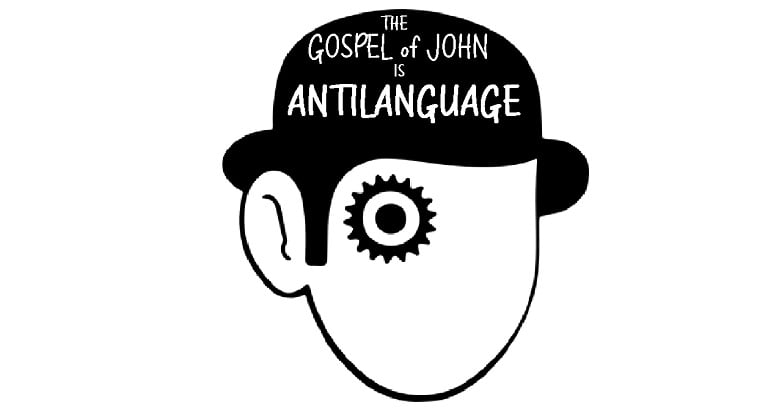
Anti-language Gospel / Image by Mario AGF from Pixabay
Anti-language fills the Gospel of John, and its author belonged to an antisociety, not a university of theologians.
We’ve been exploring eating Jesus’ flesh and drinking his blood in John 6. We have seen that “John” wrote a Gospel, not about ideas, but ensuring interpersonal relations and group cohesion. Hence, he relexicalizes, employing new words for realities not ordinarily referred to with those words. And “John” also overlexicalizes, using too many words and phrases to express the same meaning. In other words, the Gospel called “John” is a text of anti-language.
Here is a video presentation about Johannine anti-language:
Antisociety & Anti-language
Since “John” is a Gospel of anti-language, this demands that the Johannine community must have been an antisociety. According to Michael Halliday (American Anthropologist, 1978, p. 171), “Anti-language” is the language of an “antisociety,” social groups “set up within another society as a conscious alternative to it. It is a mode of resistance, resistance which may take the form either of passive symbiosis or of active hostility and even destruction.”
Whether vagabonds of Elizabethan England, criminals in Calcutta’s underground, or people involved in the American drug trade and prison culture, these groups are all antisocieties. So too was the Johannine group that produced the fourth Gospel.
The anti-language used by all these groups expresses their social experience and keeps outsiders out. Therefore, it isn’t meant to help outsiders understand them. They don’t want that. Instead, it was about keeping group-members in.
So forget about the Johannine antisociety evangelizing people “out there.” This community dropped that mission like a bad habit once they became an antisociety, probably during the 80s CE.
Anti-language in “John”
Watch how “John” overlexicalizes. He does so because of his interpersonal intention for group cohesion. This is crucial for “John.” Carefully read his gospel narrative and note WHO is involved, as well as OF WHOM and TO WHOM Jesus speaks. It will always be indicated by the set of words bearing the same denotation but with a highly different connotation. Again, “John” isn’t about communicating ideas but rather is interpersonal, concerned with group cohesion.
Therefore all of the famous “I am…” statements are interpersonal. They aren’t about teaching new ideas about Jesus. Denotatively speaking, “bread” (John 6:35), “light” (John 8:12), “door” (John 10:9), “life” (John 11:25-26), “way” (John 14:6), and “vine” (John 15:5) all refer to various real-world objects and bear their expected denotation, sure. However more is afoot.
You see, in Johannine anti-language, each “I am…” proposition gets identified with Jesus. When that happens, each proposition assumes some interpersonal dimension in the Johannine antisociety. For example, is Jesus really bread? No. But for those who stick together in the Johannine antisociety, Jesus is life-giving bread! Is Jesus really a door? No. But for Johannine believers, he is like a door granting access to the patron God.
Therefore to believe, come, abide, follow, love, keep words, receive, have, see, eat and drink are Johannine synonyms for discipleship actions. They all mean the same thing in the interpersonal context—group cohesion, stick like glue together!
Antisocial Gangs
Consider the following anti-language taken from U.S. street gangs (from “Omaha World Herald,” August 22, 1996, p. 14). Note the overlexicalized terms and the relexicalized words and expressions:
Are you claiming? = Do you belong to a gang? Bent = To get drunk. Boned out = Quit. Chickened out, left, backed down. Brown plant = Heroin. Cheese out = Snitch. Give up. Chicken = Homosexual prostitute. Clucker = Crack cocaine addict. Dissin’ = Being disrespectful. Don = Second-highest-ranking gang member. Dropping the flag = Leaving the gang. Everything is everything = It’s all right. Five O = Police. Police are coming. Frog = Girl with low moral standards; she jumps in anybody’s car. General = Third-highest-ranking gang member. Hood = Neighborhood. Hangin’ = Not directly involved. Hustler = Not into gangs, strictly out to make money or impress girls. Ice cream truck = Vehicle used to sell drugs. I’d rather be judged by 12 than carried by 6 = I’ll kill you before you kill me. Jackin’ = Robbing others. King = Highest-ranking gang member. Kite in the wind = Letter in the mail. Knockin’ boots = Having sex. K Swiss = Kill slobs when I see slobs. Love = Rock cocaine. Married = Joined a gang, group. Nut up = Fake ignorance or stupidity. OG = Original gangster. Old gangster or organized gangster. Old bird = Mother. Old jude = Father. One time = Police officers are near. Pancake = Person who becomes a homosexual due to his experience in jail. Poor box = Container for the items collected by gang members as dues or payment for protection. Put in some work = Doing a shooting. Queen = Female gang member. Rig = Combination of hypodermic needle, bottle cap, and string to tie off an arm before injecting drugs. Road dog = Close friend. Rock star = Crack-addicted woman who trades sex for drugs. Safe house = Place where large amounts of drugs and money are stored. Sell out = To betray your race. Snatch a birth date = Kill someone. Snow bunny = White female. Strapped = To carry a weapon. TWA = Teenie weenie afro. Triple OG = Third generation gangster. Undercover = Plain gang car. Violations = To break gang rules and receive punishment. Word = OK, all right
Do you see how many terms related to key interests for the gangs? Note the emphasis on gang boundaries and violating boundaries, women, and drugs, and don’t miss the relexicalizing! You see this same tendency in Johannine anti-language.
Outlawed Anti-language?
Context Group scholars Bruce Malina and Richard Rohrbaugh find it curious that, generally speaking, recent antisocieties relate to the law negatively. Either they exist on the margins of the law or are lawbreakers, outlaws. But they are not outside society. Instead, they are within society, albeit in a hollowed-out social space. By their anti-language, they resist and undermine the law.
It is essential to realize that societies are not opposed to antisocieties. Just so, language is not opposed to anti-language. Instead, antisociety is opposed to society, and anti-language is counter to language. Hence all anti-language, including Johannine anti-language, happens when antisocieties establish a counter-reality in opposition to the established or dominant society and its norms.
Therefore it is manifestly significant to note that the Johannine group was not rejected by their enemies because of anything proposed by the Fourth Gospel! This anti-language Gospel does not present any beliefs or attitudes that resulted in the expulsion of the Johannine group from the dominant society.
Instead, the anti-language Gospel of “John” reflects the alternate reality established by the Johannine antisociety. This alternate reality opposed the dominant society of first-century Israel, referred to in “John” as “this world” and “the Judaeans.”
Society Views the Antisociety as…
And how did “this world” see the Johannine antisociety? Either marginal law-keeping misfits or worse, transgressing outlaws.
The anti-language Gospel called “John” reveals the Johannine group to be an antisociety. That means this group was an antisocietal collectivity established within a dominant society as a conscious alternative to it.
The anti-language Gospel of “John” is just like all anti-language. It was consciously employed for strategic ends. Defensively, the Gospel worked to maintain a social reality through group cohesion. On the other hand, “John” offensively resisted and protested “the world” (the dominant society of first-century Israel).
Significantly, many anti-language words and sentences lack equivalent meanings in the language of the dominant society. Sorry, Greek-proficient Bible readers! This means that statements like “I and the Father [God] are one” (John 10:30) and “Truly, truly I say to you before Abraham was, I am” (John 8:58) were socially meaningless in the Greek used by Hellenist Israelites (e.g., Paul and “Mark”). Just as socially meaningless would be the Johannine identification of Jesus of Nazareth with the preexisting Word of God become flesh (John 1:1, 14).
Maverick Anti-language
The anti-language of “John” was truly maverick, indeed, a Gospel from outer space! Paul, “Mark,” “James,” “Matthew,” “Luke,” and others wouldn’t know what to do with its anti-language!
It’s the same with the anti-language of our contemporary antisocieties. Society at large finds no value in treasured gang roles (e.g., king, don, general). Of course, we can and do understand these expressions, and we can translate them adequately. But the anti-language propositions won’t function as a language with any verifiable social meaning in the ordinary language’s semantic system.
This is true of the anti-language Gospel called “John” and its relationship to the Greek used by Hellenist Israelites. It applies to contemporary Israel’s “religious” language, also. And in particular, it applies to the language of other New Testament Jesus groups as well. Significantly, in all non-Johannine New Testament writings, you will not find anything like John 1:1, 14; 8:58; and 10:30.
Re-contextualizing Anti-language
Antisocieties don’t last. Eventually, the Johannine antisociety dissolved. Its anti-language Gospel survived and has passed down to us, but it was inevitably re-contextualized. Even though the anonymous author of “John” wrote this anti-language Gospel for members of his antisociety, that isn’t how his document has been understood for the past two millennia. Traditionally, words and sentences in “John” were understood according to ordinary Greek.
Therefore, the anti-language expression “I and the Father are one” ordinarily is understood as if Jesus is providing a concise description of his own self-understanding. This could not have been the case.
How did this problem happen? Anti-language only makes sense in its antisociety in conflict with the dominant society. Therefore, once the Johannine antisociety dissolved and the conflict ended, the Gospel began to be read among ordinary ancient Mediterranean messianists. Soon after, the anonymous author became “Saint John, the Theologian,” providing a cornucopia of new information about the nature of Jesus, about which all other New Testament authors were oblivious.
God must be one helluva Jazz player, huh?
Previous Post
August 7, 2021
Eating Flesh and Drinking Blood is Anti-Language
Next Post

August 11, 2021 Johannine Anti-language
Browse Our Archives
Select a Category Uncategorized
Select a Month August 2021 July 2021 June 2021 May 2021 April 2021 March 2021 February 2021 January 2021 December 2020 November 2020 October 2020 September 2020 August 2020 July 2020 June 2020 May 2020 April 2020 March 2020 February 2020 January 2020 December 2019 November 2019 October 2019 September 2019 August 2019
Follow Us!
TAKE THE
Religious Wisdom Quiz
Who was Jesus' mother?
Select your answer to see how you score.
Elizabeth Mary Martha Anna
Support this
Column


Related posts from Messy Inspirations

Understanding Apocalypse & Its Creatures



TRENDING AT PATHEOS Catholic

Rejecting Doom: Christian Hope And Human Action
Christianity is a religion of hope. We are to have hope and...

It’s What Comes From Within Which Matters
One of the most difficult things for us to understand is why...

Why I Choose the Eucharist Over the Sermon
Choose the Eucharist, Not the Sermon What are we supposed to get...

5 Design Elements Found in Spiritually Rooted Homes
Putting Spirituality Into Home Decor Our homes are more than our living...

Credo: A Story of God Told with the...
About 10 years ago, I began to imagine a personal "Credo" that...

The Anatomy of Divine Revelation in Catholic Thought
The claim that God has made Himself known to human beings is...
view all Catholic blogs
Ad-Free & Subscriber Log-In Subscription Support
- About Us
- 2026 Calendar
- Videos
- Podcasts
- Library of World Religions
- Faith In Media Tracker
- Advertise With Us
- Write for Us
- Privacy Policy
- Terms of Service
- Do Not Sell My Data
- Contact Us
- Radiant Digital
- Manage Newsletter Subscriptions
- Unsubscribe From Notifications
- Sitemap
Copyright 2008-2026, Patheos. All rights reserved.
Subscription Support Ad-Free & Subscriber Log-In
Follow Patheos