
BuddhistCatholicContemplativeEvangelicalGeneral ChristianHinduJewishLatter-day SaintMuslimNew VisionsProgressive Christian
Beliefs
- Buddhist
- Catholic
- Contemplative
- Evangelical
- General Christian
- Hindu
- Jewish
- Latter-day Saint
- More Voices
- Muslim
- New Visions
- Pagan
- Progressive Christian
Topics
- Religion News
- Food and Religion
- Sports and Religion
- Religious Art
- Religious Music and Entertainment
- Religious Events
- History and Religion
- Style and Religion
- Politics and Religion
- Women in Religion
- Recreation Outdoors and Religion
- Business Finance and Religion
- Careers Workplace and Religion
- Education and Religion
- Family Parenting and Religion
- Health Fitness and Religion
- Home and Religion
- Relationships and Religion
- Technology and Religion
- Travel and Religion
Columnists
- Buddhist Columnists
- Business Finance and Religion Columnists
- Careers Workplace and Religion Columnists
- Catholic Columnists
- Contemplative Columnists
- Education and Religion Columnists
- Evangelists Columnists
- Family Parenting and Religion Columnists
- General Christian Columnists
- Health Fitness and Religion Columnists
- Hindu Columnists
- History and Religion Columnists
- Home and Religion Columnists
- Jewish Columnists
- More Voices Columnists
- Latter Day Columnists
- Muslim Columnists
- New Visions Columnists
- Nonreligious Columnists
- Pagan Columnists
- Politics and Religion Columnists
- Progressive Columnists
- Recreation Outdoors and Religion Columnists
- Relationships and Religion Columnists
- Religion News Columnists
- Religious Art Columnists
- Religious Events Columnists
- Religious Music and Entertainment Columnists
- Sports and Religion Columnists
- Style and Religion Columnists
- Technology and Religion Columnists
- Travel and Religion Columnists
- Women in Religion Columnists
Resource Library
- 2026 Calendar
- Library of World Religions
- The 100 Most Holy Places on Earth
- Patheos Answers
- Podcasts
- Videos
- Faith Leaders Database
- Anglican Episcopalian
- Bahai
- Baptist
- Buddhism
- Christianity
- Confucianism
- Eastern Orthodoxy
- Hinduism
- Holiness and Pentecostal
- ISKCON
- Islam
- Judaism
- Lutheran
- Methodist
- The Church of Jesus Christ of Latter-day Saints
- New Age
- Paganism
- Presbytarian and Reformed
- Protestantism
- Religion Behind the Scenes
- Roman Catholic
- Scientology
- Shia Islam
- Sikhism
- Sufism
- Sunni Islam
- Taoism
- Zen
- See all religions
Research Tools
 Ad-Free & Subscriber Log-In Subscription Support
Ad-Free & Subscriber Log-In Subscription Support
Follow Patheos 

- Trending:
- Forgiveness
- |
- Marriage
- |
- Consciousness
- |
- Death Penalty
- |
- Election
- |
- Halloween
 Messy Inspirations
- Home
- Catholic
- Authority & Healing: Mark 6:7-13
Authority & Healing: Mark 6:7-13
Last updated on: July 10, 2021 at 2:49 pm by Fellow Dying Inmate
Authority & Healing: Mark 6:7-13 2021-07-10T14:49:17-04:00 Fellow Dying Inmate
Patheos Explore the world's faith through different perspectives on religion and spirituality! Patheos has the views of the prevalent religions and spiritualities of the world.
Authority & Healing / Image by Christine Schmidt from Pixabay
Authority over demons figures heavily in this Sunday’s Gospel, but what is this really about?
Sometimes I enjoy hearing Christians—especially my fellow Catholics—talk about angels and demons citing some spiritual writer or authority. It always gives me a chuckle. I wonder, “where are these experts getting all this fanciful stuff from?” Books, they answer. But the books they cite are a rehash of Western theological and spiritual ideas only distantly related, if at all, to our Middle Eastern Scriptures.
Not only do I chuckle at pooled ignorance, but I also cry. I weep for parishes endlessly invoking Jesus the healer when so many homeless and mentally ill are shunned and expelled from the so-called “Body of Christ.” And I also rage when 20-something priests lauded as demigods dine on fine china in posh rectories ranting about smelly homeless people who are lazy and entitled.
Instead of our later-developed understanding and nonsense, why don’t we get culturally informed foundations for talking about biblical spirits? Without a grasp of Middle Eastern culture, can you, a Western Bible reader, even know what you are reading about in the Scriptures? Answer: nope.
Authority & First-Century Politics
In this Sunday’s Gospel (Mark 6:7-13), Jesus gathers his political faction (the Twelve). No, he didn’t go out to form a new religion and convert people into it. Instead, Jesus was all about Theocracy (“the kingdom of God”)—that means religion embedded in politics (Mark 1:15; Matthew 4:17; Luke 4:42). The historical Jesus was all about Theocracy, not religious organizations. Even the later interpretations of Jesus found in our Gospels (related but different!) were very political.
Jesus’ immediate circle of followers was likewise very political. After Jesus’ career ended, an Israelite political faction continued to exist, one that had been previously very close to Jesus and his concerns. Indeed this coalition was formed in Jesus’ political concern of Theocracy (Mark 1:16-20; Matthew 4:18-22; Luke 5:1-11). This Sunday’s Gospel (Mark 6:7-13) shows that he successfully brokered authority from the God of Israel for this recruited coalition to assist him in proclaiming the forthcoming Theocracy.
Authority Over Spirits
So, Jesus sends out his followers with authority over unclean spirits.
Let’s think about that for a moment. Jesus is a Galilean peasant day laborer turned folk healer and political faction leader. Peasants made up his followers. Anyone from their culture knew that such lowly people don’t have authority even over their fellow human beings, much less demons.
So Western readers, claiming that the world was full of evil spirits would not shock our ancestors in the faith. Everyone back then believed that spirits filled the air around people. No, the astonishing detail in the Gospel is that peasants were somehow given authority over spirits. That’s crazy!
Spirits?
What are spirits in the Bible, anyway? Throughout the ancient Mediterranean cultural world of the Gospels, people everywhere believed in other-than-human persons called “spirits.” They were seen as superhuman (“supernatural” is not a biblical concept) powerful beings. Some spirits were good, others mischievous, and others evil. But all spirits existed in a social hierarchy very much familiar to the circum-Mediterranean. They all were ranked above human beings.
Neither the Israelites of Jesus’ day nor the time of the Evangelists believed like later Christians (325 CE) and Jews (500 CE). In fact, they were not Christians or Jews at all! When talking about Jesus and his followers, any mention of Jews/Jewish, Christians, or Pagans is anachronistic.
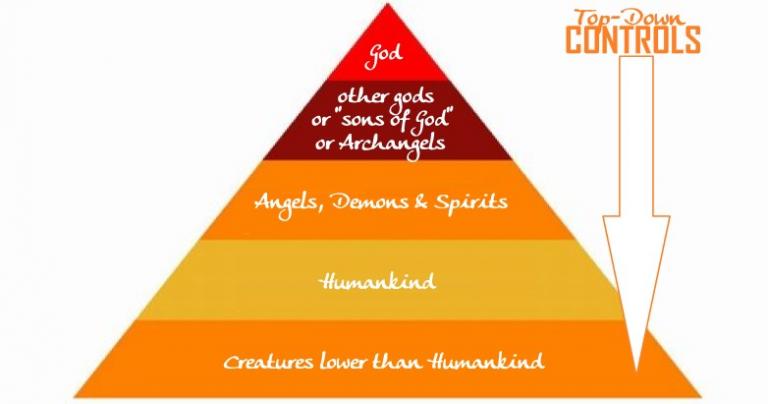
First-century Israelites were not even monotheists! Instead, New Testament Israelites were henotheists. At the top of the pile of gods was the greatest God, who, fortunately for Israel, was also patron god to Israel.
Below this ultimate God—in the Israelite tradition, the God of the Scriptures—were other gods. These were the sons of God or the archangels. The greatest of these second-tier beings in ancient Israelite belief was the Son of Man. Many Israelites believed this great sky-servant to be the constellation we call Aries, the cosmic Male-Lamb of God.
Hierarchy of Cosmic Authority
Then came the third tier of other-than-human persons. These would be angels (whether constellations or planets or stars), lesser spirits who ruled the lower winds, and the demons.
Fellow Dying Inmate / All Rights Reserved
And beneath and weaker than all of these were lowly humans. Our biblical ancestors considered humans to occupy the fourth tier, with only beasts and plants under them. And among the lowest of fourth-tier beings would be Galilean peasants like Jesus and his (probably teenager) followers.
But “Mark” reports that Jesus changed that. By brokering the Twelve power over ordinarily higher and more powerful beings, the holy man Jesus elevates them at least as high as level three. Now they could expel hostile other-than-human persons called “unclean spirits” by Semites and “demons” by Greek speakers. Jesus also had this ability (Mark 5:2, 8, 15-16).
Exorcists, or What?
So what did that make the Twelve? Did he make them exorcists? Did they perform exorcisms? 21st-century believers might describe their activity as exorcism, but not the New Testament.
Israelites like Jesus and the Twelve were like any other ancients in that they saw causality as personal. When something happened, whatever it was, the question was never, “what happened?” but rather “who did that?” This was especially true of significant events in the life of persons and groups. Every significant effect, they believed, got caused by some person, either human or nonhuman.
Whatever effect happened beyond human control—weather, earthquakes, illness, fertility—ancient Mediterraneans believed spirits caused them. Everything in the cosmos happened this way.
Hence, personified forces called “demons” or “unclean spirits” had the power to manipulate human behavior. When people got accused of being possessed, the underlying belief was that a nonhuman person caused superhuman observable effects. When someone’s behavior (external symptom) was socially deviant or when a person was embedded into a network of deviant social relationships, it was not uncommon for fellow Israelites to accuse them of being possessed.
Authority for Healing
What was the explanation for this deviance? Maybe God was the explanation—prophets different after all. But perhaps it was an evil spirit that is behind this, and that would be dangerous. The Israelite community observing the deviance would be anxious to clarify whether this was a threat. If so, the community would expel and exclude these deviants. This was a fate worse than death for collectivistic personalities.
Therefore, what Jesus and his followers did was far more than mere exorcism or liberating people from demons. Jesus was far greater than an exorcist. Jesus not only freed Israelites from demons but also restored them to a meaningful existence in the community (Mark 5:18; Luke 8:39). In other words, Jesus and his followers were folk healers.
Part of a political faction with a political agenda, Jesus and his followers healed their fellow Israelites for Theocracy. Jesus’ own alternate states of consciousness made it easy for his first followers to recognize him as a holy man, what anthropologists today would call a shaman. Through Jesus, God empowered other shamanic folk healers, the Twelve. The context of their healing activities was political religion, and this threatened the elites in authority. Jesus and the Twelve healed Israelites to restore Israelites and ready them for immanent Theocracy.
They had the authority to expel spirits and heal, restoring meaning both to the sick person and their community. Jesus, therefore, shares this authority with his coalition (Mark 6:7). In turn, they expel unclean spirits (Mark 6:13).
Previous Post

July 3, 2021
Upset? Too Bad!
Next Post

July 10, 2021 Inspiration is Messy Indeed
Browse Our Archives
Select a Category Uncategorized
Select a Month August 2021 July 2021 June 2021 May 2021 April 2021 March 2021 February 2021 January 2021 December 2020 November 2020 October 2020 September 2020 August 2020 July 2020 June 2020 May 2020 April 2020 March 2020 February 2020 January 2020 December 2019 November 2019 October 2019 September 2019 August 2019
Follow Us!
TAKE THE
Religious Wisdom Quiz
What does "Absalom" mean in Hebrew?
Select your answer to see how you score.
God is My Strength Father of Peace Mighty Warrior Son of Righteousness
Support this
Column


Related posts from Messy Inspirations

Understanding Apocalypse & Its Creatures



TRENDING AT PATHEOS Catholic

Rejecting Doom: Christian Hope And Human Action
Christianity is a religion of hope. We are to have hope and...

It’s What Comes From Within Which Matters
One of the most difficult things for us to understand is why...

Why I Choose the Eucharist Over the Sermon
Choose the Eucharist, Not the Sermon What are we supposed to get...

5 Design Elements Found in Spiritually Rooted Homes
Putting Spirituality Into Home Decor Our homes are more than our living...

Credo: A Story of God Told with the...
About 10 years ago, I began to imagine a personal "Credo" that...

The Anatomy of Divine Revelation in Catholic Thought
The claim that God has made Himself known to human beings is...
view all Catholic blogs
Ad-Free & Subscriber Log-In Subscription Support
- About Us
- 2026 Calendar
- Videos
- Podcasts
- Library of World Religions
- Faith In Media Tracker
- Advertise With Us
- Write for Us
- Privacy Policy
- Terms of Service
- Do Not Sell My Data
- Contact Us
- Radiant Digital
- Manage Newsletter Subscriptions
- Unsubscribe From Notifications
- Sitemap
Copyright 2008-2026, Patheos. All rights reserved.
Subscription Support Ad-Free & Subscriber Log-In
Follow Patheos