
BuddhistCatholicContemplativeEvangelicalGeneral ChristianHinduJewishLatter-day SaintMuslimNew VisionsProgressive Christian
Beliefs
- Buddhist
- Catholic
- Contemplative
- Evangelical
- General Christian
- Hindu
- Jewish
- Latter-day Saint
- More Voices
- Muslim
- New Visions
- Pagan
- Progressive Christian
Topics
- Religion News
- Food and Religion
- Sports and Religion
- Religious Art
- Religious Music and Entertainment
- Religious Events
- History and Religion
- Style and Religion
- Politics and Religion
- Women in Religion
- Recreation Outdoors and Religion
- Business Finance and Religion
- Careers Workplace and Religion
- Education and Religion
- Family Parenting and Religion
- Health Fitness and Religion
- Home and Religion
- Relationships and Religion
- Technology and Religion
- Travel and Religion
Columnists
- Buddhist Columnists
- Business Finance and Religion Columnists
- Careers Workplace and Religion Columnists
- Catholic Columnists
- Contemplative Columnists
- Education and Religion Columnists
- Evangelists Columnists
- Family Parenting and Religion Columnists
- General Christian Columnists
- Health Fitness and Religion Columnists
- Hindu Columnists
- History and Religion Columnists
- Home and Religion Columnists
- Jewish Columnists
- More Voices Columnists
- Latter Day Columnists
- Muslim Columnists
- New Visions Columnists
- Nonreligious Columnists
- Pagan Columnists
- Politics and Religion Columnists
- Progressive Columnists
- Recreation Outdoors and Religion Columnists
- Relationships and Religion Columnists
- Religion News Columnists
- Religious Art Columnists
- Religious Events Columnists
- Religious Music and Entertainment Columnists
- Sports and Religion Columnists
- Style and Religion Columnists
- Technology and Religion Columnists
- Travel and Religion Columnists
- Women in Religion Columnists
Resource Library
- 2026 Calendar
- Library of World Religions
- The 100 Most Holy Places on Earth
- Patheos Answers
- Podcasts
- Videos
- Faith Leaders Database
- Anglican Episcopalian
- Bahai
- Baptist
- Buddhism
- Christianity
- Confucianism
- Eastern Orthodoxy
- Hinduism
- Holiness and Pentecostal
- ISKCON
- Islam
- Judaism
- Lutheran
- Methodist
- The Church of Jesus Christ of Latter-day Saints
- New Age
- Paganism
- Presbytarian and Reformed
- Protestantism
- Religion Behind the Scenes
- Roman Catholic
- Scientology
- Shia Islam
- Sikhism
- Sufism
- Sunni Islam
- Taoism
- Zen
- See all religions
Research Tools
 Ad-Free & Subscriber Log-In Subscription Support
Ad-Free & Subscriber Log-In Subscription Support
Follow Patheos 

- Trending:
- Forgiveness
- |
- Marriage
- |
- Consciousness
- |
- Death Penalty
- |
- Election
- |
- Halloween
 Messy Inspirations
- Home
- Catholic
- Lowly Lowlife Jesus
Lowly Lowlife Jesus
Last updated on: May 4, 2021 at 11:32 am by Fellow Dying Inmate
Lowly Lowlife Jesus 2021-05-04T11:32:57-04:00 Fellow Dying Inmate
Patheos Explore the world's faith through different perspectives on religion and spirituality! Patheos has the views of the prevalent religions and spiritualities of the world.
Lowly Jesus / Image by Gordon Johnson from Pixabay
Lowly and poor was the village tektōn Jesus, just above the degraded and expendable of first-century Palestine.
How lowly was Jesus? In other words, how low was Jesus’ honor ranking? To find out, we will need to explore village life and rural peasants of first-century Galilee. Forget about the Sunday School pictures and Jesus movies—they aren’t honest to the reality.
Here is a presentation detailing just how low and why Jesus confused everyone when he spoke publicly—
Very Lowly
Jesus was near the bottom of the social spectrum of his world.
According to Context Scholar Richard Rohrbaugh, culture, economics, and politics were dominated by the poleis in the Mediterranean world of Jesus. Poleis is plural for polis or Mediterranean urban center. No, not a city—post-Industrial cities are quite different than first-century poleis.
Despite their tremendous influence, the polis wasn’t where most people lived. In fact, 90 percent of the population lived in villages. These were farmers or workers extracting raw materials. To understand Jesus’ story and who he is, you need to know about the rural groups residing throughout the villages of Galilee.
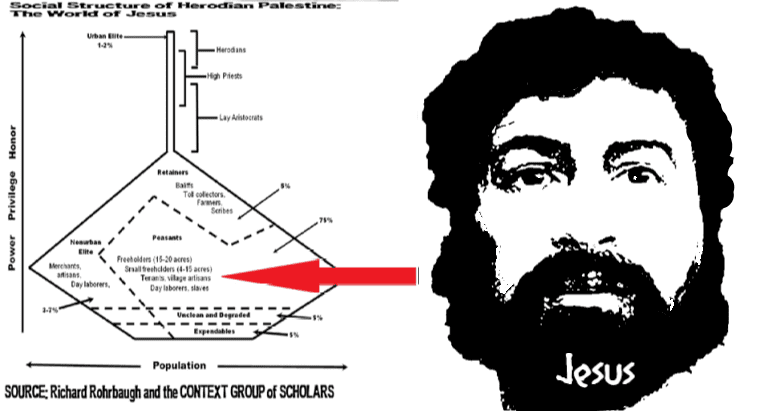
Ranking Lowly Jesus / Fellow Dying Inmate (with inspiration from Donato Giancarlo) / All rights reserved
Jesus is to be found among Galilean peasants (75 percent of the total population). Among them were freeholders, tenant farmers, day laborers (ergatai), slaves, and several groups without land. In this last bunch were fishermen, artisans, and various craftsmen.
Lowly Freeholders
Among the peasants of Galilee were those who owned and worked their own land. These were freeholders. They survived by farming and whatever nonagricultural work they got in the off-season.
Consider that peasants needed to save seed for the following year’s harvest. Add in fodder for their animals. Also, they would need to trade grain for things they could not produce. And don’t forget about the exploitation of the Temple, the priesthood, the Herodian regime, and Roman tribute in tolls. Ultimately, as Rohrbaugh explains, peasant economic viability in Jesus’ day was precarious.
Peasant freeholders were losing their lands to debt foreclosure in epidemic proportions. The greedy urban elites controlled the courts. And court decisions therefore favored those elites. Could Jesus’ family have suffered the fate of this injustice?
Even More Lowly Tenants
Imagine that you, a peasant freeholder, have fallen into debt. Drought frequently comes in the Galilee. With poor harvests, your family eats this year’s seed grain to survive. What will you do for the following season? You must borrow seed grain. Now you are in debt.
If this pattern continues, your land will be taken from you. In Jesus’ day, many former freeholding peasants had become landless tenant farmers.
Scribes wrote contracts to favor the elite lenders. How could peasants, illiterate, respond? Do you understand why labor violence pops up so frequently in Jesus’ parables? It was an everyday occurrence to Jesus and his audience.
Maybe the contract was for one year, or maybe for a lifetime. Rohrbaugh explains that payment could be provided in various ways, ranging from money to a percentage of the harvest. Fixed rents could go as high as two-thirds of the crop. Disastrously, according to David Fiensy, entire villages (like Qawarat Bene-Hassan) were consumed. All residents became tenants for a single elite landlord (see The Social History of Palestine in the Herodian Period: The Land Is Mine, p. 84).
Even More Lowly: Day Laborers & Slaves
Galilee knew plenty of day laborers and slaves. They worked harvests, but Rohrbaugh and others list them as barbers, bathhouse attendants, messengers, manure collectors, cooks, and construction workers.
Landless day laborers were very near the bottom of the honor scale and socioeconomic profile of Herodian Palestine. They were known to drift into towns and poleis looking for work. Urban centers always needed new labor. As Rohrbaugh and others explain, this wasn’t because of growing economic opportunity. Instead, it was due to the enormously high death rates among the urban poor.
Other Rural Groups
Near the bottom of village peasant life, but above the unclean, degraded, and expendables, we find Jesus and his inner circle. Here are despised fishermen and herders and the artisans—craftsmen, weavers, and potters, blacksmiths and carpenters. Artisans had to travel to find work, especially if from a tiny hamlet like Nazareth. Itinerant people were universally considered social deviants in antiquity. Such workers were ranked extremely low on the social scale.
Only the degraded and expendables were below Jesus, and we know he was always in contact with them.
Why Does This Matter?
So here is Jesus. Here is the Holy Family. Remember that at Eucharist. Bring this to mind in your devotions and Rosaries. And that, finally, brings us to Jesus, the village tektōn. Legend says that Jesus’ family were specialists at making yokes for oxen. As Dr. Rohbaugh says, if this corresponds to the historical Jesus, he would have been near the poorest and lowliest among Israelites.
Much of Christian history has robbed us of seeing Jesus (and Mary!) as they were. Why do you think that is?
Consider this: there were no schools in Nazareth. And why would Jerusalem elites want to foster a literate peasantry? On the contrary, it was their advantage to keep reading and writing limited to the very few. Therefore illiterate peasants memorized the Scriptures. They knew the Scriptures through repetition.
Beware a congenial Jesus.
Context Group of Biblical Scholars
Previous Post

May 2, 2021
Know St. Joe? A Family Story
Next Post

May 6, 2021 Mary of History
Browse Our Archives
Select a Category Uncategorized
Select a Month August 2021 July 2021 June 2021 May 2021 April 2021 March 2021 February 2021 January 2021 December 2020 November 2020 October 2020 September 2020 August 2020 July 2020 June 2020 May 2020 April 2020 March 2020 February 2020 January 2020 December 2019 November 2019 October 2019 September 2019 August 2019
Follow Us!
TAKE THE
Religious Wisdom Quiz
I am an ancestor of King David, born from a foreign widow's faithfulness. Who am I?
Select your answer to see how you score.
Boaz Jesse Salmon Obed
Support this
Column


Related posts from Messy Inspirations

Understanding Apocalypse & Its Creatures



TRENDING AT PATHEOS Catholic

Rejecting Doom: Christian Hope And Human Action
Christianity is a religion of hope. We are to have hope and...

It’s What Comes From Within Which Matters
One of the most difficult things for us to understand is why...

Why I Choose the Eucharist Over the Sermon
Choose the Eucharist, Not the Sermon What are we supposed to get...

5 Design Elements Found in Spiritually Rooted Homes
Putting Spirituality Into Home Decor Our homes are more than our living...

Credo: A Story of God Told with the...
About 10 years ago, I began to imagine a personal "Credo" that...

The Anatomy of Divine Revelation in Catholic Thought
The claim that God has made Himself known to human beings is...
view all Catholic blogs
Ad-Free & Subscriber Log-In Subscription Support
- About Us
- 2026 Calendar
- Videos
- Podcasts
- Library of World Religions
- Faith In Media Tracker
- Advertise With Us
- Write for Us
- Privacy Policy
- Terms of Service
- Do Not Sell My Data
- Contact Us
- Radiant Digital
- Manage Newsletter Subscriptions
- Unsubscribe From Notifications
- Sitemap
Copyright 2008-2026, Patheos. All rights reserved.
Subscription Support Ad-Free & Subscriber Log-In
Follow Patheos