
BuddhistCatholicContemplativeEvangelicalGeneral ChristianHinduJewishLatter-day SaintMuslimNew VisionsProgressive Christian
Beliefs
- Buddhist
- Catholic
- Contemplative
- Evangelical
- General Christian
- Hindu
- Jewish
- Latter-day Saint
- More Voices
- Muslim
- New Visions
- Pagan
- Progressive Christian
Topics
- Religion News
- Food and Religion
- Sports and Religion
- Religious Art
- Religious Music and Entertainment
- Religious Events
- History and Religion
- Style and Religion
- Politics and Religion
- Women in Religion
- Recreation Outdoors and Religion
- Business Finance and Religion
- Careers Workplace and Religion
- Education and Religion
- Family Parenting and Religion
- Health Fitness and Religion
- Home and Religion
- Relationships and Religion
- Technology and Religion
- Travel and Religion
Columnists
- Buddhist Columnists
- Business Finance and Religion Columnists
- Careers Workplace and Religion Columnists
- Catholic Columnists
- Contemplative Columnists
- Education and Religion Columnists
- Evangelists Columnists
- Family Parenting and Religion Columnists
- General Christian Columnists
- Health Fitness and Religion Columnists
- Hindu Columnists
- History and Religion Columnists
- Home and Religion Columnists
- Jewish Columnists
- More Voices Columnists
- Latter Day Columnists
- Muslim Columnists
- New Visions Columnists
- Nonreligious Columnists
- Pagan Columnists
- Politics and Religion Columnists
- Progressive Columnists
- Recreation Outdoors and Religion Columnists
- Relationships and Religion Columnists
- Religion News Columnists
- Religious Art Columnists
- Religious Events Columnists
- Religious Music and Entertainment Columnists
- Sports and Religion Columnists
- Style and Religion Columnists
- Technology and Religion Columnists
- Travel and Religion Columnists
- Women in Religion Columnists
Resource Library
- 2026 Calendar
- Library of World Religions
- The 100 Most Holy Places on Earth
- Patheos Answers
- Podcasts
- Videos
- Faith Leaders Database
- Anglican Episcopalian
- Bahai
- Baptist
- Buddhism
- Christianity
- Confucianism
- Eastern Orthodoxy
- Hinduism
- Holiness and Pentecostal
- ISKCON
- Islam
- Judaism
- Lutheran
- Methodist
- The Church of Jesus Christ of Latter-day Saints
- New Age
- Paganism
- Presbytarian and Reformed
- Protestantism
- Religion Behind the Scenes
- Roman Catholic
- Scientology
- Shia Islam
- Sikhism
- Sufism
- Sunni Islam
- Taoism
- Zen
- See all religions
Research Tools
 Ad-Free & Subscriber Log-In Subscription Support
Ad-Free & Subscriber Log-In Subscription Support
Follow Patheos 

- Trending:
- Forgiveness
- |
- Marriage
- |
- Consciousness
- |
- Death Penalty
- |
- Election
- |
- Halloween
 Messy Inspirations
- Home
- Catholic
- Docetic Addiction
Docetic Addiction
Last updated on: April 28, 2021 at 1:26 pm by Fellow Dying Inmate
Docetic Addiction 2021-04-28T13:26:08-04:00 Fellow Dying Inmate
Patheos Explore the world's faith through different perspectives on religion and spirituality! Patheos has the views of the prevalent religions and spiritualities of the world.
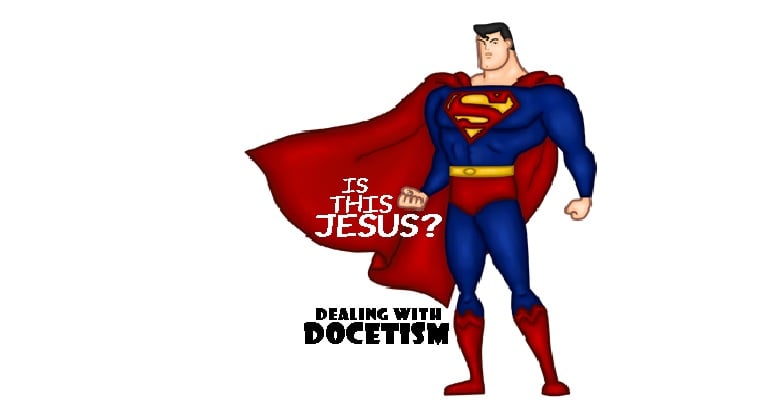
Docetic Addiction with Jesus / Image by Eduardo RS from Pixabay
Catholics frequently twist Jesus into Superman via a common Docetic addiction.
We Catholics and other Christians suffer from Docetic addiction. It is challenging to shake our affinity for the ancient heresy of Docetism (in Greek, δοκεῖν or δόκησις meaning “to seem”), the idea that Jesus was God disguised as a man. Perennially it returns to us, garbed in verbal orthodoxy, but upon careful examination gets unmasked as something other (in Greek, hetero) than what we as Church profess.
Despite our Docetic addiction, Jesus wasn’t Superman.
To see what I mean, watch the following video presentation—
Docetic Addiction Through the Centuries
You see the Docetic addition throughout the centuries. It pops up in different ways but is usually costumed in professed faithfulness. For example, Spanish scholastic theologians at Salamanca suffered from the Docetic addition. They claimed a range of knowledge for Jesus that was so outlandish it is truly alien to the human condition.
For these scholars, Jesus possessed a knowledge that was perfect in every regard. Accordingly, Jesus wasn’t just the perfect savior. He was also the perfect soldier and general, the perfect scientist and scholar, the perfect artist and poet, etc. How? It was because of Jesus’ infinite all-knowing. Jesus possessed all the facts. He knew everything.
“Jesus was God! He was the Son of God!” as the leader of the parish RCIA program used to ardently exclaim in my weekly Scripture study program years ago.
Isn’t this the same Jesus as imagined by filmmaker Mel Gibson? In Gibson’s Passion of the Christ, Jesus can switch from Aramaic to Latin on a dime. Why not? If Jesus indeed had all the factual knowledge, that would be a piece of cake.
Docetic Addiction in the New Testament?
But is there any evidence of this in the New Testament? Is that what the New Testament presents?
It is true that the Gospels do show many people being astounded at Jesus’ actions (healings, sayings, proclamation). “Where did this man get all this?” As we have been exploring, they were astounded because, being Mediterraneans, they were obsessed with honor and shame. Therefore it did not compute how a “lowlife” Galilean peasant artisan with a meager honor rating could be performing marvels. Only a Great One of high honor rating could do that!
Except if God were involved. Was God involved? Did God authorize Jesus? If so, okay, who can argue with that authorization? Of course, maybe God wasn’t involved. Perhaps it was demons? Maybe nothing-person Jesus was doing evil as a magician?
Docetic Addiction Absent in New Testament
In any case, Jesus astounded people. But do you know what characters in the Gospels are not amazed by? Jesus’ range of factual control.
Analysis of the sayings of Jesus does not reveal a trilingual Greco-Roman sophisticate. The Gospels present us with no reason to imagine Jesus knowing any languages beyond that of the Aramaic of a simple village. Likewise, there is no reason to believe that he could speak Aramaic in a way beyond that of the Galilean accent.
Jesus learned manual skills, necessary as a worker in stone or wood or metal or whatever tekton referred to. Where would he have gained those skills? His kinship group in Nazareth provided these.
Notice that “Luke,” in his childhood account of Jesus, has no problem seeing Jesus as divinely conceived and yet all the while capable of growth and learning—
Luke 2:40, 52 The child [Jesus] grew and became strong, filled with wisdom; and the favor of God was upon him… And Jesus advanced [in] wisdom and age and favor before God and man.
“Luke” didn’t have a problem with that. But we, Docetic addicts, do apparently.
Omni, Omni, Omni!
I have written before on this blog about the omniscience of God. I strongly encourage you to read the insights from W. Norris Clarke, a Thomistic metaphysician and theologian, listed there.
According to Thomas Aquinas, God’s knowledge is not like our human knowledge. God knows things actively by giving things being (God’s knowing = God’s creating). On the other hand, creatures like humans know things passively (things are there, and we come to know them).
For us human creatures, the usual form of knowledge happens through concepts and judgments; in other words, we think. But God never thinks. To say God thinks must be an anthropomorphic analogy. For Aquinas, God’s knowledge is immediate. Therefore, God has no thoughts or ideas.
As creator and sustainer, God, the sheer Act of Existence Itself, knows things intimately. The way God knows is utterly beyond and different. God does not need to think. God does not assemble concepts together or make judgments like human thinking and willing—divine knowing must be a completely different form of knowledge than human knowing.
Beyond Docetic Addiction
How does this apply to what Jesus knew? Well, moving centuries beyond the New Testament, following Chalcedon (451 CE), we Christians hold that Jesus is fully divine and human. As to his divinity, the Second Person of the Trinity (I am using language foreign and beyond the New Testament, and that evolved centuries afterward) never lost the divine knowledge in the Incarnation. God cannot change.
However, that divine knowing really cannot function in a human mind. It simply isn’t transferrable, despite all the mental gymnastics performed on the Chalcedonian Christological compromise. By the way, that compromise of Chalcedon is a starting, not the finish line as far as Christology goes for Christians.
In the Summa Theologiae (III, q. 9, a. 1, ad1), Aquinas observed (spelled out by Raymond Brown):
If there had not been in the soul of Christ some other knowledge beside his divine knowledge, it would not have known anything. Divine knowledge cannot be an act of the human soul of Christ; it belongs to another nature.
I hope every Catholic suffering from Docetic addiction reads that quote very carefully. Please don’t carelessly make Jesus into Superman or Dr. Manhattan. That’s not who Jesus is.
Sure, going around spouting “omni’s” about Jesus sure sounds verbally orthodox, but let’s start examining what you mean by that.
Previous Post
April 23, 2021
The Social Game Jesus Mastered
Next Post

May 2, 2021 Know St. Joe? A Family Story
Browse Our Archives
Select a Category Uncategorized
Select a Month August 2021 July 2021 June 2021 May 2021 April 2021 March 2021 February 2021 January 2021 December 2020 November 2020 October 2020 September 2020 August 2020 July 2020 June 2020 May 2020 April 2020 March 2020 February 2020 January 2020 December 2019 November 2019 October 2019 September 2019 August 2019
Follow Us!
TAKE THE
Religious Wisdom Quiz
Who was Ruth's mother-in-law?
Select your answer to see how you score.
Hannah Mary Naomi Elizabeth
Support this
Column


Related posts from Messy Inspirations

Understanding Apocalypse & Its Creatures



TRENDING AT PATHEOS Catholic

Rejecting Doom: Christian Hope And Human Action
Christianity is a religion of hope. We are to have hope and...

It’s What Comes From Within Which Matters
One of the most difficult things for us to understand is why...

Why I Choose the Eucharist Over the Sermon
Choose the Eucharist, Not the Sermon What are we supposed to get...

5 Design Elements Found in Spiritually Rooted Homes
Putting Spirituality Into Home Decor Our homes are more than our living...

Credo: A Story of God Told with the...
About 10 years ago, I began to imagine a personal "Credo" that...

The Anatomy of Divine Revelation in Catholic Thought
The claim that God has made Himself known to human beings is...
view all Catholic blogs
Ad-Free & Subscriber Log-In Subscription Support
- About Us
- 2026 Calendar
- Videos
- Podcasts
- Library of World Religions
- Faith In Media Tracker
- Advertise With Us
- Write for Us
- Privacy Policy
- Terms of Service
- Do Not Sell My Data
- Contact Us
- Radiant Digital
- Manage Newsletter Subscriptions
- Unsubscribe From Notifications
- Sitemap
Copyright 2008-2026, Patheos. All rights reserved.
Subscription Support Ad-Free & Subscriber Log-In
Follow Patheos