
BuddhistCatholicContemplativeEvangelicalGeneral ChristianHinduJewishLatter-day SaintMuslimNew VisionsProgressive Christian
Beliefs
- Buddhist
- Catholic
- Contemplative
- Evangelical
- General Christian
- Hindu
- Jewish
- Latter-day Saint
- More Voices
- Muslim
- New Visions
- Pagan
- Progressive Christian
Topics
- Religion News
- Food and Religion
- Sports and Religion
- Religious Art
- Religious Music and Entertainment
- Religious Events
- History and Religion
- Style and Religion
- Politics and Religion
- Women in Religion
- Recreation Outdoors and Religion
- Business Finance and Religion
- Careers Workplace and Religion
- Education and Religion
- Family Parenting and Religion
- Health Fitness and Religion
- Home and Religion
- Relationships and Religion
- Technology and Religion
- Travel and Religion
Columnists
- Buddhist Columnists
- Business Finance and Religion Columnists
- Careers Workplace and Religion Columnists
- Catholic Columnists
- Contemplative Columnists
- Education and Religion Columnists
- Evangelists Columnists
- Family Parenting and Religion Columnists
- General Christian Columnists
- Health Fitness and Religion Columnists
- Hindu Columnists
- History and Religion Columnists
- Home and Religion Columnists
- Jewish Columnists
- More Voices Columnists
- Latter Day Columnists
- Muslim Columnists
- New Visions Columnists
- Nonreligious Columnists
- Pagan Columnists
- Politics and Religion Columnists
- Progressive Columnists
- Recreation Outdoors and Religion Columnists
- Relationships and Religion Columnists
- Religion News Columnists
- Religious Art Columnists
- Religious Events Columnists
- Religious Music and Entertainment Columnists
- Sports and Religion Columnists
- Style and Religion Columnists
- Technology and Religion Columnists
- Travel and Religion Columnists
- Women in Religion Columnists
Resource Library
- 2026 Calendar
- Library of World Religions
- The 100 Most Holy Places on Earth
- Patheos Answers
- Podcasts
- Videos
- Faith Leaders Database
- Anglican Episcopalian
- Bahai
- Baptist
- Buddhism
- Christianity
- Confucianism
- Eastern Orthodoxy
- Hinduism
- Holiness and Pentecostal
- ISKCON
- Islam
- Judaism
- Lutheran
- Methodist
- The Church of Jesus Christ of Latter-day Saints
- New Age
- Paganism
- Presbytarian and Reformed
- Protestantism
- Religion Behind the Scenes
- Roman Catholic
- Scientology
- Shia Islam
- Sikhism
- Sufism
- Sunni Islam
- Taoism
- Zen
- See all religions
Research Tools
 Ad-Free & Subscriber Log-In Subscription Support
Ad-Free & Subscriber Log-In Subscription Support
Follow Patheos 

- Trending:
- Forgiveness
- |
- Marriage
- |
- Consciousness
- |
- Death Penalty
- |
- Election
- |
- Halloween
 Messy Inspirations
- Home
- Catholic
- Parenting Biblically: Joseph and Mary Raise Jesus
Parenting Biblically: Joseph and Mary Raise Jesus
Last updated on: March 25, 2021 at 3:00 pm by Fellow Dying Inmate
Parenting Biblically: Joseph and Mary Raise Jesus 2021-03-25T15:00:28-04:00 Fellow Dying Inmate
Patheos Explore the world's faith through different perspectives on religion and spirituality! Patheos has the views of the prevalent religions and spiritualities of the world.
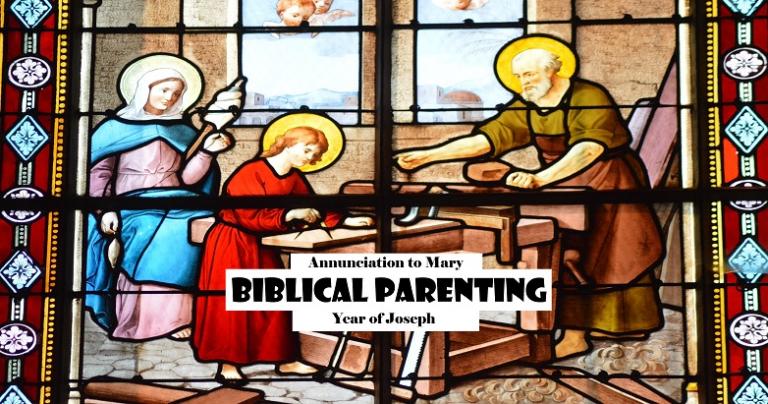
Parenting in the Bible? / Image by Dorothée QUENNESSON from Pixabay
This is a meditation on Biblical parenting and what it meant for Jesus, Mary, and Joseph.
Biblical parenting? Don’t look for parenting in the Bible. Why? Because the Mediterranean cultural world of Scripture really offers no “parents.” So there really is no biblical “parenting,” but instead culturally-specific “fathering” and “mothering.”
When you look at biblical examples of fathers and mothers, understand that their roles rarely ever touch. This is very different compared to American parenting.
Parenting? Or Fathering & Mothering?
The biblical father—that is, the Mediterranean father—dominates the family. His role isn’t parenting. Instead, he represents the family to the Outside World. Therefore, biblical fathers control everything relating the family to the Outside. This includes land and inheritance, jural relations, farm animals and tools, and postpubescent sons. Consequently, all this gets perceived as being utterly male by Mediterranean people.
In contrast, the Mediterranean biblical mother represents the family inwardly. Thus, everything inside the home is her purview and consequently, is utterly female. This includes the kitchen, non-jural relations, goats for milking and chickens, unwed daughters, resident daughters-in-law, and prepubescent boys. Like the Mediterranean father, her role isn’t parenting, but mothering, and often that means smothering.
See how so much religious artwork depicts Joseph emotionally close with Mary? Forget that stuff. It’s all ethnocentric to us and makes us 21st-century Westerners feel good. Such tender closeness and parenting hardly reflects the Mediterranean, Middle Eastern biblical world. The worlds of father and mother rarely, if ever, overlap. Consider that on this Solemnity of the Annunciation, in this Year of Joseph.
Biblical Parenting: The Strongest Emotional Bond
In the Mediterranean world of Scripture, no emotional bond is stronger than that between mother and son. By comparison, sibling bonds are also strong affective relations, even the only possible rival. But no affective bond comes close to the mother-son bond.
What produces this intense bond? Mediterranean childrearing. In the West, we might call it a codependent personality disorder. Even in the cultural world of the Bible, it is smothering.
Mutual need forges the attachment between Mediterranean mothers and sons. Wives in this cultural world receive value in their new home only by bearing sons. The biblical mother has no voice until she bears a son. And without a son, she has no “social security” for her old age. Therefore, she must control him his entire life. And she will spend her life manipulating and exerting her control over her firstborn son to these ends.
The biblical (Mediterranean) son also needs. Generally, adult males are absent for about the first twelve years of life. Then, at puberty, the son is dragged into the male world kicking and screaming. This happens by way of a violent, abrupt transition. Hardly parenting, this transfer is a cruel metamorphosis whereby boys “become men” in the Mediterranean sense. So biblical sons ever need a nurturing and caring mother, an echo of Paradise lost.
Gender-ambiguity & Biblical Parenting
What distinguishes Mediterranean biblical males? According to Bruce Malina, it is gender-identity ambivalence. You can see this in how Mediterranean males abhor vehemently and disavow anything “feminine.” Thus, Malina explains, the biblical male grows up constantly defending against any female identifications. This is lived out via Mediterranean honor-shame polarities and prohibitions specific to biblical Israel.
Don’t raise your postpubescent sons according to “the biblical way,” folks. Not unless you desire psychopathology and prison time. Severe physical discipline is the key to biblical fathering of sons. Look at the prescriptions here—
Proverbs 23:13 Do not withhold discipline from [male] youths; if you beat them with the rod, they will not die.
Proverbs 13:24 He who spares the rod hates his son, but he who loves him is diligent to discipline him.
(See also Proverbs 10:17; 12:1; 13:1; 15:5; 17:10; 19:18; 19:29; 22:15; 26:3; 29:15, 17; Sirach 7:23; 30:1, 12-13).
Does that look like good parenting advice? Biblical raising of sons isn’t parenting. It is a violent process, and with raising Jesus, how could it have been any different?
Biblical Parenting: From Mother to Father
The prepubescent Mediterranean son identifies with the only “parent” he knows, the nurturing mother doting on him, pampering him, giving him every possible comfort and pleasure. Then comes a violent switch at his puberty. Now the Israelite boy must abandon the paradisiac Garden of Eden for the brutal world of Mediterranean males. In other words, he must cease gender-identifying with mother and sisters and now gender-identify with father.
But there is a severe impediment to this dis-identification/counter-identification process. What available fathers, male surrogates, or discriminate male objects has the Mediterranean boy known throughout his early life by which to model for him? They have been almost entirely absent. Consequently, this impedes his transformation.
“But I saw in a Jesus-movie that…” or, “Sister at CCD class told us that Joseph was…” or, “EWTN said…” yeah, forget about that kitschy, culturally-implausible, feel-good nonsense. You want to love Jesus? Then get to know Jesus. That demands understanding him and his project in culturally plausible ways.
Biblical Parenting: Jesus Around 12 Years
Consider Jesus the tween, just hitting puberty. Unless we imagine Joseph as an American daddy like our ethnocentric Sunday school art does, he would have been quite remote to Jesus. What would have been the impact of this remoteness?
As Malina explains, like all Mediterranean males, the prepubescent Jesus would have been confined his entire life to a female-dominated space. All this time, he had no accessible male role model—again, forget about the kitsch artwork and the Jesus-movie nonsense! Suddenly, Jesus hits puberty. Now he must switch gears into a new gender-identification, one alien and unknown to him.
How do you think this hit Jesus emotionally? Recall the symbiosis shared between Mediterranean mothers and sons. At home, how could Jesus not perceive his mother Mary as the one wholly in charge of the entire universe? After all, didn’t she control the Inside? Didn’t she handle all the financial resources of the family? In other words, the Mediterranean household was father-ineffective. Ultimately, wasn’t Mary, like all Middle Eastern women, the intelligentsia of the village?
Trauma for the Mediterranean Male Jesus
Given all of these structural features, how could Jesus, at the moment of his puberty, identify with male gender identity? All he knew were his mother and the other village women. Forget Kal-El from Planet Krypton—Jesus is human. Precisely because he is divine, Jesus is more human, not less! So drop the Docetism.
How complicated this becomes when considering how Jesus and Mary were likely viewed by other villagers. Given his dubious origins, many thought Jesus was a bastard.
How traumatic would it have been for Jesus to be literally dragged into the world of Mediterranean men? Remember, these were not Jews. Therefore, there was no bar mitzvah ceremony for Jesus, no gradual preparation to enter the male world via ritual and careful parenting. Forget ritual and symbolism for this transfer. Ultimately, Jesus didn’t get any of that, and neither would any other Mediterranean males in his time.
Parenting or Making Mediterranean Men
As Malina shows, like all males in his cultural world, Jesus left the feminine-Inside lacking all biological markers to signal manhood. And therefore, like all Mediterranean male individuals, he had to prove himself unquestionably male according to his ingroup expectations. Like all Mediterranean males, Jesus would have lived under the constant threat that others would mistake him for being feminine. Consequently, he was forced to forever prove this to be false.
In the Mediterranean cultural world, Malina recognizes something he calls “the cult of phallic potency.” He says it gets produced by the culturally-specific need to unrelentingly prove manliness. The penis, repository of Mediterranean manhood, must be honored—whether through winning arguments in public, demonstration of withstanding intense torments without complaining, or sexual triumphs dishonoring other males.
Hypermasculinity: The Result of Biblically Parenting Males
What do biblical mothering and fathering of sons produce? The result is Mediterranean hypermasculine syndrome. In that condition, the world is phallocentric (think the Vatican), and all things feminine are to be dreaded and avoided. Hence, masculinity—culturally perceived as that which defines what a human being really is—is continually endangered. Ultimately, Mediterranean males must forever be vigilant to defend their maleness.
There is always an aspect of fear accompanying Mediterranean hypermasculine syndrome. This is because the Mediterranean male can never forget or eliminate his female origins and identifications. Therefore, he becomes a living rejection and protest of all things mother-like, dependent, without penis, “not-the-female.”
Daddy Is Impossible Through Biblical Parenting
We need to get American ideas of daddy out of our heads when thinking about the biblical God or Joseph.
American Daddies, ideally, enjoy the home, actively parent, enthusiastically provide childcare, behave informally, and are emotionally and physically close with spouse and children.
In contrast, the Mediterranean biblical father would be seen as unmanly to stay too long at home. He, therefore, is not concerned with parenting daughters and prepubescent sons. He gives no childcare. He behaves formally and distantly with his spouse and children.
Spurious Familiarity and Holiness = Otherworldly
Once, the Context Group scholars gave a lengthy workshop on the Gospels’ cultural background at the Vatican to many Italian and Spanish Catholic religious instructors. After the presentations, many in the audience, Mediterraneans all, admitted familiarity with everything asserted by the scholars.
And yet they protested: “All you say is true, but it does not apply to Jesus, Mary, and Joseph, because they are holy.”
Their dismissal is living testimony to the enduring power of Marcion of Sinope, the most influential person in Church history.
Thinking about these realities is suitable for the Year of Joseph and the Solemnity of the Annunciation and especially in Holy Week. Claiming that this did not impact Jesus in any way is to not take the prefix “in” of “incarnation” seriously.
More to come, later.
Previous Post
March 25, 2021
Forty Days—The Biblical Significance
Next Post

March 28, 2021 Evolution of the Passion Story
Browse Our Archives
Select a Category Uncategorized
Select a Month August 2021 July 2021 June 2021 May 2021 April 2021 March 2021 February 2021 January 2021 December 2020 November 2020 October 2020 September 2020 August 2020 July 2020 June 2020 May 2020 April 2020 March 2020 February 2020 January 2020 December 2019 November 2019 October 2019 September 2019 August 2019
Follow Us!
TAKE THE
Religious Wisdom Quiz
True or False: Abraham was 100 years old when Isaac was born.
Select your answer to see how you score.
TRUE FALSE
Support this
Column


Related posts from Messy Inspirations

Understanding Apocalypse & Its Creatures



TRENDING AT PATHEOS Catholic

Rejecting Doom: Christian Hope And Human Action
Christianity is a religion of hope. We are to have hope and...

It’s What Comes From Within Which Matters
One of the most difficult things for us to understand is why...

Why I Choose the Eucharist Over the Sermon
Choose the Eucharist, Not the Sermon What are we supposed to get...

5 Design Elements Found in Spiritually Rooted Homes
Putting Spirituality Into Home Decor Our homes are more than our living...

Credo: A Story of God Told with the...
About 10 years ago, I began to imagine a personal "Credo" that...

The Anatomy of Divine Revelation in Catholic Thought
The claim that God has made Himself known to human beings is...
view all Catholic blogs
Ad-Free & Subscriber Log-In Subscription Support
- About Us
- 2026 Calendar
- Videos
- Podcasts
- Library of World Religions
- Faith In Media Tracker
- Advertise With Us
- Write for Us
- Privacy Policy
- Terms of Service
- Do Not Sell My Data
- Contact Us
- Radiant Digital
- Manage Newsletter Subscriptions
- Unsubscribe From Notifications
- Sitemap
Copyright 2008-2026, Patheos. All rights reserved.
Subscription Support Ad-Free & Subscriber Log-In
Follow Patheos