
BuddhistCatholicContemplativeEvangelicalGeneral ChristianHinduJewishLatter-day SaintMuslimNew VisionsProgressive Christian
Beliefs
- Buddhist
- Catholic
- Contemplative
- Evangelical
- General Christian
- Hindu
- Jewish
- Latter-day Saint
- More Voices
- Muslim
- New Visions
- Pagan
- Progressive Christian
Topics
- Religion News
- Food and Religion
- Sports and Religion
- Religious Art
- Religious Music and Entertainment
- Religious Events
- History and Religion
- Style and Religion
- Politics and Religion
- Women in Religion
- Recreation Outdoors and Religion
- Business Finance and Religion
- Careers Workplace and Religion
- Education and Religion
- Family Parenting and Religion
- Health Fitness and Religion
- Home and Religion
- Relationships and Religion
- Technology and Religion
- Travel and Religion
Columnists
- Buddhist Columnists
- Business Finance and Religion Columnists
- Careers Workplace and Religion Columnists
- Catholic Columnists
- Contemplative Columnists
- Education and Religion Columnists
- Evangelists Columnists
- Family Parenting and Religion Columnists
- General Christian Columnists
- Health Fitness and Religion Columnists
- Hindu Columnists
- History and Religion Columnists
- Home and Religion Columnists
- Jewish Columnists
- More Voices Columnists
- Latter Day Columnists
- Muslim Columnists
- New Visions Columnists
- Nonreligious Columnists
- Pagan Columnists
- Politics and Religion Columnists
- Progressive Columnists
- Recreation Outdoors and Religion Columnists
- Relationships and Religion Columnists
- Religion News Columnists
- Religious Art Columnists
- Religious Events Columnists
- Religious Music and Entertainment Columnists
- Sports and Religion Columnists
- Style and Religion Columnists
- Technology and Religion Columnists
- Travel and Religion Columnists
- Women in Religion Columnists
Resource Library
- 2026 Calendar
- Library of World Religions
- The 100 Most Holy Places on Earth
- Patheos Answers
- Podcasts
- Videos
- Faith Leaders Database
- Anglican Episcopalian
- Bahai
- Baptist
- Buddhism
- Christianity
- Confucianism
- Eastern Orthodoxy
- Hinduism
- Holiness and Pentecostal
- ISKCON
- Islam
- Judaism
- Lutheran
- Methodist
- The Church of Jesus Christ of Latter-day Saints
- New Age
- Paganism
- Presbytarian and Reformed
- Protestantism
- Religion Behind the Scenes
- Roman Catholic
- Scientology
- Shia Islam
- Sikhism
- Sufism
- Sunni Islam
- Taoism
- Zen
- See all religions
Research Tools
 Ad-Free & Subscriber Log-In Subscription Support
Ad-Free & Subscriber Log-In Subscription Support
Follow Patheos 

- Trending:
- Forgiveness
- |
- Marriage
- |
- Consciousness
- |
- Death Penalty
- |
- Election
- |
- Halloween
 Messy Inspirations
- Home
- Catholic
- No Jews or Christians in the Bible?
No Jews or Christians in the Bible?
Last updated on: March 21, 2021 at 8:25 pm by Fellow Dying Inmate
No Jews or Christians in the Bible? 2021-03-21T20:25:06-04:00 Fellow Dying Inmate
Patheos Explore the world's faith through different perspectives on religion and spirituality! Patheos has the views of the prevalent religions and spiritualities of the world.
No Jews or Christians in Scripture? / Fellow Dying Inmate, All Rights Reserved
What if there were no Jews or Christians to be found in the Scriptures?
Trick question: how many Jews and Christians are there in the Bible? Ask almost anyone, and they’ll tell you that the Scriptures are filled with both. But what if I told you the correct answer is zero? What if I told you there were no Jews or Christians in the Bible?
Before continuing with this blog post, let me explain by way of a video presentation here—
No Jews and Christians in Scripture
Recently, I blogged about why neither Jesus nor his earliest followers were Christians. Standing on Context Group scholar John Elliott’s shoulders, I explained why we really shouldn’t use the word “Christian” for anyone or anything earlier than about 300 CE.
But what should we call earlier believers, biblical authors, and biblical characters? What do we call people from the Old and New Testaments?
Abraham To Moses: No Jews, but Apiru
Imagine that we can time travel back to 1800 BCE in the Levant. This is the time of the Patriarchs: Abraham, Isaac, and Jacob. What do we call these people? Are they Jews?
No Jews in 180 BCE. No Israelites then, either. Many scholars believe that Abraham belonged to the nomadic people called, Apiru, or its variant spelling, “Habiru.” Sound a lot like “Hebrew,” no?
Apiru means something like “dusty” or “dirty.” Some believe it meant “outsiders.” They were a wide configuration of wandering peoples. The Sumerians write about them as Aramaean nomads living and raiding southern Mesopotamia. They were a motley band of unrelated tribes, bandits, raiders, and social misfits. And like the poor outsiders of every age, the Apiru were considered a threat and dealt with mercilessly.
So what were Father Abraham and his many sons? Probably Apiru (Genesis 14:13). By this time, there are no Jews.
This continues through 1400 BCE and the time of Moses the Apiru. For the Patriarchs and Moses, there are so many layers to the history added by later peoples. So many re-contextualizations also! The stories are remembered in new contexts, and memories get updated. New peoples paint on coats of new meanings. The Bible offers us no photos, only paintings, and sketchy drawings.
David’s Days: Israelites, but No Jews
The Magen David is a symbol adopted almost universally by Jews in the 19th century. It has become a symbol synonymous with Jews. You can see it on the flag of the State of Israel. But King David wasn’t Jewish, nor was this image really his shield or star. We see no record of it before the 11th-century. Indeed, there were no Jews in David’s time.
Who were the tribal people united briefly under the short-lived Davidic and Solomonic kingdoms? What should we call them and their descendants living in divided kingdoms between 950—587 BCE? These are the descendants of once terribly poor Canaanite peoples, former rejects now called “Israelites.” Despite the mythic genealogical lists (toledoth) in Genesis saying otherwise, Israelites were ethnic Canaanites—probably the poorest, most rejected of the bunch, initially.
With ancestry bound to Canaan, they never had been to Egypt. But somehow, legends of Apiru there and their struggles would, one day, be incorporated into their own story as “Hebrew” and “Israelite” became re-contextualized.
Babylonian Exile: Israelites, but No Jews
The history of ancient Israel is marked by several significant and irreversible changes stemming from major social alterations. At the end of this time, Israelites experienced radical geographical change and displacement. Assyrian and Babylonian conquerors expelled or forced the Israelites into one-way emigration. These foreign kings forcibly resettled other peoples into Israelite lands, one-way immigration. None of these had much hope of returning home.
All this upheaval occasioned the so-called Diaspora. But still, we see no Jews.
Persian Rule: Judaeans at Yahud, but No Jews
What do we call people living in the Land of Israel from 520 BCE until 70 CE? Under the rule of and cultural influence of Persia, here we find the Judaeans. Folks, the proper translation of the Hebrew יְהוּדִים (Yehudim), and the Greek Ἰουδαῖοι (Ioudaioi), is Judaeans. Judeans or “Yahud-people” were all those who lived or originated in what became the Persian colony of Yahud, under Persian cultural influence and rule, around 500 BCE.
Who were these Yahud-people? Cyrus the Great (d. 530 BCE), the emperor to Persia, was the only person named “Messiah” in the Hebrew Scriptures (Isaiah 45:1)—a Persian! He established many colonies. In 537 BCE, Cyrus ordered the establishment of the Persian colony Yahud. He settled it with a group of mixed peoples, the people of Yahud. His scribes were authorized to scour the libraries of the region and compile a story for these people.
This is where the Judaeans originate. Do you see that ancient Apiru (ca. 1800 BCE) are not identical with later Israelites before and after David (ca. 1000—587 BCE)? And do you understand that Israelites living in the southern kingdom in or around Jerusalem are not identical with later Yahud-people and their children, the Judaeans (520 BCE—70 CE)? The connections between the gaps are mythic.
And still, there are no Jews. There are no Jews to be found in either the Old or New Testaments. By New Testament times, Yahud had become Judea. And the Greek Ioudaioi translated the Hebrew Yehudim. Both words translate correctly into Judaeans and not Jews. Everywhere in your English Bible, whenever you see “Jews,” scratch it out and write “Judaeans.” This is especially true in the Gospel called “John,” misused perennially to slander and damn Jews for the death of Jesus.
Persian-Authorized Pentateuch
All of the earlier stories about the Apiru, like Abraham and Moses, got re-contextualized by Persian authorized scribes in the fifth-century BCE. When Cyrus established Yahud, he ordered scribes to scour the region’s libraries to create a story for these new people. They took older Israelite works, like the Deuteronomistic Story (Deuteronomy, Joshua, Judges, 1—2 Samuel, 1—2 Kings). They edited them, anchoring them onto new material (Genesis, Exodus, Leviticus, Numbers).
During the Persian period, the third-generation of Yahud-people were proud of their Persian origins. They held fast to their adopted Persian customs. Esoteric language colored their writings. Angels and devils filled the universe, and the shatan tested loyalties. A new Parsi political-religious group formed, known in the New Testament as Pharisees. And the first, short-lived kiss of monotheism was introduced to these Judaeans.
By the way, this stuff never gets covered by folks like Scott Hahn, Jeff Cavins, or Robert Barron. These popular speakers present the Bible as one extensive linear timeline of events where everything fits seamlessly together. Clearly, that’s not reality.
New Testament: No Jews, No Christians
So what do we call Israelites living in New Testament times? Actually, “Israelites” is the best thing to call them. Outsiders to the Roman Province of Syro-Palestine might collectively label any native from Judaea, Galilee, Perea as Judaeans, or barbarian Israelites.
If you were an Israelite living in the land of Israel, you would distinguish Israelites regionally or geographically. In that case, you would consider someone to be Judaean if he or she lived in or around the area of Jerusalem. But if they lived around the Sea of Tiberias, you would call them Galileans. Finally, if they lived in the Eastern Transjordan, you would call them Pereans.
But no one would call them Christians or Jews. Why? Because there were no Jews or Christians back then. While you would find Pharisees, Sadducees, Messianists, Essenes, and other sects, you wouldn’t find Jews or Christians. Contrary to widespread bad English translations of the Bible and spurious belief, Christians and Jews come centuries after Jesus.
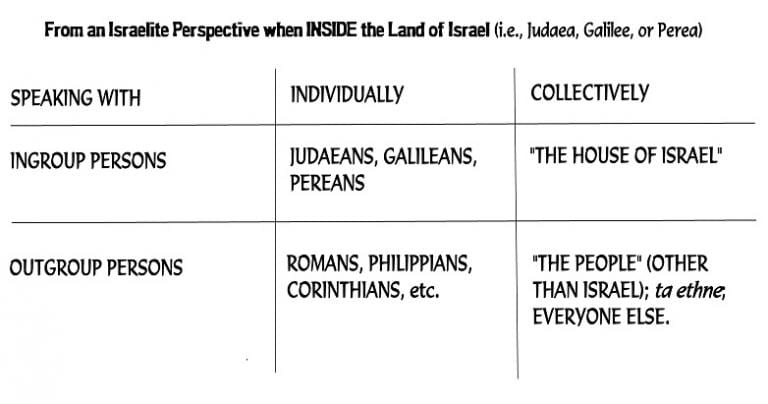
Israelite Insider Perspective: No Jews, No Christians
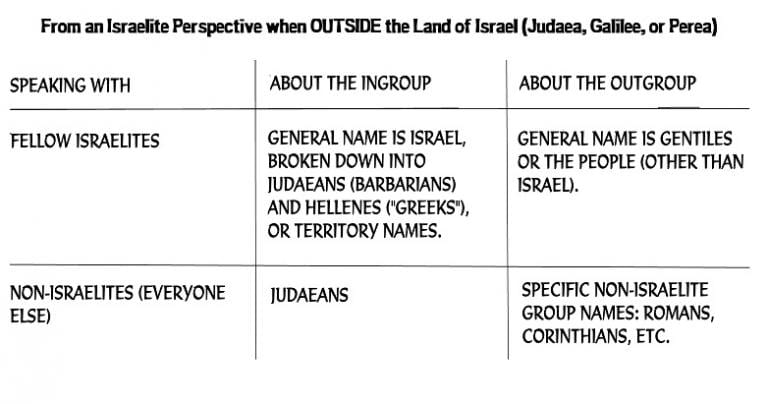
Israelite Outsider Perspective: No Jews, No Christians
So, Where Do Jews Originate?
The destruction of the Temple in 70 CE was a watershed event for Israelites. The Temple was the center of Israelite life. With it gone, everything had to be redefined and reshaped. Any Judaean groups that could not adapt? Extinction.
Two political-religious Israelite groups survived and transformed. After 70 CE, legendary Pharisee Yohanan ben Zakkai founded the Academy at Yavneh. Eventually, Rabbinic Scribalism sprang from this. And out of this and further developments came the Babylonian and Palestinian Talmuds.
The Judaism we know today, practiced by Jews, is rooted in Talmudic practices. There are no Jews before at least 500 CE. “Jew” is an English word simply inappropriate to describe anything before 500 CE. As we saw in a previous video, Christian is wrong to apply to anything before 325 CE. Jews and Christians are like sisters, not parents and children.
Therefore, following scholar John Pilch, at the end of the first century, Jesus groups may be seen as, “Israel awaiting the Theocracy proclaimed by Jesus.” And Ben Zakkaist groups were at this time, “Israel awaiting the restoration of the Temple.”
Mythic Links
Folks, don’t look for Ancestry.com “DNA-accurate” links and bridges in the Bible, okay? Memories get updated. They are reshaped and retold. Historically speaking, the Exodus story was created by Judaean scribes a thousand years later during the Persian period, modeled after their recent immigration from Persia. In other words, the relationship between Judaeans in Ezra and Nehemiah’s days and legendary Abraham the Apiru is mythic.
Understanding that helps us a great deal in recognizing how Jews and Christians relate to New Testament times and groups. Again, don’t look for Ancestry.com “DNA-accurate” Apostolic succession links. In the same way, don’t look for that between Jews and ancient Biblical peoples either.
No Jews & The Absurdity of Christian Anti-Semitic Horrors
The genocidal hatred Christians have perennially unleashed against Jews is both horrendously evil and stupid. The theological justifications used repeatedly to excuse pogroms and worse atrocities committed against Jews are absurd. No Jews existed in Jesus’ day, and not for centuries afterward. How then could they be blamed for rejecting him or putting him to death?
The same thing goes for theological justifications fundamentalist Christians use for racist Zionism and its genocidal actions against Palestinians.
Next time, as promised, we will explore the “Jewishness” of Jesus.
Previous Post

March 19, 2021
Joseph-Test: How Well Do You Know Him?
Next Post
March 25, 2021 Forty Days—The Biblical Significance
Browse Our Archives
Select a Category Uncategorized
Select a Month August 2021 July 2021 June 2021 May 2021 April 2021 March 2021 February 2021 January 2021 December 2020 November 2020 October 2020 September 2020 August 2020 July 2020 June 2020 May 2020 April 2020 March 2020 February 2020 January 2020 December 2019 November 2019 October 2019 September 2019 August 2019
Follow Us!
TAKE THE
Religious Wisdom Quiz
Blessed are the pure in heart, the peacemakers, and the meek. Where was this sermon delivered?
Select your answer to see how you score.
By the sea In a synagogue On a mountain In the temple
Support this
Column


Related posts from Messy Inspirations

Understanding Apocalypse & Its Creatures



TRENDING AT PATHEOS Catholic

Rejecting Doom: Christian Hope And Human Action
Christianity is a religion of hope. We are to have hope and...

It’s What Comes From Within Which Matters
One of the most difficult things for us to understand is why...

Why I Choose the Eucharist Over the Sermon
Choose the Eucharist, Not the Sermon What are we supposed to get...

5 Design Elements Found in Spiritually Rooted Homes
Putting Spirituality Into Home Decor Our homes are more than our living...

Credo: A Story of God Told with the...
About 10 years ago, I began to imagine a personal "Credo" that...

The Anatomy of Divine Revelation in Catholic Thought
The claim that God has made Himself known to human beings is...
view all Catholic blogs
Ad-Free & Subscriber Log-In Subscription Support
- About Us
- 2026 Calendar
- Videos
- Podcasts
- Library of World Religions
- Faith In Media Tracker
- Advertise With Us
- Write for Us
- Privacy Policy
- Terms of Service
- Do Not Sell My Data
- Contact Us
- Radiant Digital
- Manage Newsletter Subscriptions
- Unsubscribe From Notifications
- Sitemap
Copyright 2008-2026, Patheos. All rights reserved.
Subscription Support Ad-Free & Subscriber Log-In
Follow Patheos