
BuddhistCatholicContemplativeEvangelicalGeneral ChristianHinduJewishLatter-day SaintMuslimNew VisionsProgressive Christian
Beliefs
- Buddhist
- Catholic
- Contemplative
- Evangelical
- General Christian
- Hindu
- Jewish
- Latter-day Saint
- More Voices
- Muslim
- New Visions
- Pagan
- Progressive Christian
Topics
- Religion News
- Food and Religion
- Sports and Religion
- Religious Art
- Religious Music and Entertainment
- Religious Events
- History and Religion
- Style and Religion
- Politics and Religion
- Women in Religion
- Recreation Outdoors and Religion
- Business Finance and Religion
- Careers Workplace and Religion
- Education and Religion
- Family Parenting and Religion
- Health Fitness and Religion
- Home and Religion
- Relationships and Religion
- Technology and Religion
- Travel and Religion
Columnists
- Buddhist Columnists
- Business Finance and Religion Columnists
- Careers Workplace and Religion Columnists
- Catholic Columnists
- Contemplative Columnists
- Education and Religion Columnists
- Evangelists Columnists
- Family Parenting and Religion Columnists
- General Christian Columnists
- Health Fitness and Religion Columnists
- Hindu Columnists
- History and Religion Columnists
- Home and Religion Columnists
- Jewish Columnists
- More Voices Columnists
- Latter Day Columnists
- Muslim Columnists
- New Visions Columnists
- Nonreligious Columnists
- Pagan Columnists
- Politics and Religion Columnists
- Progressive Columnists
- Recreation Outdoors and Religion Columnists
- Relationships and Religion Columnists
- Religion News Columnists
- Religious Art Columnists
- Religious Events Columnists
- Religious Music and Entertainment Columnists
- Sports and Religion Columnists
- Style and Religion Columnists
- Technology and Religion Columnists
- Travel and Religion Columnists
- Women in Religion Columnists
Resource Library
- 2026 Calendar
- Library of World Religions
- The 100 Most Holy Places on Earth
- Patheos Answers
- Podcasts
- Videos
- Faith Leaders Database
- Anglican Episcopalian
- Bahai
- Baptist
- Buddhism
- Christianity
- Confucianism
- Eastern Orthodoxy
- Hinduism
- Holiness and Pentecostal
- ISKCON
- Islam
- Judaism
- Lutheran
- Methodist
- The Church of Jesus Christ of Latter-day Saints
- New Age
- Paganism
- Presbytarian and Reformed
- Protestantism
- Religion Behind the Scenes
- Roman Catholic
- Scientology
- Shia Islam
- Sikhism
- Sufism
- Sunni Islam
- Taoism
- Zen
- See all religions
Research Tools
 Ad-Free & Subscriber Log-In Subscription Support
Ad-Free & Subscriber Log-In Subscription Support
Follow Patheos 

- Trending:
- Forgiveness
- |
- Marriage
- |
- Consciousness
- |
- Death Penalty
- |
- Election
- |
- Halloween
 Messy Inspirations
- Home
- Catholic
- Grapple with Jesus and Scripture, Before Lent Begins
Grapple with Jesus and Scripture, Before Lent Begins
Last updated on: February 15, 2021 at 5:27 pm by Fellow Dying Inmate
Grapple with Jesus and Scripture, Before Lent Begins 2021-02-15T17:27:32-04:00 Fellow Dying Inmate
Patheos Explore the world's faith through different perspectives on religion and spirituality! Patheos has the views of the prevalent religions and spiritualities of the world.
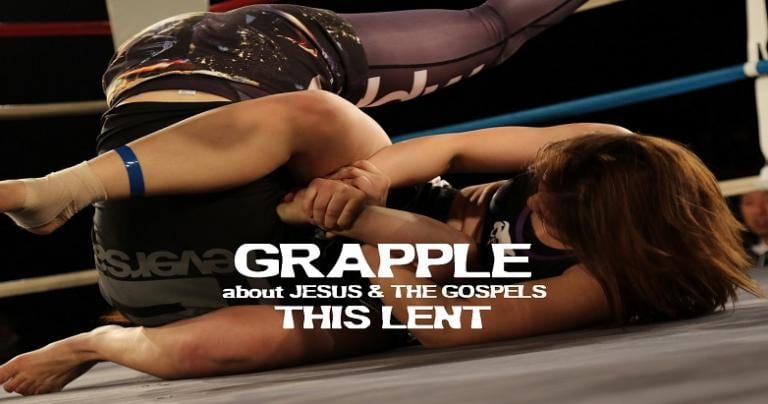
Grapple / Image by Mirko Zax from Pixabay
One way to prepare for Lent and Easter this year is to grapple with spurious familiarity concerning Jesus and the Gospels.
Before Lent begins, allow me to prayerfully and honestly grapple with you over sacred mysteries. Catholics are Christians. As such, we believe, of course, in the divinity of Christ. With Nicaea (325 CE) Chalcedon (451), we believe Jesus to be truly God and truly man (human? or “man,” because only “man” means a complete human?).
When we Catholics profess this credal proposition about Jesus, we don’t mean it in a mythical sense. Instead, we proclaim a historical and metaphysical truth about Jesus.
But verbal orthodoxy is not enough. In fact, verbal orthodoxy often hides an entire host of severe spiritual deformities and lived heresies. Psychological reaction formation by verbally professing Jesus as God-Incarnate is worthless if I live out a faith that screams Docetism, Pelagianism, racism, misogyny, warped anthropology, and/or rugged individualism. No, we must critically reflect, and we must grapple. This, too, is prayer.
Here is a great resource to help you grapple this Lent:
Grapple Over “I AM”
So here are some questions for all Christians to grapple over—
Must a Catholic accept any or all ego eimi (“I Am”) statements found in the Gospel of “John” as ipsissima verba Jesu (Latin for “the very words of Jesus himself”)? If so, why do a host of other exegetes and theologians in good standing with the Church claim otherwise? Some of these are priests, such as Fr. Roch Kereszty, Fr. Raymond Brown, Fr. John Meier, Fr. Francis Moloney, and many others.
Don’t be an ignoramus. We can’t fix many problems in our lives, but we can improve the ignorant part. Let us genuinely grapple with the fact that none of the Gospels are exact transcripts of Jesus’ spoken words.
Here is a playlist that dives deep into “John”:
Grapple with the Gospels
Here is another issue we ought to grapple with—should we treat the Gospels as 21st-century Western historiographical or biographical accounts? Were these documents factually-precise accounts of the life of Jesus? Sound biblical scholarship, recognized as being in good standing with the Church, says no. It has said no for decades.
In contrast, fundamentalist Catholic media insists that several magisterial statements affirm the unfailing historical accuracy of Scripture. These Catholics claim such teachings, reactionary to modernity, are infallible.
And yet more recent (and dare I say more exegetically-competent and informed) statements speak or suggest otherwise. Why is it that the loudest minority in the Church who are so hot and bothered about Teachings persist in complete ignorance of these later statements and teachings? Or if not ignorant, why do they downplay these post-Vatican II statements?
Grapple Over the Fourth Gospel
We must also grapple with “John.” Is the Gospel we call “John” a treatise of metaphysical statements about Jesus? Or instead (in its own antilanguage), is “John” speaking of the oneness shared by Jesus and the God of Israel in an intensely relational way? Indeed, both Arius and Athanasius used “John” as if it were presenting the former.
World-leading experts in Johannine literature, Francis Moloney and Raymond Brown, shed light on the matter. They claim that at Nicaea and afterward, “John” was employed beyond its scope and competence to answer questions it did not pose.
So grapple with my question—is “John” a metaphysical treatise on Jesus? Is it a catechism? If not, why do so many American Catholics parrot verses from it as if to prove later Christological doctrines? Whatever we are to make of “John,” Catholics are nevertheless committed to official Church teaching about who and what Jesus is. But not necessarily Mother Angelica’s, Scott Hahn’s, and Taylor Marshall’s oversimplified explanations of these Teachings.
Grapple with Gospel Evolution
Why does Dei Verbum n. 19, the Universal Catechism n 126, and the Pontifical Biblical Commission’s Instruction Concerning the Historical Truth of the Gospels nn. 6—9 maintain that the canonical Gospels all emerged through a developmental process? Indeed, they go further. They also express that this development happened in three distinct stages. Additionally, they explain that proper interpretation of these sacred documents depends on discernment of the material within and its relation to and situation within these evolutionary stages.
Additionally, they teach the good of basically understanding the scholarly, exegetical criteria without which it is impossible to see these stages. Therefore why do Catholic fundamentalists, like the ones I name above, completely ignore this? We need to grapple with this also.
Grapple with the Scandal of an Illiterate Jesus
Scholars inform us that only two percent of Herodian Palestine’s population was literate. Perhaps the percentage was higher, but not by much! The prepaschal Jesus was a Galilean peasant village artisan. But he didn’t want to starve to death, so, very often, he would be standing in village squares with the ergatai, or “day-laborers.” Picture him. Go ahead.
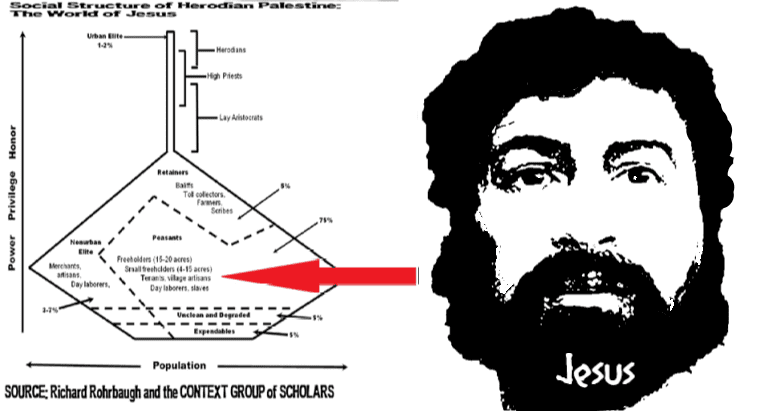
Grapple / Fellow Dying Inmate (with inspiration from Donato Giancarlo) / All rights reserved
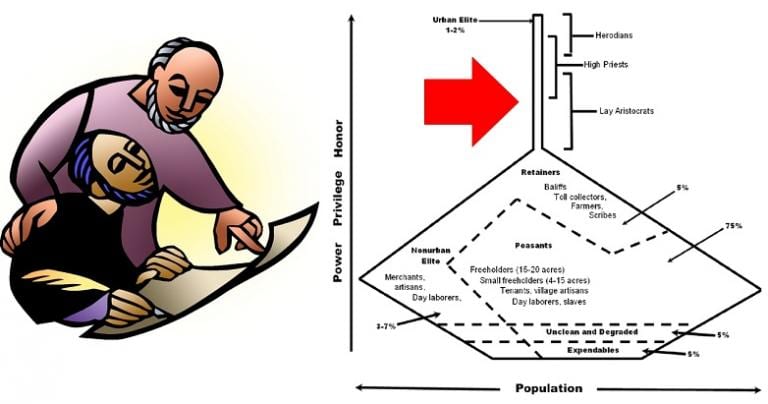
Grapple / Modified Clipart by Fellow Dying Inmate / KissClipart.com / Chart information from Dr. Richard Rohrbaugh
Now picture this. There were no schools in Nazareth and the Galilee. Hence, the historical Jesus would almost assuredly have been illiterate (at least by UNESCO standards). Like many illiterate Middle Easterners today who memorize the entire Quran through hearing it, Jesus would have learned Aramaic versions of the Torah and Isaiah probably.
Indeed, 2nd-century Jesus-group documents labor to explain away the embarrassing truth why Messiah Jesus could not read (I can provide examples). The anonymous evangelists we name “Mark,” “Matthew,” “Luke,” and “John” were all literate and would therefore come from a tiny percentage of the ancient Mediterranean. Astonishingly, it seems that between the Galilean Jesus in the 20s CE and the Markan Jesus-group in the 70s CE, an un-crossable social divide had been crossed!
Grapple with Mutating Language and Traditions
Whenever you move the language, you necessarily change the meaning. Whether it is words or sentences, language only means what it means where and when you use it. Because of this, wouldn’t this shift into the world of written language and literacy demand a re-contextualization of what Jesus said and did? Indeed, it would! And as the stories of Jesus spread, they would necessarily take on new contexts unknown and undreamed of in Jesus’ Galilean setting. What does this do to our developmental understanding of the gospels (see above)?
Grapple with Jesus the Folk Healer
Not everyone who teaches is a teacher. Therefore, would Galilean peasants really have seen the prepaschal Jesus (Stage One of Gospel Development) as a “teacher”? Or would they more readily recognize Jesus as a holy man, what today’s anthropologists might call a shamanic folk healer? When many called Jesus “teacher” in the Synoptic Gospels, were they acknowledging Jesus’ actual profession? Or instead, were they either honoring him or insulting him, mocking this peasant day-laborer?
Indeed, by “John” Stage Three of Gospel Development, the Johannine Jesus is presented as the Teacher and the definitive Revealer of God. There the Twelve and other followers are not so much apostles as they are lifelong disciples.
Why do you think that the idea of Jesus as an intellectual sage is so addictive to Western theologians, western exegetes, even atheists and agnostics who claim to admire the Jesus of history? Could it be that we in the West are committing identity theft on Jesus, calling “Jesus” our own idealized autobiography?
These are things to grapple with as we move into Lent, 2021.
What does the Church Teach about Jesus?
Previous Post

February 14, 2021
Wholeness and Healing Lepers
Next Post
February 17, 2021 Fasting—Why Did New Testament People Do It?
Browse Our Archives
Select a Category Uncategorized
Select a Month August 2021 July 2021 June 2021 May 2021 April 2021 March 2021 February 2021 January 2021 December 2020 November 2020 October 2020 September 2020 August 2020 July 2020 June 2020 May 2020 April 2020 March 2020 February 2020 January 2020 December 2019 November 2019 October 2019 September 2019 August 2019
Follow Us!
TAKE THE
Religious Wisdom Quiz
What does "Pentateuch" mean in Greek?
Select your answer to see how you score.
Five scrolls First law Book of peace Stories of heroes
Support this
Column


Related posts from Messy Inspirations

Understanding Apocalypse & Its Creatures



TRENDING AT PATHEOS Catholic

Rejecting Doom: Christian Hope And Human Action
Christianity is a religion of hope. We are to have hope and...

It’s What Comes From Within Which Matters
One of the most difficult things for us to understand is why...

Why I Choose the Eucharist Over the Sermon
Choose the Eucharist, Not the Sermon What are we supposed to get...

5 Design Elements Found in Spiritually Rooted Homes
Putting Spirituality Into Home Decor Our homes are more than our living...

Credo: A Story of God Told with the...
About 10 years ago, I began to imagine a personal "Credo" that...

The Anatomy of Divine Revelation in Catholic Thought
The claim that God has made Himself known to human beings is...
view all Catholic blogs
Ad-Free & Subscriber Log-In Subscription Support
- About Us
- 2026 Calendar
- Videos
- Podcasts
- Library of World Religions
- Faith In Media Tracker
- Advertise With Us
- Write for Us
- Privacy Policy
- Terms of Service
- Do Not Sell My Data
- Contact Us
- Radiant Digital
- Manage Newsletter Subscriptions
- Unsubscribe From Notifications
- Sitemap
Copyright 2008-2026, Patheos. All rights reserved.
Subscription Support Ad-Free & Subscriber Log-In
Follow Patheos