
BuddhistCatholicContemplativeEvangelicalGeneral ChristianHinduJewishLatter-day SaintMuslimNew VisionsProgressive Christian
Beliefs
- Buddhist
- Catholic
- Contemplative
- Evangelical
- General Christian
- Hindu
- Jewish
- Latter-day Saint
- More Voices
- Muslim
- New Visions
- Pagan
- Progressive Christian
Topics
- Religion News
- Food and Religion
- Sports and Religion
- Religious Art
- Religious Music and Entertainment
- Religious Events
- History and Religion
- Style and Religion
- Politics and Religion
- Women in Religion
- Recreation Outdoors and Religion
- Business Finance and Religion
- Careers Workplace and Religion
- Education and Religion
- Family Parenting and Religion
- Health Fitness and Religion
- Home and Religion
- Relationships and Religion
- Technology and Religion
- Travel and Religion
Columnists
- Buddhist Columnists
- Business Finance and Religion Columnists
- Careers Workplace and Religion Columnists
- Catholic Columnists
- Contemplative Columnists
- Education and Religion Columnists
- Evangelists Columnists
- Family Parenting and Religion Columnists
- General Christian Columnists
- Health Fitness and Religion Columnists
- Hindu Columnists
- History and Religion Columnists
- Home and Religion Columnists
- Jewish Columnists
- More Voices Columnists
- Latter Day Columnists
- Muslim Columnists
- New Visions Columnists
- Nonreligious Columnists
- Pagan Columnists
- Politics and Religion Columnists
- Progressive Columnists
- Recreation Outdoors and Religion Columnists
- Relationships and Religion Columnists
- Religion News Columnists
- Religious Art Columnists
- Religious Events Columnists
- Religious Music and Entertainment Columnists
- Sports and Religion Columnists
- Style and Religion Columnists
- Technology and Religion Columnists
- Travel and Religion Columnists
- Women in Religion Columnists
Resource Library
- 2026 Calendar
- Library of World Religions
- The 100 Most Holy Places on Earth
- Patheos Answers
- Podcasts
- Videos
- Faith Leaders Database
- Anglican Episcopalian
- Bahai
- Baptist
- Buddhism
- Christianity
- Confucianism
- Eastern Orthodoxy
- Hinduism
- Holiness and Pentecostal
- ISKCON
- Islam
- Judaism
- Lutheran
- Methodist
- The Church of Jesus Christ of Latter-day Saints
- New Age
- Paganism
- Presbytarian and Reformed
- Protestantism
- Religion Behind the Scenes
- Roman Catholic
- Scientology
- Shia Islam
- Sikhism
- Sufism
- Sunni Islam
- Taoism
- Zen
- See all religions
Research Tools
 Ad-Free & Subscriber Log-In Subscription Support
Ad-Free & Subscriber Log-In Subscription Support
Follow Patheos 

- Trending:
- Forgiveness
- |
- Marriage
- |
- Consciousness
- |
- Death Penalty
- |
- Election
- |
- Halloween
 Messy Inspirations
- Home
- Catholic
- Aloneness in Alternate Reality—the Transfiguration
Aloneness in Alternate Reality—the Transfiguration
Last updated on: February 28, 2021 at 4:36 pm by Fellow Dying Inmate
Aloneness in Alternate Reality—the Transfiguration 2021-02-28T16:36:32-04:00 Fellow Dying Inmate
Patheos Explore the world's faith through different perspectives on religion and spirituality! Patheos has the views of the prevalent religions and spiritualities of the world.
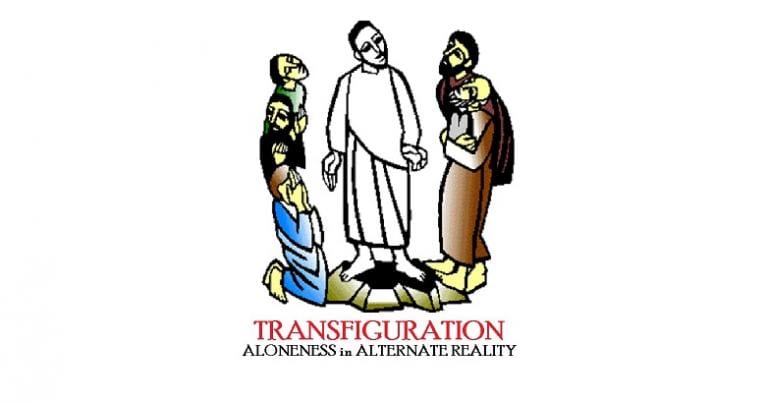
Aloneness in Alternate Reality / Modified Clipart by Fellow Dying Inmate / KissClipart.com
Aloneness or privacy in the Gospels, as in the Transfiguration story, means being with a group, even when in Alternate Reality.
This Sunday’s Gospel is the Markan version of the story of the Transfiguration of Jesus (Mark 9:2-10//Matthew 17:1-9//Luke 9:28-36). Jesus experiences Mediterranean-style aloneness and goes into Alternate Reality with three of his closest followers, Peter, James, and John. They go up a high mountain, indicating Jesus’ desire for aloneness in prayer. But what is aloneness to Jesus?
What Aloneness Means
We American Bible readers are individualists. We come from the most individualistic society ever. When we read about Jesus, a Mediterranean, being alone or praying privately, we often do so with spurious familiarity. We have the wrong ideas, and ultimately, we misunderstand what we are reading.
American aloneness and privacy are very different from Mediterranean aloneness and privacy. Never forget that Jesus and the Gospel writers were Mediterranean people. They weren’t Americans! Hence, they didn’t perceive, understand, or communicate as Americans do.
Think about all the times in the Gospels Jesus goes off “alone.” How do you picture that? Suppose you imagine him in isolation, far removed from all other human beings (like paintings and movies often depict). In that case, you have the wrong picture in mind. Jesus is rarely “alone” in the American sense of aloneness.
Instead, when Jesus goes off “to be alone” in the Gospels, invariably, he is alone with a group. Or perhaps a crowd is within shouting distance. Don’t trust your devotional paintings of Jesus being physically isolated from all other human beings (Mark 4:10; Luke 9:18).
What Is Biblical Aloneness?
Biblical people—Mediterranean people—are group-centered personalities, sharing a group-self and a group-conscience. When “self” means “group-self,” privacy and aloneness can’t be American-style. Instead, biblical privacy or aloneness means you are with your inner circle or family.
What makes privacy or aloneness in the biblical sense? It means that you are apart from the general public, but not from all others! To be separated from all others would be worse than death for the Mediterranean! At least when the Mediterranean died, they got buried with their ancestors!
Therefore, Jesus being in privacy or “alone” can mean he’s with three other Israelites, or maybe even twelve of them. That is what privacy and aloneness means in the biblical sense (Mark 4:34; 7:33; 9:28; 13:3; Luke 10:23; 12:3).
Only very rarely does the Bible imply anything like privacy or aloneness in the American sense (Matthew 18:15). But in these rare cases, is it really total absence from all others (Galatians 2:2)? Ultimately, almost always in the Bible, being alone means being with a group.
American Aloneness Is Different
In the days of Jesus, Israelites, like all other Mediterraneans, dealt with others in group-oriented ways. Whereas Americans value privacy and being alone as in apart from others, first-century Israelites not so much. Our social boundaries are not theirs. Israelites and other Mediterraneans would drop in unannounced on their friends whenever they wished.
Whereas Americans are unwilling to intrude on others’ private lives or have their own private lives invaded likewise, not so for our Mediterranean ancestors in faith. For them, it was 180 degrees reversed. They were unwilling to leave other peoples’ business alone or lock away their own affairs from all other people.
It’s not that privacy as a concept was utterly foreign to biblical people, but that it was just confined to the innermost circle. That’s what is going on in this “private” scene of the Transfiguration in this Sunday’s Gospel.
The Transfiguration
But why would Jesus seek to be alone with Peter, James, and John? The “transfiguration” is featured in all three Synoptic Gospels (Mark 9:2-10//Matthew 17:1-9//Luke 9:28-36) and is found right in the middle of the first narrative Gospel, “Mark.” Through it, “Mark” informs his audience that Jesus and his three followers experience a theophany, a manifestation of God’s presence in a vision. This is what anthropologists and researchers in cognitive neuroscience term an altered state-of-consciousness (ASC) experience.
But why? What is the reason behind this ASC experience? From Genesis to Revelation, God uses ASCs as God’s preferred means of communication with human beings. Continually, God discloses or reveals God’s self through the ASC experience. Through it, recipients are transformed, commissioned into a new role and status.
Both the Baptism of Jesus and the Transfiguration were ASC experiences where issues were clarified. At his baptism, God authorizes Jesus to proclaim Israelite Theocracy (“Kingdom of God”) and perform mighty deeds (Mark 1:15—8:30). Likewise, the Transfiguration is an ASC authorizing Jesus to go to Jerusalem and fulfill his destiny (Mark 8:31—16:8).
Insights on the Transfiguration
Context Group scholar John Pilch offers tremendous insight. He informs us that ASC experiences play a crucial role in both the ancient and contemporary Mediterranean world. People use them to solve crises and worries. And they induce them without necessarily smoking, injecting, drinking, or eating anything. Indeed, this is a usual human practice and experience for most cultures worldwide.
But what would worry Jesus and his followers? Jesus and others believed God was calling them to this work, but many times Israelites violently rejected them. They—Jesus and his followers—needed reassurance.
Remember, Jesus was a group-centered personality. So also the disciples. They, therefore, looked to the group for their identity. They were not introspective Americans. Thus, they did not look inward, with an individualistic and psychological sense of “self.” In fact, they were anti-introspective.
Jesus Needed the Transfiguration
Recall that life wasn’t pretty for a Galilean peasant artisan who abandoned his expected village existence to a Holy Man folk healer. People reacted violently to Jesus and his followers, or any Israelite they perceived as behaving socially out of bounds, regularly and routinely. @$$whippings take their toll—was God really calling them to this work? Or were they deceived by other sky-powers? God needed to reassure Jesus’ followers—and Jesus also!—of their mission and his.
Not counting healings, angelic appearances, or dreams, the Synoptic Gospels list five main ASC experiences Jesus experienced with others—
- The Baptism of Jesus (Mark 1:9-11//Matthew 3:13-17//Luke 3:21-22).
- The Testing of Jesus (or temptation story) (Mark 1:12-13//Matthew 4:1-11//Luke 4:1-13).
- Walking on the Sea (Mark 6:45-52//Matthew 14:22-33//John 6:16-21).
- Transfiguration (Mark 9:2-10//Matthew 17:1-9//Luke 9:28-36).
- And the various Resurrection Appearances.
More later…
Aloneness in Alternate Reality—the Transfiguration
altered states of consciousness
Alternate States of Consciousness
Mediterranean cultural context
Previous Post

February 25, 2021
Is “The Chosen” Realistic to the World of Jesus?
Next Post

March 5, 2021 Films Helpful for Understanding the Bible
Browse Our Archives
Select a Category Uncategorized
Select a Month August 2021 July 2021 June 2021 May 2021 April 2021 March 2021 February 2021 January 2021 December 2020 November 2020 October 2020 September 2020 August 2020 July 2020 June 2020 May 2020 April 2020 March 2020 February 2020 January 2020 December 2019 November 2019 October 2019 September 2019 August 2019
Follow Us!
TAKE THE
Religious Wisdom Quiz
In which miracle did Jesus provide wine at a wedding?
Select your answer to see how you score.
Healing a centurion's servant Walking on water Turning water into wine at Cana Feeding 4000
Support this
Column


Related posts from Messy Inspirations

Understanding Apocalypse & Its Creatures



TRENDING AT PATHEOS Catholic

Rejecting Doom: Christian Hope And Human Action
Christianity is a religion of hope. We are to have hope and...

It’s What Comes From Within Which Matters
One of the most difficult things for us to understand is why...

Why I Choose the Eucharist Over the Sermon
Choose the Eucharist, Not the Sermon What are we supposed to get...

5 Design Elements Found in Spiritually Rooted Homes
Putting Spirituality Into Home Decor Our homes are more than our living...

Credo: A Story of God Told with the...
About 10 years ago, I began to imagine a personal "Credo" that...

The Anatomy of Divine Revelation in Catholic Thought
The claim that God has made Himself known to human beings is...
view all Catholic blogs
Ad-Free & Subscriber Log-In Subscription Support
- About Us
- 2026 Calendar
- Videos
- Podcasts
- Library of World Religions
- Faith In Media Tracker
- Advertise With Us
- Write for Us
- Privacy Policy
- Terms of Service
- Do Not Sell My Data
- Contact Us
- Radiant Digital
- Manage Newsletter Subscriptions
- Unsubscribe From Notifications
- Sitemap
Copyright 2008-2026, Patheos. All rights reserved.
Subscription Support Ad-Free & Subscriber Log-In
Follow Patheos