
BuddhistCatholicContemplativeEvangelicalGeneral ChristianHinduJewishLatter-day SaintMuslimNew VisionsProgressive Christian
Beliefs
- Buddhist
- Catholic
- Contemplative
- Evangelical
- General Christian
- Hindu
- Jewish
- Latter-day Saint
- More Voices
- Muslim
- New Visions
- Pagan
- Progressive Christian
Topics
- Religion News
- Food and Religion
- Sports and Religion
- Religious Art
- Religious Music and Entertainment
- Religious Events
- History and Religion
- Style and Religion
- Politics and Religion
- Women in Religion
- Recreation Outdoors and Religion
- Business Finance and Religion
- Careers Workplace and Religion
- Education and Religion
- Family Parenting and Religion
- Health Fitness and Religion
- Home and Religion
- Relationships and Religion
- Technology and Religion
- Travel and Religion
Columnists
- Buddhist Columnists
- Business Finance and Religion Columnists
- Careers Workplace and Religion Columnists
- Catholic Columnists
- Contemplative Columnists
- Education and Religion Columnists
- Evangelists Columnists
- Family Parenting and Religion Columnists
- General Christian Columnists
- Health Fitness and Religion Columnists
- Hindu Columnists
- History and Religion Columnists
- Home and Religion Columnists
- Jewish Columnists
- More Voices Columnists
- Latter Day Columnists
- Muslim Columnists
- New Visions Columnists
- Nonreligious Columnists
- Pagan Columnists
- Politics and Religion Columnists
- Progressive Columnists
- Recreation Outdoors and Religion Columnists
- Relationships and Religion Columnists
- Religion News Columnists
- Religious Art Columnists
- Religious Events Columnists
- Religious Music and Entertainment Columnists
- Sports and Religion Columnists
- Style and Religion Columnists
- Technology and Religion Columnists
- Travel and Religion Columnists
- Women in Religion Columnists
Resource Library
- 2026 Calendar
- Library of World Religions
- The 100 Most Holy Places on Earth
- Patheos Answers
- Podcasts
- Videos
- Faith Leaders Database
- Anglican Episcopalian
- Bahai
- Baptist
- Buddhism
- Christianity
- Confucianism
- Eastern Orthodoxy
- Hinduism
- Holiness and Pentecostal
- ISKCON
- Islam
- Judaism
- Lutheran
- Methodist
- The Church of Jesus Christ of Latter-day Saints
- New Age
- Paganism
- Presbytarian and Reformed
- Protestantism
- Religion Behind the Scenes
- Roman Catholic
- Scientology
- Shia Islam
- Sikhism
- Sufism
- Sunni Islam
- Taoism
- Zen
- See all religions
Research Tools
 Ad-Free & Subscriber Log-In Subscription Support
Ad-Free & Subscriber Log-In Subscription Support
Follow Patheos 

- Trending:
- Forgiveness
- |
- Marriage
- |
- Consciousness
- |
- Death Penalty
- |
- Election
- |
- Halloween
 Messy Inspirations
- Home
- Catholic
- Strange Things in Sunday’s Gospel—John 1:35-42
Strange Things in Sunday’s Gospel—John 1:35-42
Last updated on: January 17, 2021 at 7:49 pm by Fellow Dying Inmate
Strange Things in Sunday’s Gospel—John 1:35-42 2021-01-17T19:49:56-04:00 Fellow Dying Inmate
Patheos Explore the world's faith through different perspectives on religion and spirituality! Patheos has the views of the prevalent religions and spiritualities of the world.
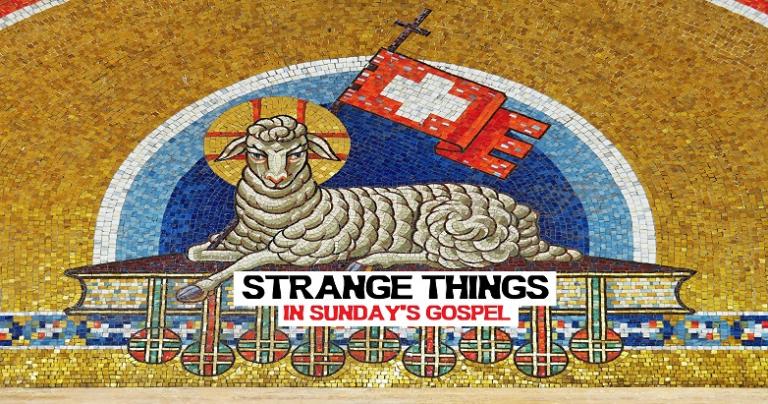
Strange Sunday Gospel / Image by AJ jaanko from Pixabay
Strange and peculiar things about evangelizing and more fill this Sunday’s Gospel of John 1:35-42.
This Sunday’s Gospel (John 1:35-42) comes from the Fourth Gospel—the Gospel from Outer Space we call “John.” Although he is the attributed author, the illiterate peasant fisherman John could not have written this Gospel. The canonical version of “John” we have is a fourth-wave Jesus-group document, evolved from an earlier version from third-wave times. But the historical Galilean John was a first-wave person—we spoke of these “waves” in the last post.
The community that produced this strange Gospel, along with its wild beliefs, brief lifespan, and peculiar characteristics, is fascinating. It is the only “antisociety” we know of among all the New Testament Jesus groups.
What is an antisociety? Namely, it is “a society that is set up within another society as a conscious alternative to it” (Michael Halliday’s “Language as Social Semiotic: The Social Interpretation of Language and Meaning,” p. 171).
Even though the Johannine community became an antisociety, it wasn’t always! Indeed, for a short while, it was quite similar to the other Jesus groups. And therefore, for a while at least, the Johannine Jesus group evangelized like the others. Today’s Gospel recalls that earlier time and showcases the missionary pattern later on abandoned by this peculiar Jesus group. Context Group scholar Fr. Jerome Neyrey explains it. Watch the video presentation here to see what I mean.
Unpacking the Strange “Lamb of God”
There is a lot to unpack in this Gospel reading. Here are a few items that prove tricky for 21st-century Christians to understand…
John 1:35-36 John was standing with two of his disciples, and as he watched Jesus walk by, he said, “Look!—the Lamb of God.”
This seems so strange! In the Fourth Gospel, John the Baptist identifies Jesus as a celestial person, a constellation called by Latin-speakers, Aries, the Cosmic Ram. Hence, the Baptizer calls Jesus the first of all cosmic beings, the first constellation in the zodiac, and the cosmic center and head. This is because ancient Mediterranean sky lore believed Aries to be these things. In Revelation, another John, the Seer, identifies this constellation directly as “the Lion of the tribe of Judah, the Root of David” (Revelation 5:5). In other words, this Cosmic Lamb was a celestial personage who many Jesus groups considered to be the Messiah of Israel.
This Cosmic Lamb is none other than the great sky avenger for Israelites called the “Son of Man” (John 1:50-51). So the author of the Fourth Gospel imagines Jesus as this divine Sky-Man come down from the sky-vault. Yes, New Testament people believed that the stars and constellations were alive and persons, albeit other-than-human persons. That’s pretty strange for American readers!
We are lightyears from the Galilean hamlet of Nazareth, folks. I told you that the Gospel called “John” is from Outer Space! But don’t be troubled by any of this, Catholics—Nicaea (325 CE) and Chalcedon (451) are still centuries after “John” was finalized (ca 100). “We’ve come a long way, baby!” So don’t expect our later-evolved creedal Trinitarian monotheism or orthodox Christology to be in Sunday’s Gospel. Only fundamentalists should go to pieces over this seemingly strange stuff.
For more about lambs, cosmic or otherwise, click on these video presentations below…
Unpacking the Strange Switch of Two Disciples
John 1:37 The two disciples heard what he said and followed Jesus.
Once the Baptist identifies Jesus as the Cosmic Lamb of God, two of his disciples leave him and begin to follow Jesus. Their rapid switch tells us they connected to John only loosely, on the periphery. Don’t miss the rivalry noted between the Baptist Group and the Jesus Group (John 4:1)!
Also, keep in mind that, according to the Fourth Gospel, the first followers of Jesus were Andrew and an unnamed disciple.
Unpacking Johannine Group-Attachment
John 1:38-39 Jesus turned and saw them following him and said to them, “What are you looking for?” They said to him, “Rabbi” — which translated means Teacher —, “where are you staying?” He said to them, “Come, and you will see.” So they went and saw where Jesus was staying, and they stayed with him that day. It was about four in the afternoon.
The Greek verb for stay or remain (meno) is used only twelve times in “Mark,” “Matthew,” and “Luke.” In contrast, the Fourth Gospel uses it a whopping 40 times! Why this seemingly strange difference?
It is because antisocieties like the Johannine Jesus group obsess over group-loyalty and deep group-attachment. Andrew and the Unnamed Disciple (it is Lazarus, but don’t tell anyone!) may have been only marginally loyal to the Baptist Group, but not to Jesus’ antisociety! They are fixed and glued in for good.
Unpacking Something Strange about Peter
John 1:40-42 Andrew, the brother of Simon Peter, was one of the two who heard John and followed Jesus. He first found his own brother Simon and told him, “We have found the Messiah” — which is translated Christ —. Then he brought him to Jesus. Jesus looked at him and said, “You are Simon the son of John; you will be called Kephas” — which is translated Peter.
Why Kephas with a “K” rather than Cephas with a C? Because it is more honest to the Greek phonetics. Ultimately, the NABRE and other translations are wrong to render Κηφᾶς (KEE-fuhs) into “Cephas” (SEE-fuhs).
Speaking of Peter, according to “John,” he is the third disciple in the Jesus group. This was because Andrew, the first to recognize Jesus being the messiah for Israel, recruited his brother Peter afterwards. The unnamed disciple, who went to Jesus with Andrew, was the second.
On the contrary, Catholics like thinking of Peter as being number one on the disciple list. Hence, this Johannine arrangement can seem strange.
The Fourth Gospel recalls that Jesus gave Simon Peter a nickname. This indicates he will be a core member of the Jesus group, with a powerful group-loyalty and permanent membership. Of course, later on, Peter will prove himself inferior to the Beloved Unnamed Disciple (it’s Lazarus!) in John 18:25-27. But he gets restored and established as the chosen shepherd after Jesus in the appended chapter 21.
Strange Disagreement
The Gospels were not fact-precise biographies of Jesus and friends, folks. According to the Synoptic Gospels, Jesus’ first followers were:
-
Simon Peter
-
Andrew
-
James, son of Zebedee
-
John, son of Zebedee
In contrast, “John” provides a different order:
-
Andrew
-
Unnamed Disciple (Lazarus!!)
-
Simon Peter/Kephas
-
Philip of Bethsaida
-
Nathanael of Cana
Strange Enthusiasm
Don’t treat the Gospels like a connect-the-dots to all Catholic beliefs and practices, folks. We should turn off Scott Hahn, Catholic Answers, and the EWTN Trump-train—these Catholic-fundamentalist outfits lead us from honest ignorance into sincere stupidity. Let’s stop proof-texting from the Gospels and drop expectations that they are historically factual and precise in every detail. Let’s instead read the Gospels as Church in context.
As today’s Gospel illustrates, the first followers of Jesus were enthusiastic about the Good News. How can we be honest with our New Testament ancestors and get passionate about our faith? One way is by rediscovering its first meaning by way of a culturally-informed, historically critical understanding of Jesus and antisocieties like the one that produced Sunday’s Gospel.
“Messy Inspirations” operates almost entirely on the generosity of readers. To tip the author, Fellow Dying Inmate, please visit the donation page. Thank you!
The Gospel for the Second Sunday of Ordinary Time
What is the Gospel of John about?
Who were the disciples of Jesus?
Who were the first disciples of Jesus?
Previous Post

January 15, 2021
Grandchildren Wrote the Gospels
Next Post

January 22, 2021 WandaVision: Perhaps the Deepest Marvel Yet
Browse Our Archives
Select a Category Uncategorized
Select a Month August 2021 July 2021 June 2021 May 2021 April 2021 March 2021 February 2021 January 2021 December 2020 November 2020 October 2020 September 2020 August 2020 July 2020 June 2020 May 2020 April 2020 March 2020 February 2020 January 2020 December 2019 November 2019 October 2019 September 2019 August 2019
Follow Us!
TAKE THE
Religious Wisdom Quiz
What does "Maranatha" mean?
Select your answer to see how you score.
Be joyful Praise Him Come, Lord It is finished
Support this
Column


Related posts from Messy Inspirations

Understanding Apocalypse & Its Creatures



TRENDING AT PATHEOS Catholic

Rejecting Doom: Christian Hope And Human Action
Christianity is a religion of hope. We are to have hope and...

It’s What Comes From Within Which Matters
One of the most difficult things for us to understand is why...

Why I Choose the Eucharist Over the Sermon
Choose the Eucharist, Not the Sermon What are we supposed to get...

5 Design Elements Found in Spiritually Rooted Homes
Putting Spirituality Into Home Decor Our homes are more than our living...

Credo: A Story of God Told with the...
About 10 years ago, I began to imagine a personal "Credo" that...

The Anatomy of Divine Revelation in Catholic Thought
The claim that God has made Himself known to human beings is...
view all Catholic blogs
Ad-Free & Subscriber Log-In Subscription Support
- About Us
- 2026 Calendar
- Videos
- Podcasts
- Library of World Religions
- Faith In Media Tracker
- Advertise With Us
- Write for Us
- Privacy Policy
- Terms of Service
- Do Not Sell My Data
- Contact Us
- Radiant Digital
- Manage Newsletter Subscriptions
- Unsubscribe From Notifications
- Sitemap
Copyright 2008-2026, Patheos. All rights reserved.
Subscription Support Ad-Free & Subscriber Log-In
Follow Patheos