
BuddhistCatholicContemplativeEvangelicalGeneral ChristianHinduJewishLatter-day SaintMuslimNew VisionsProgressive Christian
Beliefs
- Buddhist
- Catholic
- Contemplative
- Evangelical
- General Christian
- Hindu
- Jewish
- Latter-day Saint
- More Voices
- Muslim
- New Visions
- Pagan
- Progressive Christian
Topics
- Religion News
- Food and Religion
- Sports and Religion
- Religious Art
- Religious Music and Entertainment
- Religious Events
- History and Religion
- Style and Religion
- Politics and Religion
- Women in Religion
- Recreation Outdoors and Religion
- Business Finance and Religion
- Careers Workplace and Religion
- Education and Religion
- Family Parenting and Religion
- Health Fitness and Religion
- Home and Religion
- Relationships and Religion
- Technology and Religion
- Travel and Religion
Columnists
- Buddhist Columnists
- Business Finance and Religion Columnists
- Careers Workplace and Religion Columnists
- Catholic Columnists
- Contemplative Columnists
- Education and Religion Columnists
- Evangelists Columnists
- Family Parenting and Religion Columnists
- General Christian Columnists
- Health Fitness and Religion Columnists
- Hindu Columnists
- History and Religion Columnists
- Home and Religion Columnists
- Jewish Columnists
- More Voices Columnists
- Latter Day Columnists
- Muslim Columnists
- New Visions Columnists
- Nonreligious Columnists
- Pagan Columnists
- Politics and Religion Columnists
- Progressive Columnists
- Recreation Outdoors and Religion Columnists
- Relationships and Religion Columnists
- Religion News Columnists
- Religious Art Columnists
- Religious Events Columnists
- Religious Music and Entertainment Columnists
- Sports and Religion Columnists
- Style and Religion Columnists
- Technology and Religion Columnists
- Travel and Religion Columnists
- Women in Religion Columnists
Resource Library
- 2026 Calendar
- Library of World Religions
- The 100 Most Holy Places on Earth
- Patheos Answers
- Podcasts
- Videos
- Faith Leaders Database
- Anglican Episcopalian
- Bahai
- Baptist
- Buddhism
- Christianity
- Confucianism
- Eastern Orthodoxy
- Hinduism
- Holiness and Pentecostal
- ISKCON
- Islam
- Judaism
- Lutheran
- Methodist
- The Church of Jesus Christ of Latter-day Saints
- New Age
- Paganism
- Presbytarian and Reformed
- Protestantism
- Religion Behind the Scenes
- Roman Catholic
- Scientology
- Shia Islam
- Sikhism
- Sufism
- Sunni Islam
- Taoism
- Zen
- See all religions
Research Tools
 Ad-Free & Subscriber Log-In Subscription Support
Ad-Free & Subscriber Log-In Subscription Support
Follow Patheos 

- Trending:
- Forgiveness
- |
- Marriage
- |
- Consciousness
- |
- Death Penalty
- |
- Election
- |
- Halloween
 Messy Inspirations
- Home
- Catholic
- Grandchildren Wrote the Gospels
Grandchildren Wrote the Gospels
Last updated on: January 17, 2021 at 7:51 pm by Fellow Dying Inmate
Grandchildren Wrote the Gospels 2021-01-17T19:51:44-04:00 Fellow Dying Inmate
Patheos Explore the world's faith through different perspectives on religion and spirituality! Patheos has the views of the prevalent religions and spiritualities of the world.
Grandchildren Wrote the Gospels / Image by Free-Photos from Pixabay
History repeatedly shows a third-generation interest, which illuminates the origins of the Gospels as authored by grandchildren.
How do we know when the Gospels were composed, and why? One way comes from historian Marcus Hansen. He was the first scholar to articulate the principle of third-generation interest. What does that have anything to do with the Gospels, you ask? Here’s a video presentation explaining it—
Hansen Effect & Grandchildren
To understand the Gospels as third-generation or “grandchildren” documents, we need to date the New Testament Jesus groups’ sequence. But how? Consider this helpful method from Context Scholar Bruce Malina following the insights of Hansen.
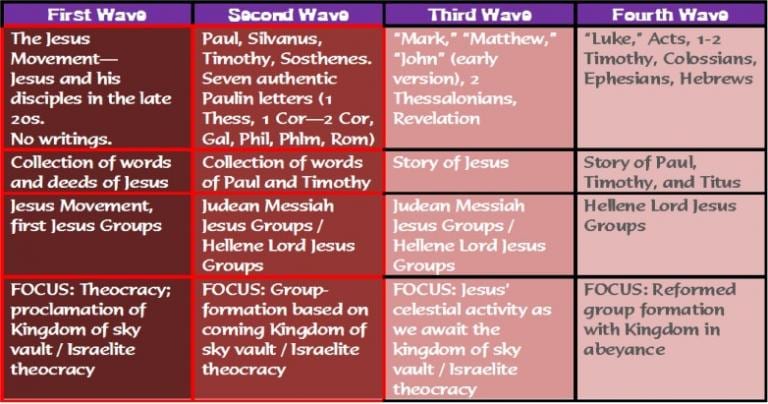
Jesus-Group Grandchildren / Image by Fellow Dying Inmate (with information by John Pilch) / All rights reserved
Look carefully at the graph on the screen. With it, one can see from where all New Testament documents originated and how each evolved. That third wave, the place of grandchildren, is where we find the earliest narrative Gospels.
First, approach this sequence in terms of waves of people rather than numbers. Therefore we’ll distinguish a “wave” by seeing new first century Israelites entering into a Jesus-group chain. Hence, we can see that “waves” means chains of people.
Grandparents, Parents, Grandchildren in the Waves
It is logical to start with Jesus. His wave would be the first, the “Jesus-Movement Wave.” It would include fellow Galilean peasants around him—Peter, the Twelve, their families, and followers. That is the first “generation” or “wave” one, the “grandparents” as far as New Testament evolution went.
Paul, his associates and coworkers, and his Mediterranean “Greek” Israelite clients mark off the second wave, the “parents.” Following the first wave, these people never experienced the prepaschal Jesus. They are not interested in the prepaschal Jesus’ sayings or actions, which is why Paul barely ever wrote any saying of Jesus. Paul is almost entirely silent concerning what Jesus said and did. Instead, Paul is utterly focused on the Risen Lord who commissioned him in Alternate Reality.
The grandchildren, the unknown, anonymous authors of the documents we call “Mark,” and later “Matthew,” first tell the Gospel-stories of Jesus. And yet they present no evidence of ever having known Jesus or Paul! They, therefore, indicate a third wave.
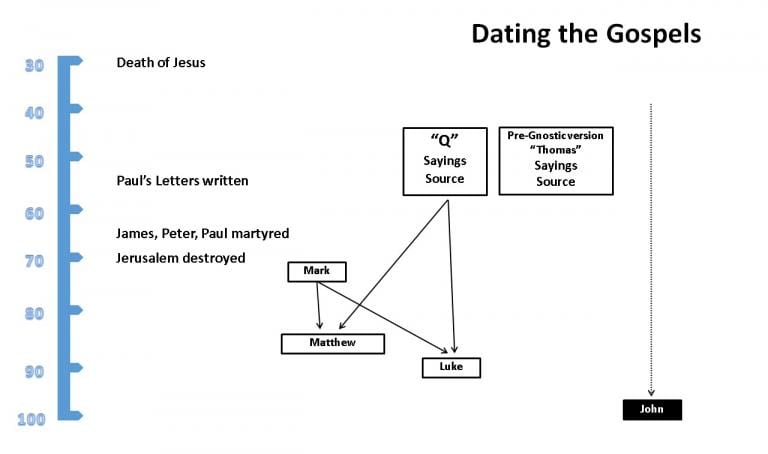
Grandchildren & Dating the Gospels / Fellow Dying Inmate / All rights reserved
Grandchildren & Great-Grandchildren
As the video presentation linked above explains, the Markan and Matthean interest in telling the story of Jesus—the prominent first wave person—indicates their third-generation activity. These documents reflect the interests of grandchildren.
Finally, we have a fourth wave—the anonymous author of “Luke-Acts” and the Pauline forger of the Pastorals show this. These were the great- grandchildren. “Luke” not only presents the story of Jesus but also paints pretty pictures of Paul, along with Barnabas, Silvanus, Timothy, and friends.
In fact, “Luke” tells us that he is a Fourth-Wave author (Luke 1:1-4)—
Inasmuch as many [third wave] have undertaken to compile a narrative of the things which have been accomplished among us, just as they were delivered to us [second wave] by those who from the beginning were eyewitnesses and ministers of the word [first wave], it seemed good to me [fourth wave] also, having followed all things closely for some time past, to write an orderly account for you, most excellent Theophilus, that you [fourth wave] may know the truth concerning the things of which you have been informed.
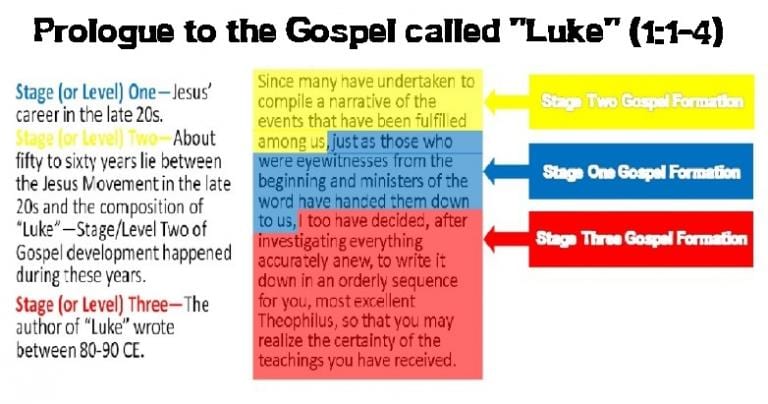
Great Grandchildren and Levels / Fellow Dying Inmate / All rights reserved
History & Third Generation Interest
Nearly ninety years ago, Hansen wrote:
“Anyone who has the courage to codify the laws of history must include what can be designated ‘the principle of third-generation interest.’ The principle is applicable in all fields of historical study. It explains the recurrence of movements that seemingly are dead; it is a factor that should be kept in mind, particularly in literary or cultural history; it makes it possible for the present to know something about the future. The theory is derived from the almost universal phenomenon that what the son wishes to forget, the grandson wishes to remember. The tendency might be illustrated by a hundred examples.”
Put simply, the “Hansen Effect” or principle of third-generation breaks down thus. Initially, a first-generation (e.g., Jesus and his faction) experiences significant, irreversible social change. For the Jesus Movement, the political calamity of Jesus’ crucifixion and the subsequent experience of him risen as Messiah, changed everything. Next, a second-generation arrives (Paul and his circle). They respond to this experienced change either by ignoring (or “forgetting”) much of the first-generation experience, which they find insufficient.
Then a third-generation (“Mark” and “Matthew”) attempts to salvage first-generation memories (their Gospels) and recover what the second generation (Paul) sought to forget.
Helpful for Gospels and Grandchildren
Hansen’s principle of third-generation interest—“*what the child wishes to forget the grandchild wishes to remember”—*helps explain many things in history, ancient as well as contemporary. For example, it sheds light on European immigrants’ experience in the United States around 1900, their children’s experience, and that of their grandchildren. Also, it illuminates generations of African Americans removed from slavery. One can also find help here in understanding the grandchildren of apartheid South Africa, the Holocaust, and Palestinians who have suffered since the criminal takeover by Zionist supremacists.
But the key to this blog post is that this principle showcases the evolution of the Gospels. With it, we can explain why “Mark” and “Matthew” wrote how they did. It was because they belong to the third-wave “third wave” of believers since the Jesus Movement. Additionally, we see why “Luke” composed “Luke-Acts” how he did. It was because he belonged to the fourth-wave out from Jesus, that is, the third generation of those affected by Paul and his circle.
Hence, grandchildren wrote the Gospels for, by, and about their third-generation interests.
More to come later.
“Messy Inspirations” operates almost entirely on the generosity of readers. To tip the author, Fellow Dying Inmate, please visit the donation page. Thank you
The principle of third generation interest
When were the Gospels written?
Why did Paul say nothing about what Jesus said or did?
Previous Post

January 12, 2021
Deaf to Jesus
Next Post

January 17, 2021 Strange Things in Sunday’s Gospel—John 1:35-42
Browse Our Archives
Select a Category Uncategorized
Select a Month August 2021 July 2021 June 2021 May 2021 April 2021 March 2021 February 2021 January 2021 December 2020 November 2020 October 2020 September 2020 August 2020 July 2020 June 2020 May 2020 April 2020 March 2020 February 2020 January 2020 December 2019 November 2019 October 2019 September 2019 August 2019
Follow Us!
TAKE THE
Religious Wisdom Quiz
What does "Maranatha" mean?
Select your answer to see how you score.
Be joyful Praise Him Come, Lord It is finished
Support this
Column


Related posts from Messy Inspirations

Understanding Apocalypse & Its Creatures



TRENDING AT PATHEOS Catholic

Rejecting Doom: Christian Hope And Human Action
Christianity is a religion of hope. We are to have hope and...

It’s What Comes From Within Which Matters
One of the most difficult things for us to understand is why...

Why I Choose the Eucharist Over the Sermon
Choose the Eucharist, Not the Sermon What are we supposed to get...

5 Design Elements Found in Spiritually Rooted Homes
Putting Spirituality Into Home Decor Our homes are more than our living...

Credo: A Story of God Told with the...
About 10 years ago, I began to imagine a personal "Credo" that...

The Anatomy of Divine Revelation in Catholic Thought
The claim that God has made Himself known to human beings is...
view all Catholic blogs
Ad-Free & Subscriber Log-In Subscription Support
- About Us
- 2026 Calendar
- Videos
- Podcasts
- Library of World Religions
- Faith In Media Tracker
- Advertise With Us
- Write for Us
- Privacy Policy
- Terms of Service
- Do Not Sell My Data
- Contact Us
- Radiant Digital
- Manage Newsletter Subscriptions
- Unsubscribe From Notifications
- Sitemap
Copyright 2008-2026, Patheos. All rights reserved.
Subscription Support Ad-Free & Subscriber Log-In
Follow Patheos