
BuddhistCatholicContemplativeEvangelicalGeneral ChristianHinduJewishLatter-day SaintMuslimNew VisionsProgressive Christian
Beliefs
- Buddhist
- Catholic
- Contemplative
- Evangelical
- General Christian
- Hindu
- Jewish
- Latter-day Saint
- More Voices
- Muslim
- New Visions
- Pagan
- Progressive Christian
Topics
- Religion News
- Food and Religion
- Sports and Religion
- Religious Art
- Religious Music and Entertainment
- Religious Events
- History and Religion
- Style and Religion
- Politics and Religion
- Women in Religion
- Recreation Outdoors and Religion
- Business Finance and Religion
- Careers Workplace and Religion
- Education and Religion
- Family Parenting and Religion
- Health Fitness and Religion
- Home and Religion
- Relationships and Religion
- Technology and Religion
- Travel and Religion
Columnists
- Buddhist Columnists
- Business Finance and Religion Columnists
- Careers Workplace and Religion Columnists
- Catholic Columnists
- Contemplative Columnists
- Education and Religion Columnists
- Evangelists Columnists
- Family Parenting and Religion Columnists
- General Christian Columnists
- Health Fitness and Religion Columnists
- Hindu Columnists
- History and Religion Columnists
- Home and Religion Columnists
- Jewish Columnists
- More Voices Columnists
- Latter Day Columnists
- Muslim Columnists
- New Visions Columnists
- Nonreligious Columnists
- Pagan Columnists
- Politics and Religion Columnists
- Progressive Columnists
- Recreation Outdoors and Religion Columnists
- Relationships and Religion Columnists
- Religion News Columnists
- Religious Art Columnists
- Religious Events Columnists
- Religious Music and Entertainment Columnists
- Sports and Religion Columnists
- Style and Religion Columnists
- Technology and Religion Columnists
- Travel and Religion Columnists
- Women in Religion Columnists
Resource Library
- 2026 Calendar
- Library of World Religions
- The 100 Most Holy Places on Earth
- Patheos Answers
- Podcasts
- Videos
- Faith Leaders Database
- Anglican Episcopalian
- Bahai
- Baptist
- Buddhism
- Christianity
- Confucianism
- Eastern Orthodoxy
- Hinduism
- Holiness and Pentecostal
- ISKCON
- Islam
- Judaism
- Lutheran
- Methodist
- The Church of Jesus Christ of Latter-day Saints
- New Age
- Paganism
- Presbytarian and Reformed
- Protestantism
- Religion Behind the Scenes
- Roman Catholic
- Scientology
- Shia Islam
- Sikhism
- Sufism
- Sunni Islam
- Taoism
- Zen
- See all religions
Research Tools
 Ad-Free & Subscriber Log-In Subscription Support
Ad-Free & Subscriber Log-In Subscription Support
Follow Patheos 

- Trending:
- Forgiveness
- |
- Marriage
- |
- Consciousness
- |
- Death Penalty
- |
- Election
- |
- Halloween
 Messy Inspirations
- Home
- Catholic
- Deaf to Jesus
Deaf to Jesus
Last updated on: January 13, 2021 at 12:19 pm by Fellow Dying Inmate
Deaf to Jesus 2021-01-13T12:19:14-04:00 Fellow Dying Inmate
Patheos Explore the world's faith through different perspectives on religion and spirituality! Patheos has the views of the prevalent religions and spiritualities of the world.
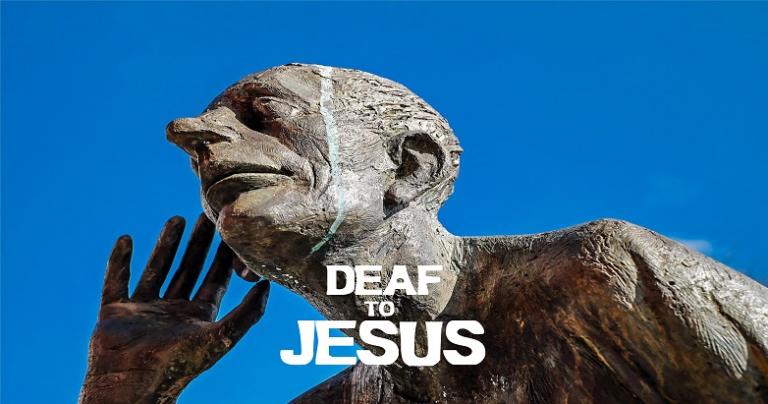
Deaf to Jesus/ Image by Couleur from Pixabay
Being culturally deaf to the Mediterranean hero Jesus makes following his edicts and commands a farce.
What good is a Christian who can’t listen to Jesus? But how can any 21st-century Western person listen to Christ if they dismiss or ignore his cultural background? If I am deaf by ignorance or rejection of Mediterranean culture being the first interpretation of the Bible and fail to read accordingly, I better forget about listening to Jesus.
For instance, how will I, culturally deaf, understand the metanoia Jesus preached? The first narrative-Gospel, “Mark,” opens with Jesus talking about theocracy and metanoia—
Mark 1:14-15 Jesus came into Galilee, preaching the gospel of God, and saying, “The time is fulfilled, and the kingdom of God is at hand; repent, and believe in the gospel.”
Matthew 4:17 Jesus began to preach, saying, “Repent, for the kingdom of sky-vault is at hand.”
Being Culturally Deaf to Jesus
As we covered in the last post, the historical Jesus was once a follower of John’s. The Jesus Movement began as a political-religious movement by proclaiming the same proclamation concerning Israelite theocracy John the Baptist announced (Matthew 3:2; 4:17).
“Matthew” therefore indicates that Jesus initially belonged to John’s coalition and that Jesus was instructed by John on how to be a shamanic holy man. Once John was imprisoned, Jesus began his own following, recruiting fellow Galilean peasants on the foundation of John’s prophetic proclamation.
Both the Baptist and Jesus command metanoia—putting on a new mind by changing attitudes and interpersonal behavior. This is often poorly translated by the culturally deaf as “repent.” By the way, did he tell us, 21st-century people, to do that? Maybe spiritually or sacramentally, but definitely not directly. Don’t be deaf to the context—Jesus tells that to his fellow Israelites. Why? To prepare them for an Israelite theocracy—“the kingdom of God.”
Deaf Eavesdroppers
That tells us something about Scripture-reading. We aren’t the primary audience. Sorry to all the deaf people on Facebook or Twitter who tag their page with a Scripture verse! If we 21st-century Western Christians are an audience in any way, we are so in an indirect, secondary sense. Therefore, all Scripture reading is like eavesdropping.
And the message we are listening to is given behind a Mediterranean olivewood door that’s two thousand years thick. That will be pretty garbled for us unless we care for how our foreign ancestors in the faith perceived, thought about, understood, and communicated reality. They weren’t Americans, folks!
If I didn’t think that Jesus’ words also, in a secondary and spiritual sense, had some meaning and relevance for us Christians today, I wouldn’t be blogging here. Really. Maybe it does! But let’s grapple and get the Literal Sense of it right first before spiritualizing his words away.
Arrogant Deafness
Skipping to the end of the Synoptic Gospels, what do we see the Risen Jesus command?
Matthew 28:19-20. “Go therefore and make disciples of all nations, baptizing them in the name of the Father and of the Son and of the Holy Spirit, teaching them to observe all that I have commanded you.”
Luke 24:46-47 “Thus it is written, that the Christ should suffer and on the third day rise from the dead, and that repentance and forgiveness of sins should be preached in his name to all nations.”
Question—what do “repent,” “believe in the gospel,” “make disciples,” “baptize,” “teach,” “observe all that Jesus has commanded us,” “preach the gospel,” “preach repentance,” and “preach forgiveness of sins” mean? To whom was he addressing these commands? How would we find the answers to these questions?
What is Jesus commanding in Matthew 28:19-20? Certainly not the imperial colonization of all continents and ethnic groups, coercing by force all peoples to abandon their cultural identities and religious commitments.
Help for the Deaf
This edict is a high-context statement, lost to culturally deaf, low-context American readers. The Risen Jesus orders his disciples to go beyond the Land of Israel (compare with Matthew 10:5) out to Israelite emigres residing as minorities among “all nations.” Scholars Bruce Malina and John Pilch explain that Jesus commands “to make disciples among all the nations.” Grammatically accusative, it is not saying what is popularly thought, namely, “to make disciples of all nations.”
The same context applies to Luke 24:46-47. According to the Gospel called “Luke,” both repentance and forgiveness of sin are exclusive to Israel. And Messiah is a role that is specific to Israel. Therefore, to proclaim “to all the nations” in context means only to those Israelite emigres residing throughout the Roman world.
Again, so far, these were commands given to Israelites, for Israelites, about Israelites. Where do we Gentiles come in and find an application? Indirectly. Spiritually. And for God’s sake, CAREFULLY!
Deaf to Mediterranean Love
What else did Jesus command, as remembered by the Gospels?
Matthew 22:37-40 “You shall love the Lord your God with all your heart, and with all your soul, and with all your mind. This is the great and first commandment. And a second is like it, You shall love your neighbor as yourself. On these two commandments depend all the law and the prophets.”
These two henotheistic commandments, taken straight from the Torah, show just how Israelite Jesus was. “Love” here doesn’t imply the affection and emotional feelings common to our Western love, but is group-attachment or ingroup-glue. Israelites must stick to their patron God come what may. And they are to stick like glue to their Israelite neighbor as well. This is the basis for everything Israelite.
If we are going to turn, love, and repeat like Jesus, we better first know what Jesus meant. You can’t understand what the Bible means unless you realize what it meant. Being culturally deaf, this is impossible. Before we divine these spuriously familiar passages’ spiritual applications, we best first get what they meant originally. We need to listen! Otherwise, distortion and nonunderstanding will inevitably follow.
Deaf to the Social Sciences
Whether I am reading Bible stories or any other literature, whatever meanings are realized in my reading inescapably derive from some social system. This is because reading is always a social act. Therefore, it is a sunny day when the reader and author share the same social system and experience. In that case, adequate communication is likely.
The problem for us, Western Gospel readers, is that we readers are alien to our Mediterranean New Testament ancestors’ social system. This is what being culturally deaf means. In other words, we are deaf to them, and thus, also to Jesus. Misunderstanding, therefore, is almost inevitable most of the time.
So before we start arrogantly proof-texting beloved verses in spurious familiarity, perhaps we should check our cultural hearing? Maybe an excellent idea would be to first see a range of culturally plausible meanings to a first-century Mediterranean Gospel reader?
And that would demand we first seek to discover and understand the appropriate social systems available to the Gospels’ original audiences, wouldn’t it? But how could we accomplish this without utilizing social-science models drawn from circum-Mediterranean studies? Without this, we can hardly be called considerate Gospel-readers. Ultimately, we are deaf to the literal sense.
Getting to Know Jesus
By the way—can you ever be in a relationship with someone whom you refuse to get to know? Say I married someone, but I never bother to see and respect how this person actually is. Why? Perhaps I am enamored of my prejudiced idea and wishful thinking I have of this woman I so-called “love.” I may say 100 times to this Other, “I love you!” but is there anything backing up my words? Do they mean anything? Or are those “I love you” statements all vacuous, meaningless? So also with our professions of faith and love in Jesus, no?
So some pretty tremendous and practical benefits come by way of a culturally-informed, historically critical understanding of Jesus and the Gospels. And without them, there are plenty of nasty pitfalls. More on this later.
Previous Post

January 10, 2021
Miss the Point of Jesus’ Baptism?
Next Post

January 15, 2021 Grandchildren Wrote the Gospels
Browse Our Archives
Select a Category Uncategorized
Select a Month August 2021 July 2021 June 2021 May 2021 April 2021 March 2021 February 2021 January 2021 December 2020 November 2020 October 2020 September 2020 August 2020 July 2020 June 2020 May 2020 April 2020 March 2020 February 2020 January 2020 December 2019 November 2019 October 2019 September 2019 August 2019
Follow Us!
TAKE THE
Religious Wisdom Quiz
Why was Daniel thrown into the lion’s den?
Select your answer to see how you score.
He spoke against the king He stole from the treasury He prayed to God He refused to bow to the king
Support this
Column


Related posts from Messy Inspirations

Understanding Apocalypse & Its Creatures



TRENDING AT PATHEOS Catholic

Rejecting Doom: Christian Hope And Human Action
Christianity is a religion of hope. We are to have hope and...

It’s What Comes From Within Which Matters
One of the most difficult things for us to understand is why...

Why I Choose the Eucharist Over the Sermon
Choose the Eucharist, Not the Sermon What are we supposed to get...

5 Design Elements Found in Spiritually Rooted Homes
Putting Spirituality Into Home Decor Our homes are more than our living...

Credo: A Story of God Told with the...
About 10 years ago, I began to imagine a personal "Credo" that...

The Anatomy of Divine Revelation in Catholic Thought
The claim that God has made Himself known to human beings is...
view all Catholic blogs
Ad-Free & Subscriber Log-In Subscription Support
- About Us
- 2026 Calendar
- Videos
- Podcasts
- Library of World Religions
- Faith In Media Tracker
- Advertise With Us
- Write for Us
- Privacy Policy
- Terms of Service
- Do Not Sell My Data
- Contact Us
- Radiant Digital
- Manage Newsletter Subscriptions
- Unsubscribe From Notifications
- Sitemap
Copyright 2008-2026, Patheos. All rights reserved.
Subscription Support Ad-Free & Subscriber Log-In
Follow Patheos